
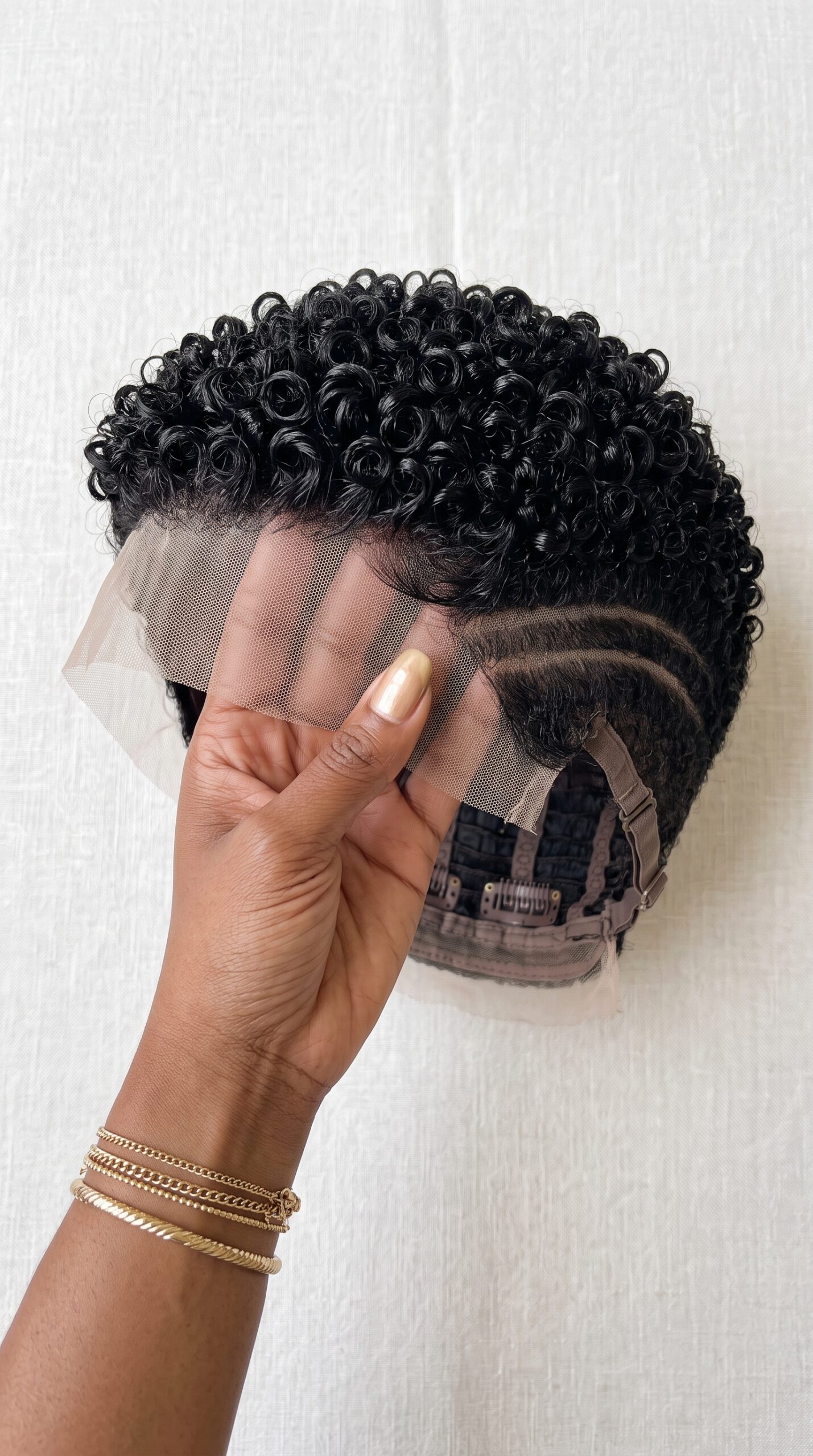
A carved side can be beautifully built and still disappear once the crown curls settle. This black ringlet pixie shows why. The upper section is densely curled, while the side underneath is cut very short and carries two curved shaved lines. The design only stays visible because the lower edge of the curly crown stops at a controlled height.
Let those ringlets grow or fall only a little farther downward and the result changes. The curls begin covering the upper fade, narrowing the visible short section and eventually hiding part of the carved design altogether.
That makes crown overhang a real buying detail on short pixie wigs. You are not only choosing how long the curls are. You are choosing how far the lower curls are allowed to drop over the faded side.
Where To Buy A Curly Pixie Wig With Controlled Crown Overhang
Custom wig makers. A custom maker is the strongest option when you want a specific amount of fade exposure. Send a true side-profile reference and mark where the lowest crown curls should stop above the short side.
Instagram and TikTok sellers. Ask for a side video with the wig sitting naturally. The stylist should not lift the curls with her fingers just to reveal the carved area for the camera.
Etsy. Independent makers may let you control crown length, curl size, fade height, side design, and how much of the short panel remains exposed beneath the curls.
Marketplaces like Amazon, AliExpress, and Temu. Product photos can exaggerate side visibility because the crown is arranged carefully before shooting. Customer videos are more useful for seeing where the curls actually settle during ordinary wear.
Local beauty supply shops and salons. Place the wig on a mannequin and leave it alone for a few minutes. Do not keep fluffing or lifting the crown. Then look at how far the lowest curls naturally fall over the side.
Vendors and wholesalers direct. Ask for the crown length at the side boundary and whether the lower curls are cut shorter than the central crown. That graduation is often what keeps the fade visible.
Regionally. Wig makers in Lagos, Accra, Atlanta, London, and major South African hair markets may describe this as tapered crown, graduated curl length, undercut pixie, or shaved-side pixie. Use a reference image because the terminology does not specify how much overhang you actually want.
Vet the seller. Favor sellers who show the side after the wig has been moved or handled. You want to see whether the carved area remains visible without constant rearranging.
Red flags. Be cautious if the seller holds the curls upward in every side photo, if the fade disappears as soon as the unit moves, or if long ringlets hang far below the intended boundary.
When you order, send. Provide your cap size, desired fade height, crown curl length, side-profile reference, and how much of the short panel you want visible after the hair settles naturally.
Contact / order inquiries: WhatsApp [WhatsApp: +XX XXX XXX XX XX]
How Much It Costs
Premium custom human hair. A carefully graduated human-hair ringlet pixie with lace, a controlled crown edge, faded side, and carved detail can commonly range from around $240–$460 depending on hair quality, cap construction, and styling labour.
Standard custom human hair. Around $180–$320 can cover many strong short units. At this level, inspect whether the lowest crown curls were actually cut and set to preserve the side silhouette.
Basic human hair. Around $150–$240 may buy a simpler version with more uniform crown length, which can cause curls to hang lower around the sides.
Good synthetic. Around $60–$150 can work well because factory-set curl placement can keep the side boundary consistent with relatively little daily styling.
Basic synthetic. Around $25–$70 is common for budget pieces. Check whether the side exposure exists because the fibre was genuinely graduated or because the seller temporarily pinned or arranged the curls upward.
What the price may exclude. Custom cap sizing, lace tinting, carved side work, crown-length adjustment, colour, and professional fitting may all cost extra.
Shipping and duty. International shipping, customs charges, and local taxes can raise the final cost substantially. Compare the complete landed price rather than only the listing amount.
Ongoing costs. Human-hair curls may gradually relax and fall lower after washing, so occasional resetting may be necessary to preserve the same amount of side exposure.
First-year total. Include curl products, lace care, possible crown reshaping, and a professional trim if the side begins looking heavier than you prefer.
Cost per wear. A unit whose crown naturally stops at the correct height gives better value than a cheaper wig that needs the side curls pinned, cut, or rearranged every time you wear it.
What a very low price may signal. It can indicate one uniform crown length across the whole cap instead of a carefully graduated lower edge.
Deposit structure. Custom makers commonly request around 30–50% upfront and the remainder before shipping. Keep your desired side exposure visible in the written reference.
Shipping, Delivery, And What To Expect After Ordering
When the wig arrives, inspect the side before trimming the lace or cutting any hair.
Place the unit on a form and let the curls settle naturally. Do not lift them manually.
Then look at the lowest row of ringlets. Identify how far they extend downward and how much of the fade remains visible underneath.
Shipping compression may temporarily move some curls, so lightly refresh the crown before deciding whether the overhang is genuinely too long.
The Lowest Row Of Curls Controls The Side Profile
The center of the crown can be extremely full without affecting the fade very much.
The important curls are the ones sitting along the lower boundary.
Those ringlets form the visual edge between the long top and the short side.
If they stop high, the fade looks broad and exposed.
If they hang low, the visible short panel becomes narrower.
A difference of only a small amount of length can completely change the side silhouette.
Crown Length And Crown Overhang Are Not The Same Thing
A wig may have long curls at the top while still preserving a clean side.
That happens when the central crown is longer but the outer perimeter curls are gradually shortened.
So asking only for a two-inch or three-inch crown does not fully describe the haircut.
You also need to know what happens to that length as it approaches the fade.
Good pixie construction often uses graduated length rather than one measurement everywhere.
Uniform Curl Length Can Create A Mushroom Shape
If every curl from the center crown to the side edge is approximately the same length, the outer ringlets can project and hang downward too far.
The top then forms a broad rounded shelf over the short lower section.
From the front, that may still look full and attractive.
From the side, the wig can begin resembling a mushroom cap instead of a tapered pixie.
Graduation is what prevents that silhouette from becoming too heavy.
A High Fade Needs Less Overhang
The higher the fade rises, the less vertical space exists between the short side and the curly crown.
If long curls are allowed to hang down into that already narrow space, the fade can disappear almost completely.
A high-fade pixie therefore often benefits from a tighter lower crown edge.
The central curls can remain full while the side-facing ringlets are kept shorter or directed upward.
A Lower Fade Can Tolerate More Curl Drop
A lower fade leaves a larger band of short hair around the side.
That gives the crown more room to hang downward without covering the entire tapered area.
This can create a softer look because the transition between curls and fade becomes less abrupt.
Again, neither approach is automatically better.
The correct amount of overhang depends on how much contrast you want between the top and side.
Carved Designs Need A Visibility Zone
The two curved lines on this unit occupy a specific region within the short side.
For the design to remain readable, the curls above need to stay out of that region.
This creates what can be thought of as a visibility zone.
The carved pattern may technically still exist underneath long curls, but a design nobody can see during normal wear is not delivering much visual value.
If you are paying extra for side carving, make sure the crown has been shaped to reveal it.
The Upper Carved Line Is Usually The First To Disappear
When curls begin dropping lower, they do not hide the entire side design at once.
The uppermost carved line usually becomes partially covered first.
That can change the appearance of the design. A two-line pattern may begin looking like one line, or a carefully spaced graphic may appear incomplete.
This is another reason to evaluate the wig with the curls resting naturally rather than lifted for the photograph.
Overhang Changes The Apparent Fade Height
Here is an important visual trick.
The fade may physically remain exactly the same height, but if curls cover its upper portion, the exposed short area appears lower.
That means buyers can mistakenly think they received a lower fade when the real problem is excessive crown drop.
Before recutting the fade, lift the curls and inspect where the short hair actually ends.
The cut may be correct while the crown is simply hiding it.
Overhang Can Make The Head Look Wider
Long lower curls extend outward and downward beyond the side of the head.
That adds width at the upper temple and side crown.
A cleaner graduated edge keeps the upper shape narrower and exposes more of the close-cut section underneath.
This is why two units with the same density can produce different perceived head sizes.
The lower crown edge controls where the fullness stops.
Shorter Side Curls Can Make The Crown Look Taller
Reducing the curl length around the perimeter creates another optical effect.
The center crown now stands higher relative to the side.
That makes the top appear more elevated even if the central curls have not changed at all.
In other words, crown height is partly a relationship between the center and perimeter.
You can create a taller-looking pixie by shortening the lower edge rather than adding more volume on top.
The Transition Should Be Gradual
The solution is not cutting the entire side boundary to one blunt line.
If every curl ends at exactly the same height, the crown can look trimmed with a ruler.
A convincing pixie usually uses small differences in curl length.
The outermost curls are shorter, the next row slightly longer, and the crown continues building upward.
That creates graduation without leaving a hard shelf.
Curl Direction Can Control Overhang Without Cutting
Length is not the only tool.
A ringlet directed upward or backward will expose more of the side than the same-length curl directed downward.
This means a stylist can sometimes improve fade visibility by resetting curl direction rather than removing hair.
That is worth trying before cutting a human-hair unit permanently.
Styling is reversible. Cutting is not.
Projection And Overhang Are Different
A curl can project strongly outward without hanging very low.
Another curl can stay close to the cap but extend downward across the fade.
Projection describes distance away from the head.
Overhang describes how far the curl extends downward beyond the crown boundary.
The two measurements affect the silhouette differently and should not be confused.
Wet Hair Can Make Overhang Look Worse
Human-hair curls become heavier when wet.
During washing or refreshing, ringlets that normally sit above the fade may temporarily stretch downward.
Do not judge the final crown edge while the hair is saturated.
Let the curls dry completely in their intended shape before deciding that the perimeter needs trimming.
Heavy Product Can Pull Side Curls Down
Thick curl cream, excessive gel, oils, and heavy serum add weight.
The effect may be small at the central crown, but lower side curls are especially sensitive because gravity is already pulling them toward the fade.
Overloading those pieces can cause the crown edge to sink.
Use only enough product to preserve the curl shape.
More product does not necessarily create more control.
Humidity Can Increase Curl Drop On Human Hair
Depending on the hair and set, humidity may soften the sculpted ringlets.
As the curls loosen, their effective length increases.
The lowest sections may then begin hanging farther over the short side.
A wig that shows the full carved design indoors can therefore reveal less of it in humid conditions.
If side visibility is essential to the look, choose a crown set capable of maintaining its shape in your usual climate.
The First Wash Is A Good Overhang Test
The seller’s original set is usually the most controlled version of the crown.
After the first proper wash, you learn how much of the shape comes naturally from the hair and how much came from salon setting.
Photograph the side before washing.
After restyling, compare where the lowest curls finish relative to the carved lines.
If they now sit much lower, you may need stronger root direction, smaller perimeter curls, or a minor trim.
Do Not Cut Every Curl That Covers The Fade
A ringlet may temporarily fall into the wrong position without actually being too long.
Before cutting, redirect it and see where it settles.
Also check whether neighbouring curls are pushing it downward.
Removing random individual curls without understanding the crown map can create holes and uneven density.
Trim the perimeter as a system rather than reacting to one stray piece.
The Crown Edge Should Look Good From Front And Side
A side trim can improve fade exposure while accidentally changing the front silhouette.
The lower crown curves around the head and eventually contributes to the temple and face-framing shape.
That means any length adjustment should be checked from multiple angles.
Do not create a beautiful side profile at the cost of an abrupt front corner.
Overhang Should Be Checked Behind The Ear Too
The area behind the ear often receives less attention than the decorative temple side.
But the same crown-drop problem can happen there.
Long ringlets may cover the rear fade and make the haircut look heavier as it travels toward the nape.
A well-graduated pixie controls the lower crown edge all the way around, not only where the seller carved the design.
Glasses Can Push The Lower Curls Upward
There is also a practical wrinkle for wearers who use glasses.
The frame arms can sit beneath lower temple curls and push them upward.
That may expose more of the fade than the wig shows without glasses.
In some cases, that looks great.
In others, it creates uneven exposure between the two sides.
Try the wig with the accessories you actually wear before permanently trimming the crown edge.
Storage Can Change The Side Boundary
If the wig is stored with the crown pressed downward, lower ringlets can become trained toward the fade.
After repeated compression, the side may appear heavier even though no hair has grown.
Store the unit on a form that keeps the curls lifted away from the short panel.
Preserving the crown edge is part of preserving the haircut.
Synthetic Fibre Can Hold The Boundary More Consistently
A quality synthetic pixie may keep the lower curl direction and length relationship very stable.
That can be useful when you specifically want a carved side to remain exposed every time you wear the unit.
The tradeoff is flexibility.
If you later want more overhang or a softer side, reshaping the synthetic perimeter may be harder than changing human hair.
Human Hair Gives You More Correction Options
With human hair, a stylist can often improve crown overhang through resetting, cutting, or both.
If the side curls are only slightly too low, directional styling may be enough.
If they are genuinely too long, a careful graduated trim can permanently open the fade.
That makes human hair more adjustable, but it also means the salon-perfect perimeter is not completely maintenance-free.
Before You Pay
- Can you show the wig from a true side view with the curls resting naturally instead of being lifted by hand?
- How far do the lowest crown curls hang over the faded section?
- Are the perimeter curls cut shorter than the central crown to preserve the side design?
- What happens to the side exposure after the first full wash and curl reset?
- Can the crown edge be trimmed or redirected later if I want more of the carved side visible?
Trimming The Lace
Place the wig in its correct position before judging the amount of crown overhang.
If the cap is sitting too low, the entire curly section will naturally appear to cover more of the side.
Align the hairline, temples, ear area, and nape first. Then let the curls settle and judge the side boundary.
Only after the fit is correct should you decide whether the lower crown needs styling or trimming.
Do not pull the whole wig upward just to reveal more of the fade. That solves one visual problem by creating a fit problem somewhere else.
Search Terms
curly pixie wig crown overhang · shaved side ringlet pixie wig · tapered curly crown pixie wig · black carved pixie wig · graduated curl pixie wig · short side curly lace wig · ringlet pixie fade exposure · undercut curly pixie wig
Final Thoughts
The carved side on this black pixie only works visually because the curly crown stops at the right place. Let the lower ringlets hang farther down and the fade becomes narrower, the upper carved line begins disappearing, and the entire haircut starts feeling heavier.
That is why the lowest row of curls deserves as much attention as the highest part of the crown. The center creates volume. The perimeter decides where that volume ends.
If you are buying a shaved-side or carved pixie, do not pay for a beautiful fade and then ignore the hair hanging above it. The amount of crown overhang determines how much of that detail you will actually see when the wig is worn.