
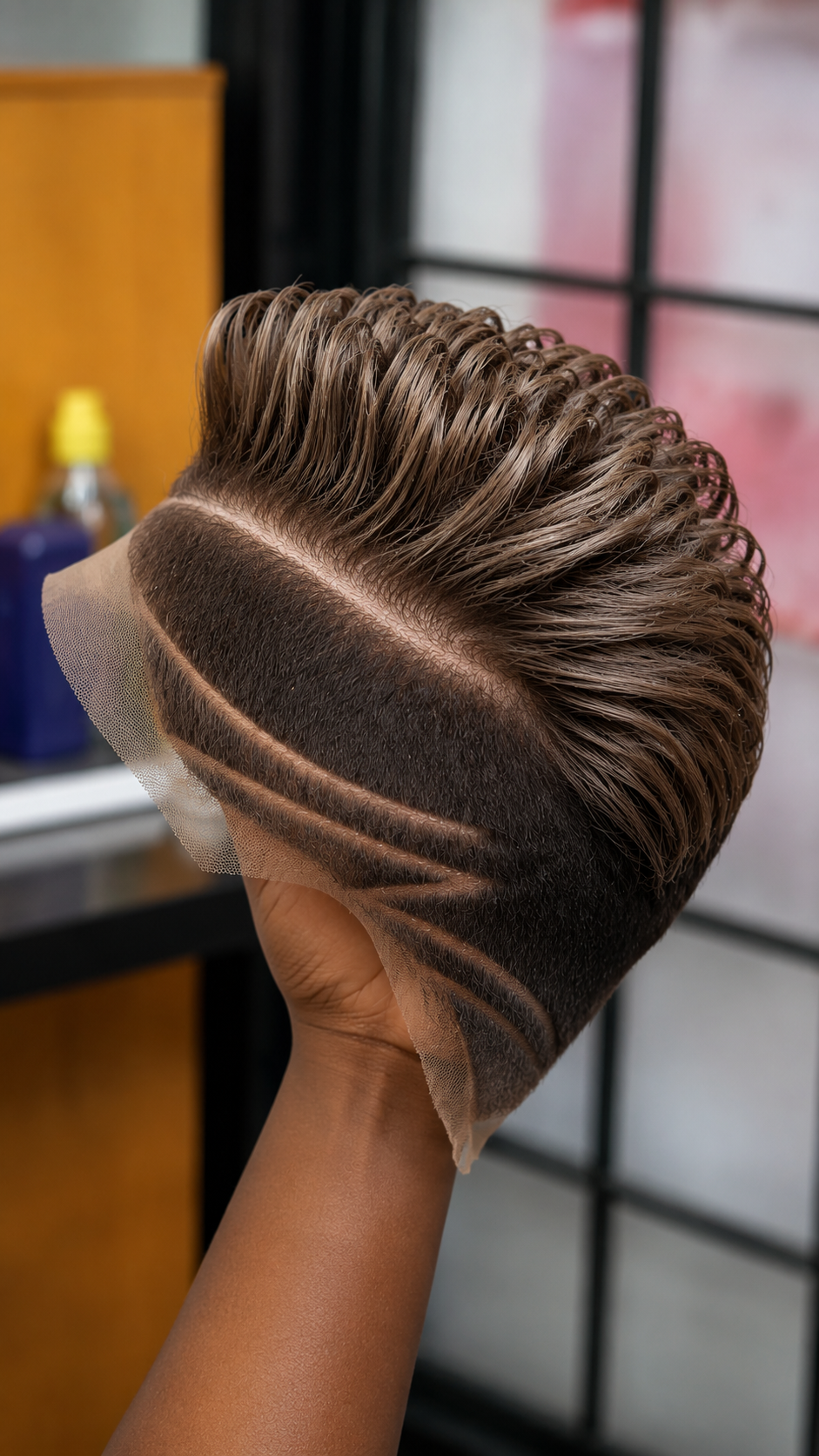
Two highlighted units can carry the exact same brown and blonde and look nothing alike, and the colours are not why. Look at how the lighter ribbons run through this unit, finer and brighter toward the top, blended into the darker base, fading into the shadowed sides. That placement is what makes highlights read as natural and expensive. The same two shades, woven crudely, would be chunky stripes, a zebra effect that announces a cheap wig from across the room. So on a highlighted unit, the shades listed tell you almost nothing. Where and how finely they are placed tells you everything.
Highlights are a placement skill, not a colour choice, because dimension imitates how sun lightens hair. The sun does not stripe hair evenly; it brightens the pieces that catch the most light, around the face and over the crown, in fine irregular ribbons that melt into the darker hair beneath. Good highlights copy that: fine, face-framing, brighter up top, seamlessly blended. Crude highlights ignore it and lay thick, even, high-contrast stripes that no sun ever made, which is exactly why they look fake. The difference between a salon-natural unit and a costume one is not the palette, it is whether the placement follows how light actually falls.
So judge a highlighted pixie wig by the weave, not the words. Are the lighter pieces fine and blended or thick and stripey, are they placed where light would hit or scattered at random, and does the whole thing melt together or read as bands. And know that you cannot re-foil a wig, so the placement you buy is the placement you keep for the life of the unit.
Where To Buy A Highlighted Pixie Wig With Natural Placement
Custom makers who colour in-house can place highlights the way sun would, finely and where the light falls, so ask how the highlights are woven and whether they are face-framing and blended. A maker who understands dimension will talk placement; one who does not will just list the two colours.
Instagram and TikTok sellers show highlighted units under bright light that exaggerates the contrast, so ask for daylight video where you can see whether the highlights blend or stripe. A highlighted pixie wig can look dimensional under studio light and zebra-striped in daylight, so judge the placement in plain light.
Etsy works with makers who show the highlight placement close up and have real buyer photos. The risk is a listing lit to make crude stripes look blended. Read reviews for anyone describing the highlights as natural, or as stripey.
Marketplaces like Amazon, AliExpress, and Temu often ship chunky, evenly striped highlights, since fine hand-placed dimension is costly. Some are blended and many are not. Judge by close daylight photos of the weave, not by the colour names, because the placement is where the price shows.
Local beauty supply shops and salons let you see the highlight placement in real light and against your face, which is where dimension either flatters or stripes. You pay a premium in-store, but highlights are a colour that photographs better than it sometimes wears, so seeing them helps.
Vendors and wholesalers direct ship standard highlight patterns, so placement is whatever the batch is, often even and stripey. For finely placed dimension, a maker who weaves highlights by hand beats stock.
Regionally, naturally placed highlights come strongly out of Lagos, Accra, Atlanta, London, and across South Africa, where colourists who weave fine dimension are easy to find on video.
Vet the seller on placement: check the account age, look for real buyer photos, time a plain question for a genuine reply, and ask how the highlights are placed and to see them in daylight. A seller who only names the shades is not showing you the thing that matters.
Red flags: thick even stripes, high contrast with no blending, highlights shown only under bright light, and a bargain price on a dimensional colour.
When you order, send your measurements and ask for fine, blended, face-framing highlights rather than even stripes, and to see the placement in daylight. That tells the maker you know dimension is placement, not palette.
On payment, thirty to fifty percent down with the balance before shipping is standard for custom coloured work. Use a method you can dispute, and ask for a daylight photo of the finished placement before releasing the last part.
How Much It Costs
A highlighted pixie wig costs more than a solid colour, because dimension is double the colour work and the placement is a skill, and the trap is paying that premium for crude stripes that look cheap anyway.
Human hair, full build with finely placed, blended highlights, glueless with bleached knots and a fine lace: roughly $220 to $460, since dimensional colour is real, layered work. Human hair, mid build: about $180 to $360. Human hair, basic cap with simpler highlights: around $120 to $270. Good synthetic with blended dimension: $70 to $150. Basic synthetic: $30 to $65, where highlights are usually crude stripes.
The honest point is that highlights are the colour where placement, not price, decides the look, so a cheap unit with even stripes wastes the money and a well-woven one earns its premium. You are paying for the weave, the fine, blended, sun-placed dimension, not for two shades of dye. Since you cannot re-foil a wig later, the placement is a one-time thing you either buy right or live with, which makes paying for good placement upfront worth it.
Shipping and any customs charge sit outside the price and change with where you live, so plan a realistic band and confirm your own country’s import rate rather than trusting a single quoted figure.
Then the later costs, which dimension shares with any lift. The lightened pieces are double-processed, so they are drier and want more moisture, and they can fade or brass at a different rate than the base, so a gloss helps keep the dimension clean. First-year math, honestly: a highlighted human unit plus shipping plus any customs plus moisture and toning upkeep tends to land between a low three-figure total and roughly double the sticker, with keeping the dimension bright as the running part. A synthetic holds its placement and tone with less fuss.
Per wear, a naturally placed highlight unit looks expensive every time and is worth it, while a stripey one looks cheap no matter the sticker. A low price on dimension almost always means crude placement, so read a bargain highlight as the stripes it usually is.
Deposits follow the custom pattern: thirty to fifty percent to start, balance before shipping, and a daylight photo of the finished placement before the last payment clears.
Shipping, Delivery, And What To Expect After Ordering
A highlighted unit can look dimensional under the seller’s lighting and reveal its true placement only in daylight, so take it to a window before you judge it. Ask that it ship so the style is protected, choose a tracked service for custom coloured work, and confirm your country’s import charge before it lands. When it arrives, look at the highlights in natural light and against your face: fine, blended, sun-placed dimension flatters, while even stripes betray a crude weave. The lightened pieces may also want a moisture treatment on arrival, since they are double-processed. What you unbox is the placement you will keep, since a wig cannot be re-highlighted.
Dimension Copies How Sun Lightens Hair
The whole logic of natural highlights is the sun. Light lifts the pieces it touches most, so real dimension is brighter around the face and over the crown and fades toward the nape, in fine ribbons that blend into the base. A unit that follows this looks like hair the sun has kissed; one that stripes evenly from root to tip looks painted on. When you judge highlights, ask whether the placement makes sense as sunlight, because that is the test of whether it will read as natural.
Even Stripes Are The Cheap Tell
The fastest way to spot a low-effort highlight job is even, thick, high-contrast stripes. Nothing in nature lightens hair that way, so the eye reads it instantly as a wig. Fine, irregular, blended pieces read as real; bold uniform bands read as costume. This single distinction separates most convincing highlighted units from cheap ones, so look for irregularity and blending, and treat perfectly even stripes as the warning they are.
You Cannot Re-Highlight A Wig
Unlike your own hair, a wig cannot be sat in a chair and re-foiled, so the highlight placement it ships with is permanent. You can gloss or tone it, but you cannot move or add the dimension. This is why the placement matters so much at purchase: it is the one colour feature you are truly stuck with. Buy the weave you want, because it is the weave you will have for the unit’s whole life.
Before You Pay
- Are the highlights finely woven and blended, or thick even stripes?
- Is the placement face-framing and brighter up top, the way sun lightens hair?
- Does the dimension blend in daylight, or read as bands under plain light?
- Am I paying a dimension premium for placement that actually looks natural?
- Do I accept the placement is permanent, since a wig cannot be re-highlighted?
Trimming The Lace
The lace comes off the front the usual way, and with dimensional colour a clean hairline matters because highlights draw the eye up and around the face. Trim in small offset steps and leave a shallow margin rather than cutting flush, working in daylight where the true placement of the highlights reads against your skin. If this is your first highlighted unit, let a stylist make the first pass, since the face-framing pieces sit right at the front and you want the hairline clean where the brightest dimension is most visible.
Search Terms
highlighted pixie wig · dimensional pixie wig · balayage short lace wig · brown blonde highlight pixie · sleek highlighted short wig · glueless dimensional pixie · woven highlight pixie unit · face framing highlight wig
Final Thoughts
This unit looks expensive because its highlights are finely woven and placed the way sunlight falls, brighter around the face and blended into a darker base. The same two shades, laid as thick even stripes, would look like a cheap wig instead. That is the whole truth about dimensional colour: it is a placement skill, not a palette, and two units with identical colours can read salon-natural or costume-fake depending entirely on how the lighter pieces were woven.
Buy a highlighted pixie wig by the weave, not the words. Look for fine, irregular, face-framing dimension that blends in daylight, and treat even, high-contrast stripes as the cheap tell they are. Pay for good placement upfront, because a wig cannot be re-highlighted and the dimension you buy is the dimension you keep. Get the placement right and the unit looks like hair the sun has lightened; get it wrong and no amount of nice colour saves the stripes. The shades are just paint. Where they sit is the art.