
Two completely different skills went into this one piece, and only one of them is expensive.
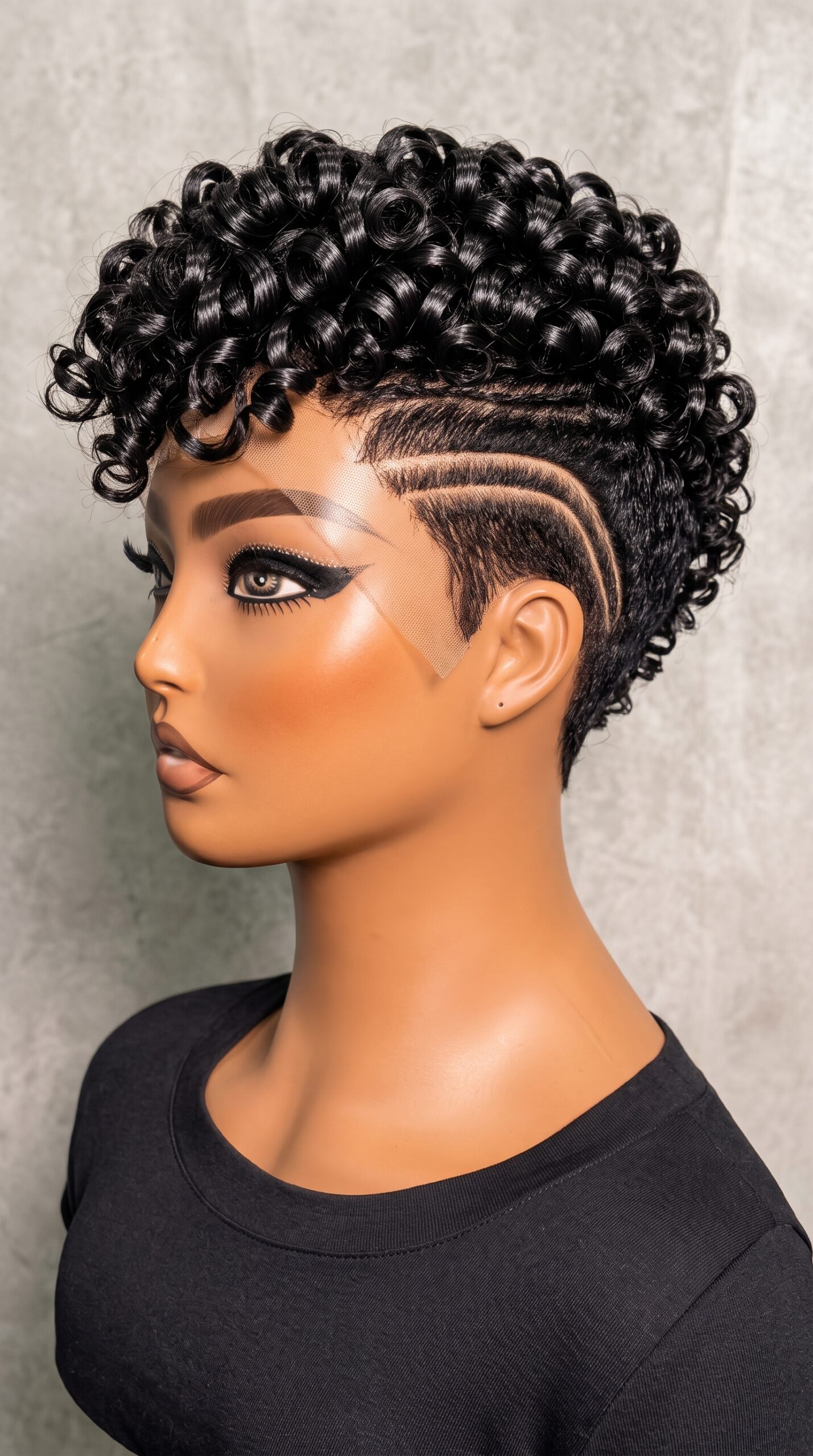
On this black curly pixie wig the top is a set of large, glossy, rolled curls sitting high on the crown. The side is something else entirely: hair smoothed flat to the head and carved into a fanned pattern of curved lines that sweep back over a laid edge above the ear. Anyone can set a curl. Very few can carve a clean multi-line pattern into flat hair on lace. The price of this piece is mostly the side, and buyers usually look at the top.
Where To Buy A Wig Like This
Carved side work separates makers more sharply than any other detail, because it cannot be faked and it cannot be fixed.
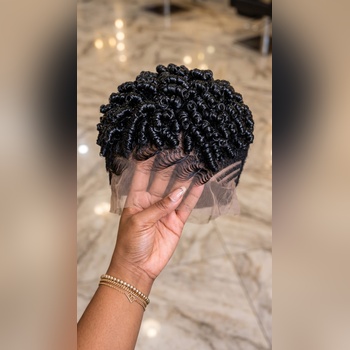
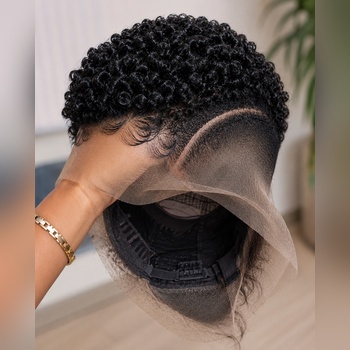
Custom makers and lace studios. The only route for genuine carved line work. One or two people working to order over WhatsApp or direct message, four to six weeks, deposit up front. Worth it because the carved fan is freehand knotting and styling on lace, and the difference between a clean one and a messy one is entirely the maker’s hand.
Instagram and TikTok sellers. The widest choice and the best way to judge carving specifically. Search the terms below plus your city, and look at the carved side in close-up stills, since a fanned line pattern either holds even spacing or it does not, and that shows in a photograph better than in video. Look at several pieces from the same maker: consistent carving across different units means real skill, one good example among many rough ones means luck.
Etsy. Workable for made-to-order, but carved detail is rarely a strength here and stock images oversell it. Read buyer photographs, which show the carving as it actually arrives.
Marketplaces such as Amazon, AliExpress and Temu. Synthetic pieces here may have a printed or moulded side pattern rather than genuine carved lines, which looks stiff and uniform. Fine at the price if you want the look and not the craft; not comparable to hand-carved work.
Local beauty supply shops and salons. Useful for seeing carved work up close before paying, since photographs flatter it. Prices run about a third above online. Some salons order custom and fit it.
Vendor or wholesale direct. Minimums of five to ten identical units, relevant only for resale.
Regional note. Independent makers doing carved-side short units are concentrated in Nigeria, Ghana, South Africa, the United States and the United Kingdom, with the busiest Instagram communities in Lagos, Accra, Atlanta and London. Ordering internationally adds shipping and duty to the comparison.
Vetting a seller. Continuous posting history rather than a burst. Several examples of carved work, not one. Buyer photographs on request. A specific answer about whether the pattern is carved or moulded. Returns position in writing.
Red flags. Only one example of carved work in the whole account. The same image across several shops. A carved pattern that looks identical on every unit, which suggests moulding rather than hand carving. A price well under the ranges below for hand-carved human hair. Payment only by irreversible transfer.
What to send when you enquire. A reference photograph of the carved pattern, your head circumference, your crown-to-nape measurement, which side you want the carving on described by ear, and your deadline.
Paying safely. Thirty to fifty percent deposit, balance before shipping. Ask for a close photograph of the finished carved side before releasing the balance, since that is the part most likely to disappoint and the hardest to correct.
Contact / Order Inquiries: WhatsApp is where most independent makers take orders. [WhatsApp: +XX XXX XXX XX XX] — ask whether the side is genuinely carved by hand or moulded, and how many lines are in the pattern.
Why The Side Costs More Than The Top
A rolled curl is a repeatable process. Wind, set, dry. A maker can do a whole crown of them in a set order and the result is forgiving, because curls sit against each other and small irregularities disappear into the mass.
A carved fan on flat lace is the opposite. Every line is exposed against smoothed hair with nothing to hide behind. The lines have to hold even spacing as they curve, stay even in width along their length, and fan out at a consistent rate. There is no mass to absorb a mistake and no second attempt once the hair is knotted and laid.
That is why two short units with identical curls can differ by a hundred dollars. The curls are the same. The side is not.
Judging The Carved Side
Look at the spacing first. The gaps between the fanned lines should stay proportional as they curve, widening smoothly rather than bunching in one place and spreading in another.
Look at the width of each line along its length. A line that starts crisp and blurs as it travels was laid by someone losing control of the section.
Look at where the lines end. A clean fan resolves each line deliberately, either into the laid edge or into a defined stop. Lines that trail off into stray hairs are the giveaway of rushed work.
And look at the smoothed hair the lines are cut into. It should lie genuinely flat, held by the set, not lifting or frizzing between the lines. Carving only reads clean against truly smooth hair.
The Laid Edge Under The Fan
The edge laid above the ear sits beneath the carved fan and does related work: it extends the smoothed, controlled surface down to the hairline so the whole side reads as one deliberate piece.
Judge it on whether it flows out of the carved pattern rather than fighting it. An edge laid in a different direction from the fan above breaks the line of the design.
Like all laid work it is product-set and washes out. The knotting and the carving direction beneath are what last.
How Much It Costs
Carved detail is the single biggest price driver on a piece like this, ahead of hair grade or curl type.
The unit itself
Human hair black curly pixie wig, rolled curl crown with a hand-carved fanned side, laid edge, sheer lace, glueless cap: $280–$580
The same curly pixie wig with a single carved line instead of a fanned multi-line pattern: $240–$490
The same piece with a plain smoothed side and no carving: $200–$420
Quality synthetic curly pixie wig with a moulded side pattern: $80–$170
Basic synthetic short curly wig: $25–$60
The gap between the first and third lines is entirely the carving. It is freehand work that takes time and cannot be rushed, and it is the reason this piece costs what it does.
What is usually included, and what is not
Included in most quotes: cap, hair, standard knotting, standard lace.
Charged separately by many makers: additional carved lines beyond a single one ($15–$35 per line), HD or fine lace over standard ($20–$50), bleached knots across the full lace ($15–$40), a laid edge from finer hair ($20–$50), pre-trimmed lace ($25–$50), rush build ($40–$100).
Ask how many lines are included in the quoted number. A fanned pattern quoted as a single carved line will cost more once the full design is specified.
Shipping and duty
Tracked international shipping on a single short unit generally runs $25–$60. Import charges vary by country on declared value; allow ten to thirty percent of the item price and check your own rates.
The costs that come after
Canvas block and stand: $25–$60 once
Satin cover: $5–$15
Edge and lay products for the carved side: $15–$40 per year
Colour-safe wash products: $20–$40 per year
Professional first lace trim: $30–$80 once
Professional reset of the curls and re-laying of the carved side: $50–$100 per visit, two to four times a year, higher than a plain curly piece because the carved side has to be re-smoothed and re-laid each time
First year, all in
A mid-range human hair version at $380, plus $45 shipping, plus roughly $60 duty, plus $50 of storage kit, plus $50 in products, plus one $50 trim and three $70 resets, comes to around $845 across twelve months. The carved side lifts the reset cost because it is re-laid each time, not just the curls.
The synthetic equivalent at $130 with a moulded side and no resets comes to around $190, but the side is moulded, not carved, and reads that way up close.
Cost per wear
Worn three times a week over a year, the human hair piece lands near $5.40 per wear and carries into a second year. The synthetic sits near $1.25 per wear with a moulded side that never quite matches hand carving but also never needs re-laying.
What an unusually low price means
Hand-carved human hair with a fanned line pattern is hard to produce under about $150. Below that the side is almost certainly moulded rather than carved, or a single line sold as a pattern, or the piece is a fibre blend.
Deposit structure
Thirty to fifty percent up front, balance before shipping. On this build the pre-shipping photograph should show the carved side in close-up, because it is the part that carries the price and the part most likely to fall short.
Before You Pay
Is the side carved by hand or moulded?
How many lines are in the pattern, and are they all in the quoted price?
Does the spacing stay even as the lines fan out?
Does the laid edge flow out of the carved pattern?
Are the knots under the smoothed side bleached?
Trimming The Lace
Work along your own hairline with short angled cuts, leaving a margin rather than trimming flush.
Specific to this build: the carved side runs close to the lace, so trim on the curl side first and approach the carved side last and cautiously. Cutting into the carved area removes lines that took real skill to lay and cannot be recreated at home.
Have the first cut done by someone experienced, with the piece on a block so the carved side sits as it will be worn.
Search Terms
carved side pixie wig · black curly pixie wig human hair · fanned line design short wig · rolled curl pixie wig with carved side · hand carved pixie wig · curly pixie wig with laid edge · carved pattern short wig where to buy
Final Thoughts
This style is two products in one: an easy set of curls on top and a hard piece of freehand carving on the side. The curls are what catch the eye and the carving is what you are paying for.
Judge the piece on the side, not the top. Look at the spacing of the fanned lines, ask whether it is carved or moulded, and get several examples from the maker rather than one. The curls will almost always be fine. The carving is where the money goes and where the skill either shows or does not.