
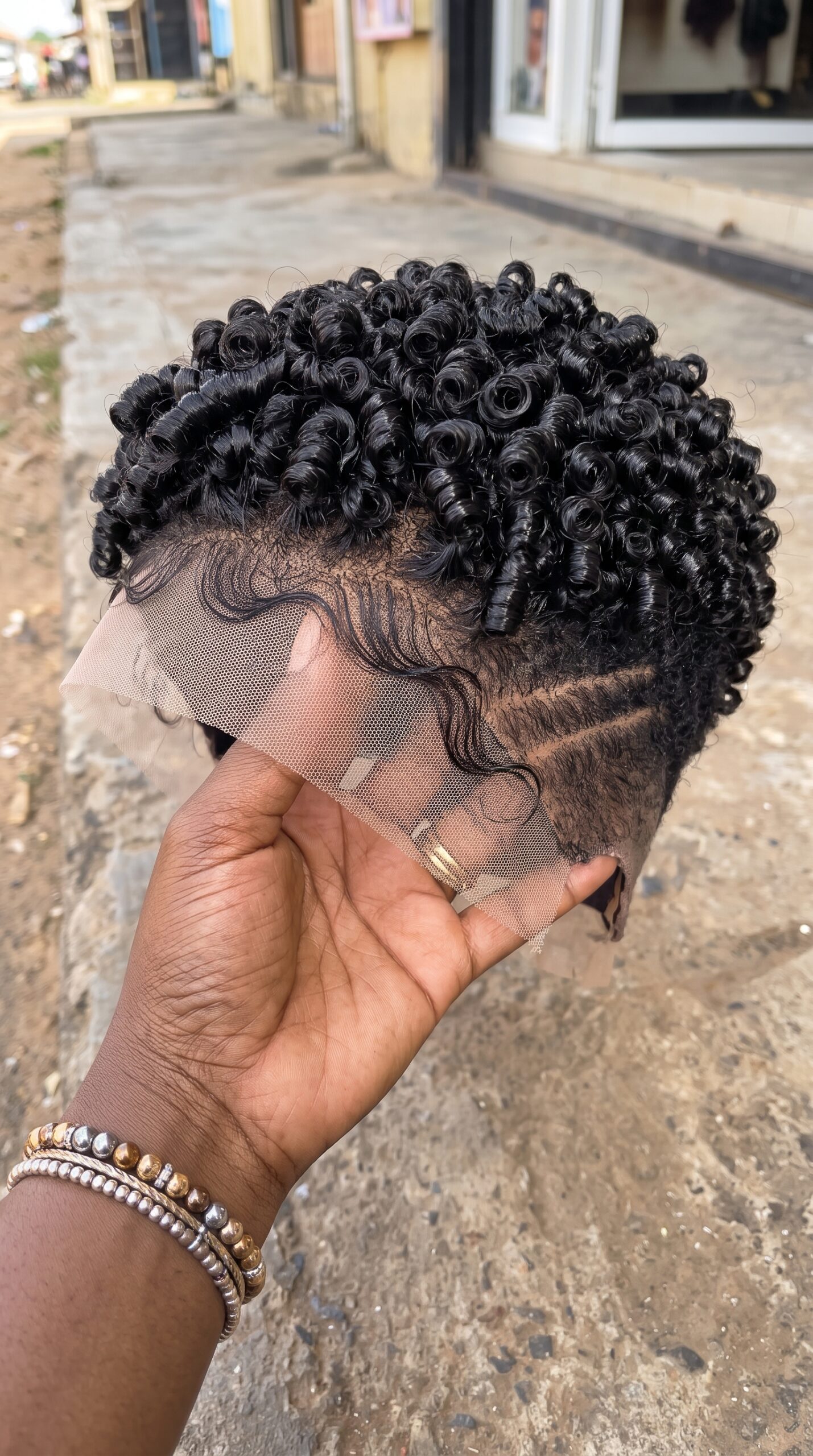
A great pixie hairstyle does not need long hair or dramatic coloring to make an impression. Sometimes, a beautifully rounded collection of curls and a few carefully placed details are enough. The black lace wig pictured here combines tight spiral coils, delicate finger-wave baby hairs, and two diagonal side lines into a compact hairstyle that looks striking from the front and side.
The photograph captures the wig being held outdoors, before its lace has been trimmed or the unit installed. Natural daylight reveals the individual black curls, their circular openings, and the closely tapered side beneath them. The front lace remains extended, with fine strands arranged into flowing curves across the forehead and temple.
What makes this particular wig attractive is the contrast between its rounded upper curls and the closely fitted side. The coils create fullness without excessive height, while the two diagonal channels add a distinctive barber-inspired detail. The forehead waves bring the separate elements together, giving the hairstyle a recognizable appearance.


For women considering a similar pixie wig, understanding the curl size, side-line placement, lace construction, and installation requirements is essential. These details determine whether a ready-made unit will be suitable or whether a custom wig maker is the better choice.
Beautiful Spiral Curls That Give the Pixie Its Shape
The upper portion of the hairstyle is covered with compact black spiral curls. Many form recognizable circular openings, while others appear as tightly wound coils that overlap neighboring sections.
The curls vary slightly in diameter, creating a rounded crown with visible depth. Some stand upright, while others lean forward or toward the sides. This variation gives the hairstyle movement without requiring long strands.
Near the front, several prominent coils sit above the hairline, while smaller spirals continue toward the visible rear. The crown remains relatively compact, avoiding the exaggerated volume sometimes associated with curly wigs.
The glossy black strands reflect daylight along their curved surfaces. These reflections emphasize the circular shape of the curls without introducing a separate hair color.
The photograph does not establish whether the curls are formed from human hair or synthetic fibers. Both materials can produce similar visual results, depending on construction and styling.
Choosing the Right Curl Size
When shopping for a similar wig, buyers should pay attention to the diameter of the spiral curls. A wig with very small spring coils may appear denser, while larger ringlets can create a more open crown.
The reference combines relatively tight coils with several larger circular formations. This balance is important because it allows individual curls to remain recognizable without making the hairstyle excessively full.
Ask the seller for a close photograph of the crown and a view from above. These angles can help determine whether the curls are distributed evenly across the upper head.
A custom wig maker should also explain whether the coils retain their shape after washing or require professional resetting.
The Double Side Lines Add a Distinctive Accent
The visible side contains two diagonal channels beneath the curly crown. These lines travel backward through closely fitted dark hair, creating a clear contrast against the surrounding strands.
The upper line begins near the front side and follows a slightly descending direction. The lower channel sits beneath it, leaving a narrow band of black hair between the two separations.
The channels appear lighter because the underlying surface is visible where the hair is separated or reduced.
This design resembles precision barber carving rather than ordinary finger-wave styling. The channels remain distinct from the decorative curves arranged along the forehead.
The lower side continues beneath the channels, with fine dark strands visible toward the lace perimeter.
Keeping the Lines Proportional
The spacing between the two channels influences the appearance of the entire side. If the lines are too wide, they may overpower the compact taper. If they are too narrow, the pattern may become difficult to distinguish.
A wig maker should examine the available hair density before attempting permanent cutting.
Removing too many strands can expose the cap or create gaps that cannot be corrected easily.
For custom orders, provide the reference photograph and ask whether the channels are incorporated during construction or added through final styling.
The Finger-Wave Hairline Makes the Design More Elegant
Along the forehead, fine black strands form flowing curves that connect the upper coils to the lace front.
One prominent wave travels across the front before bending toward the temple. Smaller curved strands continue along the lower hairline, creating a decorative arrangement.
These waves are more elaborate than ordinary scattered baby hairs. Their direction is coordinated, and several sections form recognizable S-shaped curves.
The hairline styling appears relatively flat against the lace, contrasting with the raised spiral curls above.
Because the wig is photographed before installation, the beige lace remains visible beneath the waves. The final appearance against a wearer’s forehead will depend on fitting and installation.
Preserving the Front Waves
The finger-wave section should be handled separately from the upper curls. Brushing through the fine strands can disturb their arrangement.
If the wig contains human hair, a professional stylist may be able to restore displaced waves using suitable products and techniques.
If the wig contains synthetic fibers, the manufacturer should confirm which styling methods are appropriate.
Ask whether the wig arrives with the front waves fully arranged or whether additional salon styling will be required.
The Low Taper Creates a Balanced Silhouette
Beneath the rounded crown, the visible side becomes progressively closer to the underlying cap. The hair remains present, but its apparent length and density decrease toward the lower perimeter.
This creates a tapered appearance that supports the fuller curls above.
The side does not appear completely shaved. Fine strands remain visible around the temple and beneath the decorative channels.
The taper helps prevent the hairstyle from looking excessively bulky while allowing the upper coils to remain the main point of interest.
For wig construction, the side density should be planned carefully. Cutting too aggressively may expose the underlying lace or cap.
Natural Black Color With Glossy Daylight Reflections
The hair appears predominantly natural black, with deeper jet-black areas visible in shadow.
Daylight creates reflective highlights along the circular curls, making individual spirals particularly noticeable.
There are no clearly identifiable blonde, copper, burgundy, or other contrasting color sections.
This consistent black coloring allows the curls, forehead waves, and side channels to provide the visual detail.
Buyers comparing natural black and jet black options should request actual product photographs under neutral lighting.
The photograph cannot establish whether the color is natural, dyed, or manufactured into synthetic fibers.
Understanding the Untrimmed Lace Front
The wig is displayed with a broad beige lace extension around the forehead and visible temple. The lace remains untrimmed, leaving material available for fitting.
Fine black strands are visible along the hairline, including the decorative waves that travel across the forehead.
The mesh appears relatively fine, but its exact grade cannot be confirmed from the photograph.
A portion of the dark interior cap is visible through the lower opening. Small fastening components can also be seen near the lace, although the complete attachment system is not clearly established.
The presence of lace does not automatically confirm adhesive-free compatibility.
Checking the Cap Before Purchase
Ask the seller for a complete underside photograph showing the cap opened fully.
Confirm the available cap sizes and request the manufacturer’s measurement guidance.
Ask whether the wig is intended for adhesive installation, adhesive-free wear, or another fitting method.
If glueless wear is important, obtain explicit confirmation that the cap is constructed for that purpose.
Because the decorative side lines sit near the temple, correct cap placement is particularly important.
Where to Find a Similar Black Pixie Wig
Customers can begin by searching for black finger coil pixie wigs, curly lace wigs with side lines, and sculpted baby-hair hairstyles.
Local wig boutiques may offer the advantage of inspecting the lace, cap, and curl arrangement in person.
Online custom suppliers may provide additional options, but detailed photographs and clear communication are essential.
When contacting a seller, describe the hairstyle as a black spiral coil pixie with a rounded crown, flowing forehead waves, and two diagonal temple lines.
Specify that the crown should remain compact and that the side should not contain additional decorative channels.
Preparing a Custom Order
Send the reference photograph and identify the coil size, crown shape, baby-hair arrangement, taper position, and diagonal side lines.
Ask whether the supplier can reproduce the hairstyle as a finished unit or whether additional salon styling will be necessary.
Confirm the hair fiber, lace specifications, cap measurements, and expected production timeline.
Before payment, establish the revision policy and request photographs of the completed wig for approval.
A front view, both side views, a crown photograph, and a rear image can help confirm that the finished unit matches the intended design.
Ready-Made Pixies Versus Custom Wig Construction
A ready-made black curly pixie may offer a similar color and compact silhouette at a lower initial cost.
However, the exact coil arrangement, sculpted forehead waves, and diagonal side channels may not be included.
Some ready-made units may be suitable for professional modification, depending on their fiber and construction.
Before purchasing a base wig for customization, ask a stylist whether the desired side lines can be created safely.
Custom construction may offer greater control over the hairstyle, although the result depends on the wig maker’s experience.
Illustrative Prices for Black Spiral Pixie Wigs
The following USD amounts are illustrative budgeting ranges rather than verified current product prices. The photographed wig’s actual material, supplier, and selling price are unknown.
| Wig Category | Illustrative USD Range | Potential Cost Considerations |
|---|---|---|
| Premium Custom | $290–$680+ | Individual cap sizing, carefully arranged spiral coils, sculpted forehead waves, and precision double-line temple styling. |
| Standard Custom | $160–$355 | Selected cap options with customized curls and coordinated side detailing. |
| Basic Human Hair | $95–$245 | A human-hair starting unit that may require coil setting, taper shaping, and professional side carving. |
| Premium Synthetic | $70–$170 | A manufactured black curly pixie with preformed spirals and possible decorative temple styling. |
| Basic Synthetic | $28–$85 | A lower-cost black curly pixie alternative that may not reproduce the coil arrangement or side lines accurately. |
The cost of a custom wig may depend on the amount of work required to arrange the coils and create the side channels.
Hairline customization, cap construction, lace dimensions, and finishing work can also influence the quotation.
Additional charges may include shipping, taxes, installation, and future restyling.
Ask for an itemized quotation to distinguish the base wig price from customization and fitting services.
Booking a Professional Installation
The first fitting should begin with cap alignment and hairline placement.
The two diagonal side lines must sit at the intended position relative to the wearer’s temple.
A professional wig stylist can assess cap comfort, lace placement, and the suitability of the intended fastening method.
The excess lace should remain intact until the correct wearing position has been established.
Trimming too close to the hairline may damage fine strands or reduce the available fitting margin.
The stylist should also inspect the spiral curls and forehead waves for compression caused by shipping.
Any restoration method should depend on the confirmed fiber type and manufacturer instructions.
Maintaining the Curls and Side Lines
The upper curls depend on retaining their compact spiral arrangement. Repeated brushing can stretch the coils and disturb their placement.
Handle the curls carefully and avoid unnecessary separation of neighboring spirals.
If the wig contains human hair, a professional stylist may be able to restore displaced sections using suitable techniques.
If the wig contains synthetic fibers, conventional heated tools may be unsuitable. Follow the manufacturer’s instructions before attempting restyling.
Heavy styling products can collect between the coils and reduce their visible separation.
Protecting the Lace and Temple Pattern
The closely tapered side should be handled separately from the raised crown.
Brushing across the diagonal channels may move strands into the exposed areas and reduce their visibility.
If the lines become irregular, consult a stylist familiar with wig construction before attempting additional cutting.
Store the wig on an appropriately sized stand that supports the crown without compressing the curls.
For travel, use protective packaging that provides enough room for the spirals and prevents the lace from snagging.
A Beautiful Pixie With a Distinctive Side Profile
This hairstyle demonstrates how a compact black pixie can achieve a striking appearance through the combination of circular curls, decorative forehead waves, and carefully positioned side lines.
The rounded crown provides volume, while the low taper keeps the lower section close to the head. The two diagonal channels add a recognizable barber-inspired accent without overwhelming the curls.
The design may appeal to women seeking a curly pixie for everyday wear, photography, or special occasions.
Its practicality will depend on cap comfort, installation requirements, and the maintenance needed to preserve the coils and waves.
Before purchasing, verify the fiber, lace specifications, cap measurements, fastening method, and whether the wig arrives fully styled.
A successful reproduction should preserve the natural black spiral curls, rounded crown, flowing forehead waves, low tapered side, and two diagonal temple lines. These visible details provide a practical foundation for comparing suppliers, approving a custom order, and planning professional installation.
Search Terms
Black spiral pixie wig with double side lines · Natural black finger coil lace wig · Two diagonal temple lines curly pixie · Sculpted forehead waves black wig · Compact spiral crown tapered side · Beige lace front curly pixie hairstyle · Black circular coils with side carving · Finger coil pixie with decorative baby hairs