
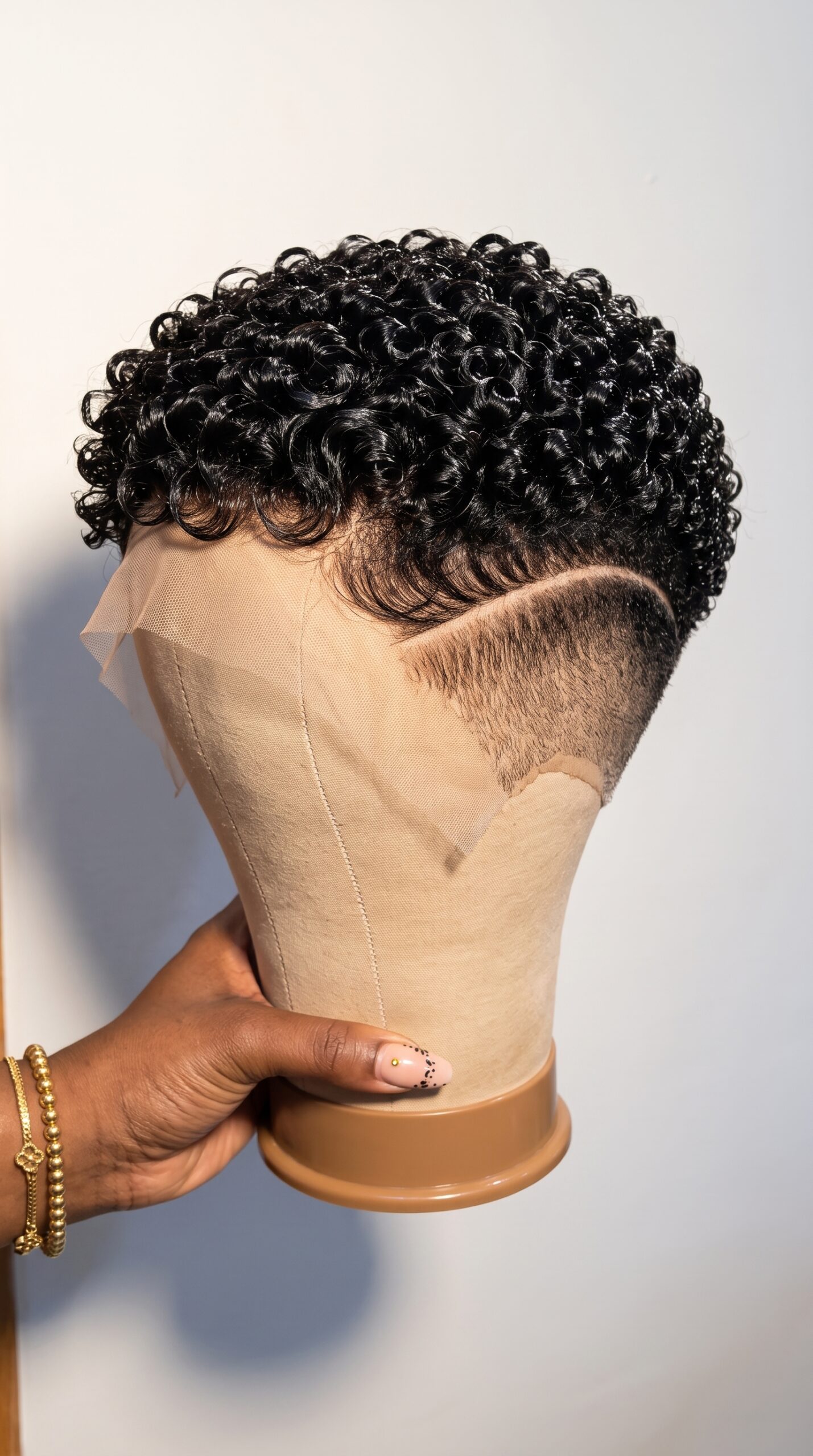
The part of this wig most likely to fail is the part with the least hair in it.
The tapered edge on this black curly pixie wig is the whole selling point and the whole weakness. Tight glossy coils sit high on the crown, a laid edge sweeps along the front, and the side drops through a graduated fade where the knots thin out row by row until the lace runs bare. Those thinning rows are where the style lives, and they are also where it wears out first.
Where To Buy A Wig Like This
A graduated fade is one of the harder things to knot well and one of the easier things to fake, so the maker matters more here than on a blunt-edged piece.


Custom makers and lace studios. The route that can build a real graduated fade rather than hair cut short over a cap. One or two people working to order over WhatsApp or direct message, four to six weeks, deposit up front. Worth it because the fade is knotted, not cut, and only a maker building the piece controls how gradually it thins.
Instagram and TikTok sellers. The widest choice and the best comparison. Search the terms below plus your city, and watch Reels where the fade is shown against the light, since that is when you can see whether the density thins smoothly or drops in steps. Look for makers who photograph the fade close up rather than only the styled crown.
Etsy. Workable for made-to-order, but a listing calling something a fade may mean hair cut short over a solid cap, which looks and wears completely differently. Ask before ordering and read buyer photographs.
Marketplaces such as Amazon, AliExpress and Temu. Cheap synthetic pieces here almost always cut the fade rather than knot it, because knotting a graduated fade is slow hand work that does not fit the price. Fine if you accept a cut edge; not what this piece is.
Local beauty supply shops and salons. Useful for seeing whether a fade is knotted or cut before paying, which is hard to tell online. Prices run about a third above online. Some salons order custom and fit it.
Vendor or wholesale direct. Minimums of five to ten identical units, relevant only for resale.
Regional note. Independent makers of knotted-fade short units are concentrated in Nigeria, Ghana, South Africa, the United States and the United Kingdom, with the busiest Instagram communities in Lagos, Accra, Atlanta and London. Ordering internationally adds shipping and duty to the comparison.
Vetting a seller. Continuous posting history rather than a burst. Buyer photographs on request. A specific answer to whether the fade is knotted or cut. Video of the fade against light. Returns position in writing.
Red flags. Only ever showing the crown, never the fade close up. The same image across several shops. No answer on whether the fade is knotted or sealed underneath. A price well below the ranges below for a hand-knotted fade. Payment only by irreversible transfer.
What to send when you enquire. A reference photograph, your head circumference, your crown-to-nape measurement, where you want the fade to begin relative to your ear, and your deadline.
Paying safely. Thirty to fifty percent deposit, balance before shipping. Ask for a close photograph of the fade against light before releasing the balance, since that shows whether the thinning is smooth and whether the knots are sealed.
Contact / Order Inquiries: WhatsApp is where most independent makers take orders. [WhatsApp: +XX XXX XXX XX XX] — ask whether the fade knots are sealed underneath, and how gradually the density thins at the bottom edge.
Why The Thinnest Rows Fail First
A knotted fade works by reducing how many hairs are tied into each row as it descends. At the top of the fade the knots are dense; near the bottom there may be only a scattered few per centimetre, each one a very short hair tied into open lace.
Short hairs have almost nothing to grip with. A full-length knotted strand has the weight and friction of its own length holding it in the knot; a fade hair a few millimetres long has neither. It pulls free under a fraction of the force.
And because the bottom rows are sparse by design, losing a few hairs there removes a visible proportion of them. On the dense crown you can shed and not notice. In the thinnest part of the fade, every lost hair shows.
So the fade fails from the bottom up. The lace runs bare a little higher each month, and the graduated edge that made the piece look like a real fade slowly becomes a blunt one.
What Slows It Down
Two things, and one of them is a construction question you ask before buying.
Sealed knots. A maker can seal the underside of the lace so the knots cannot slip. On a fade this matters more than anywhere else, because the knots have the least grip to begin with. Ask whether the fade specifically is sealed, not just the perimeter. Some makers seal the main lace and leave the fade unsealed because it is fiddly, which is exactly backwards.
Handling. The fade is stripped by friction against the direction of the hair. Running a hand up the fade, a collar rubbing against it, or a pillow dragging on it at night all pull the short hairs out. Touch it as little as possible and never against the grain.
Judging A Fade Before You Buy
Hold any photograph up to the light and look at the gradient rather than the hair.
The thinning should be continuous, with no row where the density suddenly drops. A step in the fade is where the knotting was rushed, and it is also where wear will accelerate, because the row above the step takes the friction for the sparse row below.
The bottom edge should thin to single scattered hairs before the lace runs bare, not stop abruptly at a line. An abrupt stop is a cut fade wearing the appearance of a knotted one.
The shortest hairs should lie flat against the lace. If they stand up at angles, they were tied too loose for their length and they will be the first to go.
How Much It Costs
A knotted fade is slow work and prices well above a cut edge.
The unit itself
Human hair black curly pixie wig, fully knotted graduated fade, sealed knots, laid edge, sheer lace, glueless cap: $260–$540
The same curly pixie wig with hair cut short over a solid cap instead of a knotted fade: $170–$350
Human hair pixie wig, blunt perimeter, no fade: $150–$310
Quality synthetic curly pixie wig with a cut fade: $70–$150
Basic synthetic short curly wig: $25–$60
The gap between the first two lines is the difference between hundreds of individual knots at decreasing density and a pair of scissors. Both get called a fade.
What is usually included, and what is not
Included in most quotes: cap, hair, standard knotting, standard lace.
Charged separately by many makers: sealing the fade knots underneath ($15–$40), HD or fine lace over standard ($20–$50), bleached knots across the full lace ($15–$40), a laid edge from finer hair ($20–$50), pre-trimmed lace ($25–$50), rush build ($40–$100).
Ask whether the fade sealing is inside the quoted number. It is the one upgrade that most directly affects how long this style lasts.
Shipping and duty
Tracked international shipping on a single short unit generally runs $25–$60. Import charges vary by country on declared value; allow ten to thirty percent of the item price and check your own rates.
The costs that come after
Canvas block and stand: $25–$60 once
Satin cover: $5–$15
Colour-safe wash products: $20–$40 per year
Professional first lace trim: $30–$80 once
Professional reset of the curls: $40–$90 per visit, two to four times a year
Fade re-knotting when it thins: $60–$150, and worth pricing before you buy because it is the repair this style eventually needs
First year, all in
A mid-range human hair version at $360, plus $45 shipping, plus roughly $60 duty, plus $50 of storage kit, plus $40 in wash products, plus one $50 trim and two $60 resets, comes to around $725 across twelve months. The fade re-knot usually falls in a later year rather than the first.
The synthetic equivalent at $120 with a cut fade and no resets comes to around $175, but the fade is cut rather than knotted, so it is a different-looking edge from the start.
Cost per wear
Worn three times a week over a year, the human hair piece lands near $4.65 per wear and should carry into a second year if the fade is looked after. The synthetic sits near $1.15 per wear, with a cut edge that does not thin the way a knotted one does but never looked knotted to begin with.
What an unusually low price means
A hand-knotted graduated fade in human hair is hard to produce under about $130. Below that the fade is almost certainly cut rather than knotted, or the knots are unsealed, or the piece is a fibre blend.
Deposit structure
Thirty to fifty percent up front, balance before shipping. Ask for the against-the-light fade photograph before releasing the balance, since it is the only image that shows whether you are getting a knotted fade or a cut one dressed up as one.
The Laid Edge On Top Of The Fade
The fine hairs laid along the front sit above the fade and are knotted separately, from finer hair again.
They share the fade’s weakness for the same reason: fine short hairs with little grip. The edge is the second part of this piece to thin, after the bottom of the fade.
Judge it on whether it is knotted from finer hair than the coils and whether it thins toward the perimeter rather than stopping in a line. It is product-set and washes out; the knotting beneath is what lasts.
Before You Pay
Is the fade knotted or is the hair cut short over a cap?
Are the fade knots sealed underneath specifically, not just the perimeter?
How gradually does the density thin at the bottom edge?
Do the shortest hairs lie flat against the lace?
What would you charge to re-knot the fade when it thins?
Trimming The Lace
Work along your own hairline with short angled cuts, leaving a margin rather than trimming flush.
Do not trim the lace inside or below the fade. That lace is meant to show through the thinning knots and read as skin. Cutting it back removes the surface the fade is built against and there is no adding it back.
Have the first cut done by someone experienced, and leave the fade area alone entirely.
Search Terms
knotted fade pixie wig · black curly pixie wig human hair · graduated fade short wig · tapered fade pixie wig · sealed knot fade wig · curly pixie wig with laid edge · knotted fade vs cut fade pixie wig
Final Thoughts
The graduated fade is what makes this style look like a haircut rather than hair on a cap, and it is built from the most fragile hair on the piece: short strands, sparsely knotted, with the least grip available.
It wears from the bottom up, and how long it lasts comes down to two things you can ask about before buying. Is the fade knotted or cut, and are those knots sealed. Get honest answers to both and you know how long the part that sells this wig will actually last.