
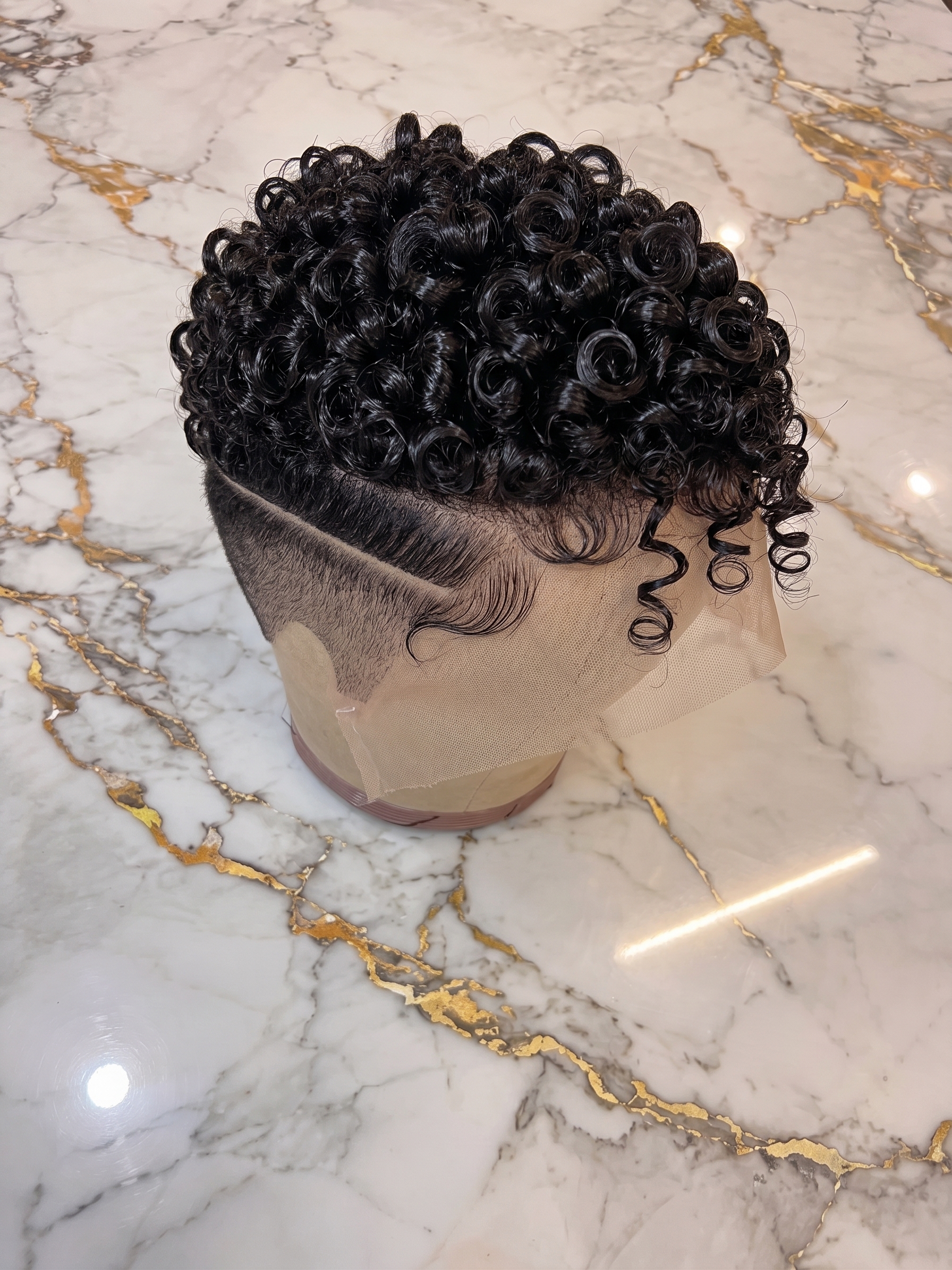
Mounted on a block, lace laid forward, the front construction fully exposed. Big loose spiral curls up top. A laid swoop edge along the hairline with a couple of defined curls dropping at the temple. A carved line cut down into a tapered, faded side. Sheer lace hanging untrimmed over the block. The curls are the first thing the eye goes to — but they are the easiest part of this piece to get right. What actually separates it from a cheap unit is everything happening at the hairline and the side.
A block-mounted shot like this is useful precisely because it puts that work on display. The laid edge, the carved line, the fade, the knots — all of it is sitting in the open to be judged before you commit.
Where To Buy A Wig Like This
The laid edge and the carved line are what narrow the field. Plenty of makers set a nice loose curl, then hand you a blunt hairline and a plain side that give the whole thing away. A shaped edge and a clean carved line are separate skills, and you have to search for them on purpose.
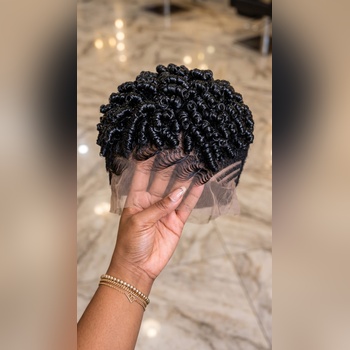
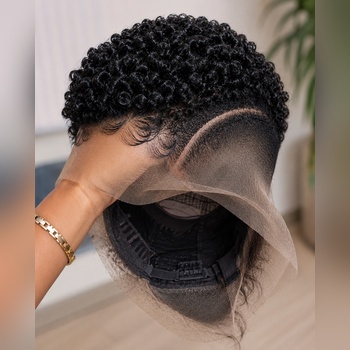
Custom wig makers and lace studios are the main route. Search with detail-specific vocabulary rather than generic terms: “carved line curly pixie wig,” “laid edge tapered pixie,” “swoop edge glueless pixie,” “HD lace curly pixie with design line.” A maker who names the edge and the line in their listing treats them as a selling point — which is exactly who you want.
Instagram and TikTok wig specialists are the richest source. Skip the full-head glamour posts and go to the close-up grid — the hairline, the carved side, the cap interior. Makers proud of their edge and line work photograph those angles deliberately. The ones who only ever post the finished head shot are usually hiding the parts that matter.
Etsy works for made-to-order pieces. Read the buyer-uploaded photos, not the seller’s staged ones. Sellers shoot the edge under perfect light; buyers shoot it in a bathroom mirror, which is where the truth shows up.
Contact / Order Inquiries: WhatsApp is the standard channel for independent makers. [WhatsApp: +XX XXX XXX XX XX] — send this exact photo as a reference and ask directly: “Can you lay an edge and carve a clean line like this, and how do I re-lay the edge?” Some makers only do a plain swept edge and a flat side. Find that out before you pay, not after.
How Much It Costs
Solid black, no lifting or toning, so every dollar above a basic unit is buying hand-finishing, not colour.
100% human hair, sheer lace, bleached knots, laid swoop edge, carved line, hand-knotted tapered fade, glueless cap: generally $200–$430
100% human hair with a simple laid edge and a plain side instead of a shaped edge and a carved line: typically $150–$310
100% human hair, basic cap, no edge or design work at all: typically $70–$180
High-quality synthetic with comparable finishing: usually $60–$140
Basic synthetic curly pixie: often $20–$55
The arithmetic worth knowing: a laid swoop edge and a carved line each add cost over a plain unit because both are slow, freehand hand-work, and a hand-knotted fade adds more because every short hair in the taper is tied individually rather than clipped. Together they push a well-finished pixie to roughly double a plain unit with identical hair — and that whole gap is hours at the hairline and the side, not the curls up top.
Shipping, Delivery, And What To Expect After Ordering
Made-to-order timing. A shaped edge, a carved line, and a hand-knotted fade are slow to build. Expect two to four weeks rather than a few days.
Lace arrives untrimmed, exactly as shown here. That excess is intentional — it is your margin to cut along your own hairline instead of a factory’s average.
International shipping is normal with Instagram, TikTok, and Etsy sellers, though delivery windows and customs fees vary by country. Ask about tracked shipping before you pay.
Returns are usually limited on custom pieces. Get the policy in writing.
Cap fit is the most common regret. Send your head measurement and ask whether they build to it.
The Laid Swoop Edge
Look at the hairline. That is not a casual swept edge — it is a shaped swoop, a curve of laid baby hairs following the contour of the hairline, with a couple of defined curls dropping deliberately at the temple.
This is a different level of work from a plain edge. A basic edge is baby hairs brushed forward in one direction. A laid swoop is controlled — the stylist shapes the curve, keeps its width even, and tapers it into fine wisps at the ends so it reads soft rather than drawn-on. Done well it looks like the hair grows that way. Done badly it looks painted on the lace.
How to judge it: the curve should be smooth and continuous with no wobble; the width should stay even rather than pinching or fanning; and the ends should melt into individual wisps instead of stopping in a hard block. It should look like hair, glossy and soft, not a flat dark stripe.
The honest problem: it will not survive the week. A laid swoop loosens with wear, washing, humidity, and sleep, so you will need to re-lay it, probably sooner than you would like. Ask your maker two things directly — how do I re-lay this edge, and what products do you use? A good one answers without being pushed. And be honest with yourself first: if you will not re-lay it, do not pay extra for it. An elaborate edge you cannot maintain is a one-week luxury.
The Carved Line And The Tapered Fade
Cut down into the side is a carved line running into a tapered, faded section. Restrained rather than busy, which is the right call — with a laid edge this detailed at the front, a crowded multi-line pattern would only create visual noise.
A carved line is harder than it looks. There is no length to hide a mistake, no un-carving once it is cut, and the line has to stay smooth and even in width as it follows the curve of the head. Any wobble is immediately visible. Judge it on cleanness: a crisp, consistent edge with no ragged breaks.
The fade beside it is the quiet mark of a careful maker. The full curls graduate down through progressively shorter lengths into stubble and finally dissolve into the lace — every hair in that taper hand-knotted at a decreasing length, no clipper involved. A bad fade has a hard stop or patchy density; a good one melts. That gradient is what lets a short wig sit against the head as if the hair naturally grows shorter toward the ear.
The Loose Spiral Curls, The Lace, And The Knots
The curls are large, open spirals — glossy defined barrels rather than tight coils. Loose curls hide nothing, so each barrel should be similar in diameter, cleanly separated, springy, and shiny. On an open-curl piece especially, ask for a short video: a still photo cannot tell you whether the curls bounce back or sag.
The lace is fine and sheer, laid over the block and hanging untrimmed. Check the knots along the hairline: on a careful unit they are bleached so the lace reads as scalp rather than a scatter of dark dots. Bleached knots are an extra production step and a reliable sign of a maker who cares.
The Cap And Glueless Fit
A block-mounted shot like this shows the front but not the inside, so ask before you buy: is the cap glueless, with combs and an adjustable strap? A glueless cap secures mechanically — no adhesive on your skin, no removers, no slow traction damage to your own edges. But glueless only works if the fit is right. Measure your head with a soft tape — from the front hairline, around above the ears, around the nape, and back to the start. Most caps run 21.5–22.5 inches, but real heads vary, so ask whether the maker builds to your measurement.
Before You Pay
Can you show me close-up photos of edge, line, and fade work from past pieces?
Can you lay this swoop edge and carve a clean line like this, and how do I re-lay the edge?
Are the knots bleached, and what lace type and tone are you using?
Is the cap glueless — combs and an adjustable strap?
What’s the cap circumference, and can it be built to my head measurement?
Trimming The Lace
Cut slowly and follow your natural hairline. Leave a small margin instead of going flush, and use small staggered cuts rather than one straight line. On a piece with a shaped edge, the lace and the swoop have to work together — the laid baby hairs sit on top of the lace and disguise its boundary, so a rough trim undoes hours of careful hand-work. If you are new to lace, pay a stylist for the first cut and copy what they do.
Search Terms
carved line curly pixie wig · laid swoop edge pixie wig · tapered fade lace curly pixie · HD lace curly pixie with design line · glueless curly pixie with combs · where to buy pixie wigs with laid edges
Final Thoughts
Study this piece if you want to see where the money actually goes on a curly pixie. The curls are the easy part. No colour, no gimmick — the price roughly doubles over a plain unit with the same hair, and the whole difference is hours of laying the swoop edge, carving the line, and hand-knotting the fade.
It earns that, if the hairline matters to you. A shaped edge, a clean carved line, bleached knots, and a fade that melts into the lace are what make a short wig stop reading as a wig and start reading as a haircut. But go in clear-eyed: the edge loosens and needs re-laying, and if that is not maintenance you will actually do, you are paying double for a look that lasts a week. Decide honestly, then buy accordingly.