
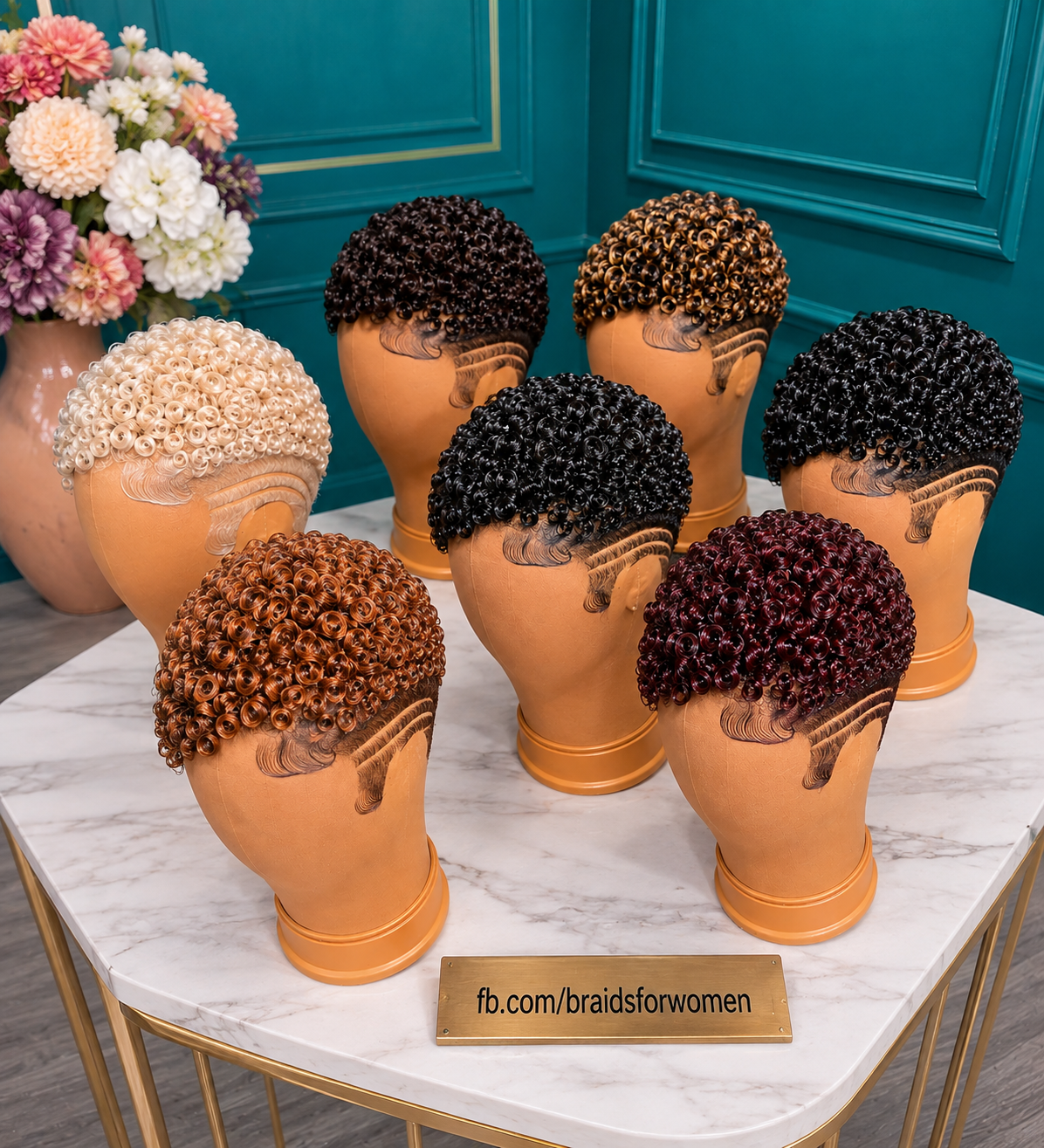
Line up seven identical curl-cap styles in seven different shades, from platinum white to deep burgundy, and something becomes visible that a single unit photo never shows: whether the maker’s quality holds steady across all of them, or only in the one they chose to photograph best. Every head here carries the same laid, swooping edge design and the same dense, rounded curl, regardless of colour, and that consistency is worth paying attention to for reasons beyond simply picking a shade. A colour range like this is not just a menu, it is an unintentional quality test, and it is worth reading it as one.
Think about what it takes to produce this. Achieving the same laid-edge pattern and the same curl density on platinum blonde, which is heavily processed and fragile, and on a deep natural brown, which behaves very differently, and on a vivid burgundy, and on black, requires real skill repeated across genuinely different starting materials. A maker who can only nail the laid edges on their favourite or easiest colour will show that inconsistency the moment you compare units side by side. One who delivers the same standard regardless of shade is demonstrating something a single product photo cannot: a repeatable process, not a lucky result.
This is why a full colour range, photographed together like this, is worth studying as a group rather than jumping straight to your favourite shade. Look across all seven heads and ask whether the edges are laid with the same care on the burgundy as on the black, whether the curl looks equally full and even on the platinum as on the brown. If it does, you are looking at a seller whose quality is a genuine standard, not a colour-dependent stroke of luck. If it does not, that inconsistency is information worth having before you commit to whichever shade you actually want.
Where To Buy A Curl-Cap Pixie Wig From A Consistent Colour Range
Custom makers who show their full range together, as here, give you the chance to check consistency directly, so look at every head, not just the shade you want, before deciding this maker’s quality is reliable. A maker confident in their consistency will happily show the full range; one who is not may only post their best individual pieces.
Instagram and TikTok sellers sometimes post a full range like this specifically to demonstrate consistency, so use it that way: scan every unit for matching edge quality and curl density before focusing on your preferred colour. A pixie wig range photographed together is an opportunity to judge the maker, not just the menu.
Etsy works with makers who sometimes show colour ranges together in one listing or across their shop. The risk is only looking at your favourite shade’s photo and missing that other colours in the same shop show rougher construction. Read reviews across multiple colours if you can, not just the one you want.
Marketplaces like Amazon, AliExpress, and Temu rarely show a full range built to the same standard, since mass production varies more between colours, so treat any range photo you do find as a genuine chance to compare quality across shades before choosing.
Local beauty supply shops and salons may have several colours of the same style in stock, letting you physically compare the edge and curl quality across them in person, which is the clearest way to judge consistency. You pay a premium in-store, but this side-by-side comparison is worth it if quality consistency matters to you.
Vendors and wholesalers direct ship standard ranges, and consistency here often comes down to whether the production process is genuinely standardised or whether quality drifts by batch or colour, so ask directly if this is a concern.
Regionally, makers who maintain visible consistency across a full colour range are easy to identify across Lagos, Accra, Atlanta, London, and South Africa, since this kind of range photo is common in their portfolios and easy to scan on video.
Vet the seller the usual way: check the account age, look for real buyer photos across multiple colours from the same seller, time a plain question for a genuine reply, and ask whether the laid-edge and curl quality is genuinely consistent across their full range. A seller who welcomes this comparison is confident in their standard.
Red flags: a range photo where some heads clearly show rougher edges or thinner curl than others, a seller who only ever posts their single best piece rather than a full range, and reviews describing inconsistent quality between different colour orders from the same shop.
When you order, send your measurements and, if you have seen their range photo, mention that you are choosing based on the consistency you observed across all the colours, not just the one you want. That signals you are evaluating them as a maker, not just picking a shade.
Contact / order inquiries: WhatsApp [WhatsApp: +XX XXX XXX XX XX].
How Much It Costs
Consistency across a colour range does not typically change the price, but it changes the risk, since a maker who proves their standard across many colours is a safer buy at any given price point than one whose quality is unproven or visibly uneven.
Tiered pricing. Human hair, full build with a dense, laid-edge curl-cap style, glueless with a fine lace, across natural shades like black or brown: roughly $180 to $400. Bold or pale shades such as platinum or burgundy add $50 to $120 for the colour work. Human hair, mid build: about $140 to $300. Human hair, basic cap: around $70 to $170. Good synthetic: $60 to $140. Basic synthetic: $25 to $60.
What that includes and excludes. The price covers the unit including whichever colour you choose from the range. It excludes shipping, any customs, and the colour-specific upkeep, toning for pale shades, refreshing for bold ones, which varies by what you pick.
Shipping and duty. These sit outside the price and change with where you live, so plan a realistic band and confirm your own country’s import rate.
Ongoing costs. Whichever colour you choose from a consistent range carries its own usual upkeep, natural shades needing little, platinum needing toning, burgundy needing colour refresh, but the construction quality, the laid edges and curl density, should not vary by colour if the maker is genuinely consistent, so that part of the unit’s quality is not something you pay extra for or risk losing depending on your shade.
First-year total. A unit from this range plus shipping plus any customs plus colour-specific upkeep tends to land in line with the shade you choose, natural colours costing less to maintain than bold or pale ones, but the base construction quality should be equally reliable regardless.
Cost per wear. A unit whose construction quality was proven consistent across the whole range gets worn with confidence regardless of which colour you picked, since you already know the edges and curl density will match what you saw in the group photo, not just your one chosen shade’s best angle.
What a very low price signals. A very cheap range is more likely to show visible inconsistency between colours, since maintaining the same standard across many shades takes skill that a rock-bottom price rarely reflects. Compare across the range rather than judging the price of your one shade alone.
Deposit structure. For custom work, thirty to fifty percent down with the balance before shipping is standard, and use a method you can dispute.
Shipping, Delivery, And What To Expect After Ordering
Whichever colour you choose from a consistent range, expect the same standard of laid edges and curl density you saw across the whole group, not a lesser version reserved for less popular shades. Ask that it ship protected, choose a tracked service, and confirm your country’s import charge before it lands. When it arrives, compare it mentally to the range photo that convinced you, checking that your specific unit matches the quality you saw across all the colours. What you unbox should reflect the consistency that made the whole range worth trusting in the first place.
A Range Photo Is A Quality Test You Get For Free
Most quality checks require you to already own a unit or read someone else’s review, but a photographed colour range hands you a direct comparison across many pieces at once, at no cost to you. Scanning every head for matching edge and curl quality is essentially free due diligence that a single product photo could never offer, so it is worth using deliberately rather than skimming past to your favourite shade.
Hard Colours Reveal Skill Level Fastest
Platinum blonde and vivid shades like burgundy are more demanding to execute well than a natural black or brown, so a maker’s performance on those harder colours, visible in a group shot, tells you more about their actual skill ceiling than their easiest shade does. If the platinum head in a range looks just as clean and full as the black one, that is a stronger quality signal than either alone.
Inconsistency Is Information, Not Just An Aesthetic Flaw
If one head in a range shows visibly thinner curl or rougher edges than the others, that is not simply a less flattering photo, it is a signal about how that maker’s quality varies, which matters for whatever colour you are about to order, even if it looks fine in isolation. Reading a range for consistency protects you from ordering the one shade that happens to be their weak point.
Before You Pay
- Have I looked at every head in the range, not just my preferred colour?
- Do the laid edges and curl density match across all the shades shown?
- Does the maker perform as well on demanding colours like platinum as on black?
- Is there any visible inconsistency I should be cautious about?
- Am I choosing this maker because their whole range proves a real standard?
Trimming The Lace
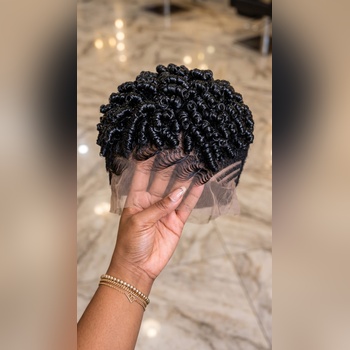
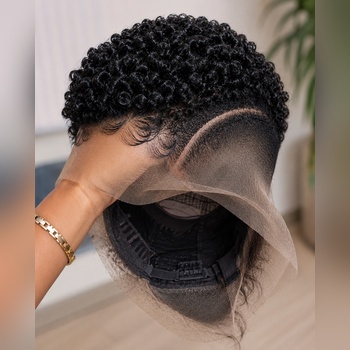
The lace comes off the front the usual way regardless of which colour you choose, and a consistent maker should deliver the same clean, layable hairline across their whole range, not just their showcase shade. Trim in small offset steps and leave a shallow margin rather than cutting flush, in daylight where your chosen colour reads true. If this is your first unit from this maker, the range photo you compared should give you real confidence in what to expect from the cut.
Search Terms
curl cap pixie wig colours · rounded curl short wig range · laid edge pixie unit colours · dense curl pixie wig shades · glueless curl cap lace wig · platinum burgundy black curl range · consistent quality pixie wig · natural coloured curl short wig
Final Thoughts
Seven identical curl-cap styles across seven shades do more than offer a menu, they show whether this maker’s quality is a genuine, repeatable standard or something that only shows up in their best individual piece. The same laid-edge design and dense curl achieved on demanding colours like platinum and burgundy, just as cleanly as on black, is a stronger signal of real skill than any single flattering photo could ever be.
Buy by reading the whole range before you fall for your favourite shade, checking that the construction quality holds steady across every colour shown, since a maker’s performance on the harder shades tells you the most. A pixie wig chosen from a genuinely consistent range gives you confidence beyond the colour itself, because you already know, from every other head in that photo, exactly what standard you are buying into.