
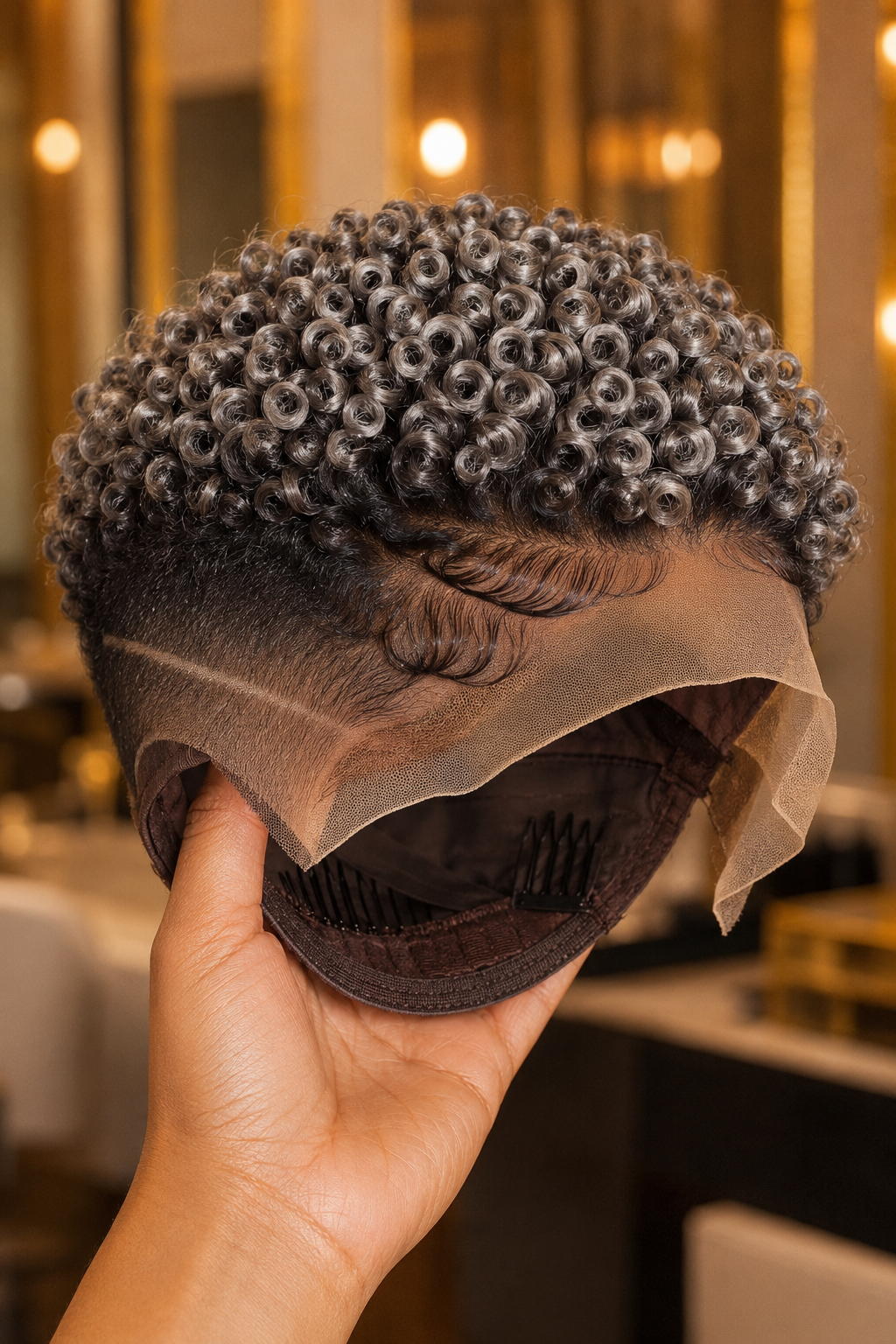
The most natural-looking grey on a short unit is often the grey that was never grey hair to begin with. That sounds backwards until you understand where hair comes from. Real grey human hair, the genuine salt-and-pepper you see on this unit, is one of the scarcest things in the whole trade, because almost no one sells their grey hair, and the hair that does turn grey has lost its melanin, which leaves it coarser, drier, and wirier than pigmented hair. So authentic grey human hair is rare, difficult to work with, and expensive when you can find it at all. Most grey units are therefore not real grey hair; they are human hair dyed to grey, or synthetic fibre made grey from the start.
For grey specifically, that is not the compromise it would be with other colours. Grey is one of the shades synthetic renders beautifully, evenly, and stably, and a good synthetic grey often looks more natural than a dyed human grey, because dyed grey tends to go flat and can yellow over time while synthetic holds its tone. So the usual rule, human hair is the better hair, bends here: for a natural salt-and-pepper look with little fuss, a quality synthetic grey is frequently the smartest buy, and a dyed human grey the trickiest to keep looking real.
What makes this unit read as authentic is not that the hair is necessarily real grey, but that the grey is varied and dark-rooted rather than a flat uniform sheet. Real grey is never one tone, and the dark base here is what sells it. Judge a grey unit on that realism, and on which of the three origins you are actually buying.
Where To Buy A Grey Curly Pixie Wig That Looks Real
Custom makers should tell you honestly whether the grey is real grey human hair, dyed human hair, or synthetic, because the three age completely differently. Ask directly which it is. A maker who sources real grey will say so and price it accordingly; one calling a dyed unit real grey is stretching the truth.
Instagram and TikTok sellers rarely distinguish the three, so ask what the grey actually is and to see it in daylight, where a flat dyed grey or a yellowing one shows itself. A grey curly pixie wig can look convincing under warm salon light and dull or brassy in daylight, so judge the tone in plain light.
Etsy works with makers who state the grey’s origin and show real buyer photos. The risk is a listing that says grey without saying real grey, dyed, or synthetic. Read reviews for anyone describing how the grey held its tone or went yellow.
Marketplaces like Amazon, AliExpress, and Temu are where good synthetic greys genuinely shine, since grey is a shade synthetic does well and holds stably, often looking more natural than a cheap dyed human grey. For a salt-and-pepper look on a budget, a quality synthetic here can be the best choice. Judge by the tone and the realism, not the fibre label.
Local beauty supply shops and salons let you see the grey in real light and feel whether real grey human hair is as coarse as it usually is. You pay a premium in-store, but grey is a colour that fools cameras, so seeing it in person helps.
Vendors and wholesalers direct rarely stock real grey human hair in quantity because it is scarce, so most bulk grey is dyed or synthetic. For an authentic grey, a specialist maker beats general stock.
Regionally, convincing grey units in all three origins come strongly out of Lagos, Accra, Atlanta, London, and across South Africa, where sellers who understand grey are easy to find on video.
Vet the seller on origin: check the account age, look for real buyer photos, time a plain question for a genuine reply, and ask outright whether the grey is real grey hair, dyed, or synthetic. A seller who cannot or will not say is one to be cautious with.
Red flags: real grey human hair offered at a suspiciously low price, no answer on the grey’s origin, a flat uniform grey with no variation, and grey shown only under warm light.
When you order, send your measurements and ask which of the three greys it is, and say you want a varied, dark-rooted salt-and-pepper rather than a flat grey. That tells the maker you know real grey when you see it.
On payment, thirty to fifty percent down with the balance before shipping is standard for custom work. Use a method you can dispute, and ask for a daylight photo of the grey before releasing the last part.
How Much It Costs
Grey is the colour where origin drives price most dramatically, because real grey human hair is genuinely scarce, so a grey curly pixie wig can cost wildly different amounts for what looks like the same shade.
Real grey human hair, full build, glueless with bleached knots and a fine lace: roughly $300 to $600 or more, reflecting how rare and hard to source true grey hair is. Dyed-grey human hair, full build: about $200 to $430, cheaper but prone to going flat or yellow. Good synthetic grey: $60 to $150, often the most natural-looking for the money and the most stable in tone. Basic synthetic grey: $25 to $60.
The honest surprise is that spending the most does not guarantee the most natural result with grey. Real grey human hair is authentic but coarse and costly; a good synthetic grey looks natural, holds its tone, and costs a fraction. So grey is the rare colour where the mid or budget option can outperform the premium one on looks and upkeep both. Pay for real grey hair if authenticity of material matters to you; choose synthetic if a natural, stable look for less does.
Shipping and any customs charge sit outside the price and change with where you live, so plan a realistic band and confirm your own country’s import rate rather than trusting a single quoted figure.
Then the later costs, which grey shares with white hair. Any grey, real or dyed, yellows from sun, product, and smoke, so it needs a blue or silver toning shampoo to stay clean rather than dull. Real grey human hair also needs extra moisture because it is dry by nature. Synthetic grey needs the least upkeep of all. First-year math, honestly: a real or dyed grey unit plus shipping plus any customs plus toning products plus upkeep tends to land above a plain unit’s year, while a synthetic grey lands lower and steadier.
Per wear, a synthetic grey is often the best value for the look, while real grey human hair is a material you pay a premium to own. A very low price on real grey human hair is a warning, because genuine grey is never cheap to source.
Deposits follow the custom pattern: thirty to fifty percent to start, balance before shipping, and a daylight photo of the grey before the last payment clears.
Shipping, Delivery, And What To Expect After Ordering
A grey unit can look cool and clean under the seller’s lighting and warmer or duller in your own, so take it to daylight before you judge the tone. Ask that it ship so the curls hold their shape, choose a tracked service for custom work, and confirm your country’s import charge before it lands. When it arrives, check the grey for yellow undertones and use a toning shampoo if needed; real grey human hair may also want a moisture treatment straight away because it runs dry. What you unbox is the grey at its cleanest, and keeping it from yellowing is the ongoing task with this colour.
Real Grey Hair Is Coarse By Nature
When hair loses its melanin it also changes texture, becoming wirier, drier, and more resistant than pigmented hair, which is part of why real grey human hair is harder to work with and why units made from it can feel coarser. This is not a defect, it is the nature of grey hair, and it is why real grey needs more moisture. If a grey unit feels unusually soft and silky, it is more likely dyed or synthetic than genuine grey.
Grey Yellows, So It Needs Toning
Like natural white and grey hair, a grey unit drifts toward yellow with exposure to sun, smoke, and product build-up. A blue or silver toning shampoo counteracts the warmth and keeps the grey clean, exactly as it does on real grey hair. Dyed human grey yellows fastest, synthetic grey holds best. Plan for occasional toning so the grey stays crisp rather than dulling to a dingy yellow-grey.
Salt-And-Pepper Beats Flat Grey
Real grey is never a single uniform tone; it is a mix of grey, silver, and darker strands, which is why the varied, dark-rooted grey on this unit looks authentic. A flat, even grey reads as costume, while a salt-and-pepper blend with a dark base reads as real. When you judge a grey unit, look for variation and a grounded root, because uniformity is the giveaway that a grey was applied rather than grown.
Before You Pay
- Is this real grey human hair, dyed human hair, or synthetic, in plain terms?
- Does the grey look varied and dark-rooted, or flat and uniform?
- For a natural look with low upkeep, would a good synthetic grey serve me better?
- Does the grey hold its tone in daylight, or show a yellow cast?
- If it is sold as real grey human hair, does the price reflect how scarce that is?
Trimming The Lace
The lace comes off the front the usual way, with one grey-specific note: work in good daylight, because a grey tone plays tricks under warm light and you want to see the true colour at the hairline as you cut. Trim in small offset steps and leave a shallow margin rather than cutting flush. If the hair is real grey human hair, handle the edge gently, since grey hair is drier and more brittle than pigmented hair. If this is your first lace unit, let a stylist make the first pass so the hairline sits clean against the salt-and-pepper.
Search Terms
grey curly pixie wig · salt and pepper pixie wig · natural grey short wig · synthetic grey pixie unit · dark rooted grey curly wig · grey coil pixie lace · silver grey short curly wig · glueless grey pixie wig
Final Thoughts
Grey is the colour that best exposes how hair is sourced, because real grey human hair is genuinely scarce, coarse, and costly, which means most grey units are dyed or synthetic whether the listing says so or not. That is not a problem to hide from; for grey specifically, a good synthetic often looks more natural and stays cleaner than a dyed human grey, and it costs far less. Grey is the rare shade where the material you pay the most for is not automatically the one that looks best.
Buy it by asking which of the three greys you are getting, judging the tone in daylight, and looking for a varied, dark-rooted salt-and-pepper rather than a flat sheet of grey. Plan to tone it like you would natural grey hair, and if it is real grey human hair, feed it the moisture its coarse texture needs. A grey curly pixie wig done right is a striking, mature look that reads as genuinely your own; done wrong, it is a flat costume grey that yellows. The colour is easy to want. Knowing where the grey came from is what gets you one that looks real.