
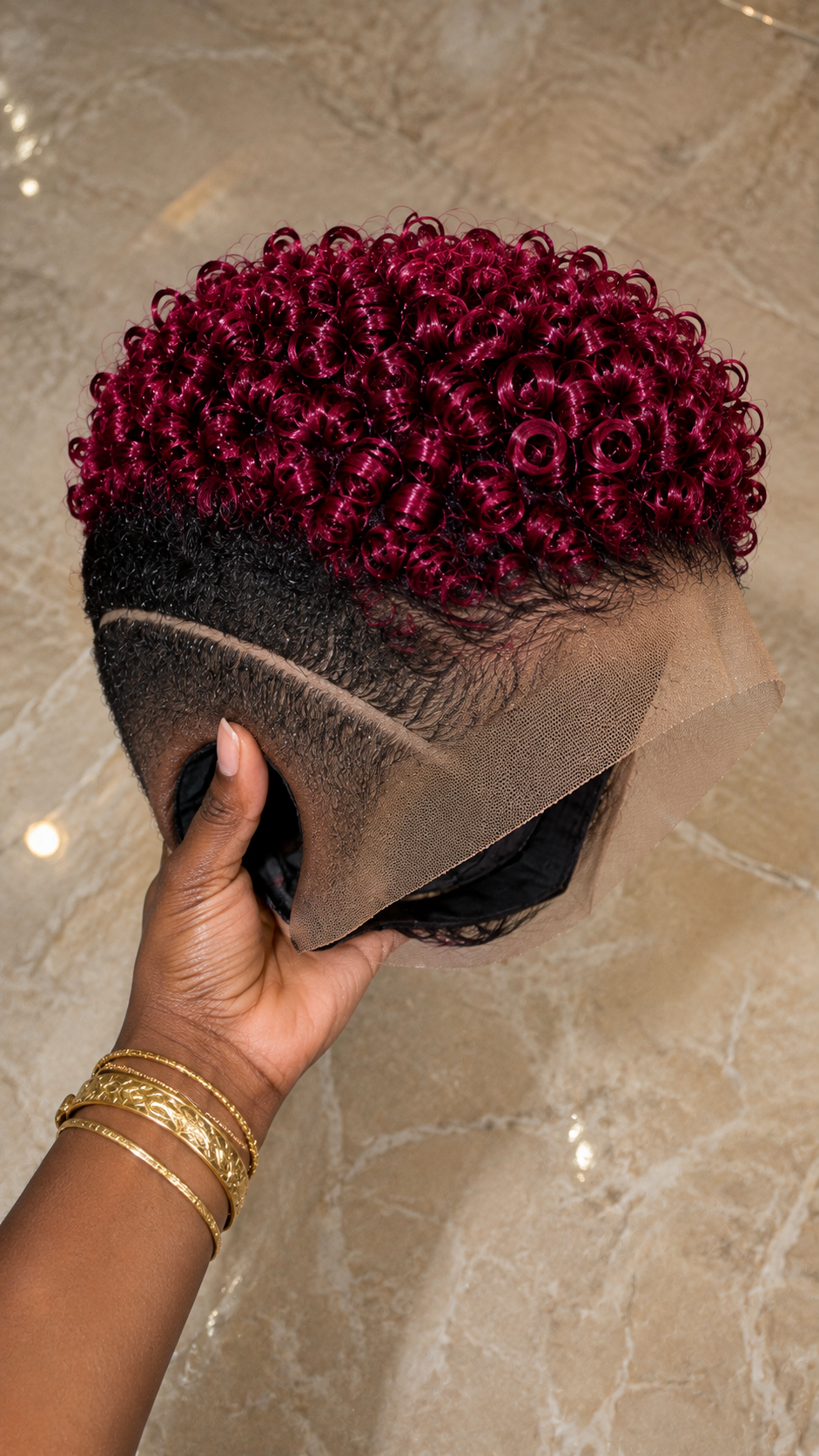
A two-tone curly pixie wig can look dramatic without using complicated highlights. The strongest contrast may come from something much simpler: keeping the upper ringlet crown in a vivid burgundy or magenta-red shade while leaving the lower side and perimeter dark.
This style shows exactly why the boundary between those two colors matters. The crown is filled with glossy wine-red ringlets, while the shorter foundation underneath remains black. The contrast clearly separates the full upper section from the close-cut side.
But choosing the two colors is only the beginning. You also need to decide where the burgundy should stop and where the black section should begin. If that transition sits too high, the colored crown can appear unusually small. If it sits too low, the burgundy can overwhelm the short dark section and change the entire pixie silhouette.
For a custom order, this color boundary deserves its own specification.
Where To Buy A Two-Tone Burgundy Curly Pixie Wig
Custom wig makers. Custom ordering gives you the best control over the exact height of the colored crown. Send a side-view reference and indicate where you want the burgundy section to end. Do not simply request “burgundy and black.”
Instagram and TikTok wig sellers. Ask for side and back rotation videos. A frontal photo can show a beautiful burgundy crown while hiding how far the color travels down the sides.
Local wig boutiques. Shopping locally allows you to inspect the actual transition. Rotate the wig and check whether the color boundary looks intentional from the temple toward the rear.
Etsy wig makers. Independent makers may allow you to choose the crown color, base color, transition height, curl formation, cap size, and lace construction.
Online wig retailers. Search using terms such as burgundy pixie wig, black and burgundy curly wig, wine-red pixie, two-tone curly pixie, and dark-base burgundy wig.
Amazon, AliExpress, and Temu. Similar styles may be available at lower prices, but customer photos are especially important because the location of the color transition may vary from the listing sample.
Salon-made units. A professional wig stylist can sometimes start with a black human-hair pixie and color only the crown, preserving the lower section as the dark foundation.
Wholesale vendors. If you buy several units for resale, request group photographs from the side. A batch can use the same two colors while the crown boundary sits at noticeably different heights from unit to unit.
Order inquiries: WhatsApp [WhatsApp: +XX XXX XXX XX XX]
How Much Does A Two-Tone Burgundy Pixie Wig Cost?
The final price depends on the fibre, lace construction, cap quality, custom coloring, curl preparation, density, and amount of hand finishing.
Premium Custom Human Hair: approximately $280–$550+. This may include premium human hair, customized burgundy coloring, dark-base preservation, HD or Swiss lace, custom cap sizing, curl setting, and detailed perimeter work.
Standard Custom Human Hair: approximately $190–$380. This range can provide good human hair with professional two-tone coloring and customized styling without the highest-cost construction.
Basic Human Hair: approximately $130–$260. These units may use simpler caps or standard lace and require additional styling after delivery.
Premium Synthetic: approximately $70–$170. Quality synthetic fibre can preserve both the burgundy shade and tight ringlet pattern particularly well.
Basic Synthetic: approximately $30–$90. Budget options can reproduce the basic look, although the transition between colors may be more factory-like and less customizable.
Shipping, taxes, custom coloring, lace preparation, cap adjustments, professional installation, and additional barber work can increase the final cost.
The Boundary Determines How Much Of The Wig Reads As Burgundy
A short pixie has limited visible surface area.
That makes the position of the color boundary extremely influential.
If the burgundy continues low toward the temple and side, most viewers will interpret the hairstyle as a burgundy pixie with a small black undercut.
If the color stops much higher, the same wig can read as a black pixie with a burgundy curly top.
The actual colors have not changed. Their proportions have.
A High Color Boundary Creates More Black Exposure
Move the transition upward and more of the dark lower section becomes visible.
This strengthens the contrast between the ringlet crown and short side.
The hairstyle can appear sharper and more tapered because the black section occupies a larger visible band around the head.
For buyers who want the shaved-side effect to remain obvious, a slightly higher color boundary can be useful.
A Lower Boundary Makes The Colored Crown Look Larger
Allow the burgundy to extend farther downward and the colored area begins occupying more of the side.
The crown appears larger even if the actual curl length remains unchanged.
This can create a fuller, more colorful appearance.
However, if the color descends too far, the visual separation between the crown and the lower short section becomes weaker.
The Transition Should Follow The Haircut
A good two-tone boundary should not feel like paint placed across the wig at an arbitrary height.
It should relate to the haircut.
The longer ringlet section naturally belongs to the upper crown, while the short side belongs to the darker foundation.
The color change should therefore generally correspond with the change in hair length and styling structure.
When those two transitions align, the wig looks much more intentional.
A Perfectly Straight Color Line Can Look Artificial
The boundary does not necessarily need to form one perfectly straight horizontal stripe around the head.
The skull curves and the crown depth changes from front to back.
A subtle rise or fall can therefore look more natural than forcing the burgundy to stop at exactly the same vertical measurement everywhere.
The key is controlled variation rather than random patches.
The Temple Is One Of The Most Visible Boundary Points
The transition near the temple deserves special attention because it sits close to the face.
If the colored curls drop too far into this zone, they may cover the black short section.
If the color ends abruptly too far above it, an unusually large dark gap can appear beneath the crown.
Ask for a true side view before approving the unit.
The Back May Need A Different Boundary Height
The rear of the head has more depth than the temple area.
Because of this, the color transition may naturally sit slightly lower toward the back while still appearing balanced.
Trying to maintain one perfectly horizontal boundary can sometimes make the rear crown appear too short.
This is why side and back references should be included in a custom order.
Color Boundary And Curl Length Work Together
The lowest burgundy ringlets create the visible edge of the colored section.
If those curls are longer, they can hang over the black base and make the color boundary appear lower than it actually is.
Shorter perimeter curls expose more black underneath.
So the buyer should distinguish between the actual dyed area and the visible color edge created by the curls.
These are related but not identical.
Check The Boundary With The Curls Resting Naturally
A seller can lift the crown slightly before photographing the wig.
This exposes more of the black base and makes the two-tone structure look sharper.
Once the unit is worn and the curls settle, the burgundy may cover considerably more of that section.
Ask for a video where the wig is left untouched rather than manually lifted throughout the clip.
The Dark Base Creates A Visual Frame
The black lower section does more than provide contrast.
It acts like a frame around the vivid ringlet crown.
Because the dark hair recedes visually, the burgundy curls appear brighter and more dimensional.
Remove too much of that dark frame and the overall style becomes more uniformly colored.
That may still look attractive, but it produces a different effect.
Burgundy Saturation Makes The Boundary Stronger
A deep wine-red crown creates noticeable contrast against a black foundation.
A very dark burgundy may blend more softly into the base, especially in low light.
A brighter magenta-red produces a much sharper visual separation.
This means the ideal boundary height can depend partly on how saturated the chosen color is.
The brighter the crown, the more visually powerful even a relatively small colored section becomes.
Black Roots Can Soften The Boundary
Another option is keeping darker roots inside the burgundy crown.
Instead of going directly from solid black side to full burgundy curls, the hair can transition through darker roots before reaching maximum color.
This creates a softer vertical blend while still preserving the two-tone concept.
Ask whether you prefer a hard color block or a dark-root transition before the wig is colored.
A Hard Color Block Produces A More Graphic Pixie
Some buyers deliberately want a clear distinction between the black base and vivid upper crown.
In that case, a sharper boundary can be a design advantage rather than a flaw.
The short foundation looks almost barbered while the crown appears deliberately colored as a separate zone.
This works especially well when the hairstyle already includes a carved side line because both features emphasize the structured nature of the pixie.
A Softer Blend Creates A Less Abrupt Result
If you prefer something less graphic, ask for a small transition zone.
The stylist can preserve deeper burgundy or black-red tones close to the boundary and allow the brightest color to appear farther into the crown.
This keeps the dark foundation while reducing the sudden color jump.
Again, this should be specified before coloring.
The Single Side Line Needs Enough Dark Space
This particular style includes a carved line through the black side.
That detail works because there is enough dark hair around it to create contrast.
If the burgundy section extends too low, the remaining black area becomes narrow and the side line has less space to breathe.
This is another reason why the color boundary and haircut design should be planned together.
The Crown Should Not Look Like A Separate Cap
There is a danger with strongly blocked two-tone pixies.
If the color boundary is too sharp, the curl crown may appear visually detached from the short base underneath, almost like a separate piece sitting on top.
A well-designed transition uses curl length, density, root color, or subtle tonal variation to keep the two areas connected.
You want contrast without making the hairstyle look assembled from unrelated sections.
Ask Whether The Black Base Is Dyed Or Naturally Dark
On human-hair units, the black foundation may be the original dark hair while only the upper section is lightened and colored.
That can be useful because the short base avoids unnecessary chemical processing.
In other units, both sections may have been colored to achieve a specific black and burgundy combination.
Ask the seller how the color was produced, particularly if future recoloring is important to you.
Human Hair Offers More Boundary Customization
A human-hair unit can usually be colored in sections with greater flexibility.
A professional colorist may be able to raise or lower the visible burgundy area during the original coloring service.
Changing the boundary later is possible in some cases but can be considerably more complicated, especially if the hair has already been lightened.
It is better to plan the placement correctly the first time.
Synthetic Fibre Gives A More Fixed Result
A synthetic two-tone pixie may have its color placement built into the fibre arrangement.
This can make the pattern consistent and easy to maintain.
The disadvantage is that moving the boundary later is usually much harder.
If you buy synthetic, inspect the exact placement carefully before ordering.
Ask For A Direct Side Photograph
Front photographs are not enough for this style.
The direct side angle reveals three important things simultaneously:
the height of the burgundy section, the width of the black base, and the position of the carved side detail.
A rear three-quarter view is also useful because it shows whether the same color logic continues around the head.
Use Natural Light To Judge Burgundy
Burgundy and magenta-red hair can appear dramatically different under different lighting.
Warm salon lights may make the shade look redder. Cool lights may push it toward wine or magenta. Direct flash can make the reflective ringlets appear much brighter than they do in ordinary conditions.
Ask for at least one natural-light photograph or video of the exact finished unit.
How To Find A Stylist For This Look
Search for a custom wig colorist, pixie wig stylist, short curly wig specialist, or human hair wig colorist.
Check the stylist’s portfolio for short units and sectional coloring.
A stylist experienced only with long balayage or long lace wigs may not automatically understand how strongly a color boundary affects a pixie silhouette.
Send the reference before booking and explain that the dark lower section must remain visible beneath the burgundy crown.
Appointments can generally be requested through phone, WhatsApp, Instagram DM, Facebook, or the salon’s booking page.
What To Send When Ordering
Include more than a front image.
Send a direct side reference showing exactly where the color transition should sit.
If possible, also send a rear view and mark the approximate height of the burgundy section.
Specify the crown shade, base shade, curl pattern, cap size, lace type, and whether you want black roots continuing into the colored curls.
The clearer the instructions, the less room there is for the seller to interpret “black and burgundy pixie” differently from you.
Before You Pay
- Can you show the exact side view of the wig I will receive?
- Where does the burgundy section stop relative to the temple and short side?
- Does the color boundary stay at the same height around the back?
- Are the roots inside the burgundy crown dark or fully colored?
- Is the black foundation natural dark hair or separately dyed?
- Can you show the color in natural daylight?
- Is this human hair or synthetic?
- Can the boundary height be customized before production?
- What lace type and cap size are included?
- Can I see the finished unit before shipping?
Maintaining A Two-Tone Burgundy Wig
When washing a human-hair unit, use products appropriate for color-treated hair and avoid unnecessarily hot water.
Vivid red and burgundy pigments can gradually lose intensity.
Handle the curls gently and avoid aggressive brushing through compact ringlets.
If the crown needs color refreshing later, protect the black foundation from unnecessary pigment transfer. A professional colorist can help keep the original two-tone boundary intact.
Store The Wig Without Disturbing The Boundary
Storage will not move the actual dye line, but compressed curls can change the visible transition.
If the lower burgundy ringlets are flattened downward during storage, they may cover more of the black base when the unit is worn again.
Use a wig stand or mannequin head and avoid pressing heavy objects against the crown.
Search Terms
burgundy curly pixie wig · black and burgundy pixie wig · wine red short curly wig · magenta pixie wig with black sides · dark base burgundy wig · two tone curly pixie wig · burgundy ringlet lace wig · short burgundy wig for black women · glueless burgundy pixie wig · black base wine red wig · custom burgundy pixie wig · vivid red curly pixie wig
Final Thoughts
A successful two-tone pixie is not created simply by choosing one dark color and one bright color. The point where those colors meet is part of the haircut.
On a short burgundy ringlet wig, moving that boundary even slightly changes how large the colored crown appears, how much of the black taper remains visible, and how strongly the carved side detail stands out.
Decide whether you want a high boundary with more black exposure, a lower boundary with a larger burgundy crown, or a softer dark-root transition between the two.
When ordering online, request side and rear views of the exact unit. When ordering custom, send a reference that clearly shows where the color should stop.
The colors attract attention, but the boundary determines how those colors belong to the pixie.