
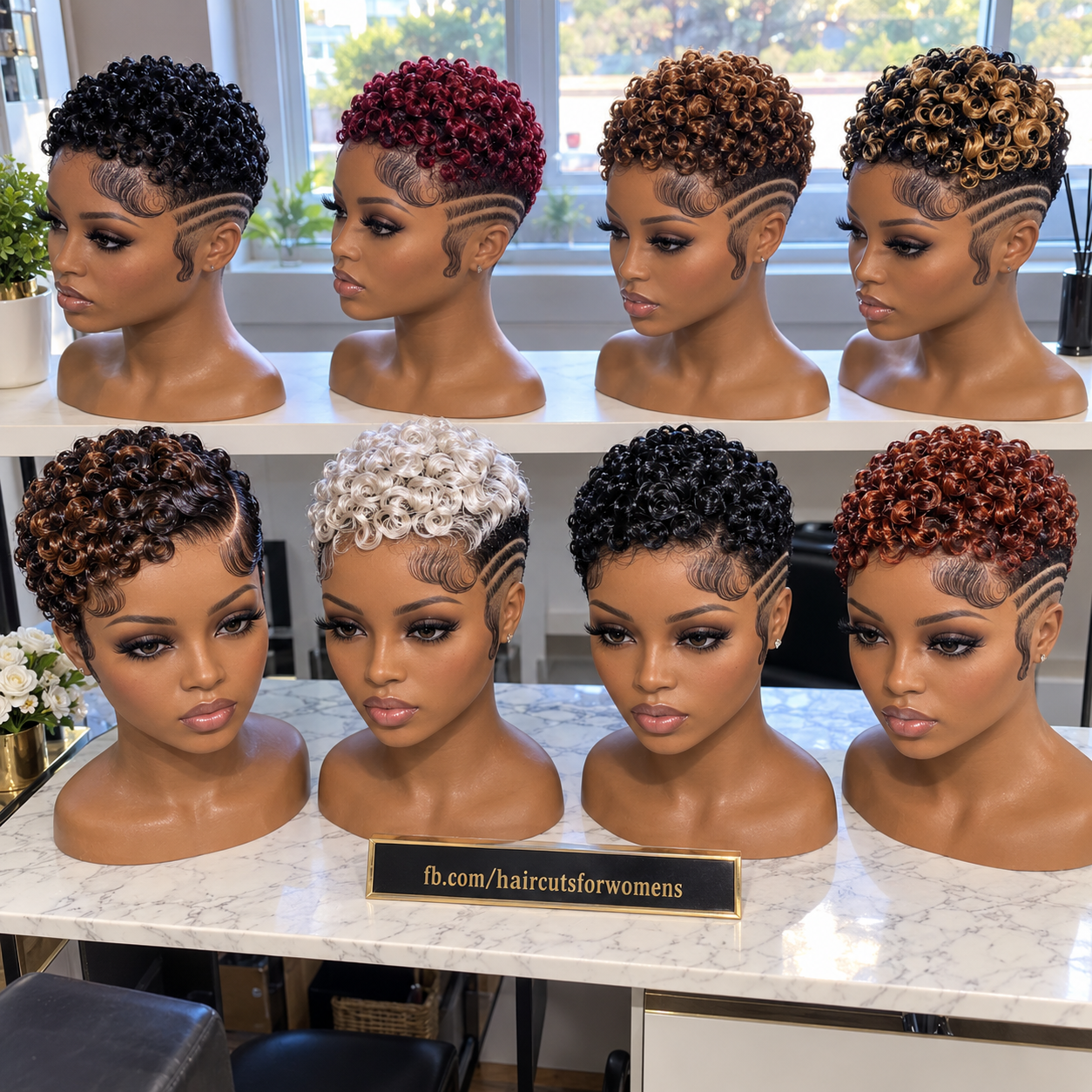
This ring curl pixie wig collection is built around a distinctive combination of compact circular curls, close tapered sides, sculpted finger-wave detailing and three parallel side lines. The eight displayed variations keep the same recognizable silhouette while changing the color placement across deep black, burgundy wine, warm copper, chocolate brown, caramel-highlighted brown and pale silver-blonde. Because the mannequins are positioned at both front and three-quarter angles, the display gives a useful reference for customers who want to communicate the crown structure and side work accurately to a wig stylist.
The hairstyle is especially recognizable because the crown and sides perform very different visual roles. The upper area carries tightly arranged glossy ring curls that form a rounded dome. Beneath them, the sides sit close to the head and contain three narrow lines that travel backward in a gentle curve. Broad finger-wave sections around the forehead and temple connect these two areas. The result is a compact pixie silhouette with enough detail to remain interesting from the front, side and three-quarter views.
Anyone ordering a similar unit should avoid describing it only as a curly pixie. That description leaves out several important elements. A more useful request would specify a compact ring-curl crown, close tapered sides, triple curved line detailing, sculpted front waves and the preferred color combination. Showing the reference image alongside those instructions gives the wig maker a much clearer target.
Small Ring Curls Build The Rounded Crown
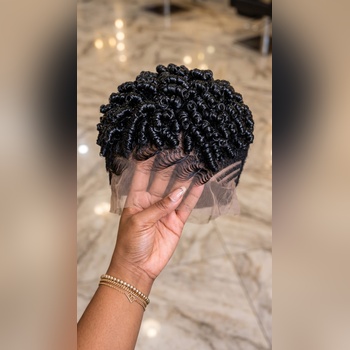
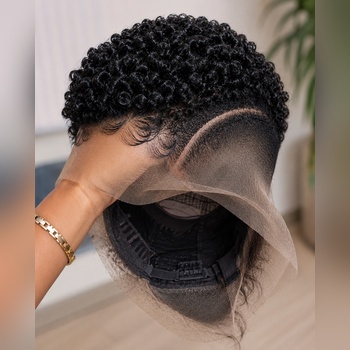
The crown consists of many closely positioned circular curls. Each loop has a visible center and a polished outer surface, producing a repeated ring pattern across the top. The curls are dense enough to create fullness, but they do not extend far away from the head. This keeps the silhouette compact and allows the side design to remain visible.
The black versions demonstrate how important shine is to this curl arrangement. Although the hair is very dark, reflected light travels around the curved strands and separates individual loops. The burgundy and copper versions make the pattern even easier to see because their warmer colors produce stronger highlights around the circular curls.
When commissioning this style, curl diameter should be discussed before production. Larger curls could create a looser and more open crown, while much smaller coils would change the overall character. Ask the stylist to preserve the compact circular loop structure shown in the reference rather than substituting a generic curly finish.
Triple Parallel Lines Create A Strong Side Signature
Three parallel lines are among the clearest identifying details in this particular collection. They sit beneath the crown and follow the side contour toward the back. The lines are narrow, evenly separated and positioned closely enough to read as one coordinated design rather than three unrelated marks.
This treatment is particularly visible on the top row because several mannequins face slightly sideways. The burgundy, copper-brown and caramel-highlighted variations show how the line pattern remains noticeable even when the crown color changes dramatically. This consistency is useful for anyone building a coordinated collection around one core design.
If you want this detail reproduced, send the stylist a three-quarter reference rather than relying exclusively on a front photograph. Specify that the three lines should remain parallel and should follow the head shape. Also confirm which side or sides of the wig will carry the design, since the photograph cannot establish every construction detail that may be hidden from view.
Broad Finger Waves Frame The Forehead And Temple
Another major element appears between the crown and side lines. Broad sections of hair sweep across the forehead and temple in curved, feather-like waves. These sections lie flatter than the ring curls, creating contrast between the raised crown and the sculpted perimeter.
The waves are especially prominent on the top-left black unit and the burgundy unit beside it. Several curved strands move together in the same direction before narrowing near the temple. A smaller downward curl then extends toward the ear area, giving the side profile additional movement.
This perimeter work should be included explicitly in a custom request. Ask for sculpted finger-wave sections around the front and temple rather than ordinary baby-hair styling. The visible waves in this reference are substantial parts of the hairstyle and contribute considerably to its overall appearance.
Deep Black Highlights The Architecture Of The Style
Deep black appears in several versions and puts the strongest emphasis on structure. Without contrasting highlights competing for attention, the circular crown, wave direction and triple-line side treatment become the main visual elements.
Salon lighting creates small reflective points around the ring curls, preventing the crown from appearing like one solid dark area. Customers who want a similarly dark result can compare natural black, raven black and very dark espresso options with their chosen seller. Shade terminology differs between suppliers, so an actual sample is more reliable than the color name alone.
A dark shade can also work well when the side pattern is a priority because the contrast between the hair and exposed line sections makes the design easy to recognize.
Burgundy Wine Creates A Rich Red Variation
The burgundy versions use a deep wine-red color across the crown while preserving darker shadows between the loops. Under stronger light, raised areas of the curls reveal brighter cherry-red reflections. In shaded areas, the color appears considerably deeper.
This variation is useful for customers who want red hair without moving into an extremely bright scarlet direction. Terms such as burgundy wine, deep cherry and dark red can help start a conversation with a stylist, but they should not be treated as universal shade codes.
Send the reference photograph and ask the seller to show the closest available color in natural daylight. Burgundy can change noticeably according to lighting, so comparing several photographs before ordering is worthwhile.
Copper Brown Brings Warmth To The Ring Pattern
The copper-brown variations introduce a warm reddish-brown direction that works naturally with the circular curl arrangement. The raised sections catch brighter copper reflections while recessed areas remain deeper brown. This creates visual depth without requiring several dramatically different colors.
A customer who wants this effect could ask to compare auburn brown, cinnamon copper and deeper copper-brown samples. If the desired result includes darker roots or darker side sections, that should be stated separately during the consultation.
The warmer shade also makes the ring structure highly visible in photographs. For wig businesses producing social media content, this can be useful because the curls remain readable even when the image is viewed on a smaller phone screen.
Caramel Highlights Increase Contrast Across Darker Curls
The upper-right mannequin provides one of the most dimensional color combinations in the display. A dark foundation is mixed with warm caramel or golden-brown pieces across the ring curls. The lighter strands outline individual loops while the darker foundation creates depth between them.
This is different from making the entire crown light brown. The contrast depends on preserving darker sections underneath and between the caramel pieces. If ordering a similar variation, tell the colorist whether you want occasional caramel accents or a stronger concentration of lighter strands.
A useful custom description could request a dark brown foundation with caramel-golden accents concentrated through the ring-curl crown. Ask to see previous highlighted work from the stylist before placing the order, particularly if precise color placement is important.
Pale Silver-Blonde Offers A Bright Alternative
The pale variation in the lower row creates the greatest contrast with the darker units. Its curls appear silver-blonde or very pale champagne under the available lighting. Darker shadowing between some curls helps the individual loops remain visible rather than blending into one light area.
Depending on the actual material and supplier, comparable shades might be sold as pearl silver, champagne blonde, icy beige or silver-blonde. The image alone cannot establish a standardized manufacturer color code, so buyers should use the photograph as the visual reference.
Light colors can be particularly effective when the goal is to emphasize curl separation. Shadows inside the loops remain visible while the outer strands reflect more light, making the circular pattern easy to identify.
The Three-Quarter Angle Reveals Details A Front Photo Can Hide
One advantage of this display is the variety of mannequin angles. Several units face partly to the side, revealing the transition from the crown into the tapered section. This makes it easier to understand how the triple lines sit below the curls and how the broad wave pattern travels around the temple.
When buying a custom wig online, request photographs from the front, left side, right side and crown before final approval whenever the seller offers progress photographs. A front image may look excellent while hiding differences in the side pattern or crown distribution.
If you are booking a local stylist, save both front and three-quarter reference images. During the consultation, point to the exact side elements you want reproduced. Visual references are especially helpful for designs involving several closely spaced lines.
Questions To Send Your Wig Stylist Before Paying
- Can you recreate compact circular ring curls across the entire crown?
- Can the crown remain rounded without becoming excessively high?
- Can you reproduce three parallel curved lines through the side section?
- Can the forehead and temple include broad sculpted finger waves?
- Which available color is closest to the reference mannequin I selected?
- Can darker roots or a darker foundation be retained with highlighted colors?
- What hair or fiber material will be used?
- Which measurements are required for the cap?
- Will the wig arrive with the ring curls already arranged?
- How should the curls be restored after repeated wear?
- What is the estimated custom production time?
- What alterations are available if the fit requires adjustment?
Premium Custom / Standard Custom / Basic Human Hair / Premium Synthetic / Basic Synthetic
No selling price is visible in the photograph, so the exact cost of these displayed units cannot be determined from the image. The ranges below are general budgeting examples rather than prices for the pictured wigs. Material, cap construction, coloring, labor, density and the amount of custom styling can substantially change the final quote.
| Category | General Planning Range | Typical Cost Considerations |
|---|---|---|
| Premium Custom | $350–$750+ | Individual sizing, advanced color work, detailed ring setting and extensive perimeter customization |
| Standard Custom | $220–$450 | Selected shade, crown shaping, side-line work and finger-wave styling |
| Basic Human Hair | $140–$300 | Hair grade, density, cap construction and additional styling labor |
| Premium Synthetic | $80–$180 | Higher-grade fiber, dimensional coloring and stronger preset curl retention |
| Basic Synthetic | $45–$100 | Stock shades, standard sizing and fewer customization options |
Ordering Online Starts With Choosing One Reference Version
Because this image contains eight variations, begin by identifying the exact mannequin closest to your desired result. Do not send the full collection without explaining which version you want. For example, you might prefer the curl structure of the top-left black unit but want the caramel-highlighted color seen on the upper-right mannequin.
Next, describe the non-color details separately: compact ring curls, rounded crown, close sides, triple parallel lines and sculpted front waves. This makes it clear that color is only one component of the order.
After the stylist confirms that the design can be reproduced, provide measurements according to their instructions. Ask for the total price, deposit requirement, expected production period, shipping terms and customization policy in writing before payment.
Booking A Local Salon For The Same Pixie Direction
If you already own a suitable wig, a local wig stylist or barber experienced with pixie work may be able to create a related appearance. Send the reference before booking so the stylist can evaluate whether your existing unit has the correct length, density and material.
Not every base wig will support the same result. A unit with insufficient density may not provide enough hair for a full ring-curl crown, while excessive length can require additional cutting and shaping. The stylist should inspect the wig before promising an exact transformation.
If you have not purchased the base unit yet, consulting the stylist first can prevent unnecessary expense. Ask what length, density and material they prefer for this type of crown setting.
Protecting The Ring Pattern During Storage
The individual loops are central to the appearance, so storage should prevent the crown from being crushed. Place the unit on an appropriate wig stand or mannequin head and keep heavy objects away from the curls. When transporting it, provide enough space around the crown to protect the circular arrangement.
Avoid brushing directly through the loops unless the stylist specifically instructs you to reset the hairstyle. Brushing can separate the rings and alter the compact crown. Maintenance should instead follow the recommendations provided for the exact hair or fiber material.
Heat should also be approached carefully. Human hair and synthetic fibers do not necessarily tolerate the same temperatures. Confirm the safe styling range before using heated tools to restore any curl.
Why The Side Design Matters For A Wig Business Listing
A seller offering this style should include side photographs rather than presenting only front-facing product shots. The triple lines and temple waves are significant parts of the design and may be among the main reasons a customer chooses the wig.
Product listings can show a direct front view, a three-quarter view, a full side view and a crown view. If several colors are available, keeping the camera angles consistent makes comparison easier. Customers can then evaluate color without wondering whether the underlying hairstyle has changed.
It is also useful to state which aspects are customizable. If customers can choose crown color, highlight placement or side-line configuration, those options should be explained clearly before checkout or booking.
Search Terms
Triple Side Line Pixie Wig · Ring Curl Pixie Wig · Burgundy Finger Wave Wig · Copper Brown Curl Pixie · Caramel Highlight Pixie Wig · Silver Blonde Ring Curl Wig · Sculpted Side Pixie Wig · Curved Line Curl Wig
Building A Custom Version Without Losing The Original Silhouette
The strongest approach to customization is to change selected details while preserving the proportions that make the hairstyle recognizable. The compact crown should remain filled with circular loops, the sides should remain close enough for the line work to show, and the front waves should continue to connect the crown with the temple area.
Color can then provide personalization. Deep black gives maximum emphasis to the styling itself. Burgundy introduces rich wine-red depth. Copper brown brings warmth, caramel accents increase dimensional contrast, and pale silver-blonde creates a brighter alternative. Each option changes the personality of the wig without requiring a different crown structure.
Before finalizing an order, confirm the curl diameter, crown height, side-line count, wave direction, chosen shade, highlight placement, cap measurements and maintenance method. Ask for photographs of comparable work from the stylist and clarify which details can realistically be reproduced with the selected material. With those decisions made before production begins, the reference becomes much more useful than a generic request for a curly pixie and gives both buyer and stylist a clear visual target for the finished unit.