
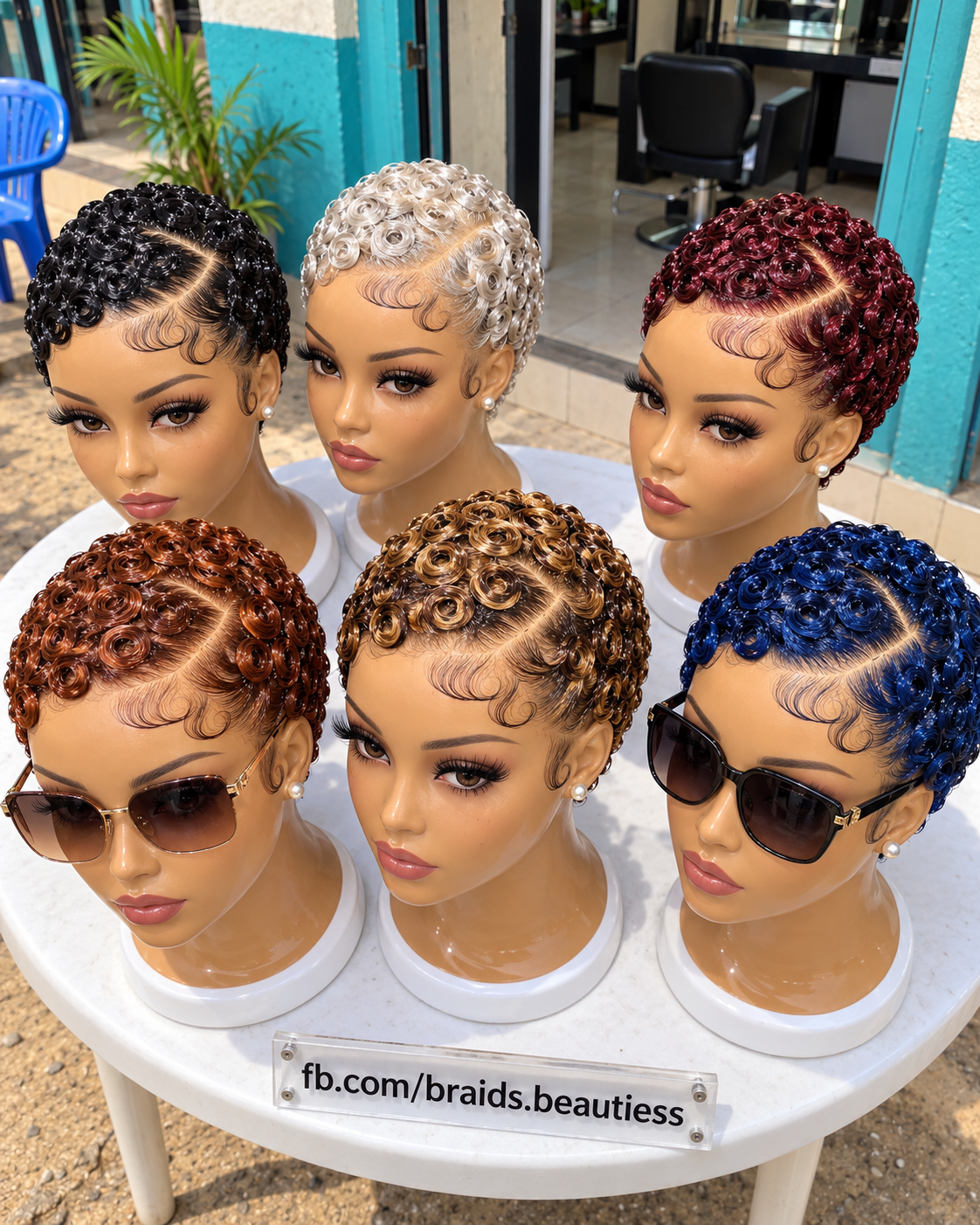
A beautiful pixie wig does not need long hair to make a memorable impression. Sometimes, the most appealing hairstyles are built from carefully arranged circular curls, a graceful diagonal parting, and delicate finger waves that follow the forehead. This collection presents six compact pixie wigs in glossy black, pearl white, wine burgundy, copper brown, golden caramel, and royal blue, offering a colorful interpretation of the same elegant styling concept.
Displayed on six female mannequin heads outside a neighborhood hair salon, the wigs are arranged in two rows of three on a round white table. The outdoor daylight makes their colors particularly noticeable, while the close positioning allows customers to compare the size of the ringlets, the direction of the front waves, and the arrangement of the upper curls.
The photograph shows a coordinated collection rather than six completely different haircuts. All six wigs have a compact silhouette, closely arranged circular coils, a visible diagonal parting, and sweeping finger-wave sections near the forehead and temples. However, the exact position of individual curls and the prominence of the hairline waves vary slightly between the displayed units.


For customers researching pixie wigs, this kind of presentation offers valuable inspiration. It makes it easier to decide whether a darker shade, a warm copper color, a bright pearl white, or a bold blue version best matches the desired appearance. It also highlights an important purchasing consideration: the color alone does not determine the final result. Curl construction, hairline placement, cap sizing, and professional styling can be equally important.
Understanding the Six-Wig Display
The collection contains six mannequin heads positioned in two clearly visible rows. Three wigs appear at the back and three at the front, creating a simple arrangement that makes their differences easy to identify.
The back row includes a glossy black wig on the left, a pearl white wig in the middle, and a deep burgundy wig on the right. The front row contains a warm copper-brown wig on the left, a golden caramel version in the middle, and a vivid royal blue wig on the right.
Each mannequin has a realistic female face with carefully applied makeup, long eyelashes, shaped eyebrows, and glossy lips. Several wear pearl-style earrings, while the front-left copper mannequin and front-right blue mannequin also wear sunglasses. These accessories enhance the display but should not be confused with parts of the wigs themselves.
The hairstyles remain compact, with the circular curls arranged close to the upper head rather than extending into long hanging strands. Their front sections are carefully shaped, with fine strands directed into curved waves that follow the forehead.
The diagonal parting is especially important. It creates a visible division through the upper front, helping separate the raised curls from the flatter hairline styling.
The Black Pixie Wig Offers a Classic Dark Finish
The back-left mannequin wears a glossy black pixie wig filled with compact circular curls. The hair appears deep black, with reflective highlights following the curved surfaces of the individual ringlets.
Several curls near the upper front form recognizable circular openings, while smaller coils occupy the surrounding areas. The arrangement gives the crown a rounded appearance without excessive height.
A diagonal parting travels through the front section, creating a pale division between the raised curls and the sweeping hairline waves.
The front strands follow delicate curved paths across the forehead. One section near the visible temple forms a decorative loop, adding movement beneath the upper curls.
The black shade emphasizes the craftsmanship of the hairstyle because there are no obvious contrasting colors competing for attention. The individual ringlets become visible through their reflective surfaces and carefully separated openings.
Customers who prefer a dark, polished pixie may find this version especially appealing. However, a generic black curly wig may not include the same diagonal parting or decorative forehead waves.
When requesting a similar unit, describe it as a glossy black spiral-coil pixie with a side part and sculpted finger waves.
Pearl White Ringlets Create a Bright Contrast
The back-center mannequin wears the lightest wig in the collection. Its curls appear pearl white with soft silver-ivory reflections, producing a bright appearance under natural daylight.
The circular curls are closely arranged across the upper section. Some form relatively open rings, while others appear smaller and more tightly gathered. Their pale surfaces make the individual curl shapes particularly easy to distinguish.
A diagonal parting remains visible through the upper front, where the light hair separates into different styling directions.
Along the forehead, fine white strands are arranged into sweeping finger waves. The wave closest to the temple forms a rounded decorative curve that sits below the raised curls.
This version has a softer color impression than the black or burgundy wigs, but its styling remains equally elaborate.
Pearl White Versus Platinum Blonde
Customers should distinguish pearl white from platinum blonde, icy silver, and pale champagne. These shades can appear similar in photographs but may differ considerably when viewed in person.
The photographed wig appears closest to a creamy pearl white with subtle cool reflections. It does not show a strong yellow-golden tone.
Before ordering, ask the seller for a daylight photograph of the actual available wig. This helps establish whether the shade is white, silver-white, or pale platinum.
The image does not establish whether the hair is human hair, synthetic fiber, or a blend. It also cannot reveal whether any chemical lightening was used to achieve the pale color.
These details should be confirmed before selecting a maintenance routine or requesting additional coloring.
Wine Burgundy Adds Rich Red Depth
The back-right mannequin wears a deep wine-burgundy pixie with compact spiral curls arranged across the upper head. The color contains reddish-purple reflections and darker maroon areas, creating a rich appearance in daylight.
The upper curls form numerous circular openings, with several prominent ringlets near the diagonal parting. Smaller curls fill the surrounding sections, maintaining a rounded silhouette.
The front hairline contains fine burgundy strands arranged into sweeping waves. These curves follow the forehead and lead toward the visible temple, where a small decorative curl sits near the side.
The darker recessed areas make the brighter burgundy surfaces more noticeable. This gives the curls depth without requiring a second contrasting color.
For buyers who want a noticeable shade but prefer something deeper than bright red, wine burgundy offers an appealing alternative.
Confirming the Burgundy Shade
Burgundy can describe several different colors, including dark cherry, wine red, reddish purple, and mahogany. The photographed wig appears closest to a deep wine-burgundy shade with red reflections.
A seller advertising bright cherry red may offer a noticeably different product. Request an actual color photograph before purchasing, particularly when ordering online.
If commissioning a custom version, confirm whether the front waves and upper curls will share the same color. A significantly darker or lighter hairline could change the intended appearance.
Customers should also ask whether the product color is expected to require special care, depending on the confirmed fiber and any coloring processes used.
Copper Brown Curls Bring Warmth to the Collection
The front-left mannequin wears a rich copper-brown pixie with warm auburn and reddish-orange reflections. Its shade is noticeably warmer than the burgundy version behind it.
The upper section contains numerous compact ringlets arranged in a rounded formation. Several curls form clear circular openings, while smaller loops gather near the front and side.
The diagonal parting provides a distinct separation through the upper hair. Beneath it, the front strands form carefully arranged finger waves that sweep toward the temple.
The copper color emphasizes the curved surfaces of the ringlets. Bright reflections follow the outer edges, while darker auburn areas remain visible between the curls.
The mannequin wears large sunglasses with gold-colored detailing, but the hairstyle itself remains visible across the upper head and hairline.
This version may appeal to customers who want a warm, noticeable color without choosing pale blonde or bright red.
Copper Brown or Auburn?
The photographed color falls between copper and auburn. It contains clear orange-red warmth but retains a noticeable brown influence.
A purely orange copper wig may appear brighter than the reference, while a dark auburn product could look considerably more subdued.
When ordering, describe the desired shade as warm copper brown with auburn reflections.
Ask for photographs in ordinary daylight, since strong artificial lighting can exaggerate the orange or golden appearance of warm hair colors.
The diagonal parting and decorative forehead waves should also be included in the order request. Matching the color without matching the styling will produce a different result.
Golden Caramel Offers a Softer Warm Alternative
The front-center mannequin wears a golden caramel wig with honey-brown reflections. Its color is lighter and more golden than the copper-brown version, with less pronounced red influence.
The circular curls appear densely arranged across the crown. Several prominent ringlets sit near the front, while smaller loops continue toward the sides and upper rear.
The diagonal parting creates a visible channel through the upper styling, separating curls that travel in different directions.
The front waves have a polished appearance, with narrow strands following graceful curves along the forehead.
This color makes the ringlet openings particularly noticeable because bright golden strands contrast with darker areas within the curls.
Customers seeking a warm blonde-brown appearance may prefer this version over the pearl white or copper alternatives.
Choosing Between Honey Blonde and Golden Caramel
Honey blonde generally suggests a lighter golden shade, while caramel often contains more brown. The photographed wig appears to combine both influences.
Its color is golden and warm, with deeper brown areas visible between the curls.
For a custom order, describe the desired appearance as golden caramel with honey-brown reflections and a compact circular-coil arrangement.
Request a daylight photograph of the proposed shade. This is especially important when purchasing from suppliers that use different commercial color names for similar tones.
The maker should also confirm that the front finger waves can be reproduced in the same general shade as the raised curls.
Royal Blue Gives the Pixie a Bold Fashion Look
The front-right mannequin wears the most dramatic color in the collection: a vivid royal blue pixie with darker navy reflections.
The circular curls appear densely arranged across the upper head, with several prominent spiral openings near the diagonal parting.
The deep blue strands reflect daylight along their curved surfaces, creating brighter blue bands against the darker recessed sections.
The front finger waves follow the forehead in closely arranged curves. A small decorative curl sits near the temple, complementing the raised spirals above.
The mannequin wears dark sunglasses, giving the display a fashionable appearance, but the wig’s main attraction remains its rich blue color and carefully arranged curls.
This version is suited to buyers who enjoy expressive fashion colors rather than conventional black, brown, or blonde hairstyles.
Royal blue generally appears brighter and more saturated than navy. The photographed wig contains a strong royal blue appearance, although some shadowed sections look much darker.
Customers should confirm the actual shade before purchasing. A navy wig may appear almost black in certain lighting, while a brighter electric blue product could be considerably more vivid than the reference.
If the unit is human hair, ask about the color-processing history and the recommended maintenance method. If synthetic, follow the manufacturer’s instructions regarding washing, heat, and color alterations.
The photograph alone does not establish the fiber or coloring method.
Why the Circular Finger Curls Matter More Than Length
All six wigs demonstrate a compact style built around carefully arranged circular curls. The hair remains relatively close to the head, but the raised ringlets provide noticeable decorative volume.
Several curls form nearly complete circles, with open centers that reveal darker recessed areas. Others overlap to create a dense, rounded surface.
The variation in curl diameter is important. Larger ringlets provide recognizable circular shapes, while smaller coils fill the spaces between them.
A wig containing uniformly tiny curls may look significantly different, even if its overall length and color are similar.
Customers requesting this style should therefore describe the desired curl arrangement rather than relying exclusively on the term curly pixie.
A professional wig maker should understand the approximate size of the circular openings, their concentration across the crown, and the intended relationship between the upper curls and front hairline.
The Diagonal Parting Creates the Collection’s Signature Structure
Each wig contains a diagonal parting that guides the direction of the surrounding hair. The parting appears as a lighter channel between the raised coils and the flatter front styling.
On one side, the hair rises into circular curls. On the other, the strands follow controlled curves that lead toward the forehead.
This arrangement gives the hairstyles an asymmetrical appearance without relying on dramatic changes in length.
The exact parting angle varies slightly between the displayed wigs. Customers who want a close reproduction should identify the preferred mannequin and specify the parting direction from the wearer’s perspective.
A reversed parting may still create an attractive hairstyle, but it will not necessarily match the selected reference.
When placing a custom order, request a frontal photograph of the finished unit to confirm the parting orientation before shipping.
Finger Waves Complete the Forehead Styling
The front waves are another important element shared by the six wigs. These sections contain fine strands arranged into sweeping curves that lie closer to the forehead than the raised circular curls.
The waves create an elegant transition between the upper hairstyle and the face. Several mannequins also display small decorative curls near the temples.
These details should not be confused with ordinary loose baby hairs. The strands are arranged into deliberate wave patterns that contribute to the overall hairstyle.
A buyer requesting only circular curls may receive a wig without the elaborate forehead styling. For a closer match, specify both finger curls and sculpted finger waves.
The hairline arrangement may require professional attention during installation, especially if the wig contains lace that must be trimmed or fitted.
What Buyers Should Know About the Mannequin Presentation
The six wigs are displayed on realistic female mannequin heads. Their outer styling is clearly visible, but the photograph does not reveal the complete interiors.
It is therefore impossible to determine whether the wigs contain human hair, synthetic fibers, or blends solely from the image.
The visible hairlines do not establish the use of HD lace, full lace construction, or a particular attachment system.
Before purchasing, request photographs of the actual available unit, including the complete underside, front hairline, side sections, and rear.
Ask the seller to confirm the cap size, lace specifications if applicable, and any included adjustment straps, combs, or clips.
Cap measurements are especially important for hairstyles with decorative front waves. A poorly fitted wig can shift the finger-wave arrangement away from its intended position.
Where To Buy These Finger Curl Pixie Wigs
Similar hairstyles may be available through local wig boutiques, online wig retailers, custom wig makers, and professional salons specializing in sculpted pixie styling.
The most reliable shopping approach begins by identifying the exact color and hairstyle from the display.
For example, someone interested in the pearl white version should send a cropped photograph of the back-center mannequin. A customer who prefers royal blue should identify the front-right wig.
This helps prevent confusion when a seller offers several wigs with similar circular curls.
Useful search phrases include finger curl pixie wig, spiral coil pixie hairstyle, sculpted finger wave wig, and side-part curly pixie unit.
Ask whether the selected color is available as a ready-made product or requires custom production.
The photograph contains a page address on a plaque attached to the table. However, that visible address should not be treated as verified evidence of a particular seller, available inventory, or current pricing.
No confirmed product listing or live stock information can be established from the image alone.
Questions to Ask Before Placing an Order
Begin by confirming the actual hair material and available cap sizes. Then ask whether the decorative front waves are included in the finished product or require additional salon styling.
Request photographs of the actual unit rather than relying entirely on promotional images.
Confirm the parting direction, curl diameter, and color under natural daylight.
If the wig is custom-made, ask whether approval photographs will be provided before shipping.
Finally, clarify whether the quoted amount includes customization, installation, lace preparation, delivery, and future restyling.
Ready-Made Wigs or Custom Finger-Coil Styling?
Ready-made wigs can be convenient for customers who want a similar general appearance without requiring individual production.
However, the circular curls and front waves may differ from the photographed reference. Some ready-made units contain looser curls or simpler hairlines.
Custom production provides more control over curl placement, parting direction, and decorative forehead styling.
For customers who want a particularly close reproduction, working with a wig maker experienced in sculpted coils may be worthwhile.
The maker should evaluate the chosen hair material and cap construction before committing to extensive styling alterations.
Not every synthetic wig can be safely reshaped with heat, and not every cap is suitable for major hairline customization.
Illustrative Prices for Spiral Curl Pixie Wigs
Pricing depends on the material, cap construction, styling complexity, color preparation, and the supplier’s market.
The following USD figures are illustrative planning ranges rather than verified live prices or quotations for the six displayed wigs.
| Wig Category | Illustrative USD Range | Possible Purchase Scope |
|---|---|---|
| Premium Custom | $290–$710+ | Individual measurements, detailed circular curl styling, customized finger waves, and selected color preparation. |
| Standard Custom | $150–$345 | Custom compact pixie styling with a diagonal parting and professionally arranged spiral curls. |
| Basic Human Hair | $95–$240 | A human-hair pixie base that may require additional curl formation, coloring, and front-wave styling. |
| Premium Synthetic | $65–$175 | Higher-priced synthetic options with prearranged ringlets and possible finger-wave styling, subject to specifications. |
| Basic Synthetic | $25–$90 | Budget curly pixie alternatives that may resemble the general silhouette without reproducing every sculpted curl. |
The final cost may differ according to color. Pearl white, royal blue, and burgundy versions may involve different production requirements from a basic black unit, depending on the material and coloring method.
The labor required to arrange individual circular curls can also influence the quotation. Detailed finger waves may involve additional styling time.
Customers should compare complete quotes that include the wig, installation, customization, shipping, and necessary adjustments.
The photograph does not establish the actual material category of any displayed unit.
Booking a Stylist for Finger Waves and Circular Coils
A salon experienced with ordinary curly wigs may not necessarily specialize in precise circular coil styling or decorative finger waves.
Look for professionals offering sculpted pixie styling, finger coils, finger-wave hairlines, and custom wig installation.
When booking, send the selected mannequin image and explain the desired color, parting direction, and curl arrangement.
If the wig contains lace, the installer should establish the correct cap fit before trimming any material.
The decorative forehead waves should remain aligned with the wearer’s natural hairline and temples.
Any restyling should use methods appropriate for the actual fiber. The photograph alone does not establish whether heated tools are suitable.
Maintaining the Circular Curl Arrangement
The spiral curls are the main maintenance consideration across all six versions. Their appearance depends on preserving the individual circular openings rather than allowing the strands to merge into an irregular mass.
Aggressive brushing may disturb the arrangement, particularly if the curls have been carefully set into sculpted shapes.
Before washing, confirm the hair material and obtain the manufacturer’s or wig maker’s instructions.
If the unit is human hair, the curls may require resetting after washing. If the hair has been chemically colored, its processing history may influence the recommended products.
If the unit is synthetic, heat compatibility must be verified before using heated styling tools.
Excessive heavy products can collect between the compact ringlets, reducing strand separation and making the hairstyle appear less distinct.
Handle the wig by supporting the cap rather than pulling on individual curls.
Keeping the Front Finger Waves Intact
The finger-wave sections require careful handling because they are formed from fine strands following controlled curved paths.
Repeated rubbing, aggressive combing, or excessive manipulation may disturb their arrangement.
If the waves lose their shape, consult a professional familiar with finger-wave styling rather than attempting uncontrolled corrections.
For storage, use a suitable wig stand that supports the cap without compressing the upper curls or rubbing against the decorative hairline.
If several wigs are stored together, allow enough space between them to prevent the circular ringlets from being crushed.
Choosing the Best Color for Your Preferred Look
The black version emphasizes the hairstyle’s glossy construction and decorative waves. Pearl white makes the circular curls highly visible, while wine burgundy offers rich red depth.
Copper brown introduces warm auburn reflections, golden caramel provides a softer golden appearance, and royal blue creates a bold fashion statement.
The right choice depends on personal preference, maintenance expectations, and the availability of a well-made wig in the desired color.
However, color should not be the only deciding factor. The quality of the curl arrangement, the diagonal parting, the finger-wave placement, and the cap fit will strongly influence the finished appearance.
Customers should identify the preferred mannequin, request photographs of the actual product, and confirm construction details before purchasing.
This six-wig display demonstrates how compact circular curls and carefully arranged finger waves can create a variety of distinctive pixie hairstyles. Whether the preference is glossy black, pearl white, burgundy, copper, golden caramel, or royal blue, the essential appeal remains the same: beautifully shaped ringlets combined with an elegant, sweeping hairline.
Search Terms
Six spiral curl pixie wigs · Black finger wave pixie hairstyle · Pearl white circular coil wig · Burgundy side part spiral pixie · Copper brown sculpted finger curls · Golden caramel finger wave wig · Royal blue circular curl pixie · Colorful pixie wigs with diagonal parting