
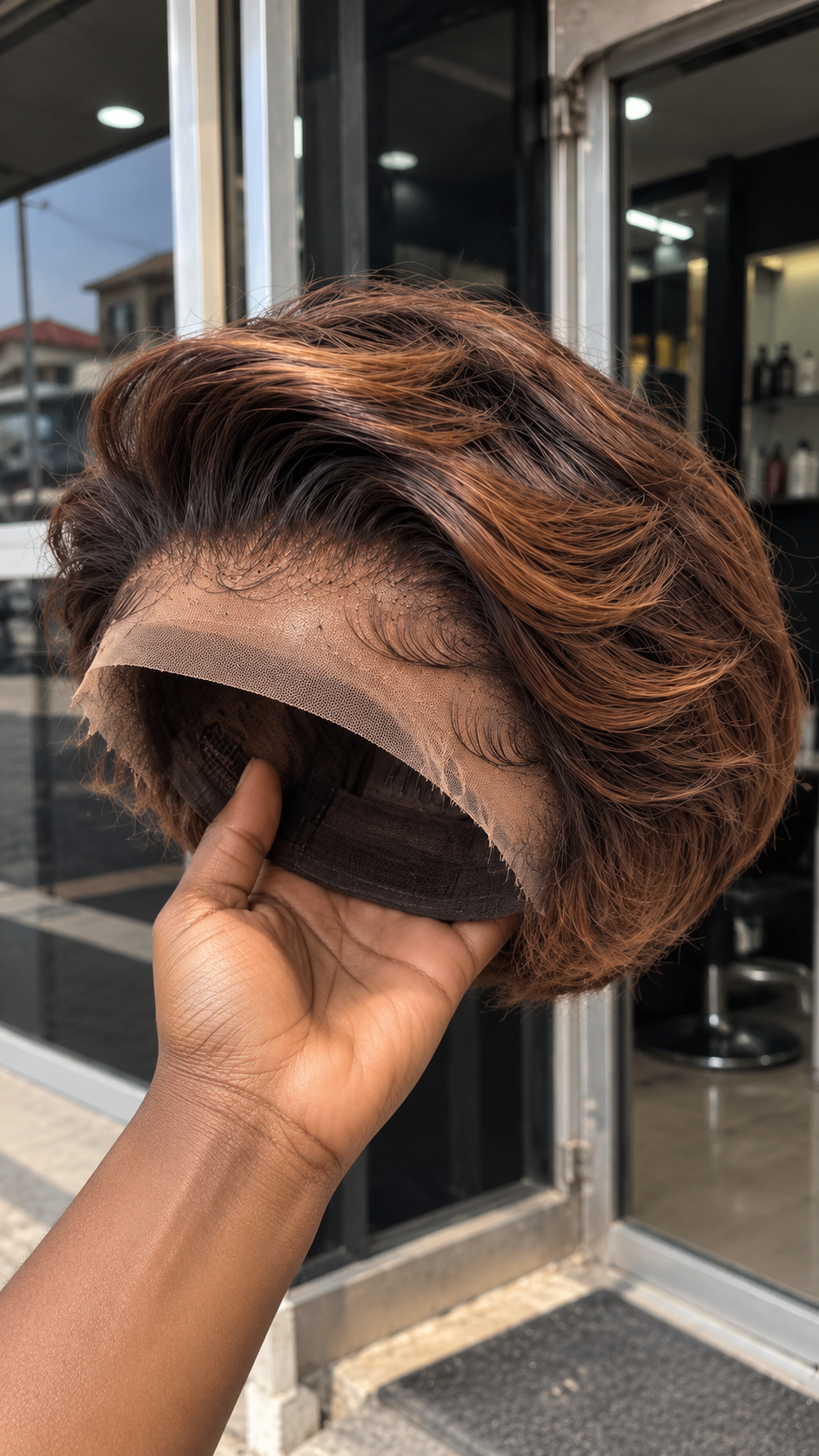
Not every pixie wig needs carefully arranged finger coils, elaborate side markings, or tightly packed curls to make an impression. Sometimes the appeal comes from natural-looking movement, warm color, and layers that fall into place without appearing rigid. This chestnut brown pixie wig offers a beautiful example, combining a softly lifted front with flowing, side-swept layers and a rounded silhouette that feels relaxed yet thoughtfully styled.
The photograph shows a single wig held in one hand outside a hair salon. Its warm chestnut-brown strands are arranged in loose, overlapping layers, with darker brown areas near the front and beneath the upper hair. The hairstyle rises gently from the forehead before sweeping backward and toward the visible side. Unlike the closely sculpted ringlet wigs often associated with decorative pixie styling, this piece has a softer, feathered appearance and considerably more natural-looking separation between the strands.
A broad section of untrimmed tan lace extends across the front hairline, while a dark brown cap is visible through the opening. The photograph therefore shows the wig before installation rather than presenting it as a finished hairstyle on a wearer. These details are important for shoppers because the final appearance will depend on the fitting, lace preparation, and any adjustments made by a professional stylist.


For women interested in a brown layered pixie wig, this design offers a versatile alternative to highly structured curls. Its appeal lies in the combination of color depth, gentle volume, a lifted front, and softly flowing ends. Recreating that balance requires attention to the direction and length of the layers rather than simply choosing any brown wig with a pixie cut.
The Warm Chestnut Color Makes the Layers Stand Out
The most immediately noticeable characteristic is the warm brown color. The hair appears predominantly chestnut brown, with copper-brown and caramel-like reflections visible where daylight strikes the upper strands.
The color is not completely flat. Some areas near the base of the front styling appear darker, approaching a deep chocolate brown, while the longer outer strands display brighter chestnut reflections. This creates visual depth and helps separate the overlapping layers.
However, the photograph does not establish a specific root-color formula or confirm that the lighter sections were created through highlights. The difference in brightness may come from the original fiber colors, lighting, and the direction of the strands.
The overall result is a warm medium-brown appearance rather than a bright copper-orange or pale blonde shade.
Choosing the Right Brown Shade
Brown wigs can vary considerably depending on their undertones. Chocolate brown typically creates a deeper appearance, while chestnut often introduces warmer reddish or golden reflections.
The photographed wig leans toward warm chestnut, with slightly darker areas beneath the outer layers.
When purchasing, request a photograph under indirect natural daylight. Salon lighting and camera processing can make warm brown hair appear more orange or golden than it does in everyday conditions.
For a custom order, ask the seller to compare the chosen color with the reference image. A physical swatch can provide a more reliable indication than a commercial color name alone.
If the chosen material is synthetic, confirm that the desired shade is available from the manufacturer. If human hair is proposed, discuss any coloring requirements and whether the hair has already undergone chemical processing.
The Lifted Front Creates a Beautiful Silhouette
The hairstyle begins with a gently elevated front section. Rather than falling directly across the forehead as a heavy fringe, the hair rises from the visible hairline and curves backward into the upper layers.
This creates a softly rounded front profile with noticeable height but without the sharply sculpted appearance of a formal pompadour.
Several strands curve over the upper front, while others travel diagonally toward the visible side. Their overlapping arrangement creates movement and prevents the hairstyle from appearing completely uniform.
The lifted front is important because it determines how the pixie frames the face after installation. A wig with a flat fringe or forward-falling bangs would create a different appearance even if the color and overall length were similar.
For custom styling, ask for a gently lifted front with loose, backward-flowing layers rather than tightly curled sections or sharply separated waves.
Why Excessive Volume Would Change the Hairstyle
The photographed pixie has a rounded silhouette, but its fullness remains controlled. The strands are layered over one another, creating volume through their direction rather than through excessive teasing.
Increasing the crown height too much could make the wig look oversized or bulky. Flattening the front would remove the soft lift that gives the hairstyle its character.
A stylist should aim for a balance between the raised front and the rounded side.
Before approving a custom wig, request photographs from the front and side. The current image provides a useful three-quarter perspective, but it does not reveal the complete opposite side or rear construction.
Feathered Layers Give the Wig Its Movement
The hair is arranged into numerous overlapping layers with softly separated ends. These strands create a flowing appearance that differs noticeably from tightly arranged pin curls or small circular spirals.
The upper layers sweep backward and toward the visible side, while shorter-looking strands beneath them help support the rounded shape.
Several sections contain gentle bends rather than complete curls. Their ends appear lightly separated, giving the hairstyle an airy, feathered quality.
This arrangement creates movement without requiring long hair. The pixie remains compact, with the longer upper strands contributing to the overall shape.
The visible side contains numerous overlapping sections, but the hair does not form distinct circular rings. Its appearance is better described as layered and softly waved.
The Difference Between Feathered Layers and Sculpted Curls
Feathered styling emphasizes separation between the ends and a natural-looking progression between shorter and longer sections.
Sculpted curl styling, by contrast, often relies on deliberately arranged circular loops or highly controlled waves.
The photographed wig belongs more closely to the feathered category. Its strands bend and overlap, but they are not arranged into a collection of individually recognizable rings.
For an accurate reproduction, avoid requesting finger coils or barrel curls unless the goal is to change the hairstyle.
Instead, describe the desired result as a layered chestnut pixie with a lifted front, flowing side movement, and softly separated ends.
The Rounded Side Maintains a Compact Shape
The visible side has a relatively full appearance, with layers flowing downward and backward from the crown. The strands overlap closely enough to create a rounded silhouette while retaining visible separation between individual sections.
The lower side appears shorter and less elevated than the upper hair, although the photograph does not reveal the precise cutting pattern beneath the surface.
There are no clearly visible shaved decorative lines, geometric side partings, or closely carved temple designs.
This distinction matters when shopping because many pixie wigs use dramatic side detailing. The photographed style instead relies on layered movement and a cohesive brown color.
For women who prefer a softer appearance, the absence of razor-style accents may be appealing. It allows the attention to remain on the front lift, warm color, and natural-looking flow of the layers.
A rear photograph would be useful for confirming how the hairstyle continues toward the nape, particularly if a buyer wants the back to be closely tapered.
The Front Hairline Needs Careful Attention
The visible hairline contains fine strands arranged beneath the lifted front section. Several shorter hairs follow the forehead contour, while the longer layers rise above them.
The transition is relatively subtle compared with wigs that use elaborate finger-wave baby hairs.
This makes the placement of the lace particularly important. The lifted front should begin at an appropriate position on the wearer’s forehead without exposing an unnatural-looking boundary.
The photograph does not establish whether the hairline has been pre-plucked or customized using a specific technique.
For a custom order, ask the seller for a close-up of the front hairline in neutral lighting. The final result should be assessed after fitting rather than assumed from the hand-held photograph.
What the Untrimmed Lace Reveals
A broad section of tan lace extends beyond the front of the wig. The mesh is clearly untrimmed, indicating that the piece is being displayed before final installation preparation.
The lace appears relatively wide across the forehead area, providing material for a stylist to evaluate during fitting.
However, the photograph does not establish the exact lace dimensions, thickness, transparency, or grade. The presence of lace does not confirm HD lace.
The mesh color may look different against an individual’s skin than it does in the photograph.
Before installation, the stylist should position the wig correctly and assess the hairline. Only then should any necessary lace trimming take place.
Removing too much lace can compromise the front edge and may be impossible to reverse.
The Interior Cap Is Partially Visible
The wig is held with its opening facing the camera, revealing a dark brown interior cap beneath the tan lace.
Several fabric sections and stitched areas are visible, but the photograph does not show the complete underside.
The number of attachment combs, adjustable straps, or other fastening components cannot be confirmed from this view.
The visible cap also does not establish that the wig can be worn without adhesive.
Before purchasing, ask for the cap circumference, front-to-nape length, and ear-to-ear measurements. Request an underside photograph that shows the full construction and any attachment hardware.
The seller should also confirm the fiber composition and provide suitable washing and styling instructions.
Where to Buy a Similar Chestnut Pixie Wig
Women searching for a similar hairstyle can begin with online wig retailers, local beauty supply stores, and custom wig makers specializing in layered pixie cuts.
However, not every brown pixie wig will reproduce the soft movement visible in the photograph.
Some products may have straight fringes, tightly curled crowns, or dramatic side partings. Others may be much shorter or fuller than the reference.
When comparing listings, focus on the lifted front, the direction of the layers, and the rounded side profile.
A ready-made wig may be suitable if these characteristics are already present. A custom wig maker may offer greater control over the layering, crown height, and hairline position.
Before payment, request photographs of the actual product from multiple angles. Confirm the fiber composition, cap size, color availability, shipping arrangements, and return conditions.
How to Order This Style
When contacting a wig seller, describe the hairstyle as a warm chestnut-brown layered pixie with a softly lifted front and feathered side-swept strands.
Share the reference photograph rather than relying exclusively on a general haircut name.
Explain that the desired wig should not have tightly arranged finger coils or sharply carved side lines.
Ask whether the supplier can provide the style fully finished or whether additional salon work will be necessary after delivery.
If custom construction is required, discuss the preferred layer length, front height, side fullness, and rear shape before paying a deposit.
Request a neutral-light photograph before shipping to confirm the chestnut shade and overall silhouette.
Choosing a Stylist for the Final Fit
A professional experienced in layered pixie wig styling and lace-front preparation is a suitable choice for this design.
The stylist should understand how to preserve the softly lifted front while allowing the surrounding layers to fall naturally.
During consultation, discuss the cap fit and the intended placement of the hairline.
If the wig arrives with untrimmed lace, it should be positioned on the wearer before any trimming begins.
The stylist can then assess whether minor adjustments are necessary to the front lift or side layers.
Any cutting should be conservative. Removing too much length from the feathered sections can change the balance and may be difficult to correct.
The final attachment method should depend on the actual cap construction and the wearer’s comfort.
Illustrative Price Guide for Chestnut Brown Pixie Wigs
The cost of recreating this hairstyle may depend on the selected fiber, cap construction, color, layering, and installation requirements.
The following USD ranges are illustrative planning estimates rather than verified live retail prices or quotations for the photographed wig.
| Wig Category | Illustrative USD Range | Potential Cost Considerations |
|---|---|---|
| Premium Custom | $300–$800+ | Individual cap measurements, specialist layered cutting, chestnut color matching, and detailed lace preparation. |
| Standard Custom | $150–$375 | Selected cap options, customized layering, and adjustments to the front lift and side shape. |
| Basic Human Hair | $85–$250 | Human-hair base unit that may require separate cutting, color adjustments, and installation preparation. |
| Premium Synthetic | $55–$165 | Higher-grade synthetic alternatives with prearranged layers and material-dependent styling flexibility. |
| Basic Synthetic | $20–$75 | Budget alternatives that may differ in layer quality, color accuracy, and cap construction. |
The photograph does not establish whether the pictured wig is human hair or synthetic. These categories represent possible purchasing alternatives rather than confirmed specifications.
Custom layering may affect the cost because the stylist must create the intended movement and maintain the correct balance between the front and sides.
Color matching may also require additional work if the desired chestnut shade is not available in the chosen base material.
Ask whether the quotation includes the wig, styling, lace preparation, fitting, shipping, and installation.
Maintaining Soft Layers and Natural Movement
The primary maintenance concern for this hairstyle is preserving the direction and separation of the layers.
Unlike tightly arranged circular curls, the feathered strands may tolerate gentle repositioning, but the correct method depends on the actual fiber composition and styling technique.
Avoid applying heavy products without checking the supplier’s recommendations. Excess buildup can cause the layers to clump together and reduce their airy appearance.
Synthetic hair should not be exposed to heated tools unless the manufacturer specifically permits them. Human hair may allow different styling methods, but previous coloring and the hair’s condition should be considered.
The lifted front may require occasional professional adjustment if its shape changes after cleaning or extended wear.
When storing the wig, use a suitable support that maintains the rounded silhouette without compressing the front section.
If the layers become difficult to manage, a professional stylist can assess whether gentle reshaping is appropriate.
A Beautiful Alternative to Highly Sculpted Pixie Styles
This chestnut brown wig demonstrates that a pixie can be distinctive without circular ringlets, geometric side channels, or elaborate finger waves.
Its defining characteristics are the warm chestnut color, softly lifted front, overlapping feathered layers, and rounded side-swept silhouette.
The visible tan lace and dark interior cap provide useful information about its preparation stage, although complete specifications still require confirmation.
Before purchasing, compare the actual layer arrangement, color depth, and front volume of available products.
With careful selection and professional fitting, a similar wig can offer a relaxed, flattering pixie appearance that emphasizes movement and warm color rather than highly structured curl styling.
Search Terms
Chestnut brown layered pixie wig · Warm brown side swept hairpiece · Feathered pixie with lifted front · Caramel brown layered lace wig · Soft flowing chestnut pixie cut · Untrimmed tan lace brown wig · Rounded side swept pixie hairstyle · Dark root chestnut feathered wig