
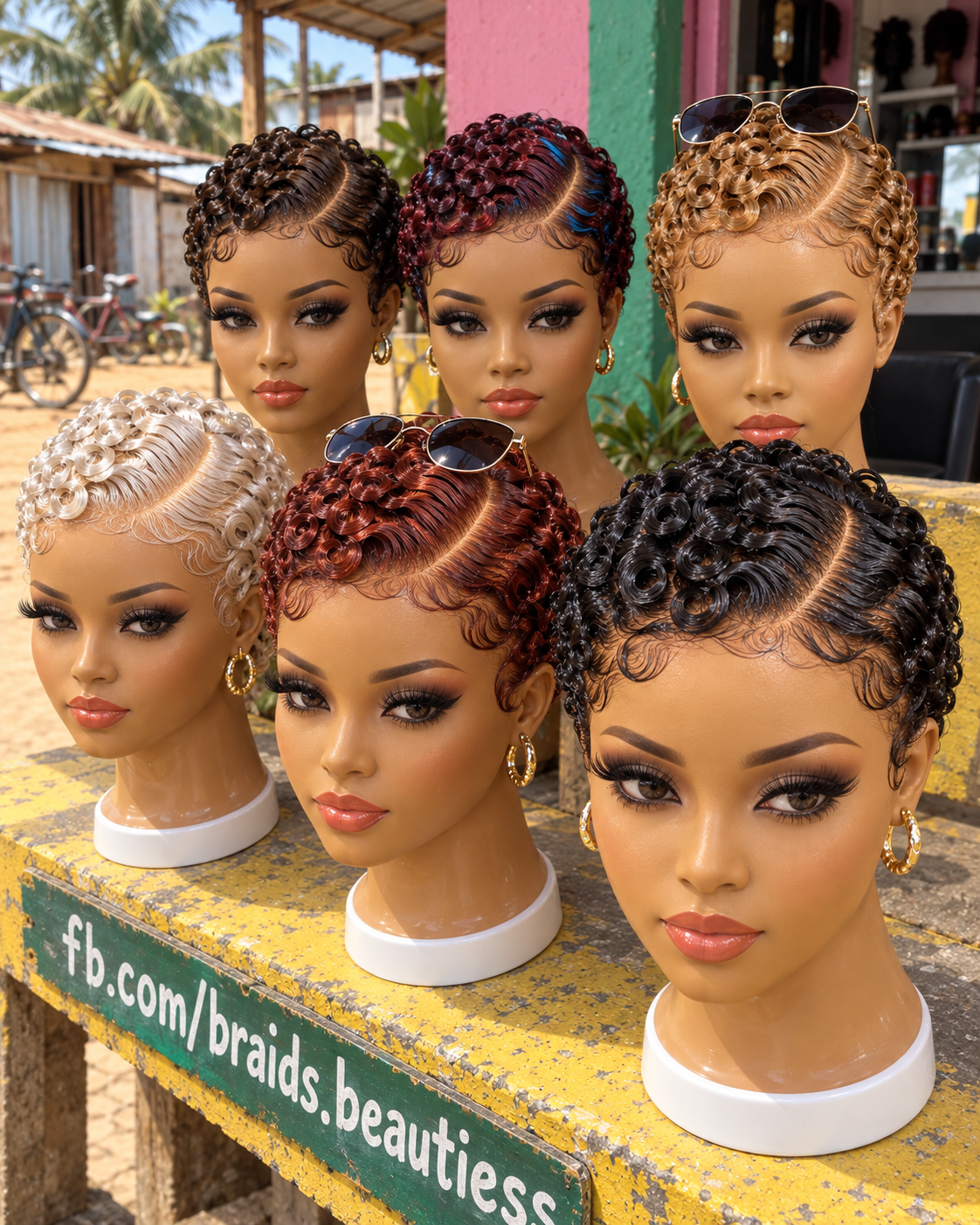
Choosing between several pixie wigs becomes easier when the hairstyles are displayed together under the same lighting. This collection presents six glossy finger curl pixie wigs on female mannequin heads outside a neighborhood beauty shop. Arranged in two rows on a weathered yellow counter, the wigs combine compact circular rosette curls, pronounced diagonal side partings, and carefully sculpted finger waves around the forehead. Their colors range from dark chocolate brown and burgundy to honey blonde, platinum blonde, copper auburn, and glossy black.
The display immediately attracts attention through its variety. Each wig follows a similar compact hairstyle concept, yet the individual curl placement and color distribution create noticeably different appearances. Several mannequins have tightly packed circular coils with visible openings, while others show broader rolled curls across the upper front. The diagonal partings are particularly prominent, giving the hairstyles a distinctive swept appearance without requiring long hair.
The photograph also captures an interesting contrast between the elaborate hairstyles and their informal surroundings. The mannequins stand outside a small salon near a painted storefront, with bicycles, neighboring buildings, and an everyday street scene visible in the background. Two mannequins have sunglasses resting above their hair, while the others display the curl arrangements without accessories covering the crown.


For women interested in compact sculpted pixie wigs, the collection provides an opportunity to compare color, curl density, hairline styling, and side-part placement. However, the mannequin presentation does not reveal the wigs’ complete construction, fiber composition, lace material, or securing systems. Buyers should use the image as a styling reference and verify the practical product details before ordering.
Six Wigs With Similar Silhouettes but Different Personalities
The display contains three wigs in the back row and three in the front. The rear-left mannequin wears a dark chocolate-brown style, the rear-center mannequin displays a burgundy wig with noticeable cool blue accents, and the rear-right mannequin wears a golden honey-blonde version.
In the front row, the left mannequin wears a pale platinum-blonde wig, the center mannequin displays a warm copper-auburn hairstyle, and the right mannequin presents a glossy black version.
All six wigs are compact, with closely arranged curls across the upper hair and no long sections extending toward the shoulders. Their silhouettes remain rounded and relatively close to the head.
Most of the upper curls resemble circular rosettes. Individual strands form small rings with visible openings, while other sections appear as overlapping rolled curls.
Along the front, each wig incorporates carefully arranged hair that follows curved paths toward the temples. The combination of these sculpted strands and the diagonal parting creates a recognizable hairstyle family.
Nevertheless, the individual curls are not identical across the six mannequins. Some upper sections are more densely packed, while others have slightly larger circular openings. These variations should be considered when selecting a reference for a custom order.
The Chocolate Brown Wig Offers a Rich Natural-Looking Option
The back-left mannequin wears a dark chocolate-brown pixie wig with closely arranged circular curls across the crown. The color appears predominantly deep brown, with warmer chestnut reflections where the hair catches the sunlight.
The upper hairstyle contains numerous compact coils. Several rounded openings are visible near the front, while smaller curls continue toward the rearward section.
A pronounced diagonal parting travels across the upper side, dividing the raised curls from the flatter hair around the forehead.
Below the parting, fine strands are arranged into sweeping finger waves. These curves follow the hairline and bend toward the visible temple.
The chocolate-brown shade gives the hairstyle depth without introducing an especially bright color. It may appeal to buyers who prefer dark hair but want something warmer than black.
Because sunlight and surface reflections affect the photograph, the exact color cannot be established from this image alone. A seller should provide a neutral-light photograph if the customer wants to distinguish between chocolate brown, espresso, and dark chestnut.
Burgundy With Blue Accents Creates the Most Unusual Color Combination
The rear-center mannequin displays a glossy burgundy pixie wig with dark wine-red curls and visible blue accents across selected upper-side sections.
This color arrangement distinguishes the wig from the others in the collection. The burgundy curls remain dominant, but several cool blue strands or reflective sections introduce a second noticeable color.
The upper hairstyle contains compact circular rosettes, with a dense arrangement across the crown and several larger loops near the front.
A diagonal parting divides the upper curls from the sculpted hairline. Beneath it, carefully arranged finger waves curve across the forehead and toward the temple.
The blue areas are visible in the photograph, but their exact color placement and manufacturing method cannot be established conclusively. Some of the apparent variation may be affected by lighting.
For a custom reproduction, ask the supplier to confirm whether the desired design should include actual blue-colored strands or merely cool-toned reflections within a predominantly burgundy hairstyle.
Why Color Placement Matters More Than the Color Name
A wig marketed simply as burgundy may not reproduce the appearance of the rear-center version.
The visible cool-toned accents introduce contrast within the upper curls. Removing them would create a more conventional burgundy style, while adding too much blue could overwhelm the original wine-red appearance.
If commissioning this version, provide a close photograph and specify the desired proportion of burgundy and blue.
Ask whether the maker can reproduce the selected color placement with the proposed fiber material.
The photograph does not establish whether the hair is human or synthetic, so bleaching, dyeing, or other color-processing methods should not be assumed suitable.
Golden Honey Blonde Brings Warmth to the Back Row
The rear-right mannequin wears a warm honey-blonde pixie wig with glossy circular curls distributed across the upper hairstyle.
The color appears golden brown with caramel and amber reflections. Some curl openings look darker because of the shadows between the strands.
The upper curls are closely arranged, although several larger circular formations are visible near the front.
A pronounced diagonal parting runs across the upper side, creating a visible separation between the raised curls and the flatter finger-wave sections.
Fine strands near the forehead follow curved paths that blend into the temple styling.
The mannequin has sunglasses resting above the crown, which adds to the retail presentation but partially obscures some of the upper curls.
For a buyer interested in this specific design, an additional photograph without sunglasses would help establish the complete curl distribution.
Golden honey blonde should also be distinguished from pale platinum blonde. The rear-right wig has a warmer and deeper appearance than the light-colored version displayed in the front row.
Platinum Blonde Reveals Every Circular Curl
The front-left mannequin wears a pale platinum-blonde wig with numerous small circular rosettes across the upper hair.
The shade appears creamy blonde with light beige reflections rather than a strongly yellow golden color.
Because the hair is relatively pale, individual curl shapes are particularly visible. Several rosettes form clear circular openings, while smaller loops fill the surrounding areas.
The diagonal parting is prominent near the upper front, and the finger-wave arrangement follows a sweeping direction toward the temple.
The hairstyle remains compact despite the intricate curl arrangement. No long curls fall over the shoulders or extend significantly below the mannequin’s head.
This version may appeal to women who prefer a light hairstyle with an elaborate curl structure.
However, the exact shade and maintenance requirements depend on the material. The photograph cannot establish whether the hair was manufactured in platinum blonde or processed after production.
What to Ask Before Purchasing a Pale Blonde Wig
Light-colored hair may reveal product buildup or tonal changes more noticeably than darker hair, depending on the material and styling products used.
Ask whether the wig requires special cleansing products and whether its color is expected to change with repeated washing.
If the unit contains color-treated human hair, the processing history may affect its condition and future styling options.
If the wig is synthetic, conventional hair dye should not be used unless the manufacturer specifically confirms compatibility.
Request a photograph under neutral daylight before approving the final blonde shade.
Copper Auburn Gives the Front Row a Rich Warm Color
The front-center mannequin wears a copper-auburn pixie wig with glossy rolled curls across the upper hair.
The color appears reddish brown with copper and cinnamon reflections. Several curls near the front have pronounced circular openings, while others overlap toward the crown.
The diagonal parting is especially noticeable because it separates the raised upper curls from the flatter hair near the forehead.
Below the parting, broad finger waves follow the direction of the hairline and bend toward the temple.
The warm coloring emphasizes the glossy surfaces of the curls while preserving darker depth inside the circular openings.
This version differs from the burgundy wig in the back row. Copper auburn appears brighter and more orange-brown, while burgundy has a deeper red-wine character.
The mannequin has sunglasses resting above the hairstyle, so a complete upper view would be useful before ordering an exact reproduction.
Glossy Black Makes the Hair Structure the Main Attraction
The front-right mannequin wears a jet black pixie wig with densely arranged circular curls.
The dark color creates strong contrast between the reflective curl surfaces and the shadowed openings inside them.
Several rosettes near the front appear larger than those positioned farther back, producing a varied upper arrangement.
A prominent diagonal parting travels across the upper side, while the hair beneath it follows sweeping finger-wave curves toward the forehead.
The front styling includes small curved strands that create a decorative transition between the upper curls and the mannequin’s face.
This version may appeal to buyers who prefer a dark hairstyle without additional color processing.
Although the photograph contains bright reflections across the black curls, these should not automatically be described as silver or gray highlights.
The actual shade should be confirmed with the supplier if the customer specifically wants natural black rather than blue-black.
The six wigs have a recognizable diagonal parting that separates the upper rosettes from the closely styled front-side hair.
This exposed channel follows an angled direction rather than a conventional straight center part.
Its position influences the distribution of curls and the direction of the finger-wave styling.
The parting appears relatively narrow, but its pale contrast against the surrounding hair makes it noticeable.
For a custom reproduction, the exact parting direction should be identified before the upper curls are arranged.
Changing the angle could alter the entire hairstyle, particularly the amount of space available for the front waves.
The photograph does not establish whether the visible channels were produced through a particular lace construction, hair separation technique, or another method.
Finger Waves Bring Precision to the Front Hairline
The front hairline styling is another important characteristic shared by the collection.
Fine strands are arranged into broad, curved waves that follow the forehead and bend toward the temples.
These sections lie closer to the mannequin heads than the upper rosettes, creating a contrast between flat directional styling and raised circular curls.
The wave arrangements are not perfectly identical. Some wigs have broader curves, while others contain several smaller sections near the front.
For buyers who want an exact reproduction, the preferred front-wave pattern should be identified separately from the color.
The stylist should preserve the relationship between the diagonal parting and the waves rather than treating the front hairline as an unrelated decorative detail.
Choosing Between Compact Coils and Larger Rosettes
The upper curls vary slightly in size across the six wigs.
Some hairstyles contain numerous small spirals packed closely together, while others display several larger circular openings around the front.
Small coils can create a densely detailed upper surface. Larger rosettes make individual curls more immediately recognizable.
Both approaches can work within a compact pixie silhouette.
When commissioning a custom wig, curl diameter should be discussed alongside crown height and density.
Adding excessive hair can conceal the circular openings, while reducing density too much may create visible gaps.
Ask the maker for photographs from above and from both sides before approving the finished hairstyle.
What the Mannequin Display Cannot Confirm
The photograph provides useful information about color, curl size, diagonal parting placement, and finger-wave styling.
However, the wigs are mounted on mannequin heads, concealing their undersides.
The image cannot establish whether the products contain human hair, synthetic fibers, or blended materials.
It also cannot confirm cap construction, lace coverage, attachment hardware, or exact sizing.
The carefully arranged front hairlines should not automatically be interpreted as proof of HD lace or another specialized construction.
Before purchasing, request a complete underside photograph of the selected wig.
Ask for written specifications covering hair material, cap measurements, lace type if applicable, and recommended installation method.
Finding Similar Pixie Wigs in Local Shops
Neighborhood beauty supply stores, wig boutiques, and salons experienced in sculpted hairstyles are appropriate places to search for comparable designs.
Useful search descriptions include circular rosette pixie wig, side-part finger-wave hairpiece, compact spiral curl wig, and sculpted colored pixie wig.
When shopping in person, inspect the hairstyle from the front, side, and above.
Ask whether the displayed wig is the exact unit available for purchase.
If the seller permits, examine the underside and confirm the cap construction.
For online shopping, request photographs of the actual product being shipped rather than relying entirely on promotional images.
A generic curly pixie may have similar length but lack the distinctive diagonal parting and circular curl placement.
How to Order One of These Six Wig Styles
Begin by selecting the preferred mannequin as the primary reference.
Identify the desired color, curl diameter, diagonal parting direction, and finger-wave arrangement.
Send the supplier a clear photograph of that specific wig rather than relying solely on the group image.
Explain that the upper hairstyle should remain compact, with visible circular openings and carefully arranged curls.
Ask the maker to avoid increasing the crown height excessively or adding unrelated decorative side patterns.
Confirm the intended hair material, cap measurements, lace specifications if applicable, and securing method.
If the color of one wig is desired with the curl arrangement of another, explain that combination clearly and request written confirmation.
For custom production, a progress photograph can help identify significant differences before final completion.
Ready-Made Shopping Compared With Custom Production
A ready-made wig may provide faster delivery and a lower initial price.
It can be a reasonable choice if the desired color, curl arrangement, and cap dimensions are already available.
However, generic curly pixie wigs may have different curl sizes, parting directions, or front hairline styling.
Custom production offers greater control over these details, although it may require more labor and expense.
Buyers should compare actual completed work rather than assuming that a custom label guarantees a better hairstyle.
A carefully made ready-to-wear wig may provide better value than a custom unit that does not reproduce the reference accurately.
Illustrative Prices for Sculpted Spiral Pixie Wigs
The cost of a comparable wig may depend on hair material, cap construction, curl-setting labor, color processing, and the extent of customization.
The photograph does not provide verified selling prices or confirm the material used in any of the six displayed wigs.
The following US dollar amounts are illustrative planning ranges rather than live product quotations.
| Wig Category | Illustrative USD Range | Potential Purchase Scope |
|---|---|---|
| Premium Custom | $320–$780+ | Individual cap measurements, detailed rosette placement, personalized color work, and specialist finger-wave styling. |
| Standard Custom | $170–$405 | Selected adjustments to curl diameter, parting direction, cap sizing, and front-wave placement. |
| Basic Human Hair | $100–$270 | A human-hair base unit that may require additional professional curl setting or coloring. |
| Premium Synthetic | $70–$200 | A higher-grade synthetic option with potentially prearranged circular curls and finger-wave styling. |
| Basic Synthetic | $25–$105 | A budget alternative where curl accuracy, color consistency, and restyling flexibility may be limited. |
These categories describe possible purchasing approaches and do not identify the material or value of the photographed wigs.
Installation, shipping, lace preparation, color customization, and future curl restoration may be charged separately.
Ask for an itemized quotation and confirm what is included before making payment.
Booking a Stylist for Installation
After receiving the selected wig, inspect the curls, hairline, parting, and cap before making adjustments.
When booking a salon appointment, explain that the hairstyle contains circular rosettes and carefully arranged finger waves.
Ask whether the stylist has experience fitting compact sculpted pixie wigs without disturbing the upper curls.
If lace is present, the cap should be positioned and checked for comfort before trimming.
The diagonal parting should align appropriately with the forehead, and the finger waves should retain their intended direction.
Any cutting near the hairline should be approached cautiously because cap material may lie immediately beneath the visible strands.
Maintaining the Curls and Color
The upper circular curls depend on retaining their rounded shape and visible openings.
Aggressive brushing may separate the strands, while unnecessary pressure can flatten carefully arranged curls.
Before washing or restyling, confirm the hair material and ask which methods are appropriate.
For synthetic wigs, heat tools should only be used within manufacturer-confirmed limits.
For human-hair wigs, professional restyling may be possible, but the correct technique depends on previous processing and the original setting method.
Color care may also differ. Pale blonde hair can make residue more visible, while color-treated human hair may experience tonal changes after repeated washing or excessive heat exposure.
Burgundy, purple, golden brown, and other colored fibers may require different maintenance approaches depending on how they were manufactured.
The finger waves near the forehead should be handled carefully because their appearance depends on the strands remaining arranged in specific directions.
Choosing the Best Color for Your Preferred Look
The six wigs provide different ways to wear the same compact hairstyle family.
Chocolate brown offers a restrained warm appearance, while black emphasizes glossy curl detail.
Burgundy introduces a deep red tone with visible cool-colored accents, and copper auburn creates a brighter warm alternative.
Platinum blonde reveals the individual circular curls particularly clearly, while golden honey provides a richer blonde-brown shade.
The best choice depends on personal preference, curl size, hairline styling, and maintenance expectations.
Before purchasing, compare individual photographs under similar lighting conditions.
Why This Outdoor Collection Works as a Shopping Reference
This collection demonstrates how a compact spiral pixie hairstyle can be adapted across several colors without losing its recognizable silhouette.
The six mannequin heads share circular curls, diagonal side parts, and sculpted front waves, yet each color creates a different visual impression.
The informal outdoor display is useful for comparing styling details, but it does not establish fiber quality, cap construction, or installation suitability.
For buyers seeking a similar wig, the strongest approach is to identify a specific reference, verify the product specifications, and choose a stylist experienced in compact sculpted curls.
By evaluating color, curl diameter, parting direction, and cap fit together, customers can select a hairstyle that more closely matches their expectations while remaining practical to wear and maintain.
Search Terms
Six glossy finger curl pixie wigs · Chocolate brown rosette side part wig · Burgundy blue accent pixie hairstyle · Honey blonde circular curl hairpiece · Platinum blonde finger wave pixie · Copper auburn spiral rosette wig · Jet black sculpted pixie curls · Outdoor mannequin finger wave wig display