
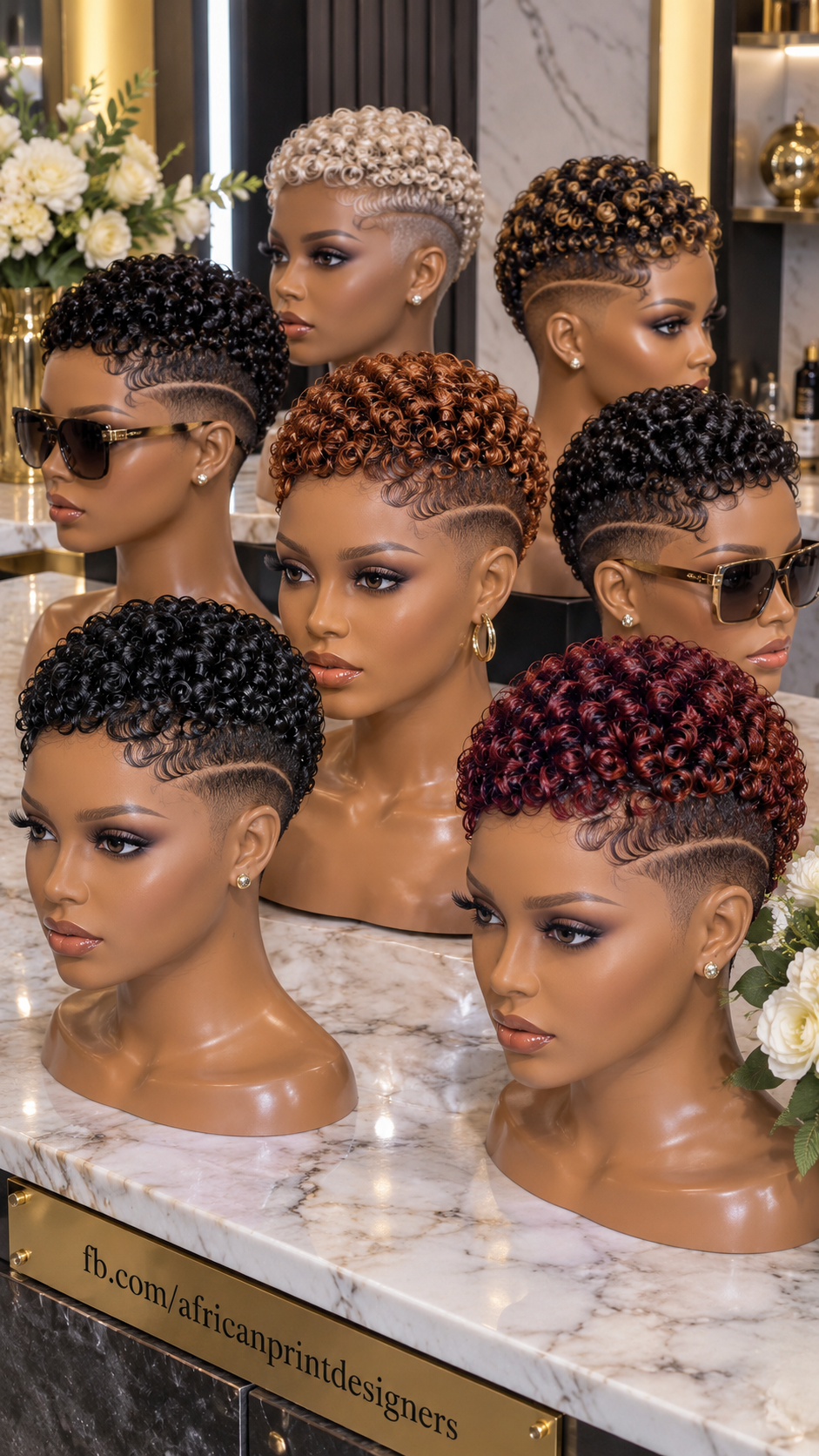
This seven-piece pixie wig collection is built around dense polished ringlets, closely reduced sides, arched exposed parting and fine feathered temple waves. The visible color choices include jet black, copper auburn, deep burgundy, creamy champagne blonde and black with golden caramel accents. The colors give each unit a different personality, but the underlying construction remains closely connected across the collection.
The strongest detail is the contrast between the rounded curl crown and the much flatter side area. Small glossy ringlets create volume through the upper section, while the temple is shaped close to the head. A curved exposed division separates these two areas, and carefully arranged strands soften the transition around the forehead.
A Dense Ringlet Dome Controls the Upper Silhouette
The crown contains dozens of small circular curls packed closely together. Most remain compact, with visible openings that allow individual ringlets to be recognized even when several overlap.
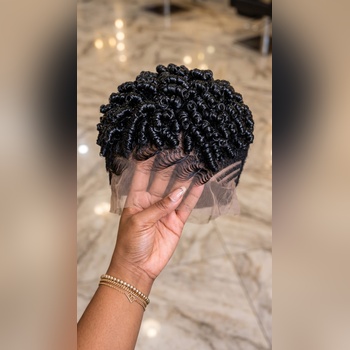
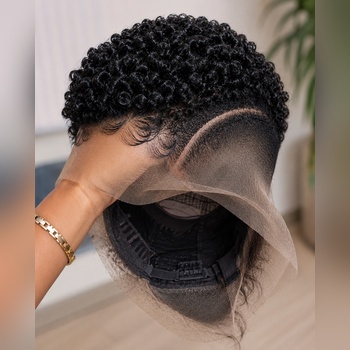
The hair does not depend on long length for volume. Instead, density and curl formation create a rounded upper profile. This keeps the hairstyle relatively compact while still providing substantial texture.
When requesting a comparable wig, describe the crown as closely packed circular ringlets with a rounded pixie silhouette. Large loose curls would produce a noticeably different result.
The Arched Part Separates Two Distinct Textures
A prominent curved division runs above the ear on several of the units. Dense curls remain above this boundary, while the section underneath becomes significantly closer and flatter.
The exposed curve follows the contour of the head instead of travelling in a rigid straight line. This makes it appear integrated with the overall silhouette rather than added as an isolated decorative stripe.
For custom work, send a clear profile reference and specify how high the arch should sit above the ear. Its position has a major influence on the proportions of the finished wig.
Feathered Temple Strands Add a Softer Transition
Between the ringlet crown and the close side, numerous fine strands are arranged into sweeping curves. These strands sit considerably flatter than the circular curls above them.
The individual hairs remain visible and travel in a coordinated direction, creating a feather-like effect around the temple. Smaller curved sections continue toward the frontal perimeter.
These are more substantial than ordinary baby hairs, so they should be included explicitly when describing the desired construction to a stylist.
Jet Black Creates Strong Depth Without Extra Color
The jet black wigs demonstrate how much dimension can come from curl formation alone. Deep interiors contrast with narrow reflective highlights running around the outer surfaces of the ringlets.
The color also creates a strong visual difference between the full crown and close side. Fine temple strands remain easy to see because the polished black hair reflects light along their curved direction.
For an all-black version, preserving strand separation is especially important because texture must provide most of the visual dimension.
Copper Auburn Brings Warmth Across the Ringlet Surface
The central copper-auburn unit uses a rich warm brown foundation with stronger copper reflections across the raised curls. Darker sections remain visible between the ringlets, giving the crown considerable depth.
The warm color also makes the transition from circular curls into flatter temple strands easy to follow. As the hair changes direction, its reflected tone changes with it.
For a custom color request, use the reference and describe the target as deep copper auburn rather than bright orange copper.
Burgundy Adds Wine and Cherry Tones
The burgundy variation combines dark red depth with brighter cherry reflections through the crown. The darkest portions remain close to wine red, while direct light reveals more saturated color on the outer curl surfaces.
This keeps the unit rich rather than uniformly bright. The close side appears slightly deeper because the cropped texture catches less light than the polished ringlets above.
Showing the reference photograph to a colorist is useful because burgundy can vary substantially between brown-red, cherry and violet-red interpretations.
Champagne Blonde Makes the Curl Pattern Highly Visible
The pale blonde version immediately reveals the construction of the crown. Individual ringlets are easy to distinguish, and the directional temple strands remain clearly visible against the mannequin complexion.
The shade appears closer to creamy champagne or pale beige blonde than icy white. Slightly deeper areas remain between the curls, helping preserve dimension.
If ordering this color in human hair, discuss the processing history and maintenance requirements before purchase because very light shades may require additional care.
Golden Caramel Accents Trace Dark Ringlets
One of the darker units incorporates golden caramel accents through selected curls. The lighter strands follow the ringlet direction rather than forming large isolated color blocks.
This creates a ribbon-like effect as individual curls rotate between dark brown or black and warmer golden sections. The darker foundation remains dominant, which preserves depth throughout the crown.
For a similar result, request selective golden caramel accents over a dark foundation rather than evenly distributed blonde highlights.
The Side Taper Keeps the Perimeter Narrow
Hair beneath the curved division becomes substantially closer around the ear. The reduction in density creates enough visual space for the arched part and temple styling to remain noticeable.
The taper follows the natural head contour instead of ending abruptly. Hair becomes progressively closer as it approaches the lower side, helping the wig maintain a compact profile.
A stylist should evaluate side density carefully before cutting because leaving too much hair can hide the design, while removing too much can change the intended proportions.
The Frontal Curls Stay Smaller Than the Crown
Ringlets closest to the forehead are generally more controlled than the fuller curls through the upper crown. This allows the frontal perimeter to transition into the sweeping temple strands without excessive bulk.
Several small curls also appear around the edges, providing continuity between the raised crown and flatter side work.
This difference in scale is worth preserving during customization. Using identical large curls across every section would make the perimeter heavier than the reference.
The Crown Carries Texture Toward the Rear
The ringlet pattern continues beyond the frontal section and maintains visible density toward the back. This gives the wig a balanced rounded profile from side and three-quarter viewing angles.
Rear curls can become slightly tighter while still following the same overall texture. What matters is avoiding a sparse back beneath an extremely dense frontal crown.
For a made-to-order unit, request a rear three-quarter photograph before final approval.
The Reflective Finish Separates Neighboring Curls
The collection displays mirror-like glossy hair, silky reflective finish, healthy wet-look shine, individually visible strands and ultra-defined texture. This finish is particularly useful with such a dense curl arrangement because reflected highlights help distinguish one ringlet from another.
The effect changes according to color. Black creates narrow highlights, copper and burgundy produce warmer reflections, while champagne blonde reveals the individual strands more openly.
Avoid applying excessive heavy product during maintenance because closely packed curls can begin sticking together and lose their circular separation.
How to Describe This Construction at a Consultation
Begin by requesting a rounded crown filled with numerous small glossy ringlets. Explain that the curls should remain compact and individually recognizable rather than becoming loose spirals.
Next, request a broad curved division above the ear with a closely tapered section underneath. Fine feathered temple strands should remain between the crown and the close side.
Choose the color separately and provide the specific mannequin that best represents your preferred combination. This reduces the chance of details from several different units being mixed together.
Where to Have the Wig Customized
Look for a wig stylist experienced with precision pixie shaping, compact curl setting and sculpted perimeter work. Portfolios showing side profiles are particularly useful because much of this hairstyle’s detail is concentrated around the temple.
Send the reference before booking and ask whether the stylist can complete the ringlet setting, side reduction and molded temple work as one service.
If you already own a wig, send photographs of its current crown length and side density so the stylist can determine whether the desired transformation is practical.
Finding a Comparable Wig to Purchase
Custom wig studios, independent wig makers and specialist pixie sellers are appropriate places to look for a similar foundation. Search for sellers who provide detailed front, side and rear photographs of their finished units.
When contacting a seller, mention the actual visible characteristics: compact ringlet crown, arched side part, close taper and feathered temple waves.
Confirm whether the wig arrives fully styled. A basic curly pixie may still require significant professional customization to reproduce this construction.
Ordering a Custom Version in the Right Sequence
Choose the hair material and preferred color first, then provide the measurements requested by the wig maker. Identify which side should contain the prominent curved division.
Discuss ringlet diameter, crown density, taper depth and temple-wave placement individually. If the style needs to face the opposite direction, request a mirrored construction before production begins.
Confirm cap construction, production time and included styling services before payment. When approval photographs are available, request frontal, direct profile and rear three-quarter views.
Price Guide for Comparable Sculpted Pixie Wigs
| Category | Estimated Range | Typical Configuration |
|---|---|---|
| Premium Custom | $475–$950+ | Premium human hair, custom coloring, intensive ringlet setting, precision side reduction and detailed temple sculpting |
| Standard Custom | $275–$525 | Human-hair pixie with compact ringlet crown, curved side division and professional perimeter shaping |
| Basic Human Hair | $150–$310 | Human-hair foundation requiring additional ringlet setting, tapering and sculpted side work |
| Premium Synthetic | $90–$195 | Higher-grade fiber with structured compact curls and stronger pre-set shape retention |
| Basic Synthetic | $45–$105 | Entry-level fiber foundation with simpler curls and limited side customization |
These figures are broad estimates for comparable custom work rather than prices for the exact wigs shown. Hair quality, coloring requirements, cap construction, stylist location and the amount of manual sculpting can significantly affect the final quotation.
Check the Arch From a Direct Side View
The curved division should follow the contour above the ear without becoming excessively wide. Inspect where the line begins near the temple and where it finishes toward the rear.
There should also be enough close hair beneath the arch to maintain a recognizable tapered panel. If that area becomes too narrow, the side design can lose its intended balance.
A direct profile photograph is more useful for checking these proportions than a frontal image.
Inspect the Curl Distribution From Above
Look across the entire crown rather than judging only the frontal curls. Ringlet density should remain reasonably consistent toward the center and rear.
Individual circular formations should still be visible in the fullest areas. If the curls merge into one continuous mass, the distinctive ringlet texture becomes less apparent.
For highlighted units, check that the accent color continues naturally through the crown instead of appearing only near the front.
Preserving the Feathered Temple Work
The fine directional strands around the temple should not be brushed aggressively. Their appearance depends on multiple hairs remaining aligned within the same sweeping curve.
If minor sections loosen, follow the existing direction instead of creating a new pattern. More extensive restoration is better handled by a stylist familiar with molded pixie work.
Keep a clear profile image of the original wig for future appointments so the intended curvature can be recreated accurately.
Maintaining the Compact Ringlet Crown
Store the wig upright on a suitable stand with enough clearance around the upper curls. Avoid compressing the crown inside tight packaging between wears.
Do not routinely brush through the ringlets. When individual curls lose their shape, targeted resetting is preferable to disturbing the entire crown.
Before using heated tools on synthetic hair, confirm the fiber’s heat tolerance. Human-hair versions should also be handled conservatively to preserve the original ringlet arrangement.
Search Terms
Arched Side Part Ringlet Pixie · Feathered Temple Wave Panel · Champagne Blonde Ringlet Crown · Burgundy Tapered Pixie Curls · Copper Auburn Compact Ringlets · Black Golden Caramel Curls · Close Side Pixie Taper · Glossy Circular Ringlet Crown