
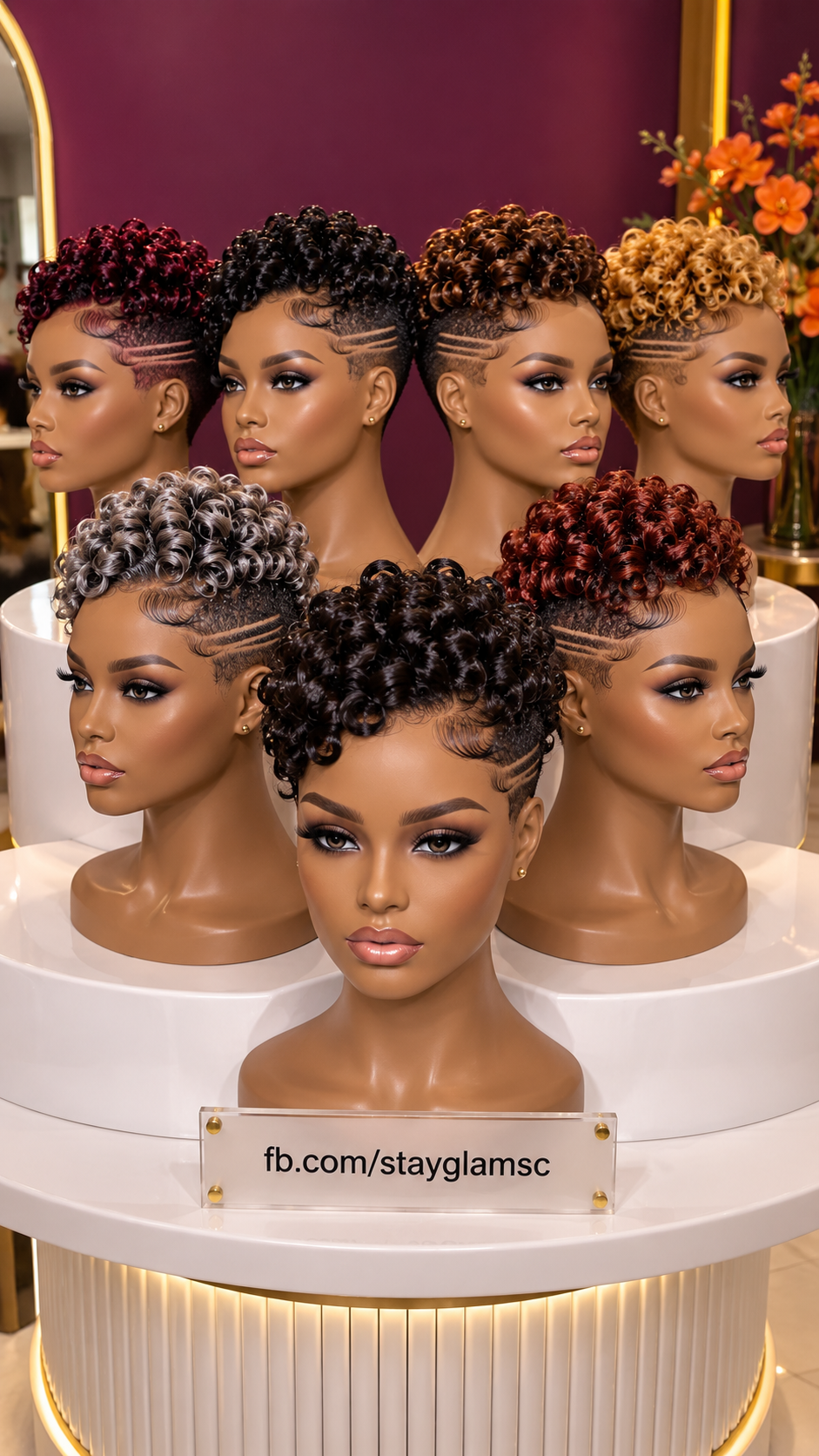
A well-planned pixie wig collection gives buyers more than a selection of colors. It allows them to compare curl density, side detailing, hairline placement and the overall balance of the hairstyle before choosing a unit. The seven-piece display shown here brings those elements together through compact spiral curls, closely shaped sides and several distinct color directions.
The collection includes deep burgundy, glossy dark tones, warm brown, golden honey, copper and a silver-toned option. Although the wigs share a similar silhouette, the different colors change how clearly the curls and side lines can be seen. This makes the display especially useful for customers who know they like the hairstyle but are still deciding which color will suit their wardrobe and personal style.
The design also shows why purchasing a customized pixie wig should involve more than simply choosing a color from a product menu. The position of the curls, the shape of the temple area and the angle of the side lines can significantly affect the final result.
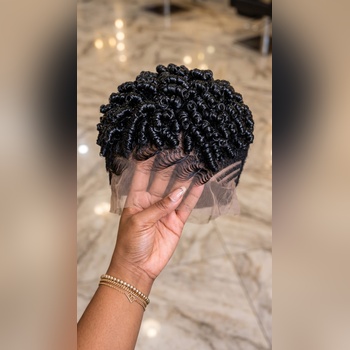
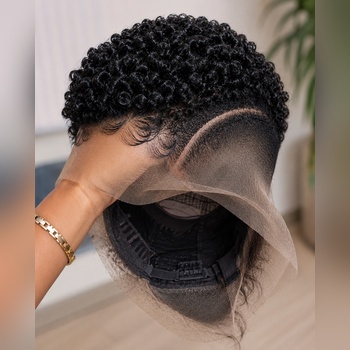
A Closer Look at the Rounded Curl Crown
The crown is built around closely packed spiral curls that create height without producing excessive length. Rather than falling around the face, the curls remain concentrated above the head. This gives the style a compact silhouette and keeps attention on the face, hairline and side details.
The curl pattern appears intentionally repetitive in size, which creates visual consistency across the crown. A successful recreation should preserve that balance. If the front curls are extremely large while the back curls are tiny, the hairstyle can lose its rounded shape.
When ordering, ask for photographs from the front, both sides and the back. A single front-facing image cannot show whether the curl density continues evenly around the entire unit.
The Side Design Is Just as Important as the Curls
Parallel lines around the temple are one of the strongest visual elements in this collection. They sit beneath the dense curls and create a clear transition between the upper section and the closely cropped-looking sides.
Some designs use several closely spaced lines, while others rely on fewer lines combined with curved hairline detailing. These variations can change the character of the hairstyle even when the crown remains almost identical.
If you want this detail reproduced, do not simply tell a stylist that you want “lines on the side.” Show the exact reference and specify whether you want two, three or more lines, how far they should extend toward the back and whether they should follow a straight or slightly curved direction.
Burgundy Curls Bring Depth Without Losing Detail
The burgundy options are particularly noticeable because the deep red tone highlights the spiral shape while maintaining enough darkness to preserve depth. Under warm salon lighting, individual curls reveal brighter red reflections while the spaces between the curls remain darker.
This color can be useful for customers who want a statement shade that still works with the compact pixie silhouette. The side lines also remain easy to see because the tapered-looking section creates contrast beneath the burgundy crown.
When purchasing online, ask for the seller’s own unfiltered video of the burgundy shade. Some burgundy colors lean toward purple, while others lean toward red or wine. Photographs alone may not reveal the difference accurately.
Golden Honey Highlights Every Spiral
Golden honey makes the curl pattern highly visible. Light reflects along the outer edge of each spiral, helping the circular structure stand out from neighboring curls. This is one reason lighter shades often photograph particularly well on compact curl styles.
Customers considering this color should ask whether the shade is uniform or blended with darker strands. The difference can be substantial. An all-over golden result appears brighter, while a darker base with golden sections creates more contrast and depth.
A color consultation with a wig stylist can help determine whether warm honey, caramel or a slightly deeper golden brown is the best direction.
Copper and Warm Brown Offer an Easy Middle Ground
For buyers who want more color than a dark unit but do not want blonde, copper and warm brown are practical alternatives. These shades make the curls visible without creating the very high contrast of silver or pale blonde.
Warm brown can also be customized with lighter pieces around selected curls. This gives the crown additional dimension while preserving a deeper overall base. Ask the colorist to show the planned distribution before the final coloring stage if you are ordering a custom human-hair unit.
Silver Tones Create Strong Contrast
The silver-toned wig immediately draws attention because it differs so strongly from the deeper shades around it. The light curl color makes individual spirals visible even from a distance, while the darker areas near the side design create separation between the crown and temple.
Silver shades vary widely. Some are nearly white, some contain grey, and others have a slightly beige or pearl undertone. For that reason, customers should avoid ordering solely from a generic “silver” color label.</