
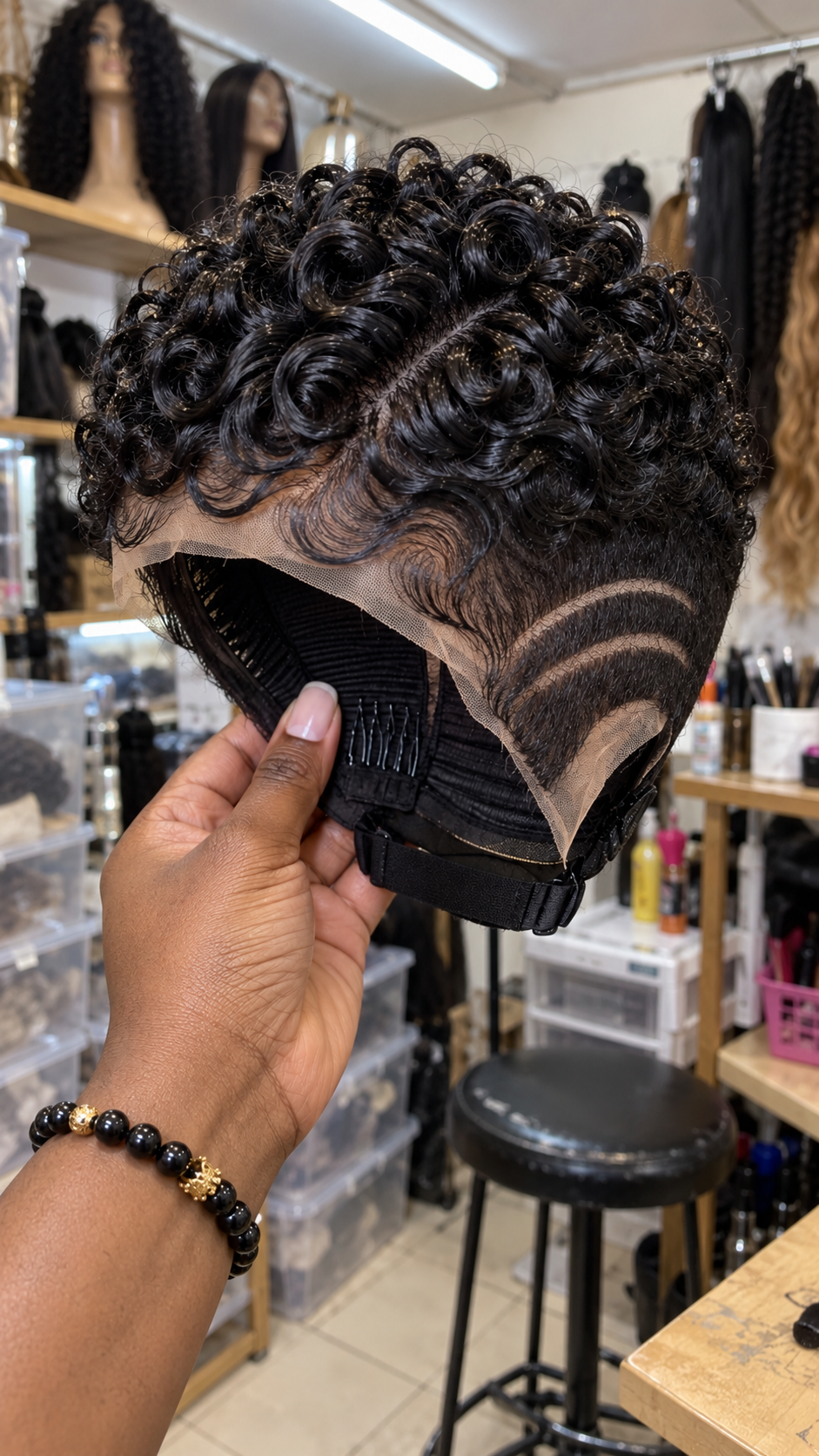
A buyer comparing sculpted pixie wigs will often encounter photographs that reveal the hairstyle but conceal almost everything about its construction. This raven-black spiral wig offers a more informative perspective. Held open inside a working hair shop, it displays an intricate crown of circular curls, two arched temple separation lines, untrimmed tan lace, and a partially exposed black cap containing visible attachment hardware. The photograph allows the appearance and several practical fitting considerations to be evaluated together.
The most distinctive element is the contrast between the closely arranged side hair and the clustered spiral curls above. A diagonal separation runs through the upper hairstyle, while two curved channels follow the temple area beneath the raised crown. These details give the wig a directional appearance that differs from a conventional curly pixie with an evenly rounded surface.
The hair appears consistently deep black, with bright reflections along the circular strands. There is no clearly visible contrasting color treatment. Its character comes primarily from the positioning of the curls, the geometry of the temple section, and the close-fitting lower silhouette.


For shoppers interested in a black finger curl lace wig, this photograph provides a useful starting point for a more technical purchasing decision. It shows enough to identify several construction details, but not enough to establish the fiber composition, lace grade, cap dimensions, or whether the unit can be worn securely without adhesive.
Start With the Cap, Not the Hairstyle
One advantage of this photograph is that the wig is held with its interior facing partly toward the camera. The black cap construction is visible beneath the lace and hair, including stitched fabric sections, an interior attachment comb, and an adjustable-looking strap assembly near the lower opening.
The visible comb is positioned inside the cap and has several narrow teeth. Such hardware can help anchor certain wigs to suitable underlying hair, although its effectiveness depends on placement, hair condition, and the overall fitting method.
Near the lower edge, a black strap and fastening component can also be seen. The photograph suggests an adjustment mechanism, but it does not establish the full adjustment range or whether additional straps are present elsewhere.
These observations are more useful than an unsupported claim that the wig is automatically secure or suitable for every head size. A well-designed attachment system still requires appropriate sizing and careful positioning.
What the Interior Photograph Does Not Establish
Although part of the cap is exposed, several important specifications remain unknown. The image does not reveal the complete underside, the full number of attachment combs, the exact cap circumference, or the complete distribution of lace and fabric.
The visible black material also does not establish a particular proprietary cap technology. A seller should provide the actual construction description rather than relying on broad promotional language.
Before purchasing, request an underside photograph showing the cap laid open. Ask for the circumference, front-to-nape measurement, ear-to-ear width, and available adjustment range.
If the wig will be worn over braided or closely arranged natural hair, discuss the attachment hardware with a stylist. Combs should not create excessive pulling or discomfort, particularly around delicate hairline areas.
Two Arched Temple Channels Create the Lower Design
The visible temple area contains two prominent curved separation channels. They follow a broadly parallel path, arching across the closely arranged side hair before descending toward the lower front section.
The channels expose a lighter foundation beneath the dark strands, creating a strong contrast against the surrounding black hair. Their curvature follows the shape of the wig rather than forming straight horizontal lines.
The upper channel separates a narrow band of hair from the denser section above. The lower channel establishes another division closer to the front perimeter. Together, they create a layered side pattern with a distinctive arched appearance.
The closely arranged hair between the channels is directed along the curves. This directional placement is important because the pattern depends on both the exposed lines and the hair sections surrounding them.
The photograph does not prove that the channels were produced using a barber’s razor on natural scalp hair. They are visible separations within a styled wig, and their exact construction method should be confirmed with the maker.
Why the Temple Pattern Needs a Fitting Check
Curved side designs can appear different when a wig is held in the hand compared with when it is positioned on a person’s head. The cap may stretch slightly during fitting, and the angle of the temple area can change according to the wearer’s proportions.
For this reason, the stylist should evaluate the channel placement before trimming the lace or making permanent adjustments.
The two arches should remain visually separate without appearing excessively wide. If the hair between them becomes displaced, the channels may lose their intended relationship.
For a custom order, request a direct side photograph showing the complete curves. This will help establish their starting points, spacing, and downward direction more accurately than a general description of decorative side lines.
A Diagonal Crown Separation Adds Another Layer of Direction
Above the temple design, a separate diagonal parting is visible among the circular curls. It travels from the forward upper area toward the rearward crown, dividing the loop arrangement into distinct sections.
This parting is different from the two temple arches. It sits within the elevated upper hairstyle rather than the compact lower side.
Its presence gives the crown a directional structure. The curls on either side of the separation appear arranged around the exposed channel instead of forming one completely uninterrupted mass.
The line also creates a visual connection between the forehead styling and the upper loops. Several curls near the front follow the diagonal orientation before turning into broader circular shapes.
A buyer requesting this hairstyle should distinguish the upper diagonal parting from the lower temple channels. Combining them into a generic description of side lines could lead to an inaccurate reproduction.
The Spiral Crown Is Dense Without Becoming Oversized
The upper hair contains numerous dark circular curls, ranging from relatively broad loops near the front to smaller, closely grouped spirals around the outer sections.
Several curls have visible central openings, giving the crown a ring-like appearance. Others overlap and create a layered surface, with individual strands reflecting the overhead shop lighting.
The loops appear concentrated around the upper head rather than extending into long hanging ringlets. This keeps the hairstyle compact while still providing noticeable height.
The front curls are particularly prominent. Some project slightly forward above the hairline, while others curve backward into the denser crown arrangement.
The outer portions contain smaller curls that help fill the spaces between the larger rings. This variation creates a more intricate surface than a wig made from uniformly sized curls.
Preserving the Circular Openings
The visible openings within the curls are central to the hairstyle’s identity. If a reproduction uses tightly compressed coils without recognizable openings, the result may appear substantially different.
Conversely, excessively large loops could create unnecessary height and disrupt the compact proportions.
When commissioning a similar wig, ask for a dense circular spiral crown with varied loop sizes and controlled height. The stylist should preserve the diagonal separation while arranging the curls around it.
Because the photograph does not reveal every rear section, request additional views before assuming that the same curl pattern continues uniformly across the entire back.
The Black Color Relies on Reflection Rather Than Highlights
The hair appears predominantly raven black or deep natural black. Under the fluorescent shop lighting, several strands reflect cool gray and silver-like highlights, particularly along the curved surfaces of the larger loops.
These bright areas should not automatically be interpreted as dyed silver streaks. The photograph does not clearly establish a separate highlight color.
The lower side appears slightly less reflective than the crown because its strands lie closer to the foundation and follow a different direction.
For online ordering, request photographs under natural daylight. Deep black wigs can appear warmer, cooler, or more reflective depending on the camera and lighting environment.
Ask the seller whether the available shade is natural black, off-black, or jet black. These descriptions are not standardized across every supplier, so actual product images remain important.
The glossy appearance also does not establish the fiber composition. Human hair and synthetic fibers can both reflect light strongly depending on their surface and styling.
Forehead Waves Bridge the Lace and the Circular Curls
At the front, fine strands are arranged into sweeping waves that sit relatively close to the lace. These waves transition into the larger circular curls above.
The front arrangement is more intricate than a simple straight hairline. Several curved strands follow the forehead contour, creating a flowing boundary beneath the raised crown.
This styling helps prevent the upper curls from appearing disconnected from the lower hairline. It also creates a different visual scale, with fine waves beneath larger loops.
The photograph shows the hairline before installation, so its final appearance against a person’s forehead cannot be established.
For an accurate recreation, ask the stylist to preserve the front wave direction while keeping the lace preparation separate from the curl styling. Cutting or repositioning the front strands carelessly could disturb the transition into the crown.
Tan Lace Requires Individual Assessment
A broad section of tan mesh extends beyond the front and temple hairline. The lace is visibly untrimmed, indicating that the wig has not yet undergone final preparation for wearing.
The mesh appears relatively fine in the photograph, but its exact grade, thickness, and transparency cannot be verified. It should not be described as HD lace without independent product information.
The visible lace extends around the curved temple design, making fitting especially important. The side channels should sit at the intended position once the wig is placed on the wearer’s head.
Before installation, the stylist should assess the lace color and determine whether it is suitable for the wearer’s complexion and preferred appearance.
Trimming should occur only after the wig has been positioned correctly. Removing too much lace can compromise the hairline and may be impossible to reverse.
Where to Look for This Specific Construction
A suitable purchasing search should focus on wig customization specialists, sculpted pixie wig makers, and salons experienced in circular finger curl styling.
Generic black curly pixie listings may contain similar colors but different curl arrangements, side designs, or cap constructions.
When contacting a seller, describe the desired hairstyle as a raven-black lace pixie wig with a dense circular spiral crown, an upper diagonal parting, and two arched temple separation channels.
Provide the reference photograph and ask whether the seller can reproduce the visible cap arrangement or offer an alternative with comparable fitting options.
A ready-made wig may be suitable if the curl placement and temple geometry already match. A custom commission may offer greater control over the parting positions and crown proportions.
Before paying a deposit, confirm the material composition, cap dimensions, lace specifications, attachment hardware, production time, shipping arrangements, and return conditions.
Booking the Installation in the Correct Order
Begin with a consultation to discuss the intended hairstyle and the wearer’s head measurements. The stylist should understand that the upper diagonal parting and the two lower temple arches are separate design elements.
When the wig arrives, inspect the circular curls and attachment hardware before making permanent modifications.
The next step is fitting. The stylist should position the wig so that the temple channels follow the intended contour and the front waves sit naturally against the forehead.
If the cap includes adjustable hardware, it should be set for comfort without excessive tension. The visible comb should be evaluated according to the wearer’s underlying hair and scalp sensitivity.
Only after the fit is confirmed should the lace be trimmed where necessary. Any final curl adjustments should preserve the diagonal crown separation and the recognizable circular openings.
The attachment method should be selected according to the actual cap construction. Visible straps and combs do not automatically establish that the wig can be worn securely without adhesive.
After installation, examine the hairstyle from the front, side, and rear. The crown should retain its compact height, while the two temple arches remain distinct.
Illustrative Budget for a Black Spiral Wig With Detailed Temple Work
The potential cost of this design is influenced by the circular curl arrangement, the upper diagonal parting, the two curved temple channels, and the lace and cap preparation.
The following USD ranges are illustrative planning estimates, not verified live selling prices or quotations for the photographed wig. Its fiber composition and actual retail price remain unknown.
| Wig Category | Illustrative USD Range | Possible Cost Factors |
|---|---|---|
| Premium Custom | $360–$860+ | Individual cap fitting, advanced circular curl construction, detailed temple arches, and specialist lace preparation. |
| Standard Custom | $180–$410 | Selected cap options, customized spiral placement, and adjustments to the diagonal and curved separation channels. |
| Basic Human Hair | $100–$260 | Human-hair base unit that may require separate curl setting, side styling, and lace customization. |
| Premium Synthetic | $65–$175 | Higher-grade synthetic alternatives with prearranged spirals and material-dependent styling flexibility. |
| Basic Synthetic | $25–$80 | Budget alternatives that may differ in curl precision, temple geometry, and cap construction. |
These categories represent possible purchasing routes rather than confirmed classifications of the photographed product. Actual prices vary by supplier, country, materials, workmanship, and included services.
The dark color may reduce the need for complex multitone processing, but the detailed curl arrangement and temple geometry can still require substantial styling labor.
Ask whether the quotation includes the completed hairstyle, lace preparation, cap fitting, installation, and shipping.
A lower-priced base wig may require additional customization, so compare the total expected expense rather than the initial purchase price alone.
Care Priorities for the Spiral Crown and Curved Channels
The upper curls require careful handling because their appearance depends on maintaining recognizable circular openings. Repeated brushing or aggressive finger separation can disturb the arrangement.
Ask the supplier how the spirals were formed and whether they can be safely repositioned. Some constructions may require professional resetting after significant disturbance.
The temple channels need separate attention. Hair crossing the exposed areas can reduce their visibility, so maintenance should preserve the direction of the closely arranged side strands.
Cleaning instructions must follow the confirmed fiber composition. Synthetic hair should not be exposed to heat unless the manufacturer specifically permits it. Human hair may allow different styling methods, but its condition and any previous processing should be considered.
The visible attachment comb and adjustment hardware should also be inspected periodically for damage or discomfort. Avoid forcing a comb into tightly secured natural hair or using excessive strap tension.
When storing the wig, avoid compressing the raised curls or stretching the lace. A suitable support can help preserve the compact silhouette.
If the spirals lose their circular shape or the temple channels become difficult to maintain, professional restyling may be preferable to extensive home adjustments.
What Should Determine the Final Buying Decision?
This wig is distinguished by the combination of a dense raven-black spiral crown, an upper diagonal separation, two arched temple channels, and a partially visible adjustable cap.
The hairstyle should not be evaluated solely as a black curly pixie. Its identity depends on the arrangement of the circular curls and the relationship between the upper and lower separation lines.
Before purchasing, request multiple product angles, confirm the cap and lace specifications, and determine whether the seller can reproduce the temple geometry accurately.
The best result will come from balancing visual accuracy with comfortable fitting and realistic maintenance requirements. A carefully constructed wig should preserve the distinctive spiral arrangement while allowing the wearer to secure and maintain it appropriately.
Search Terms
Raven black spiral pixie lace wig · Twin arched temple line hairpiece · Black circular curl crown wig · Diagonal crown parting spiral pixie · Tan lace wig with visible attachment comb · Black adjustable strap curly wig · Sculpted forehead waves with ring curls · Deep black compact pixie with curved side channels