
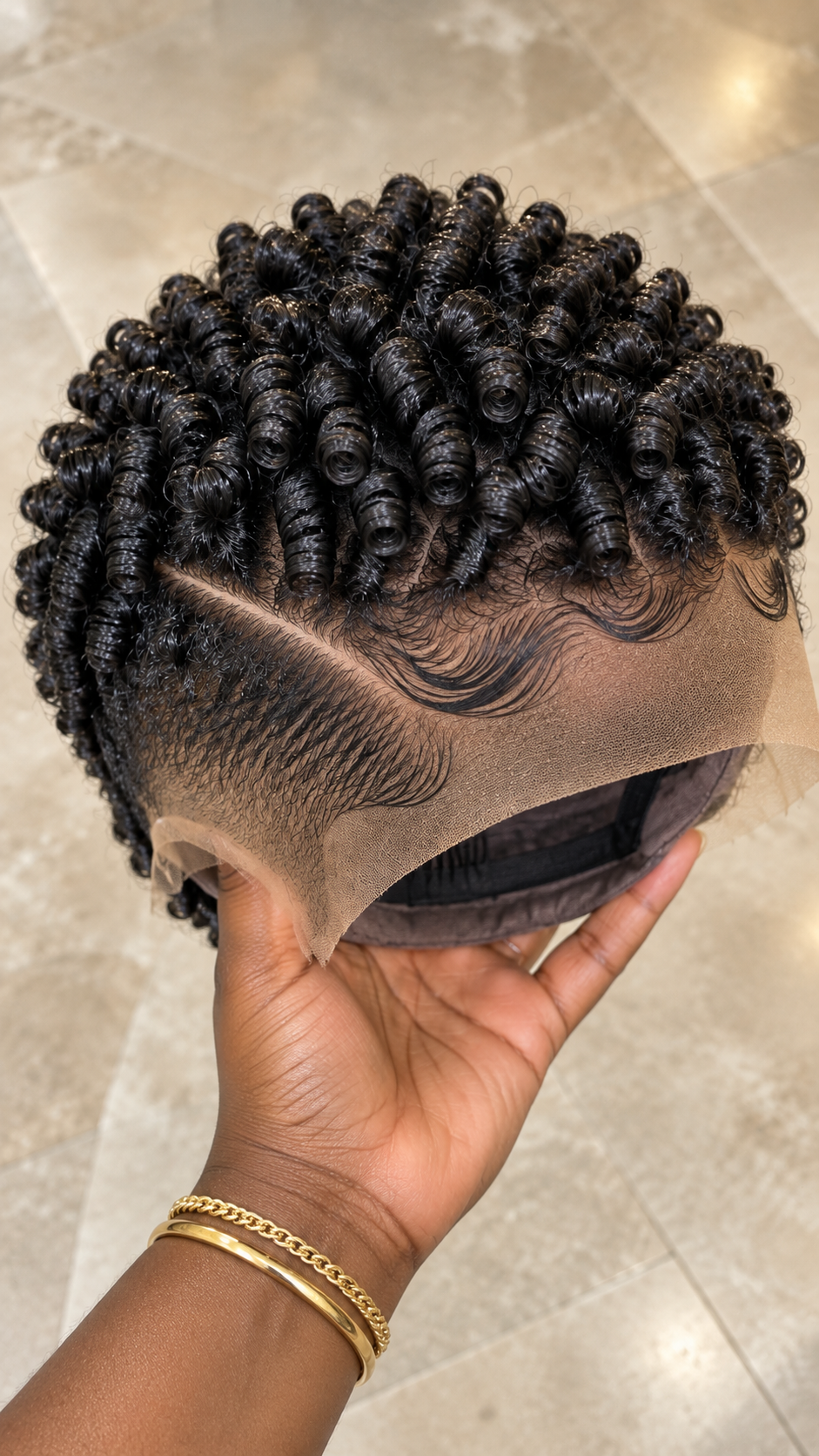
A wig with dozens of individual spiral curls can look impressive from a distance, but its real character becomes apparent when the hairline and crown construction are examined closely. This raven-black unit presents an unusually clear example of that relationship. Rows of compact corkscrew curls rise above the forehead, a deep diagonal separation organizes one side, and fine hairline strands flow into broad feathered waves. The result is a compact sculpted hairstyle whose identity comes from the contrast between cylindrical coils and delicate directional hair.
The wig is photographed from a slightly elevated angle while being supported in one hand. The beige-toned lace remains untrimmed across the forehead and around the visible side. A dark interior cap is exposed beneath the front, showing that the unit has not yet been fitted to an individual wearer. The photograph offers enough detail to study the curl openings, side division, front waves and visible cap construction, although it cannot establish the fiber composition, exact lace grade or complete attachment system.
Unlike wigs with oversized open circles or elaborate temple carving, this piece uses comparatively narrow, spring-shaped tubular coils. Many are arranged in short, closely spaced rows that follow the head’s rounded contour. Their dark, glossy surfaces catch the light while the interiors remain almost black. Along the front, elongated finger-wave strands create a softer transition between the dense coils and the lace.
The Crown Is Organized Into Compact Corkscrew Columns
The upper hairstyle contains numerous short tubular spirals, several of which resemble tightly wound corkscrews. The coils rise above the foundation before turning into compact circular ends.


They are not arranged as long hanging ringlets. Instead, they sit close to the crown, with many positioned in related directions. Several spirals appear nearly vertical near the upper center, while others angle forward or toward the sides.
This produces a densely populated rounded shape without excessive overall length.
A custom maker should distinguish these narrow spirals from the broad hollow rings used in other sculpted wigs. Their more compact diameter and layered placement contribute directly to the appearance.
When ordering, request small tubular corkscrew coils with visible spiral winding, not loose waves or oversized circular ringlets.
The Spiral Winding Matters More Than Maximum Volume
Each prominent coil contains several turns of hair. The strands travel around the formation repeatedly before reaching the curled end, giving the upper hairstyle its distinctive spring-like appearance.
The individual windings are visible because the glossy surfaces reflect light at different points along each coil.
This construction requires careful spacing. Packing additional hair between the curls could make the crown fuller but conceal the individual spiral turns.
Likewise, arranging the coils too far apart might produce unwanted gaps in the overall crown.
The strongest result balances substantial coverage with recognizable individual corkscrews.
The Forward Coil Ends Create a Rounded Fringe Effect
Several of the frontmost spirals terminate in circular openings close to the forehead. Their compact ends produce an elevated fringe-like edge without allowing the hair to hang over the eyes.
The curls differ in orientation. Some openings face forward, while others angle downward or sideways.
This variation helps the crown avoid appearing mechanically repeated. It also allows the curls to follow the contour of the front hairline.
A faithful recreation should maintain the compact circular ends rather than turning them into loose dangling strands.
Raven Black Creates Dimension Through Reflective Surfaces
The hair appears consistently raven black with subtle charcoal reflections. Some raised strands catch warm light, but no clearly separate blonde, copper or burgundy highlight color is visible.
The dimensional appearance comes primarily from the sculpted hair itself. Each tubular curl contains shiny outer surfaces and dark recessed sections.
This monochromatic palette makes the arrangement particularly important. A displaced coil may become noticeable because neighboring curls follow a deliberate pattern.
Buyers should therefore prioritize accurate curl construction over additional color processing when trying to match this reference.
The Diagonal Side Part Establishes a Strong Boundary
A visible scalp-toned part travels diagonally along the side beneath the upper coils. It separates the densely curled crown from the flatter hair below.
The exposed path follows the rounded foundation rather than forming a perfectly straight horizontal stripe.
Its position influences the apparent size of the crown and the amount of lower side hair. Moving it significantly could change the proportions of the wig.
For custom production, the diagonal division should be established before the coils are arranged along its upper edge.
A direct side photograph can help confirm the location and curvature.
The Lower Side Retains Fine Black Hair
Beneath the diagonal division, the visible side contains closely arranged fine strands. The hair lies much nearer to the foundation than the tubular curls above.
This contrast creates a tapered appearance without relying on an elaborate collection of carved patterns.
The lower area is still populated with black hair. It should not automatically be treated as a completely shaved section.
For a recreation, the maker should preserve enough lower density to create a gradual transition from crown to perimeter.
Feathered Forehead Waves Are a Major Design Element
Along the front, fine black strands form several elongated curved movements. These waves are visibly flatter than the corkscrew crown, creating a decorative transition toward the lace.
Some strands sweep downward before bending back toward the temple. Others follow a broader curved path beneath the first row of coils.
This hairline work should not be dismissed as ordinary incidental baby hairs. It occupies a noticeable portion of the front and contributes to the hairstyle’s identity.
A custom stylist should preserve its elongated direction rather than turning the front into another row of tubular curls.
The Front Waves Use Several Different Strand Lengths
The feathered arrangement contains longer sweeping pieces and shorter supporting strands. Their combined movement creates a layered wave shape rather than one simple curve.
This variation makes the front appear carefully arranged while remaining lighter in density than the crown.
If every front strand were cut to the same length, the transition could become too uniform and lose the natural variation visible in the photograph.
For professional styling, the front should be established with the wig in its intended wearing position so the waves can be evaluated relative to the hairline.
The Crown and Hairline Require Different Styling Skills
The upper hair needs tightly wound tubular spirals. The front requires flat directional finger waves. These are separate techniques that must be coordinated without allowing one to interfere with the other.
A stylist experienced only with loose curly wigs may not automatically reproduce the narrow corkscrew construction.
Similarly, experience creating finger waves does not guarantee consistent spiral setting throughout a dense crown.
When evaluating a custom wig maker, look for portfolio examples demonstrating both types of work.
The Rear Should Continue the Tubular Curl Arrangement
The photograph emphasizes the front and one side. Although part of the rear curls is visible, the complete back cannot be evaluated from this single angle.
For a custom order, request a rear photograph showing how the narrow spiral columns continue around the crown.
The buyer should also examine whether the curls become progressively smaller or more compact toward the lower rear.
That information helps ensure the hairstyle is constructed coherently around the entire head rather than only in the most visible areas.
The Untrimmed Lace Is Clearly Visible
A broad section of beige-brown mesh extends beyond the front hair-bearing edge and wraps around the visible side. The material has not yet been trimmed to fit an individual wearer.
This gives a professional installer room to position the unit before determining the final lace perimeter.
The apparent mesh shade may be influenced by lighting and the hand beneath it. Its exact color should be confirmed through the seller’s available options.
The photograph does not establish HD lace or another specialized commercial grade. Such claims require product specifications rather than visual assumptions.
The Interior Cap Is Partially Exposed
The front underside reveals a dark brown cap foundation beneath the lace. Its fabric structure is visible, but the photograph does not clearly identify every attachment or adjustment component.
Before purchasing, request a full underside photograph of the actual unit.
The seller should confirm cap dimensions, attachment preferences and available adjustment options.
Visible lace and an interior foundation alone do not establish adhesive-free installation suitability.
Cap Placement Influences the Forehead Wave Position
The front strands, diagonal side part and crown curls are fixed to the wig foundation. When the cap moves, these elements shift together.
A unit placed too far forward may position the feathered waves lower than intended, while a cap sitting too far backward may alter the front-to-crown relationship.
For made-to-order wigs, follow the supplier’s measurement guide. Depending on construction, circumference, front-to-nape and ear-to-ear dimensions may be relevant.
A professional wig stylist can assist with sizing before ordering.
Where to Find a Comparable Corkscrew Wig
Specialist lace-wig studios, custom hairpiece makers and salons experienced with finger-coil styling are practical places to begin.
Generic black curly wigs may offer suitable foundations, but reproducing the tight tubular crown and delicate forehead waves may require additional work.
When contacting a seller, provide the photograph and identify the essential details: raven-black color, narrow corkscrew coils, a diagonal side part and long feathered front waves.
Ask whether the style is available as finished stock or needs to be commissioned.
Booking the Correct Salon Service
The required appointment depends on the wig’s condition when purchased.
A fully styled unit may need fitting and minor corrections after shipping. An unfinished foundation may require complete spiral setting, parting refinement and front-wave construction.
When booking, explain that the desired result uses tightly wound tubular coils rather than ordinary loose curls.
This allows the salon to estimate the time required and determine whether a specialist is available.
A Custom Brief Should Focus on Coil Diameter
The crown requirement should specify dense black corkscrew columns with small circular openings and several visible spiral turns.
The side should contain one diagonal part beneath the crown and a closely arranged lower section.
The front should preserve long feathered waves that follow the forehead toward the temple.
Finally, cap size, hair material, lace specification and preferred installation method should be confirmed.
Approval Photographs Need a Close Crown View
An elevated photograph should reveal whether the individual tubular coils retain their winding pattern.
A direct side image should show the diagonal part and the lower hair density.
A frontal photograph should capture the feathered waves and their relationship with the first row of curls.
A rear image should confirm continuity around the crown, while an underside view can document the cap construction.
Pricing Depends on Individual Spiral Setting
The compact length and single black color do not necessarily make this wig inexpensive. The dense crown contains numerous individually wound coils that can require substantial professional preparation.
Hairline detailing, cap construction and lace preparation may contribute additional costs.
Estimated Pricing for Black Corkscrew Coil Wigs
| Category | Illustrative Price Range | Potential Scope |
|---|---|---|
| Premium Custom | $315–$575+ | Higher-grade hair, individualized cap sizing, hand-wound corkscrew coils, detailed forehead waves, diagonal side parting and professional lace preparation. |
| Standard Custom | $190–$340 | Prepared narrow spiral crown, coordinated front-wave styling and standardized cap options. |
| Basic Human Hair | $110–$205 | A human-hair foundation requiring coil setting, side styling and professional fitting. |
| Premium Synthetic | $75–$150 | A quality pre-set option that may preserve its corkscrew construction with relatively limited professional resetting. |
| Basic Synthetic | $35–$90 | A budget alternative where spiral winding, front-wave precision or cap construction may be simplified. |
These are illustrative budgeting estimates rather than confirmed prices for the photographed unit. Actual quotations depend on material, supplier, location, styling labor, cap construction, shipping and fitting.
Ask whether the listed price includes the completed tubular crown and feathered hairline. An inexpensive foundation requiring extensive salon work may ultimately cost more than a finished custom unit.
Human Hair May Allow Selective Coil Resetting
A human-hair version can potentially support professional restoration of individual corkscrews when they loosen, depending on the hair’s condition.
Because the crown contains many separate coils, it may be possible to repair only affected sections rather than rebuilding the entire style.
Heat should be selected according to hair quality and any previous processing.
Premium Synthetic Can Favor Shape Retention
A quality synthetic version may maintain its pre-set corkscrew pattern with comparatively little daily manipulation.
However, heat tolerance varies by fiber and conventional permanent hair dye should not be assumed suitable.
Confirm the material before selecting tools or maintenance products.
Washing Should Protect the Spiral Winding
Before the first wash, photograph the crown from above. This documents the original direction and diameter of the tubular coils.
During cleansing, avoid aggressive rubbing that can intertwine neighboring spirals or loosen their winding.
Use methods appropriate for the confirmed human-hair or synthetic material.
After drying, restore only those coils that have shifted.
The Front Waves Need Separate Attention
The feathered forehead strands should remain elongated rather than being rolled into additional corkscrews.
If a wave loses its direction, a stylist should guide it back along the original curve.
Heavy styling product can cause neighboring strands to adhere together and obscure the delicate detail.
Use suitable styling aids conservatively.
Protect the Diagonal Part From Unnecessary Cutting
The side division is already an important structural feature. It does not need to be widened at every maintenance appointment.
If fine strands move across the exposed path, repositioning may restore its appearance without cutting.
Because wig hair does not naturally regrow, unnecessary removal can permanently change the proportions between crown and side.
Keep the Crown Reflective Without Heavy Buildup
The black corkscrews already reflect light across their curved surfaces. Excessive oils and waxes can cause neighboring coils to stick together and become less individually recognizable.
Use care products appropriate for the confirmed material.
If buildup becomes visible, suitable cleansing may restore the curl separation more effectively than adding more shine product.
Installation Should Preserve the Existing Hairline
When the unit arrives, inspect the crown, forehead waves, diagonal part, lace and cap before permanent alterations.
The installer should establish the final wearing position and evaluate the feathered strands.
Only after that placement is approved should excess lace be trimmed and any optional adjustment considered.
Storage Must Protect the Tubular Crown
A suitable wig stand or mannequin head can help retain the compact spiral arrangement between wears.
Other objects should not press against the raised coils, because compression can loosen their winding or change their direction.
The cap and lace should be fully dry before storage.
For transportation, use packaging that provides sufficient clearance around the crown.
The Hairstyle Depends on Contrasting Curl Scales
This raven-black wig is recognizable because the upper crown contains tightly wound tubular coils while the front and lower side use much finer directional strands. A diagonal separation organizes the side, and broad feathered waves frame the forehead.
For buyers, the essential quality checks are spiral diameter, visible winding, crown density, diagonal part placement, fine hairline direction, lace condition and cap suitability.
For wig businesses, close overhead and frontal photographs can demonstrate the quality of the individual corkscrews and the decorative hairline. A complete underside image and verified material specifications can help customers understand the practical foundation.
A successful recreation should preserve the small tubular coils and delicate wave work without adding unnecessary highlights, exaggerated volume or unrelated side carving. The precision of the original hair arrangement provides enough visual distinction on its own.
Search Terms
raven black corkscrew wig · tightly wound tubular coil crown · feathered forehead wave wig · diagonal side part lace hairpiece · black spiral winding pixie · compact curled black crown · fine directional hairline wig · untrimmed lace corkscrew unit