
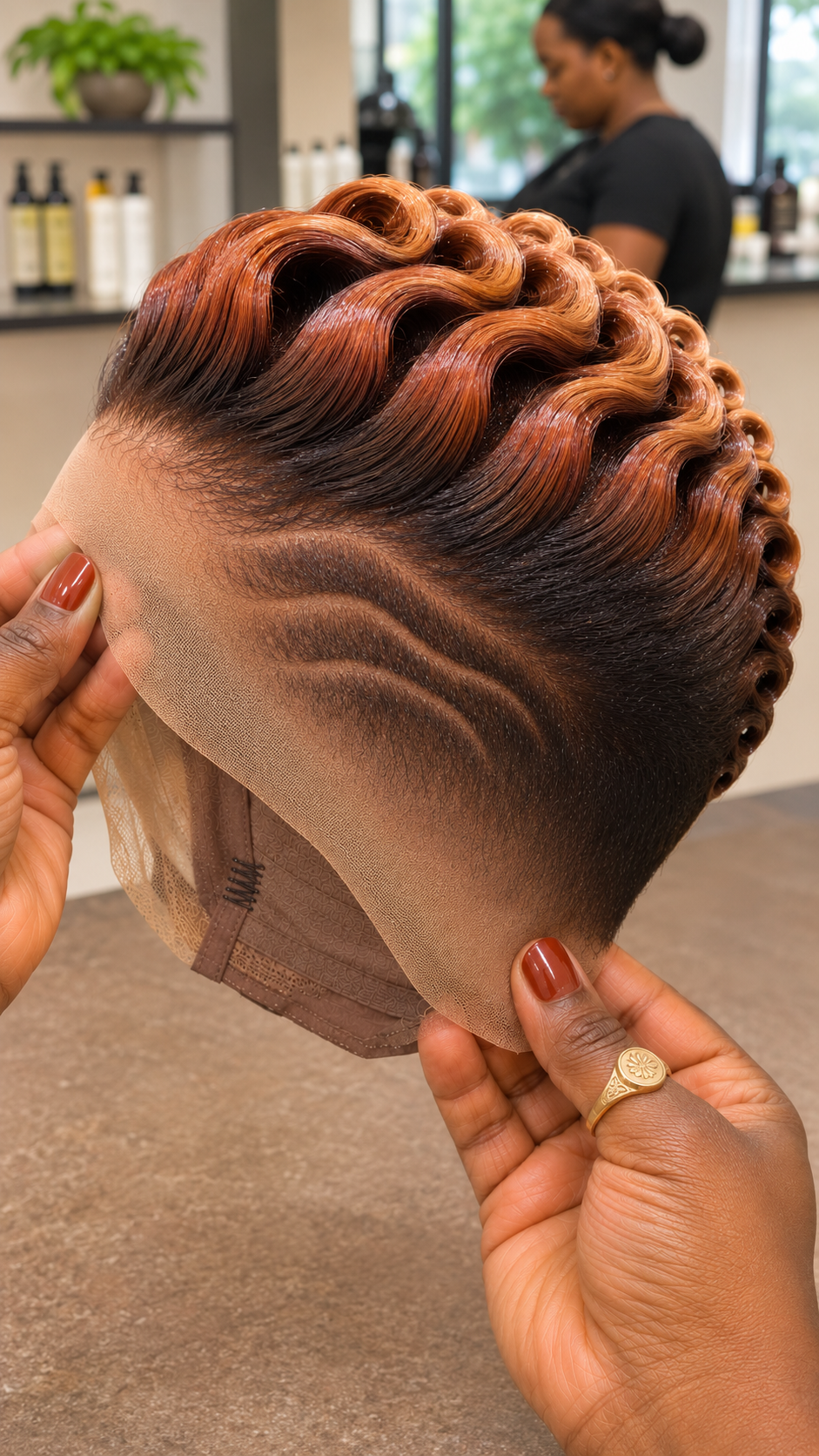
A short hairstyle can make an extraordinary impression when every curve has a purpose. This striking copper pixie wig combines dramatically raised crown waves, warm auburn reflections, and beautifully sculpted temple detailing. Its appeal comes from the contrast between the glossy, upward-flowing curls and the closely arranged dark hair beneath them. Rather than relying on long strands or excessive volume, the design creates a glamorous silhouette through carefully controlled movement and rich color placement.
The photograph captures the wig inside a beauty salon, held between two hands to reveal its side profile, untrimmed lace, and part of the interior cap. Across the upper crown, broad copper-colored ribbons rise from darker roots and curl backward into prominent rounded crests. These formations gradually become smaller toward the rear, where several compact circular curls complete the silhouette. The lighter copper surfaces reflect the surrounding light, while the underlying dark strands create depth between the raised sections.
Along the visible temple, the hair follows a completely different arrangement. Dark brown strands lie close to the supporting surface, interrupted by two sweeping curved separations. These channels create a layered appearance that complements the movement of the upper curls without competing with their dramatic height. The lower side remains compact, producing the appearance of a tapered pixie while preserving visible hair coverage.


The photograph also reveals a broad section of beige-toned lace and part of a brown interior cap. Although these details are useful for evaluating the product, they do not confirm the exact lace grade, fiber composition, or complete installation system. Those specifications should be verified with a seller before purchasing.
For women interested in a copper pixie wig with sculpted curls, the hairstyle offers a distinctive alternative to ordinary finger coils and short loose-curly wigs. Its character depends on the height of the upper waves, the placement of the warm copper color, and the shape of the decorative temple sections.
The Copper Crown Creates an Elegant Rising Silhouette
The most recognizable element of this hairstyle is the arrangement of broad curls that rise from the front and bend backward across the crown.
Several prominent sections form large, rounded arches with open spaces beneath their elevated curves. These shapes are noticeably wider than conventional finger coils and resemble carefully folded ribbons of hair.
The front section contains some of the tallest waves. Their strands travel upward from the darker roots before curving backward into smooth, glossy loops.
Moving toward the rear, the waves gradually become smaller and more closely arranged. This creates a progression from dramatic raised crests to compact circular curls around the back of the crown.
The hairstyle’s height is concentrated mainly in the upper sections. Its sides remain relatively close to the base, allowing the curls to appear substantial without creating an excessively wide silhouette.
Each crest follows a similar backward direction, but the individual shapes are not identical. Some arches rise higher, while others form lower overlapping curves.
This variation contributes to a more intricate appearance and prevents the crown from resembling a uniform row of identical curls.
For custom production, preserving the elevated copper ribbon waves is essential. Replacing them with small, tightly packed ringlets would create a significantly different hairstyle.
Broad Ribbon Curls Give the Pixie Its Distinctive Character
Traditional finger coils are often created from relatively narrow sections of hair twisted into individual spirals.
The curls in this photograph have a different visual structure. The most prominent formations contain wide groups of strands arranged together into substantial arches.
Instead of hanging freely, they rise from the crown before turning backward.
The resulting curls have smooth outer surfaces, visible openings, and considerable directional movement.
Near the rearward edge, smaller circular formations create a more closely arranged finish.
This combination of broad front waves and smaller rear curls gives the hairstyle its distinctive proportions.
A wig maker attempting to reproduce the design should consider the width, height, and direction of the large curls rather than relying solely on overall hair length.
The upper styling should retain clear spaces between the largest arches while maintaining enough hair coverage to conceal the supporting base.
The Warm Copper Color Enhances Every Curve
The hairstyle displays a rich copper-brown color across its raised upper sections.
Several curls contain bright auburn and orange-copper reflections, particularly along their outer surfaces.
The roots and lower areas remain considerably darker, appearing deep brown or nearly black.
This contrast makes the raised waves especially noticeable because the lighter sections follow their curved shapes.
Unlike a completely copper-colored hairstyle, this design preserves substantial dark hair beneath the upper curls.
The rearward curls also contain copper tones, although their smaller shape creates a different pattern of light and shadow.
Some highlighted sections appear brighter because of the salon lighting. The exact coloring formula cannot be established from one photograph.
Nevertheless, the overall appearance is clearly centered on warm copper and auburn shades over a dark foundation.
Women who prefer warm hair colors may find this combination particularly appealing because it introduces brightness without eliminating the depth of the darker base.
Copper Brown, Auburn, and Ginger Are Different Color Choices
When purchasing a comparable wig, it is important to understand that sellers may use several different names for warm reddish-brown hair colors.
Copper brown generally describes a warm brown shade with orange or reddish undertones.
Auburn often contains a deeper reddish-brown appearance, while ginger may refer to a brighter orange-toned result.
The photograph contains elements of warm copper and auburn, with darker brown roots creating contrast.
For custom orders, describe the desired appearance as a dark-rooted copper-brown blend with warm auburn highlights.
Request photographs under neutral daylight before confirming the final shade.
If human hair is being colored, ask whether the process requires lightening and how the stylist plans to protect the hair during treatment.
For synthetic wigs, confirm that the desired color blend is available from the manufacturer. Most synthetic fibers cannot be recolored successfully with ordinary permanent hair dye.
The Front Waves Rise Into Beautiful Sculpted Crests
The front of the hairstyle contains several large raised sections that curve backward from the hairline.
These formations resemble smooth, flowing crests rather than ordinary loose curls.
The darkest strands remain closer to the roots, while the copper surfaces become increasingly visible as the hair rises.
This arrangement creates a strong directional effect, drawing attention from the lower front toward the elevated crown.
The prominent arches are separated by dark spaces that emphasize their individual shapes.
Some crests form broad rounded openings, while others overlap neighboring sections before transitioning into smaller curls.
Unlike a forward-facing curly fringe, the front styling does not fall heavily over the forehead.
Instead, it moves upward and backward, creating height without excessive length.
For accurate reproduction, the wig maker should preserve the rising front sections and avoid flattening them into ordinary waves.
The Decorative Temple Design Adds a Beautiful Contrast
Beneath the colorful crown, the visible temple is arranged into several dark sections separated by sweeping curved channels.
The upper separation follows a broad path through the closely arranged hair.
A second curved channel appears beneath it, creating a layered effect.
These channels follow the contour of the wig rather than forming perfectly straight horizontal stripes.
The exposed separations contrast with the surrounding dark strands, making the pattern particularly noticeable.
Unlike hairstyles with numerous carved parallel lines, this design relies on a small number of prominent curves.
The decorative side complements the movement of the upper waves because both elements follow flowing, rounded directions.
The result is a hairstyle that appears carefully coordinated from crown to temple.
For custom production, the visible curves should remain the primary side detailing. Adding unrelated geometric patterns would alter the composition.
The Lower Side Has a Compact Tapered Appearance
The hair beneath the curved temple channels lies close to the supporting surface.
Its strands appear shorter and finer than those forming the raised crown.
This creates a tapered visual effect without demonstrating a completely shaved natural scalp.
The lower section remains covered with dark hair, especially around the visible temple.
The compact arrangement provides an important contrast with the elevated upper curls.
If the lower side were made equally full, the dramatic height of the crown would become less noticeable.
If too much hair were removed, the supporting wig material could become exposed.
For buyers seeking a similar design, the most accurate description is a closely arranged dark temple with sweeping curved separations.
The photograph does not establish the technique used to produce the channels, so they should not automatically be described as shaved lines cut into natural hair.
Why the Side Curves Should Be Reproduced Carefully
The decorative temple pattern occupies a noticeable part of the wig’s side.
Its appearance depends on the direction and spacing of the exposed channels.
The upper curve is broader, while the lower separation follows a related path beneath it.
Dark hair remains visible between the channels, creating distinct panels.
Positioning the curves too close together could make those panels appear unusually narrow.
Placing them too far apart could reduce the layered appearance.
The shape of the curves should also be considered in relation to the wearer’s head size.
A pattern arranged on a display form may sit differently once installed.
For custom orders, accurate cap measurements can help the maker position the decorative sections appropriately.
The Front Hairline Remains Delicate and Restrained
The forward edge shows fine dark strands arranged across the lace beneath the raised copper curls.
These strands create a subtle transition between the styled hair and the exposed mesh.
The hairstyle does not rely on oversized baby-hair spirals or elaborate forehead decorations.
Instead, the main visual emphasis remains on the elevated copper crests.
The restrained hairline allows the crown and temple details to remain balanced.
Because the wig is photographed before installation, the exact position of the hairline against the wearer’s forehead cannot be determined.
A professional fitting may be necessary to establish the correct placement before trimming excess lace.
The Beige Lace Requires Careful Installation
A broad section of beige-toned lace extends beyond the front and visible temple.
The mesh remains untrimmed, and its irregular outer edge can be seen between the fingers holding the wig.
This extra material may provide room for fitting and customization, depending on the construction.
However, the photograph does not confirm whether the lace is HD lace, Swiss lace, or another commercial type.
Buyers should request those specifications directly from the supplier.
The lace shade is another important consideration because the finished appearance may vary depending on the wearer’s skin tone and installation method.
Before trimming, the wig should be positioned correctly and checked for comfort.
Excessive cutting near the decorative temple could damage the supporting material or alter the intended hairline.
The Brown Interior Cap Provides Useful Information
Part of the wig’s brown interior cap is visible through the lower opening.
The exposed section contains stitched fabric panels and a reinforced-looking perimeter.
A small dark component is also visible inside, although the complete securing system is not shown.
The photograph therefore does not establish the number of comb attachments, the presence of adjustable straps, or the complete cap construction.
It also does not confirm that the wig can be worn without adhesive.
Before purchasing, request a complete underside photograph showing the front, sides, and rear.
Ask the seller to confirm the cap circumference, front-to-back measurement, and ear-to-ear dimensions.
These details are important because incorrect sizing can affect the placement of the decorative temple curves.
Choosing the Right Installation Method
Similar sculpted pixie wigs may be offered with lace-front, closure, frontal, or glueless construction options.
These terms describe different aspects of wig design and should not be treated as interchangeable.
A closure generally provides a smaller lace area, while a frontal may extend across more of the front hairline.
For this hairstyle, the selected construction should support the fine front strands and decorative temple sections.
If adhesive-free installation is preferred, ask the supplier whether the particular cap is specifically designed for that method.
Visible lace alone does not prove that a wig can be worn securely without adhesive.
A professional wig stylist can help evaluate the selected construction and recommend a suitable fitting approach.
Where To Buy a Similar Copper Sculpted Pixie Wig
Specialized wig boutiques, custom wig makers, and salons experienced in sculpted short hairstyles are suitable places to search for comparable designs.
Useful descriptions include copper ribbon curl pixie wig, dark-rooted auburn wave hairpiece, sculpted copper crest wig, and curved temple pixie hairstyle.
When reviewing online listings, compare the actual curl arrangement rather than relying exclusively on color names.
A generic copper pixie may contain ordinary short curls instead of raised ribbon-shaped crests.
Another wig may reproduce the warm color but lack the distinctive temple curves.
For ready-made wigs, request photographs of the exact product available for shipment.
For custom orders, review examples of the maker’s previous work involving broad sculpted waves and decorative sides.
The photograph does not establish the original supplier or verify current product availability.
How To Order This Style
Begin by sending the reference photograph and explaining that the upper hairstyle should contain broad backward-bending ribbon curls in warm copper and auburn tones.
Specify that the roots and lower side should remain dark.
Ask the maker to preserve the large raised front crests and smaller curls around the rearward crown.
Next, identify the sweeping curved separations along the visible temple.
Explain that the lower side should remain compact with visible dark hair coverage.
Ask the maker to avoid introducing additional decorative lines or unrelated colors.
Finally, confirm the fiber material, cap measurements, lace specifications, and intended installation method.
If possible, request progress photographs before the final styling is completed.
This can help identify differences in curl size, color placement, or temple design while corrections remain feasible.
Ready-Made Convenience Versus Custom Precision
A ready-made wig may offer faster delivery and lower initial cost when a comparable hairstyle is available.
However, ordinary copper pixie wigs may use small curls rather than the broad raised waves shown in the photograph.
Some ready-made products may have suitable color placement but a different temple arrangement.
Custom production offers greater control over the height of the front crests, the distribution of copper tones, and the position of the decorative side channels.
It may also allow the buyer to select specific cap measurements and installation preferences.
The trade-off may include higher cost, additional styling labor, and more detailed communication.
Before placing an order, decide whether a similar overall appearance is acceptable or whether the individual design elements must closely match the reference.
Illustrative Pricing for Copper Sculpted Pixie Wigs
The cost of producing a comparable hairstyle may depend on fiber material, cap construction, color blending, curl-setting labor, and decorative temple styling.
The photograph does not establish the manufacturer, material composition, or actual retail price.
The following US dollar figures are illustrative planning estimates rather than verified live quotations.
| Wig Tier | Illustrative Price Range | Possible Features |
|---|---|---|
| Budget | $35–$115 | Basic synthetic copper pixie wigs with simplified curls and limited side customization. |
| Value | $75–$195 | Higher-grade synthetic or blended-fiber options with structured waves and warm copper coloring. |
| Mid | $145–$325 | Selected human-hair or premium alternative units with professional curl setting and partial customization. |
| Premium | $290–$615 | Custom copper color placement, sculpted crown waves, decorative temple curves, and selected cap adjustments. |
| Salon-Grade | $510–$975+ | Specialist custom production with individual measurements, detailed ribbon curl styling, precise side design, and professional finishing. |
These ranges represent possible purchasing categories rather than confirmed versions of the photographed wig.
Shipping, lace preparation, installation, cap adjustments, and future professional styling may involve additional costs.
Ask for an itemized quotation before making payment.
Booking a Professional Salon Installation
After receiving the wig, inspect the copper color, raised crown waves, temple curves, and cap before making alterations.
When booking an appointment, explain that the hairstyle combines sculpted copper crests with a compact dark temple.
Ask whether the stylist has experience fitting decorative pixie wigs without disturbing carefully arranged curls.
The fitting should begin with positioning the cap and checking its comfort.
The temple design should align appropriately with the intended side of the head.
If lace is present, trimming should only take place after the correct placement has been established.
The stylist should also preserve the backward direction of the upper waves.
Any cutting near the decorative side should be approached cautiously because the supporting cap may lie directly beneath the strands.
Maintaining the Raised Copper Curls
The upper styling depends on grouped strands retaining their broad curved shapes.
Aggressive brushing may separate the ribbon sections and reduce the appearance of the raised crests.
Before washing, ask the supplier whether the waves are designed to retain their arrangement or require professional resetting afterward.
If the wig contains synthetic fibers, heat should only be applied within manufacturer-confirmed limits.
If human hair is used, professional restyling may be possible, but the method should account for previous color processing.
Warm copper shades may require additional color maintenance when created through chemical treatment.
Avoid harsh coloring products, excessive heat, or aggressive handling that could affect the appearance of the highlighted strands.
Heavy product buildup can also reduce the clarity of the individual wave surfaces.
Protecting the Decorative Temple Curves
The lower side requires careful handling because its appearance depends on dark strands remaining separated around the visible channels.
Repeated brushing across the curves may move hair into the exposed spaces and reduce their definition.
Attempting to cut additional hair to restore the pattern can be risky because the supporting wig material may be close beneath the strands.
Ask the original maker whether localized restyling is possible and which products are appropriate for the confirmed material.
If the side arrangement becomes significantly distorted, professional correction may be preferable to home cutting.
The objective should be to preserve the existing curved design rather than add new patterns.
Storing the Wig Without Flattening the Crown
The raised upper waves may become distorted if the wig is compressed during storage.
Placing heavy objects on top of the crown could flatten the prominent arches and alter the hairstyle’s silhouette.
A suitable wig stand or supportive storage method may help maintain the shape, provided the cap is not stretched.
Keep the copper curls away from rough surfaces that could catch individual strands.
After any approved cleaning process, allow the wig to dry according to the manufacturer’s instructions before storage.
The maintenance schedule should depend on the confirmed fiber material, frequency of wear, and stability of the original styling.
How Often Should the Hairstyle Be Maintained?
The appropriate maintenance schedule depends on how frequently the wig is worn and the material used in its construction.
For occasional wear, careful storage and visual inspection may help preserve the raised curls between professional appointments.
For frequent wear, monitor whether the broad crests retain their intended shape and whether the temple channels remain visible.
If the wig contains human hair, washing frequency should reflect actual product buildup and wear rather than a rigid schedule.
Synthetic wigs may have different cleaning and restyling requirements.
Before attempting to reset the curls, confirm the appropriate method with the supplier.
A professional wig stylist can help determine whether localized adjustments or a complete restyling session would be more suitable.
Matching the Crown Height to Personal Preferences
The photograph shows a relatively compact wig with noticeable height concentrated around the upper front and crown.
This arrangement may appeal to women who prefer short hairstyles but still want an expressive silhouette.
For everyday wear, buyers may wish to discuss whether the raised crests should match the reference exactly or be adjusted slightly.
Any modification should preserve the backward direction of the waves and the relationship between the crown and lower side.
Reducing the height too much could flatten the most distinctive styling element.
Increasing it excessively could make the wig appear bulkier than the photographed design.
For custom orders, a three-quarter progress photograph can help establish whether the proportions are appropriate before final completion.
Additional Photographs Worth Requesting
The reference provides a clear view of the copper crown and one decorative temple, but several important areas remain unseen.
A direct front photograph would establish how the raised curls frame the forehead.
An opposite-side image would reveal whether the decorative curves are repeated or intentionally different.
A rear photograph would show how the smaller curls continue toward the nape.
A complete underside photograph would help verify the cap construction and securing components.
A short video under neutral daylight could also clarify the warm copper coloring and actual scale of the raised crests.
These additional views are particularly valuable for remote purchases and custom orders.
Advantages and Practical Considerations
The hairstyle’s strongest advantage is its combination of warm copper coloring and carefully sculpted wave placement.
The elevated crown creates movement and visual height, while the compact dark temple provides contrast.
The sweeping side channels introduce decorative detail without requiring an extensive collection of straight stripes.
The short overall silhouette may appeal to women who prefer compact hairstyles with a glamorous finish.
However, the carefully arranged upper waves may require more delicate maintenance than ordinary loose curls.
Copper-colored human hair may also need additional attention if the shade was achieved through chemical processing.
Custom production may involve higher costs because accurate color placement and decorative temple styling require specialist labor.
Buyers should consider cap comfort, installation preferences, material-specific maintenance, and access to professional styling services before purchasing.
A Beautiful Balance of Copper Color and Sculpted Movement
This pixie wig brings together warm copper ribbon curls, dark roots, and elegant sweeping temple channels.
The upper hair rises into prominent backward-bending crests before transitioning into smaller circular curls around the rearward crown.
The lower side remains compact and dark, allowing the copper waves to become the central attraction.
The extended beige-toned lace and partially visible brown cap provide useful pre-installation information, although the exact construction and fiber composition require supplier confirmation.
For buyers seeking a comparable hairstyle, the most important considerations are the placement of the copper highlights, the shape of the raised curls, the direction of the decorative temple channels, and accurate cap measurements.
A successful reproduction should preserve these characteristics without adding unrelated patterns, excessive volume, or unnecessary color changes.
With careful supplier communication, professional fitting, and maintenance suited to the confirmed material, this sculpted copper pixie offers a striking combination of warm color, glossy curls, and beautifully coordinated side styling.
Search Terms
Copper ribbon curl pixie wig · Dark rooted auburn crest waves · Glossy copper sculpted crown hairstyle · Sweeping temple curves copper pixie · Beige lace copper brown hairpiece · Raised auburn ribbon curls short wig · Dark tapered side copper wave pixie · Warm ginger copper sculpted hair curls