
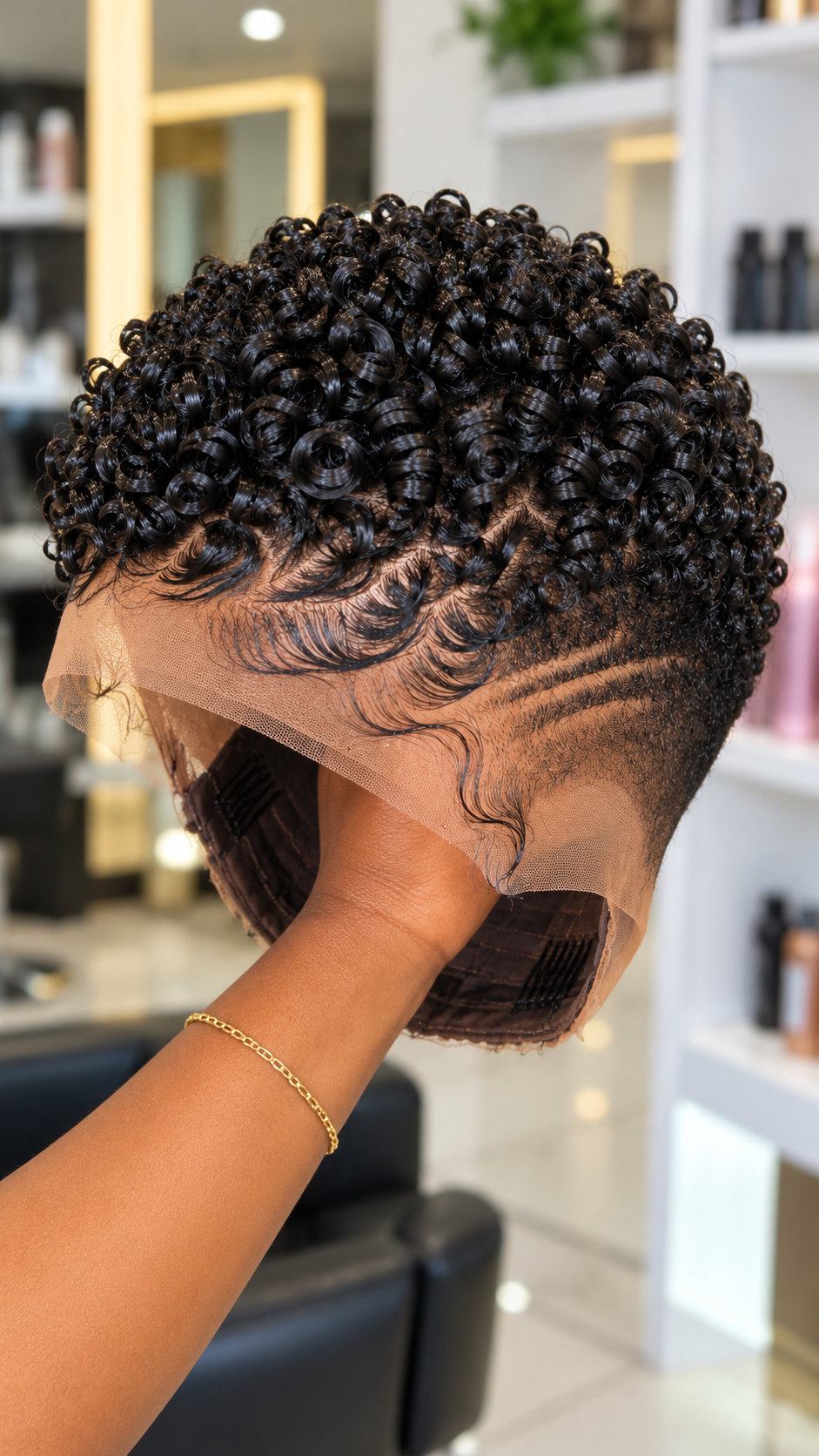
The most revealing detail in this obsidian-black wig is not the abundance of curls across its crown. It is the delicate relationship between those raised corkscrews, the intricate forehead swirls and the narrow lines crossing the temple. At first glance, the hairpiece appears to be a compact spiral pixie. Closer examination shows a carefully organized design in which different curl sizes, exposed partings and directional strands work together to create a distinctive silhouette.
The wig is displayed in one hand inside a bright salon, with its untrimmed lace extending around the front and sides. The dark brown interior foundation is partially visible beneath the hair, including a comb attachment near the lower edge. Unlike wigs whose crown consists of broad ribbon loops, this unit uses numerous tightly wound tubular curls. Several spirals have open circular ends, while smaller coils fill the spaces between them.
Its appearance is entirely within the black color family, with glossy charcoal reflections created by the light falling across the individual strands. Beneath the dense crown, sweeping forehead waves frame the front, and two closely spaced diagonal temple lines introduce a restrained geometric element. A long, tapered curl descends toward the lower side, completing the transition between the forehead and the compact perimeter.
The Crown Is Built From Tightly Wound Tubular Spirals
The upper hair contains numerous cylindrical curls arranged closely across a rounded foundation. Several resemble small springs, with multiple turns visible along their lengths and hollow openings at the ends.


The coils vary in diameter. Some are noticeably larger and more open, while others are compact enough to fill the spaces between neighboring formations.
This arrangement creates substantial crown detail without requiring long hanging hair. The curls remain concentrated around the upper head and gradually become smaller toward the lower side.
A custom wig maker should understand the difference between these tubular spirals and broad, loosely arranged ringlets. Using oversized curls throughout the crown would produce a different silhouette and reduce the closely packed appearance visible in the photograph.
The Individual Spiral Openings Create Depth
Many of the coils terminate in open circular centers. These openings allow dark recessed hair to remain visible beneath the reflective outer strands.
On a monochromatic black wig, this contrast is especially important. The raised curl surfaces catch light, while the spaces between them remain almost black.
Excessive density could cause the spirals to overlap until their winding patterns become difficult to distinguish.
For custom production, the objective should be balanced coverage with recognizable individual coils rather than simply maximizing the quantity of hair.
The Upper Curls Follow a Rounded Crown
The crown has a compact dome-like silhouette. Its curls are concentrated above the side styling, with the largest formations appearing across the upper and forward sections.
Smaller coils continue toward the rear, helping the hairstyle remain proportional rather than excessively tall.
A buyer commissioning this unit should request an overhead photograph before final approval. That view can help establish whether the spirals have been distributed evenly across the crown and whether the individual openings remain visible.
The supplied photograph does not show the entire back, so rear coverage should be verified separately.
Obsidian Black Makes the Strand Arrangement Stand Out
The hair appears predominantly deep obsidian black. Narrow glossy reflections create subtle charcoal tones along the curls, but no clearly separate blonde, copper or burgundy highlights are visible.
This restrained color palette places emphasis on curl shape, strand direction and the exposed temple details.
For buyers seeking a faithful reproduction, the color should remain within the black family without additional contrasting highlights.
A neutral-light photograph of the actual available hair can help distinguish natural black from blue-black or very dark brown.
The Forehead Swirls Are a Major Styling Element
The front perimeter contains several elongated strands arranged into feathered curves. These sections sweep across the forehead and gradually bend toward the temple.
Unlike the tubular crown curls, the forehead strands lie relatively flat against the foundation. Their finely separated appearance creates a delicate transition from the lace toward the raised upper hair.
The waves should not be treated as incidental baby hairs. They occupy a noticeable portion of the hairstyle and contribute directly to its face-framing appearance.
A professional recreating the wig should preserve their direction and relative length rather than trimming them into a conventional straight hairline.
The Front Waves Overlap in Different Directions
Several fine strands travel through broad curved routes, while neighboring sections form smaller inward turns. This creates a layered arrangement across the visible forehead.
The overlapping curves give the hairline visual movement without introducing large circular curls directly at the perimeter.
For custom styling, the maker should preserve the different wave lengths rather than shaping every section into one identical curve.
The front should appear deliberately arranged but not overcrowded.
The Temple Contains Two Narrow Parallel Etchings
Along the visible side, two exposed diagonal pathways cross the closely arranged black hair beneath the crown. Their relatively narrow width and similar direction create a restrained geometric accent.
The markings are positioned below the upper curls and above the compact lower side.
Unlike extensive barber artwork with several curved or angular motifs, this design relies on two clear, closely spaced lines.
A buyer requesting the same hairstyle should specify paired diagonal temple etchings rather than a generic shaved-side pattern.
The Dark Hair Between the Lines Must Be Preserved
The exposed temple channels remain distinguishable because a section of black hair separates them.
If the lines are widened excessively, the retained panel could become too narrow and the markings may begin merging visually.
This is particularly important on wigs because removed strands cannot naturally grow back.
A wig-cutting specialist should map the intended placement before trimming and preserve the existing widths during later maintenance.
The Side Uses Closely Arranged Black Hair
Beneath the tubular crown, the hair becomes more compact and follows the rounded foundation. This creates a tapered-looking transition without leaving the entire side bare.
The close hair provides a dark background for the exposed diagonal lines and the longer temple curl.
A custom maker should avoid extending the largest crown spirals throughout the lower side, because doing so could obscure the decorative details.
The lower section should remain populated but significantly flatter than the upper crown.
The Long Temple Curl Creates a Distinct Endpoint
One of the most recognizable details is an elongated black strand that descends near the temple before turning into a small inward curl.
This accent differs from the compact spiral crown and the paired diagonal lines. It creates a flowing connection between the feathered forehead waves and the lower perimeter.
Its scale should remain controlled. Enlarging it into a large decorative ring would change the side profile, while removing it would eliminate a distinctive feature.
A professional installer should check its final position after the wig has been placed on the wearer.
The Lace Remains Extended Around the Front and Side
The photograph shows beige-toned mesh extending beyond the front and lower side hair-bearing areas. The unit has not yet been trimmed for an individual wearer.
This extra material provides flexibility during professional fitting. The stylist can position the wig, evaluate the front waves and check the temple details before establishing the final lace boundary.
The apparent mesh shade may be influenced by the salon lighting and the hand beneath it.
The photograph does not establish HD lace or another specific commercial grade. Buyers should request the actual lace specification directly from the seller.
The Interior Cap Is Partially Visible
The open underside reveals part of a dark brown foundation with stitched sections and a visible comb attachment near the lower edge.
These details confirm that the hairstyle is constructed on a wig foundation rather than shown directly on a person’s natural hair.
However, the complete attachment and adjustment arrangement cannot be established from the photograph.
Before purchasing, ask the seller for a separate underside image of the actual unit.
The Visible Comb Does Not Establish Glueless Suitability
An internal comb may be part of a wig’s securing system, but its presence does not independently guarantee that the unit can be worn securely without adhesive.
Installation requirements depend on the complete cap construction, intended fastening system and fit.
Customers who prefer adhesive-free installation should ask the supplier to confirm whether the specific unit supports that method.
Any attachment preferences should be discussed before a custom wig is produced.
Cap Sizing Influences the Temple Artwork
The paired diagonal lines, forehead swirls and longer temple curl are fixed to the wig foundation. Their position changes if the cap moves forward or backward.
Correct sizing is therefore important for visual accuracy as well as comfort.
For made-to-order wigs, follow the manufacturer’s measurement guide. Depending on construction, circumference, front-to-nape and ear-to-ear dimensions may be required.
A professional wig stylist can help determine the appropriate size before ordering.
Where to Find a Maker Experienced With Corkscrew Crowns
Custom lace-wig studios, specialist wig makers and salons experienced with finger-coil styling are practical places to begin.
The professional should understand how to create numerous closely packed tubular spirals while maintaining individual curl openings.
Experience with precision temple cutting and feathered forehead waves is also important because the lower styling requires different techniques.
When evaluating a portfolio, look for close crown photographs and direct side images showing the actual hairline work.
Buying a Finished Wig Versus Commissioning the Design
A ready-made black curly wig may provide a suitable foundation, but it may not reproduce the exact corkscrew arrangement, paired temple lines or elongated front swirls.
Custom production gives buyers greater control over curl diameter, line placement and the direction of the hairline strands.
However, that work may require additional professional labor and production time.
Before purchasing, confirm whether the seller provides the complete hairstyle or only a base wig requiring further customization.
Preparing a Custom Order With the Correct Details
The crown should contain densely arranged black tubular spirals with varied diameters and clearly visible circular openings.
The forehead should have elongated feathered waves that flow toward the temple.
The side should contain two narrow diagonal exposed lines above a compact lower section.
A longer curled strand should descend near the temple and turn inward at its endpoint.
Finally, confirm hair material, cap size, lace specification, attachment preferences and intended installation method.
Approval Photographs Should Prioritize the Hairline and Side
An elevated crown photograph should show the distribution of tubular spirals and their open centers.
A direct side view should reveal the paired diagonal lines and the longer temple curl.
A frontal photograph should document the overlapping feathered waves.
A rear photograph can confirm that the spiral crown continues coherently toward the nape.
An underside image should establish the complete cap construction.
Pricing Depends on Spiral Setting and Hairline Detail
The wig has a compact length and a single black color, but its crown contains numerous individually wound curls. The feathered front, paired side lines and lace preparation can require additional professional work.
Estimated Pricing for Obsidian Corkscrew Pixie Wigs
| Category | Illustrative Price Range | Potential Scope |
|---|---|---|
| Premium Custom | $325–$590+ | Higher-grade hair, personalized cap sizing, individually arranged corkscrew crown, detailed forehead waves, paired temple etchings and lace preparation. |
| Standard Custom | $195–$350 | Prepared black spiral crown, established front styling, twin temple lines and standardized cap options. |
| Basic Human Hair | $115–$210 | A human-hair foundation requiring coil setting, temple detailing and professional fitting. |
| Premium Synthetic | $80–$155 | A quality pre-set alternative that may maintain the tubular coil arrangement with comparatively limited professional resetting. |
| Basic Synthetic | $40–$90 | A budget interpretation where coil definition, front-wave detail, side-line accuracy or cap construction may be simpler. |
These figures are illustrative budgeting estimates rather than verified prices for the photographed wig. Actual quotations depend on material, supplier, location, customization labor, cap construction, shipping and installation.
Before comparing sellers, confirm whether the completed corkscrew crown, front waves and paired temple lines are included in the quoted amount.
Human Hair May Allow Selective Curl Restoration
A human-hair version may allow individual corkscrews to be reset when they lose their shape, depending on the condition of the strands.
The feathered front waves can potentially be maintained separately from the tubular crown.
Heat should be selected according to the actual hair quality and processing history.
Premium Synthetic May Preserve the Pre-Set Coils
A quality synthetic version may retain its tubular curl arrangement with relatively limited daily styling.
However, heat tolerance varies by fiber, and conventional permanent coloring should not be assumed compatible.
The manufacturer’s material specification should guide maintenance decisions.
Washing Should Protect the Individual Spiral Windings
Before the first wash, photograph the crown from above to record the original coil arrangement.
During cleansing, avoid aggressive rubbing that can intertwine neighboring spirals and obscure their openings.
Use care methods appropriate for the confirmed material.
After drying, restore only the curls that have shifted.
The Forehead Swirls Need Separate Care
The fine front strands should retain their elongated directional movement rather than being rolled into additional tubular curls.
If a wave becomes displaced, guide it back along the original route using material-appropriate styling methods.
Heavy holding products can cause neighboring strands to adhere together and reduce the layered appearance.
The Temple Lines Should Not Be Widened Repeatedly
The two exposed diagonal channels are permanent elements of the wig and do not require automatic recutting during routine maintenance.
If fine hair moves across the openings, careful repositioning may restore the original appearance.
When professional refinement is necessary, use the original side photograph to preserve line width and spacing.
Protect the Long Temple Curl
The descending curled strand near the lower side is relatively delicate compared with the compact crown.
It should be protected from excessive rubbing, pulling and heavy styling product.
If the curl loses its direction, a professional may be able to restore it using techniques appropriate for the confirmed hair or fiber.
Maintain the Black Shine Without Excess Residue
The glossy coils already reflect light strongly. Heavy oils and waxes can make neighboring curls adhere together and reduce their individual outlines.
Use care products appropriate for the confirmed material.
When buildup becomes noticeable, suitable cleansing may restore the separation more effectively than applying additional shine product.
Installation Should Preserve the Fine Front Arrangement
When the wig arrives, inspect the spiral crown, forehead swirls, temple lines, lace and cap before permanent alterations.
The installer should establish the correct wearing position and verify where the longer temple strand falls.
Only after that alignment is approved should excess lace be trimmed and optional refinements considered.
Storage Should Support the Rounded Corkscrew Crown
A suitable wig stand or mannequin head can help preserve the upper spiral arrangement between wears.
The side should remain free from pressure that could disturb the fine temple strands or cover the exposed lines.
Make sure the cap and lace are fully dry before storage.
For transportation, choose packaging that allows sufficient clearance around the crown.
The Wig’s Character Comes From Fine Details Around a Dense Crown
This obsidian-black wig combines tightly wound tubular spirals, intricate forehead swirls, paired diagonal temple lines and a distinctive descending curl near the lower side. The crown creates circular texture and volume, while the finer front and side strands provide the face-framing detail.
For buyers, the essential quality checks are spiral diameter, visible curl openings, forehead-wave direction, temple-line spacing, longer side-curl placement, lace condition and cap fit.
For wig businesses, detailed crown, front and side photography can communicate the craftsmanship more accurately than a general description of a black curly wig. Verified material specifications and clear product information support better purchasing decisions.
A faithful reproduction should preserve the compact black spiral crown and delicate hairline arrangement without adding unnecessary highlights, oversized curls or unrelated side artwork. The design’s identity lies in the balance between dense circular coils and precise directional strands.
Search Terms
obsidian black corkscrew pixie wig · feathered forehead swirl lace wig · twin diagonal temple etchings · narrow tubular spiral crown · black curled temple strand wig · compact sculpted coil hairpiece · visible interior comb lace wig · untrimmed lace black spirals