
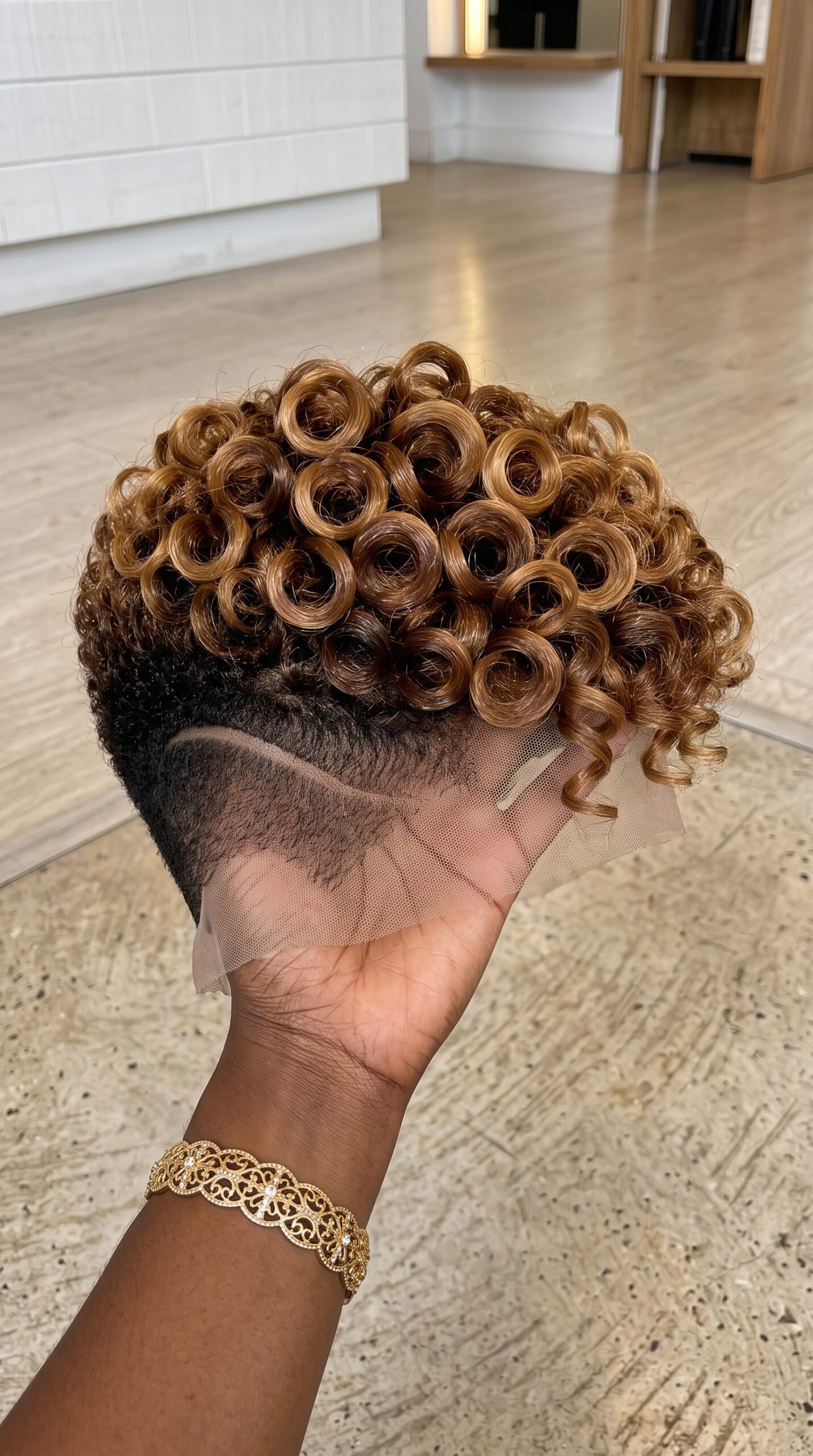
Most buyers see the light coils and assume the colour is the hard part. The dark root is the part that actually decides whether the unit melts. This short spiral sits in a warm honey-caramel tone with a clearly deeper root zone that transitions into the brighter coils. The lace is left long, the edge is soft, and the coils are tight and uniform. What looks like a simple colour choice is a deliberate root-melt construction that does more practical work than the highlight itself.
On a short dense unit the root zone sits right against the lace and the forehead. A solid light colour in that zone makes every knot and every millimetre of lace more visible. A darker root creates an immediate shadow that helps the lace disappear and gives the brighter coils a place to start from. The eye reads dimension; the lace gets a free assist.
Where To Buy This Honey Rooted Pixie
Custom makers
Makers who specialise in short curly units with controlled root melts are the most reliable source. Ask for a honey or caramel coil with a deep root that is blended rather than a hard line. Request close-ups of the root zone under natural light so you can see how cleanly the transition sits against the lace.
Instagram and TikTok sellers
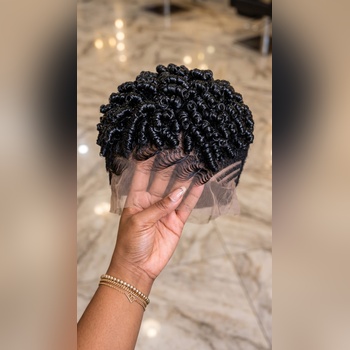
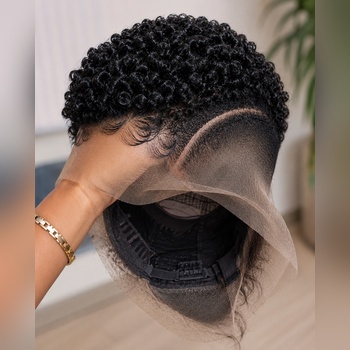
Search terms such as “rooted honey curly pixie”, “caramel spiral dark root”, and “honey coil lace front” surface accounts that show the root placement clearly. Prioritise sellers who post side and three-quarter angles, not only the top of the curls.
Etsy
Filter for short curly lace fronts that specify a rooted or ombré construction in warm tones. Read the description for language about root depth and blend. Avoid listings that only show the lightest part of the coil.
Marketplaces like Amazon, AliExpress, and Temu
These platforms carry honey and caramel short curly units, but root placement varies widely. Some have a clean graduated melt; others have a blunt colour change or almost no root at all. Check recent reviews that mention the root and the lace.
Local beauty supply shops and salons
If a shop stocks short curly lace fronts in warm tones, hold the unit and examine the root zone under bright light. A good melt shows a gradual shift from deep root into the brighter coil without a harsh line.
Vendors and wholesalers direct
Wholesale sources can supply this construction in volume. Request a sample that shows the exact root depth and blend before placing a larger order.
Regionally (Lagos, Accra, Atlanta, London, South Africa)
These markets produce large numbers of short curly units in rooted warm tones. Local maker networks often allow in-person inspection of the root placement and lace match before purchase.
Vet the seller
Ask for a clear photograph of the root zone against the lace, not only the brightest coils. The transition should look gradual. Confirm whether the root is dyed into the hair or achieved with a different fibre placement.
Red flags
Listings that never show the root area clearly. Units photographed only from above with the lace hidden. Descriptions that call every warm-toned unit “rooted” without visual proof of a deeper zone. Prices that undercut the market while claiming a hand-blended root melt.
When you order, send
Your preferred root depth, how soft you want the transition into the honey coils, and a note that the root should help the lace melt rather than sit as a separate band. Clear instructions reduce the chance of receiving a solid light unit.
Contact / order inquiries: WhatsApp [WhatsApp: +XX XXX XXX XX XX]
How Much It Costs
Tiered pricing
Human-hair versions with a controlled dark root and honey-caramel spiral typically range from $180 to $420. The root-melt work and the lighter pigment both add cost compared with solid black. Mid-range human units land around $150–290. Basic human or mixed-fibre pieces start near $100–170. Good synthetic versions that hold the tight coil and a believable root transition usually fall between $70 and $145. Entry-level synthetic can be found from $35 to $75.
What that includes and excludes
The quoted price covers the unit with the root melt already finished and the lace left long for trimming. It rarely includes extra bands, additional styling product, or later colour correction. Shipping and duty sit outside the base figure.
Shipping and duty
International shipping commonly adds $15–50. Duty and tax vary by country and can add 10–25 % of the declared value. Factor both into the true landed cost.
Ongoing costs
The lighter coils fade faster than a solid dark unit and may need occasional toning to prevent brassiness. The dark root is more stable but still requires gentle cleansing at the lace edge. Budget $45–85 per year in maintenance and colour-care products if the unit is worn several times a week.
First-year total
Unit price + shipping + duty + one year of products. A solid mid-range human rooted honey spiral often lands between $260 and $520 for the first twelve months.
Cost per wear
At three wears a week the mid-range unit costs roughly $1.70–$3.40 per wear in the first year. After that the major outlay is behind you, provided the root stays clean and the coils do not mat or fade unevenly.
What a very low price signals
A dense honey spiral with a perfect dark root offered well below market usually means the root is a surface stain or the lighter pigment is unstable. Extremely low prices almost always mean the colour will shift or the root will look disconnected after the first few washes.
Deposit structure
Custom makers typically request 30–50 % to begin, with the balance due before shipping. Use a payment method that allows dispute if the finished root melt does not match the depth and blend you requested.
Shipping, Delivery, And What To Expect After Ordering
Ready-to-ship units usually leave within a few business days. Custom root-melt work takes 2–5 weeks depending on the maker’s queue. Once shipped, most international orders arrive in 7–18 days. On arrival, open the unit under natural light and check the root zone first. The transition from deep root into the honey coils should look gradual and sit cleanly against the lace. If the root is missing, too light, or ends in a hard line, contact the seller with clear photographs before any washing or trimming.
The Root Is A Shadow That Helps The Lace
On a short unit the hairline sits close to the face and is visible in every forward-facing view. A solid light colour in that zone has nowhere to hide. Every knot, every bit of lace mesh, and every slight density variation becomes more obvious because there is no darker frame around it. A deeper root creates an immediate shadow band. That shadow does two things at once: it makes the brighter coils look more dimensional, and it gives the lace a darker backdrop that helps it disappear against most skin tones.
The effect is strongest when the root is graduated rather than a hard block of colour. A soft melt looks like natural regrowth. A hard line looks like a colour placement error. When you evaluate the unit, look at the root under the same daylight you will wear it in. The product photograph shows a clean, soft transition that sits right at the lace edge — that is the standard to demand.
Why Short Curly Units Benefit More Than Long Ones
On longer styles the root can be partially hidden by the length and movement of the hair. On a short dense spiral the entire root zone is exposed. There is no length to fall over it and no heavy fringe to cover it. The root therefore has to work harder. A well-executed dark root on a short honey unit is not a decorative ombré. It is a functional element that improves the melt and protects the realism of the hairline.
Colour Stability And The Lighter Coils
Honey and caramel tones are more vulnerable to fading and brassiness than solid black or deep brown. The lighter the coil, the more porous the hair tends to be after the lift or deposit process. The dark root, by contrast, is usually more stable. Over time the contrast can increase if the coils lighten while the root holds. That shift is manageable with toning, but it is a maintenance reality that solid dark units do not share. Buyers who love the bright coil should budget for occasional colour refresh, especially if the unit is worn in strong sun or washed frequently.
Soft Edge And Root Working Together
This unit uses a soft, non-carved hairline. The dark root and the soft edge reinforce each other. The root provides the shadow; the soft edge keeps the transition natural rather than graphic. Together they produce a hairline that looks less “designed” and more like short natural hair with a grown-out colour. The absence of a hard part or multi-line carve also leaves the unit free to be shifted or parted without a permanent side pattern fighting the new angle.
Before You Pay
Does the seller provide a clear photograph of the root zone against the lace, not only the brightest coils?
Is the transition from dark root into the honey coils gradual, or does it end in a hard line?
How deep is the root relative to the overall length of the coil, and does that depth suit your preferred melt?
Are the lighter coils even in tone, or do they show patchy lift or brassiness already in the product photo?
After the first wash, will the root still sit cleanly against the lace, or does the seller warn that the colour can migrate?
Trimming The Lace
Leave the excess lace in place until the unit is on your head and the root zone is positioned exactly where you want the hairline to sit. The dark root should align with your natural hairline shadow. Trim gradually with sharp lace scissors. Do not cut into the knotted area. Once the lace is removed, the placement of the root relative to your forehead is fixed.
Search Terms
rooted honey curly pixie · caramel spiral dark root · honey coil lace front rooted · warm tone short curly root melt · dark root honey pixie · soft edge caramel spiral · rooted blonde brown curly unit · dimension root short spiral
Final Thoughts
The light coils are what first catch the eye on this unit. The dark root is what makes the unit wearable. On a short dense spiral the root zone sits in the most visible place on the head. A deeper, softly blended root gives the lace a shadow to hide against and gives the brighter coils a natural starting point. Without it, the same honey colour would sit more harshly against the forehead and expose every detail of the lace.
Evaluate the root with the same attention other buyers give to the brightest part of the coil. If the melt is clean, graduated, and deep enough, the unit gains both dimension and a better chance of melting. If the root is missing or ends in a hard line, the colour becomes a liability rather than an asset. On a short honey spiral the root is not background. It is the working part of the colour.