
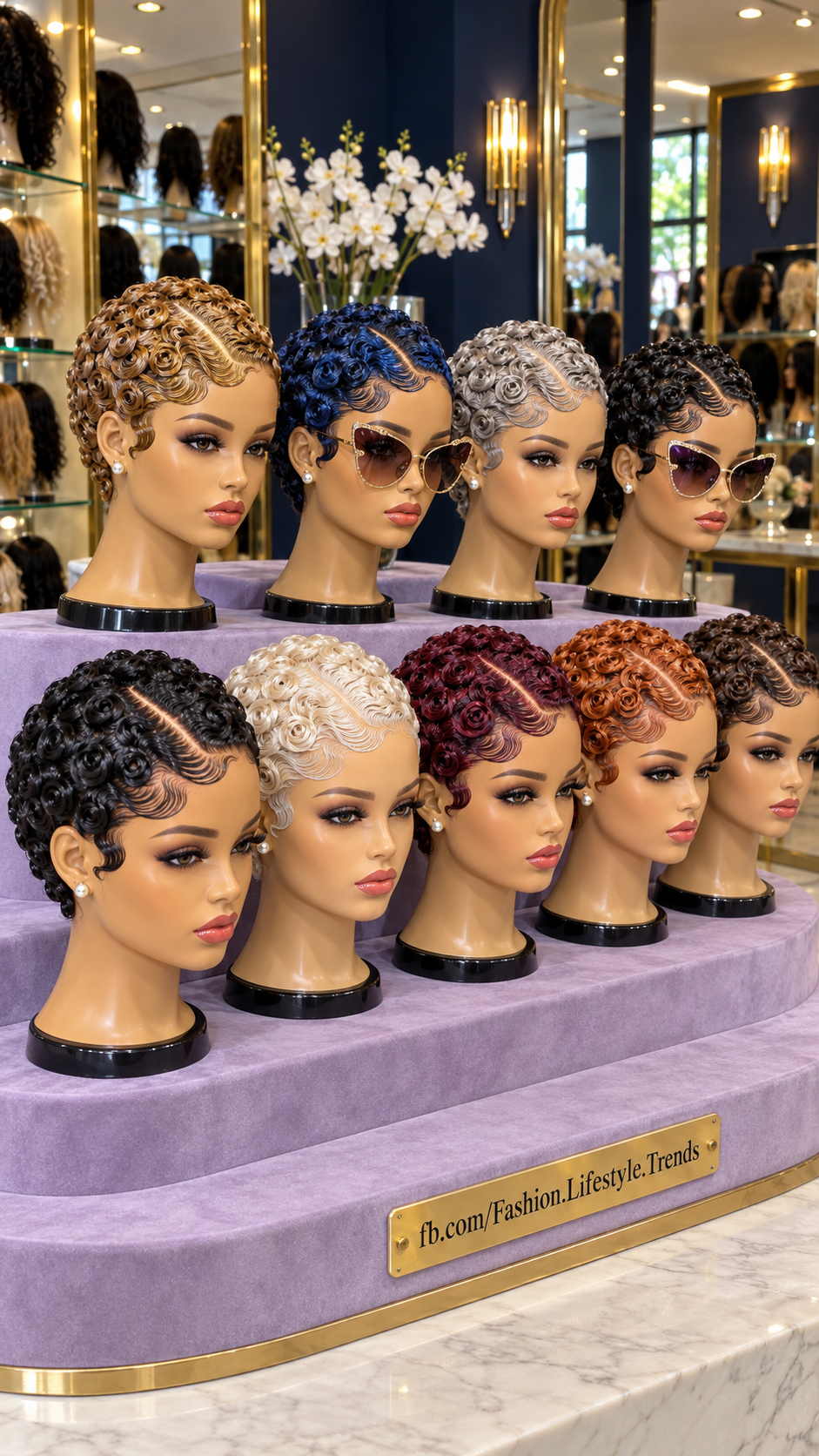
Finding a pixie wig that looks beautiful in a photograph is easy. Finding one that delivers the right color, curl arrangement, comfortable fit, and professional finish takes considerably more attention. This collection of nine sculpted pixie wigs offers an excellent opportunity to compare those details before making a purchase. Displayed on a lavender velvet podium inside an elegant beauty boutique, the hairstyles combine glossy circular rosette curls, sweeping finger waves, and diagonal side partings in nine distinctive color presentations.
The selection includes golden caramel brown, royal blue, silver gray, two black variations, creamy platinum blonde, burgundy, copper auburn, and deep chocolate brown. Four mannequin heads occupy the upper level, while five stand along the lower platform. Their closely arranged curls create a recognizable hairstyle family, but differences in curl diameter, front wave placement, and color intensity make each presentation worth examining individually.
The most useful question for a potential buyer is not simply which color looks best. It is whether the hairstyle can be purchased in the exact form shown, whether the cap will fit properly, and whether the carefully arranged curls can be maintained after installation. A wig that looks exceptional on a mannequin may require professional customization before it achieves a similar appearance on a person.


This article examines the nine hairstyles from a buyer’s perspective, explains how to compare their visible characteristics, and outlines practical steps for finding a similar wig through local beauty suppliers, online retailers, independent wig makers, and professional salons.
Understanding the Nine-Wig Collection
The display is organized across two lavender velvet levels. Four mannequins occupy the raised rear platform, and five are positioned along the lower curved section.
The upper row begins with a golden caramel-brown pixie on the left. Next is a saturated royal-blue version, followed by silver gray and glossy black. The blue and black mannequins wear sunglasses, while the other two leave their faces unobstructed.
The lower row contains a second black wig, creamy platinum blonde, burgundy, copper auburn, and deep chocolate brown.
All nine wigs share a compact rounded silhouette with circular curls arranged across the crown and sides. A diagonal parting is visible on each hairstyle, separating the raised curls from flatter, carefully directed hair near the forehead.
Despite their similarities, the wigs should not be treated as identical products. The front rosettes vary slightly in size, and the finger waves follow different curves around the temples. The golden caramel version, for example, displays numerous prominent circular openings, while the lower black wig appears more densely packed across portions of its crown.
The photograph establishes the appearance of the displayed hairstyles, not their manufacturing specifications. No fiber labels, cap measurements, lace classifications, or product prices are visible.
Golden Caramel Brown for a Warm Everyday Look
The upper-left mannequin wears a golden caramel-brown pixie with numerous compact circular curls. The color contains warm amber and brown reflections, giving the hairstyle depth without relying on dramatically contrasting color panels.
Its upper rosettes are arranged closely together, with several larger circular openings visible near the front and upper side. Smaller coils fill the surrounding spaces, maintaining a compact silhouette.
A diagonal parting travels backward from the front-side area. Beneath it, fine strands follow a sweeping finger-wave pattern that curves toward the temple.
This color may appeal to women who want a warm hairstyle that is lighter than chocolate brown but deeper than conventional blonde.
When discussing the shade with a seller, avoid relying on the word caramel alone. Some suppliers use that name for golden blonde, while others apply it to medium brown with warm highlights.
Request a photograph under neutral daylight and ask whether the color is uniform or contains intentional variations. The boutique lighting makes the curls appear especially glossy, so daylight confirmation is useful.
Royal Blue for a More Expressive Pixie
The second mannequin on the upper platform displays a rich royal-blue pixie with closely arranged circular rosettes.
The blue appears saturated and relatively deep, with brighter reflections across the outer strands. Its dark interior curl openings create contrast that emphasizes the circular arrangement.
The diagonal parting is clearly visible near the front-side area, where the upper curls transition into decorative waves along the forehead.
The mannequin wears sunglasses, partially covering the face but leaving the upper hairline and much of the curl arrangement visible.
This version is suitable as a visual reference for customers who enjoy expressive colors without choosing long extensions.
However, royal blue, cobalt blue, navy, and electric blue are different color requests. A seller may use those descriptions inconsistently.
Before ordering, request a sample photograph of the exact shade and confirm whether the color is available in the desired fiber category.
If a custom unit requires coloring, ask the maker whether the chosen material supports the proposed process. Conventional dyeing methods should never be assumed appropriate for synthetic fibers.
Silver Gray with Beautiful Metallic Reflections
The upper-row silver wig offers a noticeably cooler appearance than the warm brown and copper alternatives.
Its curls are compact and closely arranged, with several open circular formations near the front. The light silver shade makes the individual strands particularly visible.
The diagonal parting creates a curved division between the upper rosettes and the flatter finger-wave section beneath them.
Near the forehead, fine silver strands follow carefully arranged curves that complement the upper hairstyle.
Silver gray can be an attractive option for customers who want a light-colored pixie without the golden warmth of honey blonde.
However, silver, ash gray, pearl gray, and platinum blonde should not be treated as interchangeable.
The photograph shows a cool silver-gray appearance, but it cannot establish the exact color formula or whether the fibers were processed to achieve that shade.
For a custom order, ask for neutral-light photographs and discuss how much darker gray should remain between the curls.
Two Black Pixies with Different Curl Impressions
The collection includes two black wigs, one at the upper right and another at the lower left. Their inclusion provides a useful comparison because similar colors can still produce different visual impressions through curl placement.
The upper black version contains numerous circular rosettes arranged across a compact crown. Its diagonal parting is prominent, and the front strands form decorative waves near the forehead and temple.
The lower black version appears particularly dense across portions of its upper surface. Several larger rosettes remain visible, while smaller curls fill the surrounding areas.
Both wigs appear predominantly black, with bright reflections along the curved strands. These reflections should not be mistaken for verified highlights.
The upper mannequin wears sunglasses, while the lower mannequin does not. This makes the lower version especially useful for evaluating the relationship between the hairstyle and the face.
Customers interested in black pixie wigs should compare the curl arrangement rather than assuming that every black version will produce the same result.
Ask the supplier whether the available unit matches the upper or lower reference and request an individual photograph before purchasing.
Creamy Platinum Blonde with Delicate Front Waves
The second mannequin in the lower row wears a pale creamy-platinum pixie with numerous circular curls.
The light shade creates strong visibility between individual strands, allowing the rosettes to stand out across the crown.
Several larger curls appear near the upper front, while smaller spirals continue toward the sides and rearward portion.
A diagonal parting separates the raised curls from the flatter finger-wave styling near the forehead.
The front waves appear delicate and closely arranged, with individual strands following curved paths toward the temple.
This version may appeal to women who prefer a light blonde hairstyle with a compact silhouette.
Before ordering, distinguish creamy platinum from icy platinum, pearl blonde, and champagne blonde. The differences may be subtle in photographs but noticeable under daylight.
Also ask whether the shade is available as a finished product or requires additional coloring. The answer can affect both price and maintenance expectations.
Burgundy Curls with Rich Wine-Red Depth
The center mannequin in the lower row displays a burgundy pixie with glossy circular rosettes.
The color contains deep wine-red and dark cherry reflections. The curls appear brighter along their outer surfaces, while the spaces between them remain darker.
A diagonal parting separates the raised curls from the carefully arranged front hair. Fine strands follow sweeping curves near the forehead and temple.
The burgundy shade creates a different impression from the copper-auburn wig beside it. Burgundy has a deeper wine-colored appearance, while copper auburn emphasizes warmer orange-brown tones.
For buyers who prefer red-based hairstyles, that distinction is worth confirming before purchase.
A supplier may describe several shades as burgundy even when their undertones differ substantially.
Ask whether the desired result should lean toward dark wine, cherry burgundy, or plum burgundy.
If the wig contains color-treated human hair, request guidance about color preservation. If it contains synthetic fibers, ask how the manufacturer recommends maintaining the appearance without applying unsuitable dye or heat.
Copper Auburn Creates a Warm Salon Statement
The fourth mannequin in the lower row wears a copper-auburn pixie with numerous compact rosette curls.
Its color contains rich copper and reddish-brown reflections, giving the hairstyle a warm appearance.
The upper curls form a rounded silhouette, with several larger circular openings near the front and smaller coils continuing toward the visible side.
A diagonal parting creates a visible division between the raised curls and the decorative finger-wave styling.
Near the forehead, the strands follow sweeping curves that frame the face without extending into long loose curls.
This color may appeal to women who enjoy warm hair tones but prefer a shade that appears more brown-based than bright scarlet.
When ordering, distinguish copper auburn from cinnamon brown, ginger copper, and reddish chestnut.
The exact color should be approved using an actual sample or neutral-light photograph rather than a generic product description.
Deep Chocolate Brown for a Refined Dark Pixie
The lower-right mannequin completes the collection with a deep chocolate-brown pixie.
The color appears dark and warm, with subtle brown reflections across the circular curls.
Several larger rosettes are visible near the front, while smaller formations fill the surrounding crown.
A diagonal parting separates the upper curls from the flatter front styling, and fine strands follow curved paths toward the temple.
This version offers an alternative for customers who prefer dark hair without choosing black.
Chocolate brown can vary from medium warm brown to very dark espresso-like shades, so the exact tone should be confirmed before ordering.
For a custom unit, ask whether the color should remain uniform or include subtle tonal variation. The photograph does not establish whether its lighter reflections are intentional highlights.
The Real Value of Comparing Curl Density
One of the most useful lessons from this collection is that curl density changes the appearance of a pixie even when the overall haircut remains similar.
Some wigs display larger circular openings, allowing the viewer to distinguish individual rosettes immediately. Others contain smaller coils packed closely together, creating a denser upper surface.
Neither arrangement is automatically better. The choice depends on the desired silhouette and the amount of visible curl detail.
Larger rosettes may create more prominent individual shapes, while smaller coils can make the crown appear fuller.
The relationship between curl diameter and crown height is equally important. Increasing the curl size without adjusting placement may create an excessively tall or wide hairstyle.
For custom production, ask the maker to reproduce the proportions of the selected mannequin rather than simply requesting maximum volume.
A close photograph taken from above can help confirm the distribution of the curls before final approval.
Why the Diagonal Parting Matters
The diagonal parting is a recurring visual element across the nine hairstyles, but its exact placement varies.
Each visible separation divides the raised circular curls from the flatter hair near the forehead.
The angled direction creates an asymmetrical appearance that differs from a conventional center part.
In some wigs, the separation appears longer and more pronounced. In others, nearby curls partly conceal its rearward continuation.
This difference influences how the front waves are arranged and how the hairstyle frames the face.
When commissioning a custom wig, select one mannequin as the primary reference and specify its parting direction.
The photograph does not establish the exact technique used to create these separations, so the maker should explain how the requested appearance will be achieved.
Finger Waves That Complement the Rosette Crown
The front hairline styling provides a delicate contrast to the raised circular curls.
Fine strands follow sweeping curves near the forehead and temples, creating decorative waves that remain close to the head.
These sections differ from loose ringlets because their strands follow coordinated directions rather than hanging freely.
The waves also vary between mannequins. Some are broader and more pronounced, while others remain narrower and closer to the hairline.
For customers who want a particular appearance, the front wave arrangement should be discussed separately from the upper curls.
A generic request for baby hairs may not communicate the desired result accurately.
Ask the stylist to preserve the direction and scale of the selected reference rather than adding unrelated decorative swirls.
Where to Find Out About These Pixie Wigs
The photograph shows a boutique display, but it does not establish the seller’s current inventory, prices, shipping destinations, or purchasing conditions.
Customers interested in comparable hairstyles can begin with specialized wig boutiques, beauty supply stores, online wig retailers, and independent wig makers.
Search descriptions should combine the preferred color with the distinctive curl structure. For example, a customer interested in the silver version could search for a silver rosette pixie wig with finger waves.
Someone interested in the burgundy version could search for a wine-red circular curl pixie with a diagonal part.
When comparing online listings, prioritize photographs of the actual product rather than relying solely on promotional images.
A product described as a curly pixie may contain ordinary loose curls rather than the compact rosettes visible in this collection.
Ask whether the displayed hairstyle is available as a ready-made unit or requires custom production.
Questions Worth Asking Before Paying
Before purchasing, identify the exact mannequin hairstyle that interests you and request photographs of that individual wig.
Ask for a direct front view, both sides, the complete rear, and an underside photograph.
The underside is especially important because the mannequin display does not reveal the cap construction.
Confirm the hair material, cap measurements, attachment components, and any lace specifications.
Do not assume that a natural-looking mannequin hairline proves HD lace, human hair, or adhesive-free construction.
Ask whether the curls are intended to retain their arrangement after washing and whether the supplier provides maintenance instructions.
For international purchases, confirm shipping charges, delivery estimates, customs responsibilities, and return conditions.
If the wig is custom-made, request written confirmation of the color, curl diameter, parting direction, and included styling services.
Choosing Between a Finished Wig and a Custom Order
A ready-made wig may be the most convenient option when the desired color and curl arrangement are already available in a suitable cap size.
However, the exact combination of rosette curls, diagonal parting, and front waves may not be available in every color.
Custom production allows the buyer to request specific adjustments to curl diameter, crown density, color, and hairline styling.
The trade-off may involve additional cost and longer production time.
Before choosing either route, determine which characteristics are essential and which minor differences would be acceptable.
For example, a customer may prioritize the silver-gray color while accepting slightly smaller curls. Another may insist on the exact rosette arrangement but remain flexible about the shade.
Communicating those priorities clearly can reduce misunderstandings during production.
Illustrative Prices for Rosette Pixie Wigs
The price of a comparable wig depends on factors that cannot be verified from the photograph, including fiber composition, cap construction, customization requirements, and the labor involved in arranging the curls.
The following US dollar amounts are illustrative planning ranges, not verified current selling prices for any of the nine displayed wigs.
| Wig Category | Illustrative USD Range | Possible Cost Considerations |
|---|---|---|
| Premium Custom | $375–$950+ | Individual cap measurements, detailed rosette curl placement, personalized color work, and specialist finger-wave styling. |
| Standard Custom | $195–$475 | Adjustments to curl diameter, crown density, diagonal parting, color selection, and cap sizing. |
| Basic Human Hair | $115–$325 | A human-hair base unit that may require additional professional curl setting, coloring, and front styling. |
| Premium Synthetic | $80–$240 | Higher-grade synthetic options with potentially prearranged rosettes and decorative front waves. |
| Basic Synthetic | $30–$125 | Budget alternatives with potentially fewer options for exact curl placement and personalized fitting. |
These categories describe possible purchasing approaches and do not establish the material of the photographed wigs.
Installation, shipping, lace preparation, cap adjustments, and future curl restoration may be charged separately.
Custom colors such as royal blue or burgundy may also involve additional charges if the requested shade is not