
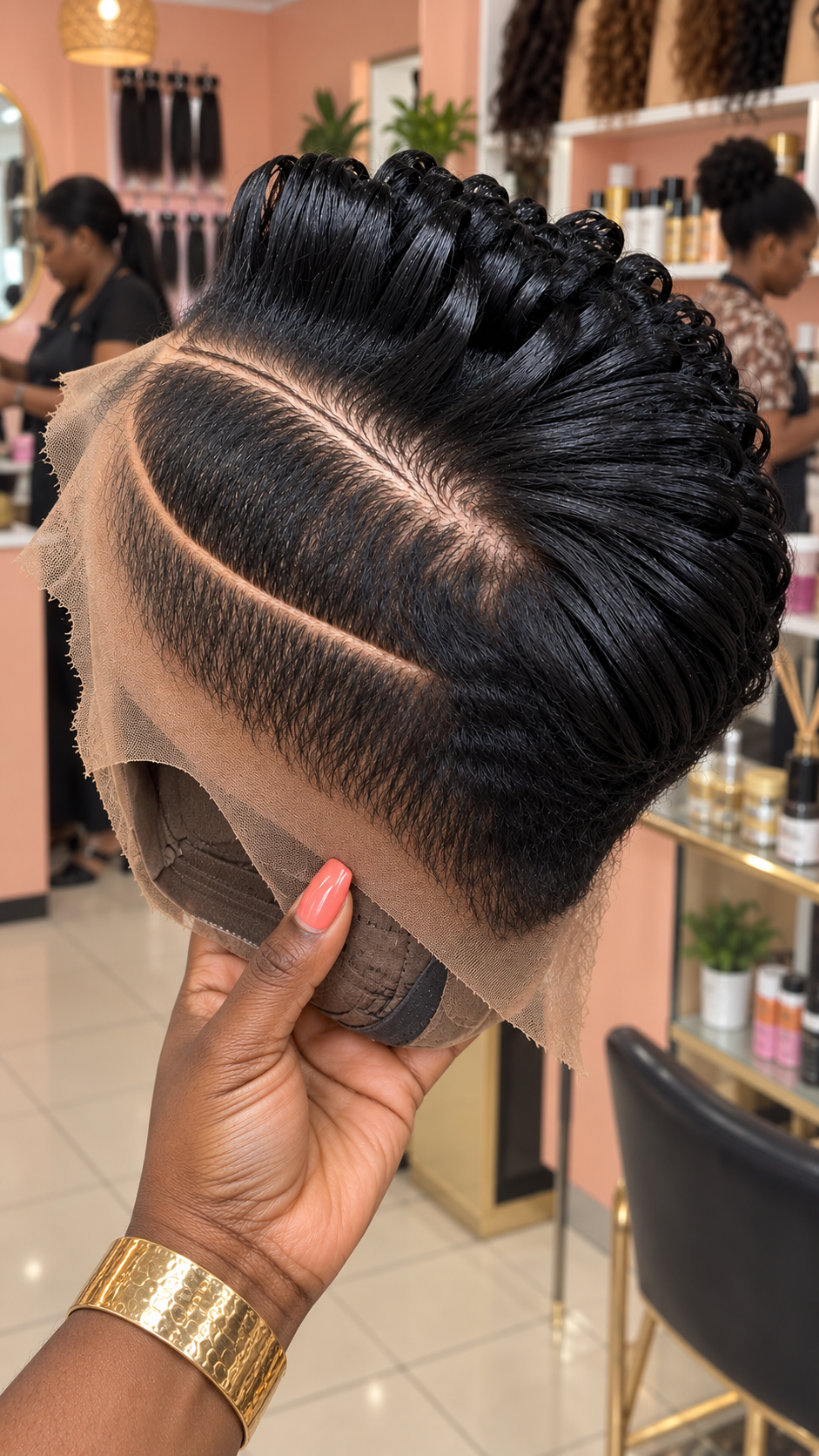
This natural-black wig takes a noticeably more restrained approach to side detailing than many carved-side designs. Instead of filling the lower section with several decorative paths, it relies on one long sweeping curve to establish the profile. Above that line sits a compact dark panel, followed by a narrow separation beneath the sculpted crown. The upper hair then changes direction completely, rising into broad loop formations before becoming tighter toward the back. The simplicity of the side is precisely what makes the proportions important: there are fewer elements available to disguise an inaccurate curve, an oversized crown or poorly controlled density.
The photograph also gives a clear view of the wig before installation. Untrimmed lace extends beyond the hair-bearing perimeter, while part of the inner cap can be seen underneath. Fine strands occupy the front and lower side before density increases toward the crown. Lace is visibly part of the construction, but its exact grade cannot be established from the image, so there is no reliable basis for labeling it HD lace without confirmation from the maker.
One Side Curve Carries More Responsibility Than Several Smaller Lines
The dominant side detail is a long exposed curve beginning near the forward portion of the wig and traveling downward and backward. It is neither horizontal nor sharply diagonal. Instead, it follows the rounded profile of the unit, gradually changing direction as it approaches the rear.
Because there is only one major lower curve, its placement becomes particularly important. With a busier pattern, several lines can collectively create visual movement. Here, the single path has to establish that movement by itself. Making it substantially straighter would change the personality of the side, while placing it too close to the crown would compress the dark panel above it.
The width also needs restraint. The exposed path is clearly visible, yet enough black hair remains above and below it to maintain two separate dark areas. A barber recreating the design should preserve those areas rather than widening the channel for extra emphasis.
A Dark Panel Creates Space Between the Crown and Lower Curve
Immediately beneath the crown is a broad section of closely controlled black hair. This panel gives the profile visual weight and prevents the sculpted upper portion from appearing disconnected from the lower side. Its density is deliberately different from the large loops above: the strands lie much closer to the foundation and follow the cap rather than projecting outward.
A narrow exposed separation runs along the upper edge of this dark panel. That separation marks the point where the larger crown begins. The combination is therefore more sophisticated than simply having a shaved line beneath a hairstyle. There is a sequence: raised crown, narrow division, compact black panel, sweeping lower curve and then another close section near the perimeter.
When ordering from a custom maker, describing this hierarchy is more useful than asking for “a black wig with one line.” The latter could result in a completely different distribution of hair.
The Crown Begins With Tall, Elongated Bends
The forward crown is dominated by long sections that rise relatively high from their roots before folding backward. Their shape is closer to an elongated bend or loop than a conventional round curl. Several sections sit beside one another, creating a repeating rhythm across the upper surface.
The hair remains natural black throughout these areas. Because there are no contrasting highlights, the loops become visible through reflection and shadow. Light catches the outer surface of each raised section, while the spaces between them remain darker. This makes separation an essential part of the crown construction.
If those sections were brushed together, much of the visible architecture would disappear even though the length and color remained unchanged. For that reason, a buyer assessing a custom version should look at the spacing between crown sections rather than judging only whether the hair appears glossy.
The Back Uses Smaller Loops to Reduce Bulk
The crown does not maintain the same scale from front to rear. Moving backward, the larger sections become increasingly compact and smaller curled ends appear around them. This allows the styling to follow the rounded rear of the cap without producing excessive projection.
That change is especially important for the side silhouette. A crown made entirely from the larger forward loops could create a bulky rear profile. The tighter work shown here reduces the scale gradually and gives the styling a natural visual endpoint.
Custom buyers should therefore request a rear three-quarter approval image. A maker may reproduce the prominent forward loops accurately while simplifying the back, and that difference is difficult to detect from a frontal photograph alone.
Natural Black Keeps Attention on Construction
The single-color palette gives this unit a different commercial appeal from highlighted versions. Rather than using color to separate individual crown pieces, it asks the shape itself to create dimension. Natural black also allows the carved side area to remain prominent without competing with bright upper tones.
For customers who want this exact character, adding blonde, copper or red ribbons during customization would fundamentally change the balance. Color variation can be attractive, but it would turn the eye toward placement and away from the monochromatic crown architecture that defines this particular version.
When discussing color with a supplier, requesting natural black or the closest available deep-black shade is more useful than assuming every seller uses identical color terminology. Ask for an image of the actual hair in neutral lighting when shade accuracy matters.
The Front Perimeter Should Be Evaluated Before Trimming
One of the advantages of receiving a unit with uncut lace is that the stylist retains control over final placement. In this photograph, the lace extends well beyond the front and lower side. That extra material allows the wig to be positioned before a permanent perimeter is created.
Fine strands are visible close to the front transition. They should be assessed after the cap is sitting correctly rather than automatically removed. Their role is different from the heavier crown hair, and retaining some delicacy near the boundary can prevent the front from appearing unnecessarily dense.
The apparent lace color in a photograph should not be used as the only guide when ordering. Indoor lighting, camera exposure and screen settings can change its appearance. Ask the seller which lace shades are offered and select according to the manufacturer’s actual options.
The Side Curve Makes Placement a Fitting Issue
This design demonstrates why fitting is not only about comfort. The sweeping curve has been positioned for a particular relationship with the crown and lower perimeter. Moving the entire cap forward or backward changes where that curve appears on the wearer.
A correctly sized cap should therefore be treated as part of the visual specification. Follow the maker’s measurement chart carefully and provide all requested dimensions. If the seller uses circumference, ear-to-ear and front-to-nape measurements, each one should be taken rather than assuming that a familiar size label will be sufficient.
A local wig stylist can help with measurements before an expensive custom order. That small preliminary appointment may be worthwhile when the side placement is one of the main reasons for choosing the design.
Decide Which Work Should Happen Before Shipping
There is no single correct way to purchase a wig like this. Some customers may prefer a fully completed unit with the crown already sculpted and the side curve established. Others may benefit from ordering a suitable black lace base and having the final shaping completed locally.
The decision should depend partly on access to skilled professionals. If a trusted local wig stylist and barber are available, performing the final side work after fitting provides greater control over placement. If local services are limited, commissioning a maker who has demonstrated experience with sculpted crowns may be more practical.
Before paying, ask the seller exactly what will arrive. Is the crown already set into separate loops? Is the side curve included? Is the upper separation already established? Does the wig arrive with uncut lace? Are cap adjustments included in the quoted price? These questions prevent a reference image of a finished wig from being mistaken for the specification of a basic product.
Use a Side Photograph as the Primary Approval View
For this design, the most informative approval photograph is not necessarily the front. A direct or slightly elevated side view can reveal the crown height, upper separation, dark panel and lower curve simultaneously. It allows the buyer to judge whether all of those elements are proportioned correctly.
An overhead photograph should then be used to inspect the crown sectioning. Individual loops should remain recognizable rather than merging into a continuous backward sweep. A rear view can confirm that the upper styling becomes tighter as it approaches the back.
If the unit is custom-made, request these photographs of the actual wig being shipped rather than relying exclusively on the original inspiration image. They provide a practical checkpoint before international shipping or final payment.
Price the Craftsmanship Separately From Hair Length
The amount of hair used in a compact sculpted wig may be lower than in a long unit, but material quantity does not accurately represent the labor involved. Crown setting, density control, lace work and precision side shaping can require significant hands-on time. A carefully customized piece may therefore cost more than a longer but simpler wig.
| Construction Tier | Estimated Range | Where the Cost May Be Concentrated |
|---|---|---|
| Premium Custom | $295–$510+ | Higher-grade hair, personalized cap sizing, hand-arranged crown loops, carefully positioned side work and detailed lace preparation. |
| Standard Custom | $180–$305 | Prepared natural-black crown shaping and established side geometry with a more standardized fitting service. |
| Basic Human Hair | $110–$195 | A restylable base that can be customized locally when professional crown and barber work are available. |
| Premium Synthetic | $70–$140 | A higher-quality pre-set option where the loop formation may retain its arrangement with less frequent salon resetting. |
| Basic Synthetic | $35–$80 | A lower-cost foundation where crown separation, lace construction or precision of the side curve may be simpler. |
These figures are comparison ranges rather than fixed prices. Hair source, fiber, cap type, lace selection, customization labor, seller location and shipping can all affect the final amount. Installation may also be billed independently.
Ask for an itemized quotation whenever possible. A lower-priced base that requires separate crown shaping and barber work should not be compared directly with a completed custom unit. Adding the expected salon costs provides a more realistic picture of the final investment.
Human Hair Makes Sense When Future Reshaping Matters
A human-hair version can be valuable for a wearer who expects to have the crown professionally refreshed. The large forward loops may eventually relax, and human hair generally provides greater styling flexibility when the material is suitable for controlled heat.
That flexibility does not mean unlimited temperature should be used. The hair’s processing history matters, and the maker or stylist should establish an appropriate range before heat is applied. Repeated high-temperature work can reduce the useful life of the strands.
A premium synthetic version serves a different type of customer. When manufactured with the crown already set, it may retain the loop pattern with less intervention. The buyer should still confirm fiber specifications because heat tolerance varies and cannot be assumed.
Maintenance Should Protect Separation Between the Black Loops
The absence of highlights makes section separation especially important. When neighboring loops collapse into one another, the crown can quickly begin to look like a generic backward-combed style. Routine care should therefore focus on keeping the individual sections recognizable.
Avoid running a brush through the entire crown in one movement. Instead, identify the larger sections and work along their existing direction. Fingers or an appropriate styling tool can help separate strands without dismantling the arrangement.
Product buildup should also be controlled. Too much wax, oil or holding product can cause neighboring loops to adhere together. Shine should come from healthy or appropriately finished fiber rather than repeated saturation.
Record the Crown Before the First Full Wash
Before washing the unit, take clear photographs from above, both sides and the rear. This creates a personal reconstruction guide. Once wet, the crown may temporarily lose the spacing that makes the loop sequence obvious.
During cleansing, avoid vigorous circular rubbing through the upper sections. Work according to the care instructions for the actual material and handle the lace gently. After rinsing, allow the cap and lace to dry thoroughly before storing or reinstalling the wig.
Once appropriate for the material, the upper sections can be guided back into their previous direction. The reference photographs make it much easier to determine where the larger front loops end and the tighter rear work begins.
The Side Curve Should Age Slowly
A major advantage of the simpler side pattern is that it can remain attractive without constant recutting. The sweeping channel does not need to be deepened every time the wig is worn. If nearby strands begin to cover portions of it, repositioning those hairs may be sufficient.
When actual refinement becomes necessary, use the original image as a width guide. The objective should be to recover the existing path, not create a larger one. Every additional amount removed from a wig is permanent.
This conservative approach also protects the broad black panel above the curve. If repeated maintenance gradually moves the channel upward, that panel becomes narrower and the proportions between the side and crown begin to change.
Coordinate Booking With the Type of Customization Needed
For a completed online order, wait until the wig arrives before scheduling irreversible salon work. Inspect the crown, side curve, lace and cap first. If there is a significant problem with the order, contact the seller before trimming or cutting because alteration can affect the options available under a return or correction policy.
After inspection, book the lace fitting. Once the stylist establishes where the wig will sit, any necessary barber refinement can follow. This order gives the side design a stable position and reduces the chance of carving a beautiful curve in the wrong place.
If the wig is being built locally, an initial consultation can be used to choose the base and record measurements. The crown and side can then be developed with the client’s final wearing position already known.
A Simpler Side Makes Accuracy Easier to Judge
This natural-black version demonstrates that complexity does not have to come from adding more decorative lines. Its profile is built from contrast between large and small forms: broad crown loops against compact side hair, a narrow upper separation against a wider dark panel, and one long sweeping curve against an otherwise restrained lower section.
That simplicity gives buyers a straightforward quality checklist. Examine whether the forward loops remain individually separated, whether the crown becomes tighter toward the rear, whether enough density remains in the side panel, and whether the single lower curve follows the rounded profile instead of becoming a straight stripe.
When those proportions are preserved, the monochromatic color becomes an advantage. Nothing distracts from the craftsmanship. A buyer can focus on construction, fitting and longevity, while a wig business can use clear side and crown photography to demonstrate the work that went into the unit. Accurate material descriptions, realistic customization expectations and professional fitting are ultimately more valuable than attaching premium terminology that cannot be verified from an image.
Search Terms
natural black raised loop wig · single sweeping side curve wig · black sculpted crown lace wig · curved side channel hairpiece · close side black crown wig · untrimmed lace loop wig · backward folded black crown · natural black side separation wig