
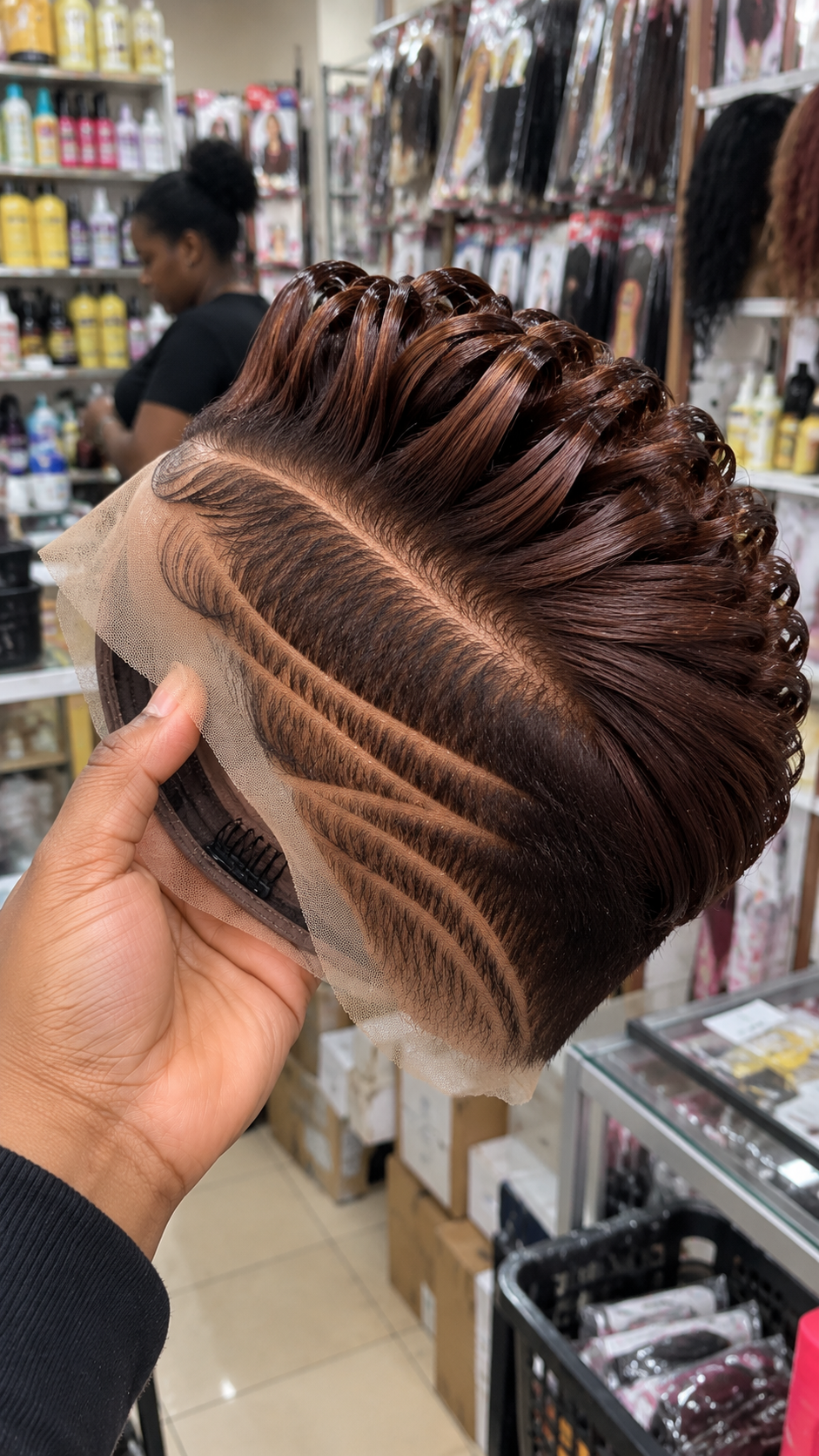
This chestnut-brown wig is a strong example of a design whose value is easiest to understand from the side. The crown carries a sequence of polished loop formations, but the lower half introduces a completely different visual rhythm: one long separation beneath the crown and two additional sweeping paths below it. Rather than treating those elements as decoration added after the haircut, this piece uses them to divide the entire profile into carefully proportioned zones. The result is a wig where crown movement, side density, brown tonal depth and line placement all depend on one another.
The photograph also captures the unit at a useful stage for anyone considering a custom order. The perimeter lace has not yet been trimmed, the cap can be seen beneath it, and the side work is already present. Fine strands appear around the front transition before the hair becomes denser farther back. Lace is unquestionably visible, but its specific grade cannot be established from this photograph alone, so describing it as HD lace would require confirmation from the seller.
The Brown Shade Works Differently Across the Wig
The hair sits within a warm chestnut-to-deep-brown family, but it does not look identical across every area. Stronger brown reflections appear over the raised crown sections because those surfaces catch more light. The roots, recessed spaces between loops and compact side area read considerably darker. That tonal shift creates dimension without requiring obvious blonde or copper streaks.
This is worth noting when commissioning the piece. Asking for a generic medium brown could produce a much flatter result, while requesting bright highlights would introduce contrast that is not necessary here. The reference depends on a rich brown foundation that can move from dark shadow to warmer chestnut reflections according to the angle of the strands.
A seller working from this image should ideally show the completed color in more than one lighting condition. Indoor salon lighting can exaggerate warm reflections, so an additional photograph near neutral daylight can help a buyer understand the actual brown level before approving the order.
The Front Loops Establish a Repeating Rhythm
Across the crown, large sections rise individually and then bend backward. They resemble elongated loops rather than tight conventional curls. The front pieces are particularly easy to distinguish because each has enough spacing around it for its direction to remain visible.
The repetition is controlled without being perfectly mechanical. Some loops are wider, others sit closer together, and their angles change as they travel toward the rear. This variation allows the crown to follow the rounded shape of the wig instead of looking like a row of identical pieces attached to a flat surface.
The upper construction also remains relatively compact. There is visible height, but the hair is not expanded into an oversized dome. A stylist recreating this look should preserve that balance. Increasing the crown dramatically might make the wig more voluminous, but it would no longer reproduce the proportions shown in the reference.
The Rear Uses Compression Rather Than Additional Height
One of the most useful details in this image is how the styling resolves toward the back. The larger forward loops gradually give way to tighter curled pieces and more compressed hair. Instead of continuing to build upward, the crown begins to follow the rear contour of the cap.
This transition keeps the silhouette balanced. If the same large loops continued all the way around the back, the unit could become unnecessarily bulky. The smaller rear work allows the wig to retain complexity while reducing its overall projection.
When ordering from a custom maker, request at least one rear three-quarter photograph before shipment. That angle can confirm whether the crown actually transitions into tighter work or whether the maker has concentrated only on the portion most visible from the front.
The Upper Side Separation Creates the Main Boundary
Beneath the crown is a long exposed path that runs diagonally around the side. It is visually stronger than the lower accents because it separates two major areas of the wig: the heavier sculpted crown above and the compact hair below.
This boundary follows the curvature of the unit rather than cutting across it as a straight stripe. Its path begins near the front side and continues toward the rear, creating a continuous visual direction beneath the crown. Fine dark-brown hair remains on both sides of the separation, which keeps the line integrated into the construction.
For a custom reproduction, this upper path should be discussed separately from the lower two. Treating all three as identical carved lines would miss the hierarchy visible in the reference. The upper division is part of the crown architecture, while the lower paths function more like secondary side accents.
Two Lower Paths Extend the Movement Toward the Perimeter
Below the main separation, two additional curved paths travel through the compact side. They follow a broadly similar direction but do not sit at perfectly equal distances from one another. The lower curve sweeps toward the perimeter and helps carry the design into the bottom portion of the wig.
Dark chestnut hair remains clearly visible between the paths. This preserved hair is essential. It gives each exposed channel an independent outline and prevents the lower side from becoming one large open section.
The design therefore depends on both cutting and restraint. A barber must know where to create separation, but also where to stop. Enlarging the channels during repeated maintenance could gradually remove the dark sections that currently hold the composition together.
The Front Has Its Own Fine Directional Detail
Near the forward edge, finer strands are arranged into a curved movement before the denser side begins. This detail is considerably more delicate than the broad crown loops and should not be overlooked during installation. It contributes to the transition between the lace perimeter and the heavier sections behind it.
Because the lace is still untrimmed, a stylist has room to decide how this area should sit on the wearer. Cutting the lace first and assessing placement afterward would reverse the safer order of operations. The wig should be positioned, the side design checked, and the final front boundary established before excess material is removed.
Buyers should also avoid requesting unnecessary removal of the finer front strands simply to make the hairline appear sharper. This wig already contains strong geometric work farther down the side. Retaining a softer front transition provides useful contrast against those larger lines.
The Side Design Makes Accurate Cap Sizing More Valuable
For a basic wig, a slightly imperfect cap fit may primarily create discomfort or affect the front position. On this piece, fit can also change the presentation of the side artwork. If the unit sits too far forward, the sweeping paths may move toward the face. If it slides backward, their relationship to the temple and ear can change.
That is why a custom buyer should follow the manufacturer’s measurement instructions instead of selecting a size from habit. Circumference, front-to-nape and ear-to-ear measurements may all be relevant depending on the cap design.
If measurements are difficult to take accurately at home, a local wig stylist can help before the order is placed. Paying for a consultation at the beginning may prevent considerably more expensive corrections after a customized unit arrives.
Use the Photograph as a Construction Specification
A successful order request should describe this wig in layers. Begin with the rich chestnut-brown color and darker root depth. Next specify the broad looped crown, including the gradual compression toward the rear. Then describe the compact side and identify the long upper separation plus two lower sweeping paths.
The seller should also know whether the customer wants the lace delivered untrimmed. If a local stylist will handle installation, retaining excess lace can provide more fitting flexibility. Lace shade options should be discussed directly because the apparent shade in a photograph can change with exposure, lighting and display settings.
Ask whether the side design is completed by the wig maker or requires a separate barber service. The answer affects both cost and scheduling. A listing may show a finished reference while the actual product being sold is only the underlying base wig.
Approval Photos Should Answer Specific Questions
Rather than asking a seller for a generic picture before shipping, request angles that answer construction questions. An elevated view should show whether the crown loops remain separated. A side view should capture all three sweeping paths. A rear three-quarter image should reveal the transition from the larger loops into the tighter back area.
The lace should also be photographed before trimming if it is part of a custom order. This provides a record of the condition in which the unit is being shipped and allows the buyer to inspect the front density.
These photographs are particularly useful when purchasing through social media or from an independent wig maker. They help distinguish the actual commissioned unit from the reference photographs originally used to discuss the order.
Price Should Follow the Amount of Skilled Work
A compact wig is not automatically a low-labor wig. The crown has to be sectioned and set, the side density must support the exposed paths, the front requires careful transition work, and the lace and cap still need appropriate construction. The amount of material may be modest compared with a long wig, but the amount of detailed labor can be substantial.
| Category | Estimated Price Range | What the Buyer May Be Paying For |
|---|---|---|
| Premium Custom | $310–$535+ | Higher-grade hair, individualized sizing, carefully formed crown loops, precision side pathways and advanced lace preparation. |
| Standard Custom | $190–$325 | Prepared brown crown construction with planned side detailing and a more standardized fitting process. |
| Basic Human Hair | $120–$210 | A human-hair foundation that can be taken to a wig stylist and barber for additional shaping and line work. |
| Premium Synthetic | $75–$150 | A better pre-set fiber option for buyers who want the crown arrangement to retain its form with less intervention. |
| Basic Synthetic | $40–$85 | A budget base where crown complexity, lace quality or side precision may be simplified. |
These figures are planning ranges rather than guaranteed retail prices. Hair source, fiber type, cap construction, labor market, lace choice and customization can change the quotation considerably. Delivery and salon installation may also be separate.
The useful comparison is therefore not simply $150 versus $300. Ask what happens before the wig reaches you. If the more expensive quotation includes crown setting, side detailing and custom cap preparation while the cheaper option requires all three services locally, the apparent price difference may shrink quickly.
A Salon Consultation Can Prevent Irreversible Corrections
Once the unit arrives, inspect it before booking an immediate adhesive installation. Check the crown, brown shade, side paths, lace and cap. If the order differs materially from what was approved, contact the seller before cutting anything.
After inspection, a wig stylist can establish the correct position on the head. The lace can then be trimmed according to that placement. If a barber will refine the lower section, their work should happen only after the cap position has been established.
This sequence protects the side geometry. A barber working on a loose wig may create beautiful lines that sit incorrectly once the unit is moved into its final wearing position. Fitting first gives the side work a reliable reference.
Maintenance Should Begin With Shape Memory
Before the first wash, photograph the crown from several angles. Those photographs become a practical map for future care. Once wet, the large loops may temporarily lose some of their separation, and having a visual reference makes it easier to return each section to its original direction.
Avoid brushing indiscriminately from the front through the rear. The crown should be approached in sections so the broad bends remain independent. Heavy styling products can also reduce separation by causing neighboring strands to adhere to one another.
For human hair, heated tools may be useful during professional resetting, but the correct temperature depends on the hair and any color processing it has received. Synthetic fiber requires confirmation of heat tolerance before any hot tool is applied.
Preserving Chestnut Depth Requires Gentle Color Care
The brown shade is central to this version because it provides enough warmth to distinguish the loops while retaining dark shadow near the roots and side. Repeated exposure to excessive heat can gradually alter that balance on human-hair units.
Use cleansing and conditioning products appropriate for color-treated hair when relevant, and avoid unnecessary chemical processing. If the color eventually fades, a professional should evaluate whether the entire unit needs refreshing or only selected areas have changed.
Adding bright highlights is not necessary to restore visual dimension. The existing crown architecture already creates variation through reflected light. Preserving the rich brown family maintains the understated character of the reference.
The Side Paths Need Preservation, Not Constant Redesign
The carved areas should be treated as permanent architecture. There is little reason to deepen them at every appointment. When the pattern begins to look less visible, the first step should be checking whether nearby strands have shifted into the channels.
If actual cutting is required, it should be minimal. The goal is to recover the existing curves, not make them progressively larger. Keeping a clear photograph of the original side is valuable because the barber can compare the width and spacing before removing hair.
This conservative approach extends the useful life of the design. Once the brown sections between the channels become too narrow, restoring the original proportions can be difficult or impossible without reconstructing part of the wig.
Storage Should Support the Rear as Well as the Front
Placing the unit carelessly on a flat surface can compress the rear loop work even when the front remains visually intact. A suitable wig stand or mannequin head gives the entire crown room to retain its rounded profile.
Before storage, make sure the cap and lace are fully dry. Adhesive residue should be removed with methods appropriate for the material rather than aggressively pulling at the lace. The fine front area deserves particular care because repeated tension can weaken ventilated strands.
When transporting the wig, avoid packing heavy objects directly on top of it. If the crown is compressed for a long period, a professional reset may be needed to recover the spacing between the larger sections.
What Makes This Brown Version Worth Customizing
The strongest quality of this wig is the way several quiet decisions combine into one recognizable profile. The chestnut-brown palette gives the crown warmth without overwhelming it. Large upper loops create movement, the rear becomes progressively tighter, and the lower side introduces three sweeping paths while retaining enough dark hair to separate them visually.
For a buyer, those relationships provide a better shopping checklist than any generic product name. Look for the brown depth, crown direction, compact side density, one dominant upper separation and two lower curves. Confirm cap measurements and lace options before paying for customization, then request approval photographs from angles that expose the actual construction.
For a wig business, this design also demonstrates why an uninstalled product photograph can be persuasive. Customers can see the lace, examine the side work and understand the labor hidden beneath the finished appearance. Accurate descriptions and honest material information can then turn that visual interest into a purchase without promising characteristics that the photograph itself cannot verify.
Search Terms
chestnut brown loop crown wig · three sweeping side paths wig · warm brown lace front wig · curved triple side design wig · dark root chestnut crown wig · sculpted brown loop hairpiece · compact carved side wig · untrimmed lace brown wig