
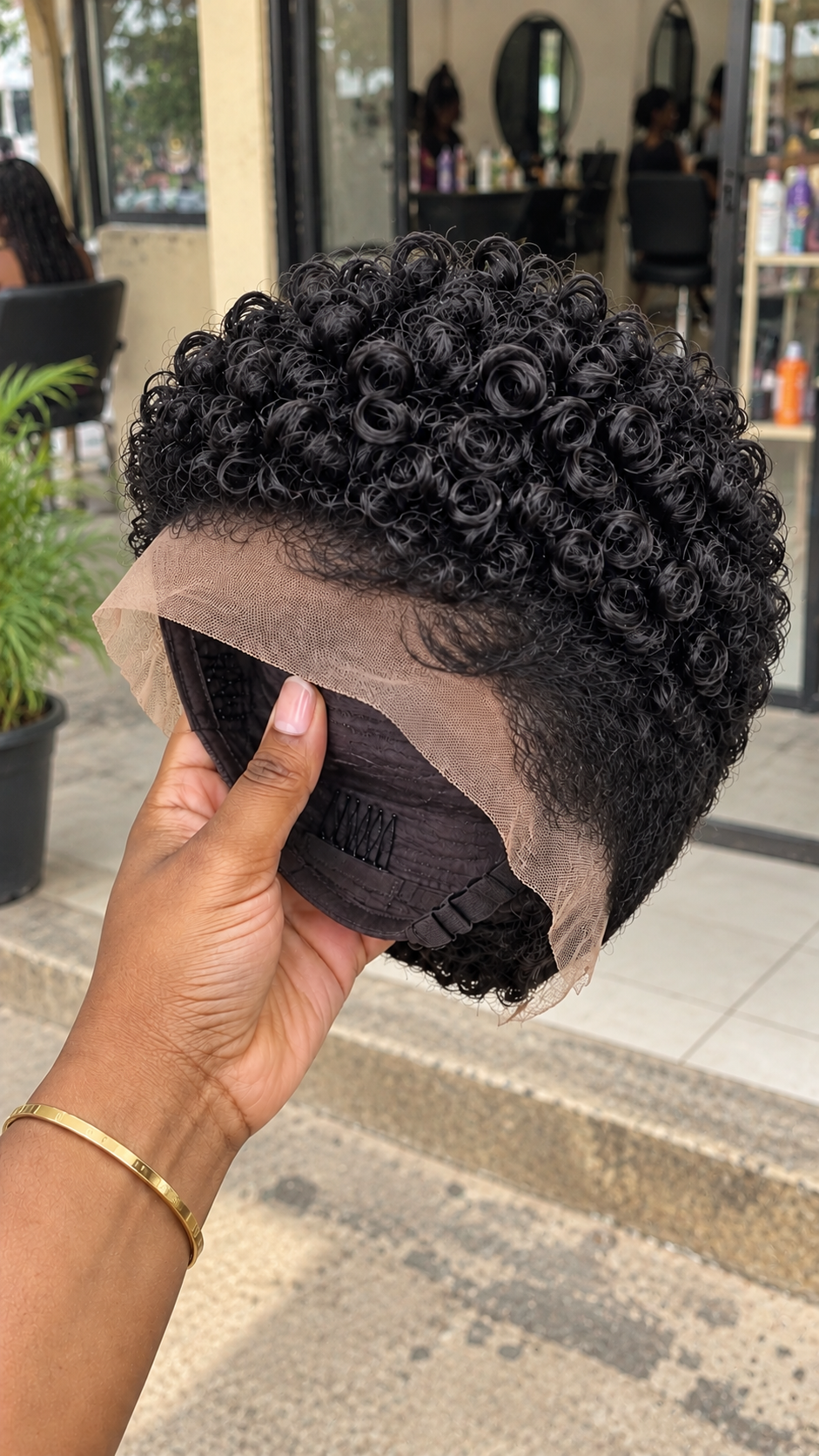
A wig displayed outside a neighborhood salon offers a different kind of buying evidence from a carefully arranged showroom photograph. Natural daylight makes it easier to examine the relationship between curl density, hairline construction, and the material beneath the hairstyle. In this photograph, a compact black pixie wig is held in one hand outside a salon entrance, exposing its tightly clustered spiral curls, dark lower side, beige lace, and black interior cap.
The most distinctive characteristic is the upper curl arrangement. Hundreds of fine strands appear gathered into small circular formations, with several larger rose-like spirals visible across the front and central crown. Unlike a hairstyle dominated by wide ribbon arches or elaborate side patterns, this design places nearly all its visual emphasis on the curls themselves.
The visible side is comparatively restrained. Dark, tightly curled hair becomes less elevated toward the temple and lower edge, producing a tapered-looking silhouette without a clearly visible shaved stripe or decorative parting channel. This is an important distinction for customers who want a natural-looking curly pixie profile rather than a heavily carved side design.


The photograph also reveals part of the cap’s securing system. A black adjustable strap, interior stitching, and dark fabric panels are visible beneath the untrimmed lace. These details make the image useful not only as a hairstyle reference but also as a starting point for evaluating fit, construction, and installation requirements.
The Appeal Begins With an Irregular Arrangement of Tiny Spirals
At first glance, the upper hairstyle appears to be a dense collection of black curls. A closer examination reveals several different curl shapes working together.
Some strands form compact circular loops with clearly visible centers. Others create small spirals that turn inward several times, resembling miniature rosebuds. Fine, loosely curved strands extend between these more organized formations, creating a less rigid appearance than a collection of identical manufactured rings.
The largest visible spirals are concentrated around the upper front and central area. Several face outward, allowing their circular openings to be seen directly. Smaller curls occupy the spaces between them and continue toward the rearward portions of the hairstyle.
The upper silhouette is rounded, with a moderate amount of elevation above the lower side. The hair does not form long hanging ringlets, nor does it extend into a tall afro shape.
This compact arrangement makes the wig particularly interesting for buyers who appreciate intricate curls but prefer a hairstyle that remains relatively close to the head.
Why the Different Coil Sizes Should Be Preserved
The visual character of this wig depends partly on the variation between neighboring curls. The larger circular spirals create recognizable points of interest, while the smaller coils provide continuity across the surface.
If every curl were made the same size, the hairstyle could appear overly uniform. If the larger spirals were replaced by loose curls, the upper arrangement would lose much of its distinctive character.
A custom wig maker should therefore consider the distribution of curl sizes rather than simply selecting one spiral diameter for the entire crown.
Ask the supplier to provide an elevated photograph of the upper hairstyle. This view can reveal whether the larger rose-like coils remain visible among the finer surrounding curls.
The photograph does not establish the exact setting technique used to create the spirals. Their appearance may depend on the selected hair material, styling products, and construction process.
Black Hair Without Contrasting Color Panels
The wig appears predominantly natural black, with subtle charcoal reflections visible where the curls catch daylight.
There are no clearly established blonde, copper, burgundy, or other colored highlight sections. The hairstyle relies on curl shape and light reflection rather than contrasting color placement.
The outer surfaces of several spirals appear slightly lighter because of the way daylight reaches the curved strands. Their centers remain darker, helping emphasize the circular openings.
This contrast is especially noticeable around the larger rose-like curls near the upper front.
For buyers seeking a single dark shade, the hairstyle provides a useful reference. However, the photograph cannot establish whether the fibers were manufactured in black, dyed after production, or made from naturally dark human hair.
Anyone who specifically wants natural black rather than blue-black or very dark brown should request an additional photograph under neutral lighting and confirm the supplier’s color designation.
The Temple Has a Gradual Reduction in Curl Height
The visible side differs considerably from the raised upper section. The curls become smaller and sit closer to the wig base as they approach the temple and lower edge.
This creates a tapered-looking profile without requiring an obvious decorative separation.
The photograph does not show a clearly exposed curved parting channel, multiple razor lines, or an elaborate geometric pattern. Instead, the side appears to transition gradually from the fuller upper curls into shorter-looking, closely arranged hair.
The lower section remains dark and visibly covered with hair. It should not be described as a bare skin fade.
For customers who prefer a less ornamental side design, this arrangement may be particularly appealing. The hairstyle maintains its identity through the upper spirals while allowing the temple to remain relatively understated.
Why Adding a Decorative Line Would Change the Reference
Many sculpted pixie wigs are marketed with curved shaved-looking lines or geometric side patterns. Those designs can be attractive, but they are not interchangeable with this example.
Introducing a prominent carved stripe would create a new focal point and interrupt the gradual transition between the upper curls and lower hair.
For a custom reproduction, explain that the side should remain closely curled and dark, without additional decorative channels.
The exact amount of lower-side hair should also be considered. Removing too much could expose the underlying cap, while leaving excessive volume could weaken the tapered silhouette.
The Front Transition Is Softer Than a Formal Finger-Wave Design
Near the front edge, small curls and fine strands extend toward the beige lace. The hairline does not display the large, carefully separated finger-wave panels found on some sculpted pixie wigs.
Instead, the front appears to transition gradually from compact coils into finer hair near the lace boundary.
This gives the hairstyle a softer visual edge, although its final appearance against a wearer’s forehead cannot be determined from the uninstalled photograph.
The cap position and any hairline customization will influence how the front curls sit once the wig is worn.
A stylist should avoid automatically adding exaggerated baby-hair waves if the buyer wants to preserve the reference’s relatively restrained front styling.
The Interior Construction Is Partially Exposed
The lower opening reveals a black fabric cap with visible stitching and several reinforced sections. A dark comb attachment can be seen within the interior, along with a black adjustable strap and fastening hardware near the lower side.
These components provide useful clues about how the wig may be secured, but they do not reveal the complete construction.
The total number of combs, full strap configuration, rear cap structure, and exact adjustment range cannot be established from the photograph.
For a buyer, this partial view is a reason to request more information rather than assume that the wig will fit securely.
Ask the seller for a complete inside-out photograph showing the entire cap. Confirm whether the visible attachment components are removable or replaceable and whether the cap is available in different sizes.
Assessing Comfort Before Choosing a Securing Method
Some wearers prefer comb attachments, while others find them uncomfortable against their natural hair or scalp.
The appropriate securing method depends on individual preferences, natural hair preparation, cap fit, and the intended activities.
The presence of an adjustable strap does not automatically establish that the wig can be worn securely without adhesive.
If adhesive-free wear is important, ask whether the unit was specifically designed for that purpose and request the manufacturer’s recommended fitting procedure.
Also confirm the cap circumference, front-to-back length, and ear-to-ear measurements before purchasing.
Untrimmed Beige Lace Around the Front and Side
A broad beige-toned lace section extends beyond the front hairline and visible temple. The mesh remains untrimmed and hangs freely beneath the hairstyle.
The lace is particularly noticeable where it overlaps the black interior cap.
Its appearance does not establish a specific commercial lace classification. The photograph cannot confirm whether the material is HD lace, Swiss lace, transparent lace, or another type.
Those specifications should be obtained from the seller.
Buyers should also ask whether different lace shades are available and whether the material is appropriate for their preferred installation method.
Because the wig has not been installed, the photograph cannot demonstrate how closely the lace will blend with a particular wearer’s skin.
What to Check Before the Lace Is Trimmed
The first fitting should establish whether the cap sits comfortably and whether the rounded upper curls are positioned correctly relative to the forehead.
The stylist should also examine how the closely arranged side hair follows the temple.
If the cap sits too far forward, the upper curls may project farther over the forehead than intended. If it sits too far backward, the front hairline may appear unusually high.
Only after confirming the fit should excess lace be trimmed where necessary.
Cutting too much lace prematurely may reduce adjustment flexibility and make later corrections difficult.
For this design, the goal is to preserve the soft transition between the fine front strands and the compact upper spirals.
Finding a Supplier for a Natural Black Rose-Coil Pixie
Specialized wig boutiques, custom wig makers, and salons experienced in compact spiral hairstyles are suitable places to search for this design.
Useful search descriptions include natural black rose coil wig, miniature spiral pixie lace wig, compact black curly hairpiece, and dense circular coil pixie.
When browsing online listings, compare actual photographs rather than relying solely on product titles.
A generic curly pixie may have similar length but use larger ringlets. Another unit may reproduce the small curls while including a decorative side pattern that does not match the reference.
For ready-made products, request photographs of the exact wig available for shipment.
For custom production, ask the maker to demonstrate experience with closely arranged spiral curls and compact tapered sides.
Preparing a Custom Order Around the Curl Distribution
Begin by identifying the small rose-like spirals as the main styling requirement. Explain that the upper hair should contain numerous compact coils with several larger circular openings visible near the front and center.
Next, specify the predominantly natural black appearance and rounded upper silhouette.
Ask the maker to preserve the gradual reduction in curl height toward the temple without adding decorative shaved-looking lines.
Explain that the front hairline should remain relatively restrained, with fine strands connecting the upper curls to the lace.
Finally, confirm the cap measurements, lace specifications, hair material, and attachment system.
If possible, request a progress photograph before final styling is completed. This can help identify significant differences while adjustments remain feasible.
Ready-Made Shopping Versus Custom Coil Placement
A ready-made wig may be suitable if the buyer finds a unit with comparable coil size, density, side profile, and cap dimensions.
However, the exact balance between larger rose-like spirals and smaller surrounding curls may be difficult to locate in a standard catalog.
Custom production offers greater control over curl diameter, density, and the gradual temple transition.
The trade-off may involve additional cost and production time.
Before choosing either route, determine which details are essential and which minor variations would be acceptable.
For this hairstyle, the compact spirals, natural black color, rounded upper silhouette, and undecorated tapered side are the strongest identifying elements.
Booking a Stylist for Installation and Curl Restoration
After receiving the wig, inspect the curls, lace, cap, and visible attachment components before making any adjustments.
When booking a salon appointment, explain that the hairstyle contains densely arranged miniature spirals and a close-fitting side without decorative parting channels.
Ask whether the stylist has experience fitting compact curly pixie wigs without disturbing the upper coils.
At the appointment, the cap should be positioned and checked for comfort before any lace trimming.
If the side requires adjustment, the stylist should inspect the underlying construction before using cutting tools.
For future maintenance, ask whether the salon can restore individual spirals if they lose their shape during wear or washing.
Illustrative Pricing for a Natural Black Rose-Coil Wig
The cost of reproducing this hairstyle may depend on hair material, cap construction, lace coverage, coil density, and the labor involved in arranging the compact spirals.
The photograph does not establish the manufacturer, fiber composition, or actual selling price.
The following US dollar figures are illustrative planning estimates rather than verified current product prices.
| Wig Category | Illustrative USD Range | Potential Cost Considerations |
|---|---|---|
| Premium Custom | $310–$735+ | Personalized cap sizing, detailed miniature spiral placement, specialist temple styling, and hairline preparation. |
| Standard Custom | $165–$385 | Selected adjustments to coil density, cap sizing, and the gradual side transition. |
| Basic Human Hair | $95–$255 | A human-hair base unit that may require professional compact spiral setting. |
| Premium Synthetic | $65–$195 | A higher-grade synthetic option with potentially prearranged miniature curls and detailed cap construction. |
| Basic Synthetic | $25–$105 | A budget alternative where exact coil size and curl distribution may vary. |
These categories describe possible purchasing approaches and do not identify the material of the photographed wig.
Installation, shipping, lace preparation, cap adjustments, and future curl restoration may be charged separately.
Ask for an itemized quotation and confirm which services are included before paying.
Maintaining Tiny Spirals Without Flattening the Crown
The upper curls depend on their compact spiral structure. Aggressive brushing may separate the strands and change the hairstyle’s appearance.
Before attempting maintenance, ask the supplier how the coils were formed and whether they are intended to retain their shape after washing.
If the wig contains synthetic fibers, avoid heat tools unless the manufacturer confirms the permitted temperature.
If the unit contains human hair, professional resetting may be possible, but the appropriate method depends on previous processing and the original styling technique.
The natural black color may make certain types of product residue more noticeable, depending on the products used.
The lower side should be maintained without excessive manipulation so the gradual transition from dense upper curls to closely arranged hair remains intact.
Ask how the wig should be stored to avoid compressing the upper spirals and whether periodic professional maintenance is recommended.
Additional Photographs Worth Requesting
The reference provides a useful view of the upper curls, one side, and part of the interior, but it does not show the complete rear or opposite temple.
A direct front photograph would help establish the hairline and upper-coil distribution.
An opposite-side view would reveal whether the tapered appearance continues or whether the other side has a different arrangement.
A rear photograph would show how the compact spirals transition toward the nape.
A complete underside image would help verify the cap construction and securing components.
A brief video under neutral lighting would also provide a more reliable impression of the black shade and overall proportions.
A Compact Black Pixie Defined by Its Curl Detail
This wig combines numerous miniature rose-like spirals with a rounded upper silhouette, a gradually tapered-looking side, and a partially exposed adjustable cap.
Its appearance depends on the fine curl structure rather than contrasting colors or elaborate decorative side channels.
The visible strap, comb, and black interior provide useful construction clues, but they do not establish the complete attachment system or guarantee adhesive-free suitability.
For buyers seeking a comparable hairstyle, the strongest purchasing strategy is to evaluate coil diameter, curl density, temple coverage, and cap fit together.
A successful reproduction should preserve the miniature spirals and natural black appearance without adding unrelated decorative lines or increasing the upper volume unnecessarily.
With careful supplier selection, clear custom-order instructions, and appropriate professional fitting, this design can provide a distinctive alternative to conventional curly pixie wigs.
Search Terms
Natural black miniature rose coil wig · Dense tiny spiral pixie lace hairpiece · Black rounded micro curl crown wig · Undecorated tapered temple curly pixie · Visible black adjustable strap wig cap · Beige untrimmed lace spiral hairpiece · Compact black rosette curls wig · Fine coil hairline black pixie unit