
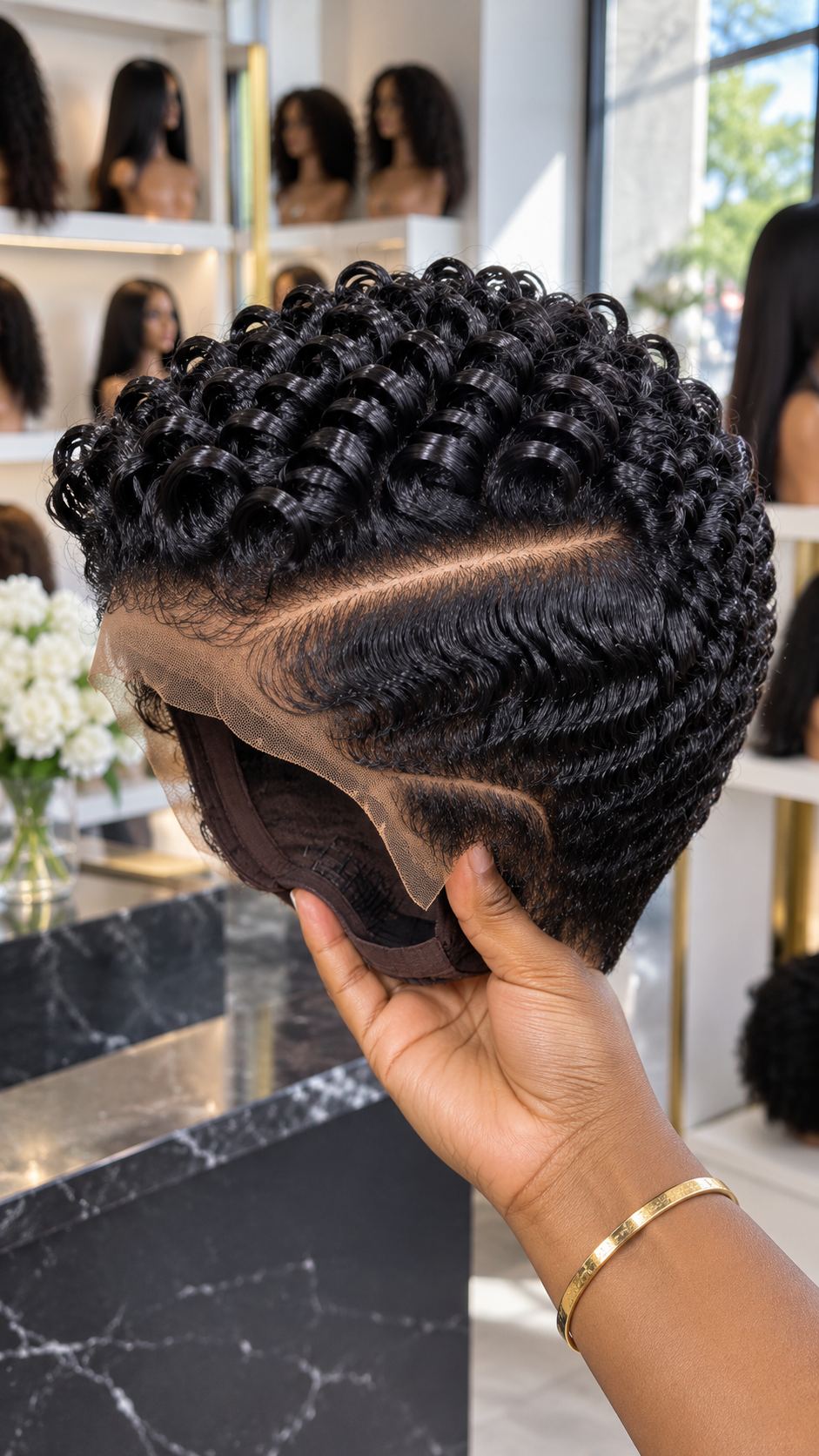
Some pixie wigs make their statement through bold color, while others create something special with the direction and arrangement of the hair itself. This jet black design belongs to the second group. Its upper section is packed with glossy, rounded barrel-like curls, while the visible side displays a series of flowing waves beneath a long diagonal parting. A second, shorter separation near the lower temple introduces an additional detail, creating a hairstyle that combines a full curly crown with a carefully organized side profile.
The photograph shows a single wig held in one hand inside a bright beauty salon. Its lace remains untrimmed, and part of the dark brown interior cap is visible through the opening. The hair appears predominantly black, with cool reflections across the raised curls and closely arranged waves. No contrasting dyed color sections are clearly visible.
Unlike a uniform finger-coil pixie, this hairstyle uses two noticeably different curl forms. The upper hair contains broad loops with visible circular openings, while the side has elongated, flattened waves flowing backward. This difference is essential to the overall appearance. A similar black wig with small curls covering the entire surface would not create the same result.


For women shopping for a sculpted black pixie wig, the main priorities are matching the crown curl size, preserving the long side-wave arrangement, and ensuring that the two visible partings sit correctly once the wig is fitted. The photograph provides useful styling evidence, although fiber composition, lace grade, and complete cap construction remain unverified.
How the Crown and Side Create Two Different Looks
The most interesting feature of this hairstyle is the contrast between the rounded curls above and the directional waves below. Across the upper head, numerous cylindrical-looking curls form a densely arranged crown. Their openings are clearly visible from the photographed angle, especially near the front and central sections.
The curls do not hang freely toward the shoulders. Instead, their ends are turned into compact rings, creating a rounded pixie silhouette with significant fullness but relatively little length.
The visible side follows another styling direction. The strands below the upper parting sweep backward in broad, closely arranged waves. Rather than forming complete circles, they bend through elongated S-shaped movements, with successive ridges creating a continuous flowing surface.
These two structures complement one another. The upper curls give the wig height and dimension, while the side waves keep the overall shape controlled and close to the head.
When considering a similar wig, it is worth examining whether the seller has preserved both structures. A wig with accurate barrel curls but a plain, unstyled side would lose much of the reference’s character.
The Broad Barrel Curls Make the Crown Stand Out
The circular curls across the upper hairstyle are relatively large compared with tightly packed miniature finger coils. Several loops contain obvious hollow centers, and their rounded strands travel together in polished bands.
Some curls face forward, while others turn slightly toward the side or rear. This creates movement without making the crown appear disorganized.
The front curls are particularly noticeable because they sit just above the long diagonal parting. Their placement provides a strong boundary between the elevated crown and the flatter hair beneath it.
Farther toward the visible rear, smaller curls appear among the larger loops. This variation fills the hairstyle and helps maintain a consistent outer silhouette.
Although the wig has generous curl coverage, the shape is not extremely tall. Its volume is distributed across the upper head, producing a full but contained pixie profile.
What to Request When Recreating the Crown
Ask a wig maker for compact, open barrel-style curls with recognizable circular openings. The coils should be arranged densely across the top, with slightly smaller curls supporting the larger front sections.
Coil diameter should be discussed before styling. Larger curls may produce a dramatic, rounded crown, while smaller coils can make the hair appear more tightly packed.
The goal is not to maximize the number of curls. Instead, the wig should preserve the spacing and direction of the rings so that each prominent opening remains visible.
Request a photograph from above and a direct front view before approving a custom piece. The uploaded photograph shows the visible side and crown clearly, but the complete opposite side cannot be evaluated.
A Long Diagonal Parting Separates the Two Styling Areas
A prominent pale channel travels diagonally beneath the circular curls. It begins near the forward upper side and extends toward the visible rear, creating a continuous division between the raised crown and the side-wave arrangement.
This parting is longer and more directional than an ordinary small temple accent. It establishes where the crown ends and where the lower waves begin.
The light appearance of the channel comes from the underlying foundation visible between the dark strands. The photograph does not prove that this separation was created by shaving natural hair with a razor.
The parting also determines how the surrounding hair moves. Above it, strands curl upward into rounded rings. Below it, they travel backward and downward into elongated waves.
If the separation is positioned too high, the crown may appear smaller. If it sits too low, the side-wave panel may become overly broad. For an accurate reproduction, the channel should follow the intended contour while remaining narrow enough to complement the surrounding hair.
The Side Waves Deserve as Much Attention as the Curls
Below the diagonal parting, the hair is arranged into a compact flowing panel. The strands curve backward through several elongated waves, creating a ridged surface with visible highlights along each bend.
The wave pattern is not perfectly uniform. Some curves are broader near the upper side, while the lower sections become smaller and closer together.
The side hair appears predominantly deep black, matching the crown. This consistent color makes the styling direction particularly important because the contrast comes from shape rather than highlights.
The photograph reveals a second, shorter separation beneath the main wave panel. It is visible near the lower temple and helps distinguish the flowing upper side from the more compact hair beneath it.
This lower channel does not extend as far as the primary diagonal parting. Its limited length creates a subtle additional division without overwhelming the side.
Why the Lower Separation Should Stay Subtle
Making the lower channel too broad could create an unintended gap in the closely arranged hair. Likewise, extending it much farther than the reference would change the design.
The stylist should preserve the relationship between the large upper parting, the flowing side-wave panel, and the shorter lower separation.
These areas should be assessed together rather than treated as independent decorative lines.
For a custom commission, request a close side photograph showing the two channels and the direction of the hair between them.
Dark Black Color With Natural Reflective Depth
The wig appears predominantly jet black or very deep natural black. The curved surfaces reflect light, producing cool gray highlights along the upper loops and elongated side waves.
These reflections do not establish the presence of silver-dyed strands or contrasting highlights. The visible color remains consistently dark.
The interior areas between the curls appear nearly black, creating depth and emphasizing the circular openings.
For an online purchase, request neutral-daylight photographs of the actual wig. Deep black fibers can appear warmer or cooler depending on the lighting and camera settings.
Ask the seller whether the available shade is natural black, off-black, or jet black. These labels are not always standardized between manufacturers.
The glossy appearance alone does not establish fiber quality or composition. Synthetic fibers and human hair may both appear reflective after styling.
The Untrimmed Lace Needs Individual Fitting
A broad section of tan lace extends beyond the front and side perimeter. The mesh remains untrimmed, indicating that the wig is being displayed before final preparation for wearing.
The exposed lace is especially visible beneath the long diagonal parting and around the lower side. Its color may look different against an individual wearer’s skin than it does in the photograph.
The photograph cannot establish the exact lace grade, softness, transparency, or dimensions. In particular, the presence of lace does not confirm HD lace.
Before installation, a stylist should position the wig correctly and assess whether the hairline sits comfortably around the forehead and temples.
Any necessary trimming should follow the fitting. Cutting too much lace can compromise the finished hairline and may be impossible to reverse.
Understanding the Brown Interior Cap
The wig is held with part of its interior opening facing the camera, revealing a dark brown cap with visible fabric bands and stitching.
The photograph does not reveal the full underside, so the exact number of attachment combs, adjustable straps, or other hardware cannot be confirmed.
The visible construction also does not establish that the wig is glueless or suitable for every head size.
Before purchasing, ask for the cap circumference, front-to-nape distance, and ear-to-ear measurements. Request a photograph of the fully opened underside, including the attachment areas.
It is equally important to confirm the fiber composition. The wig’s glossy appearance does not prove that it contains human hair, and the styling limitations of synthetic hair may differ considerably.
Where This Wig Comes From
The photograph shows the wig in a salon environment, but it does not identify a verified manufacturer, seller, or country of origin. Anyone attempting to purchase the same design should therefore begin with a visual product comparison rather than assuming that a particular retailer supplies the photographed item.
Search for compact black barrel curl pixie wigs, sculpted black curl wigs, or black lace pixies with flowing side waves. These phrases can help locate products within the relevant hairstyle family.
When evaluating a listing, compare the actual curls, diagonal parting, side-wave arrangement, and lower separation. A generic black curly pixie may share the color and approximate length without reproducing the design.
A ready-made wig may be suitable when the product already has the desired styling. If the side waves or crown curl arrangement differ considerably, custom work may be necessary.
Before ordering, ask whether the photographed product is the exact item being sold, what materials are used, what cap sizes are available, and whether styling is included in the price.
Booking a Stylist for a Proper Installation
A wig customization specialist experienced in sculpted curls, finger waves, and lace preparation is a suitable professional for this hairstyle.
During the consultation, explain that the upper hair contains broad circular barrel curls, while the side is shaped into longer waves separated by a diagonal parting.
Ask the stylist to evaluate the placement of both the main parting and the shorter lower channel before installation.
If the wig arrives with untrimmed lace, it should be fitted before any permanent cutting takes place. The stylist can then assess how the side design aligns with the wearer’s temple.
The attachment method should be chosen according to the actual cap construction and the wearer’s comfort. The photograph does not confirm whether adhesive is required.
Once installed, the wig should be examined from the front, side, and rear. The crown should retain its open curls, and the flowing side waves should remain visible without excessive bulk.
Illustrative Price Guide for Sculpted Black Pixie Wigs
The cost of a similar wig may depend on the fiber composition, cap design, individual curl styling, precision of the side waves, and fitting requirements.
The following USD ranges are illustrative planning estimates, not verified live prices or quotations for the photographed wig.
| Wig Category | Illustrative USD Range | Potential Cost Considerations |
|---|---|---|
| Premium Custom | $340–$880+ | Individual cap measurements, specialist barrel curl placement, flowing side-wave styling, and detailed lace preparation. |
| Standard Custom | $170–$410 | Selected cap options, customized crown curls, and adjustments to the diagonal parting and side waves. |
| Basic Human Hair | $95–$270 | Human-hair base wig that may require separate curl setting, hairline styling, and installation preparation. |
| Premium Synthetic | $60–$185 | Higher-grade synthetic alternatives with prearranged curls and material-dependent styling flexibility. |
| Basic Synthetic | $25–$85 | Budget alternatives that may differ in curl size, side-wave accuracy, and cap construction. |
These categories are purchasing possibilities, not confirmed classifications of the pictured product. Actual prices vary by seller, material, workmanship, and included services.
A custom piece may cost more when the upper curls must be individually arranged and the side waves require additional shaping. The diagonal parting and lower channel can also increase styling labor.
Ask whether the price includes the base wig, styling, lace preparation, fitting, installation, shipping, and future adjustments.
Maintaining the Crown and Side Waves
The upper curls require careful handling because their appearance depends on retaining their rounded shape. Repeated brushing, aggressive finger separation, and compression can disturb the circular openings.
Ask the supplier how the curls were formed and whether they can be safely repositioned after washing or regular wear.
The side waves need a different maintenance approach. Their flowing shape depends on keeping the strands directed along the original pattern.
Cleaning instructions should follow the confirmed fiber composition. Synthetic hair should not be exposed to heated styling tools unless the manufacturer specifically permits them. Human hair may allow other methods, but its condition and previous processing should still be considered.
During storage, use a suitable wig support that protects the crown without flattening the side waves or stretching the lace.
If the curls lose their openings or the wave arrangement becomes difficult to maintain, professional restyling may be preferable to extensive home adjustments.
A Black Pixie Worth Comparing Carefully
This hairstyle stands apart because it combines open barrel curls with a broad flowing side-wave panel and two visible separations. The upper curls create volume, while the side remains closely arranged, producing a controlled compact silhouette.
The black color emphasizes the shape of the strands without relying on bright highlights. The long diagonal parting establishes the main styling division, and the shorter lower channel adds another layer of detail.
For buyers seeking a faithful reproduction, the best approach is to compare actual product photographs, confirm the cap and fiber specifications, and consult a stylist who understands both circular curls and flowing side waves.
A carefully chosen wig should preserve the distinctive arrangement while fitting comfortably and remaining practical to maintain.
Search Terms
Jet black barrel curl pixie wig · Flowing side wave black lace wig · Black circular crown curls hairstyle · Long diagonal parting pixie wig · Compact black curly wig with side waves · Untrimmed tan lace barrel curl hairpiece · Dark brown interior cap black wig · Black sculpted pixie with lower side channel