
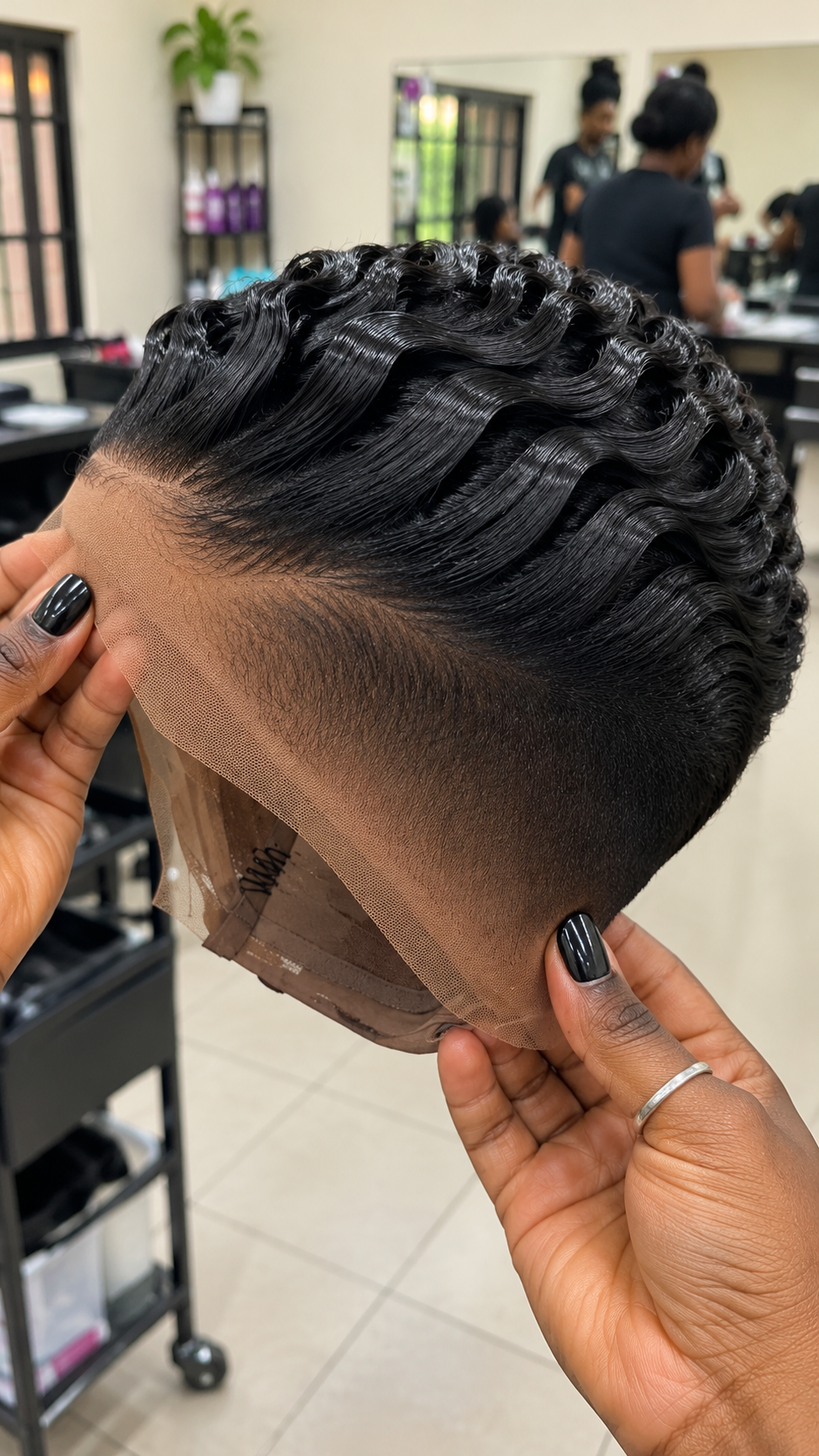
Some pixie hairstyles command attention through elaborate decorations, while others make their impression through the movement of the hair itself. This striking jet black wig belongs to the second group. Its upper section is arranged into broad, glossy waves that rise from the front, travel backward in flowing ribbons, and gradually become smaller near the rear. Beneath that elevated movement, a closely fitted side creates the appearance of a softly graduated taper.
The photograph captures the wig before installation, supported by two hands inside a working hair salon. The unusual angle makes several construction details visible: an extended beige-brown lace perimeter, fine strands along the front hairline, a neatly arranged lower section, and part of the brown interior cap. These elements allow shoppers to examine the relationship between hairstyle, hairline, and cap before making a purchasing decision.
Unlike the circular rosette pixie wigs that emphasize individual ring-shaped curls, this design uses longer, sweeping sections. The hair does not form a collection of evenly spaced miniature roses. Instead, its glossy strands travel in coordinated directions, producing layered arches that resemble flowing ribbons. The result is an elegant, compact style with a pronounced difference between the raised upper hair and the closely fitted sides.


Its deep black coloring further emphasizes the design. Bright reflections follow the curves of the upper waves, while the lower side appears darker and more restrained. The visual contrast is created through hair placement and length rather than colorful highlights or decorative shaved stripes.
For buyers interested in sculpted pixie wigs, this hairstyle offers a useful example of how a carefully arranged crown can create movement without excessive length. However, the photograph cannot establish the fiber composition, exact lace grade, manufacturer, or full fastening system. Those details should be verified before purchasing.
The Cascading Waves Create the Main Visual Attraction
The most distinctive characteristic is the arrangement of broad waves across the upper portion. Several sections rise from the front hairline before bending backward into pronounced arches.
These arches are not perfectly identical. Some form large, open curves, while others transition into tighter bends as they approach the visible rear.
The strands are closely grouped within each wave, creating a ribbon-like surface. Reflections travel along these grouped strands, making the shape of each section particularly noticeable.
From the front toward the middle of the crown, the hair appears lifted and carefully directed. As the waves progress backward, they overlap and gradually become more compact.
This produces a cascading effect without introducing long hair that hangs freely below the hairstyle.
The Difference Between Cascade Waves and Circular Coils
Many curly pixie wigs rely on circular finger coils or tightly wound spiral formations. Those styles create a surface covered in recognizable individual curls.
The photographed wig takes a different approach. Its most prominent strands are arranged into longer, broader curves that connect visually across the upper section.
Rather than placing numerous circular curls next to one another, the hairstyle emphasizes the movement of grouped strands flowing in a consistent backward direction.
Smaller curled sections appear near the visible rear, but they do not dominate the overall design.
When searching for a similar wig, buyers should distinguish between ordinary curly pixies and wigs styled with broad, backward-flowing waves.
The Front Lift Establishes the Hairstyle’s Silhouette
The upper strands begin close to the hairline and rise noticeably before bending backward.
This front elevation gives the hairstyle its distinctive profile. Without the lift, the broad waves would lie flatter against the head and lose much of their sculptural appearance.
The front does not contain a long fringe falling over the forehead. Instead, the hair moves upward and away from the face.
The raised sections create a gentle progression toward the crown, where the waves overlap more closely.
The overall result is a rounded upper silhouette with controlled height.
Why Crown Height Matters When Ordering
Crown height can significantly change the appearance of a sculpted pixie wig.
If the upper hair is too short, the strands may not have enough length to form the broad arches visible in the reference.
If the hair is excessively long, it may fall backward or outward differently, creating a larger silhouette.
Buyers should ask the supplier for the approximate finished crown height and the expected strand length before placing an order.
The photograph does not provide reliable measurements because the hair is arranged into overlapping curves.
A front-facing photograph of the completed wig can help verify whether the elevation matches the desired appearance.
The Jet Black Color Gives the Waves Greater Dimension
The hair appears consistently deep black, with glossy reflections following the direction of the upper waves.
There are no clearly visible blonde, burgundy, copper, or other contrasting highlights.
The hairstyle creates its visual depth through changes in strand direction and reflected light.
Along the elevated waves, bright reflections emphasize the curved surfaces. Between overlapping sections, darker shadows create separation.
The lower side appears less reflective because its strands are shorter and lie closer to the underlying cap.
This contrast makes the crown appear fuller without requiring additional color processing.
However, the glossy appearance does not establish whether the wig contains human hair or synthetic fibers.
Choosing a Black Shade for a Similar Wig
Black wigs may be sold under descriptions such as natural black, soft black, raven black, or jet black.
The photographed hairstyle appears closest to a rich jet black shade, although lighting can influence how dark hair is perceived.
Ask suppliers for photographs taken under neutral lighting before choosing a color.
Some natural black options contain subtle brown undertones, while jet black shades may appear deeper and more uniform.
The desired choice should reflect the buyer’s preference rather than an assumption about the photograph’s exact manufacturer color code.
The Side Resembles a Softly Graduated Taper
Beneath the elevated crown, the visible side contains much shorter-looking strands arranged close to the lace.
The hair appears denser near the upper transition and gradually becomes finer toward the lower perimeter.
This creates the visual impression of a tapered haircut without introducing prominent shaved designs.
Unlike pixie wigs with decorative barber stripes, the side shown here does not contain clearly visible carved channels or multiple exposed razor lines.
Its appearance depends instead on the gradual change in hair coverage and the contrast between the short side and flowing crown.
The darker lower section provides a visually restrained foundation for the raised upper waves.
Why a Plain Taper Can Be More Versatile
A plain tapered side allows the upper hairstyle to remain the main attraction.
Without decorative shaved lines, the wig can be styled around the movement of the crown rather than a specific geometric pattern.
For customers who prefer a less elaborate side, this may be an appealing option.
It can also make the hairstyle easier to coordinate with different clothing styles and occasions.
However, the exact lower density should still be considered during custom production.
If too much hair is removed, the cap may become visible in unintended areas.
The Transition Between Long and Closely Fitted Hair
One of the most carefully arranged areas is the boundary between the raised crown and the shorter side.
The longer upper strands travel backward in broad ribbons, while the lower hair follows the cap more closely.
The two areas meet without a clearly carved decorative stripe separating them.
Instead, the hair appears to change gradually in length, direction, and elevation.
This transition gives the hairstyle a cohesive appearance.
For custom work, it is important that the upper hair retains enough volume while the lower side remains compact.
Questions About Side Density
Ask the wig maker how the shorter side is constructed and whether its density can be adjusted.
A densely covered lower section may appear heavier than the photographed style.
A sparsely covered side may reveal too much of the underlying lace or cap.
The goal is to create a graduated appearance without exposing unwanted construction details.
Request a close side photograph of the finished unit before approving a custom order.
The Fine Front Hairline Remains Visible
The forward edge contains fine black strands extending from the upper hairstyle into the beige lace area.
These strands create a relatively soft transition between the raised hair and the untrimmed mesh.
Unlike wigs with elaborate baby-hair curls or long finger-wave decorations, the front remains comparatively restrained.
The hairstyle relies on its elevated waves rather than ornate hairline spirals.
This is an important distinction for anyone requesting an accurate reproduction.
Adding large decorative baby hairs would introduce an element that is not prominent in the reference.
Preserving the Natural-Looking Front Arrangement
During installation, the stylist should evaluate the fine front strands before attempting any cutting or additional styling.
The hairline should sit at the intended position without excessive tension.
Removing too many strands may create gaps or expose the underlying mesh.
If customization is needed, it should be performed conservatively and according to the wig’s construction.
The photograph does not establish whether the hairline was individually ventilated or created through another manufacturing process.
What the Untrimmed Lace Reveals
A broad beige-brown lace perimeter extends beyond the visible front and side hairline.
The lace remains untrimmed, indicating that the unit is being presented before its final fitting.
The mesh is particularly visible beneath the tapered side, where the dark hair gradually becomes finer.
Although the lace appears relatively fine, its exact grade and material cannot be determined from the photograph alone.
Buyers should request written specifications from the supplier.
Choosing the Right Lace Shade
The lace shade should be considered according to the intended wearer’s complexion.
The visible mesh appears beige-brown, but its appearance can change under different lighting conditions.
Ask for close photographs under neutral lighting or request a sample when possible.
The photograph does not establish whether the lace will blend appropriately with a particular skin tone.
Any customization should preserve the fine front hairline and the graduated side coverage.
The Interior Cap Shows Part of Its Construction
The lower opening reveals brown fabric construction, visible seams, and a small dark component along the interior.
These details indicate that the wig contains an internal supporting structure.
However, the photograph does not provide a complete view of the underside.
The total number of combs, adjustable straps, clips, or other fastening components cannot be confirmed.
The visible interior also does not prove that the wig is designed for adhesive-free installation.
Buyers should request a complete underside photograph before purchasing.
Cap Measurements and Installation Security
Correct cap sizing is essential for maintaining the intended relationship between the raised crown and tapered side.
A cap that sits too far forward may position the elevated hair lower than expected.
A cap that sits too far backward may expose more of the wearer’s natural hairline.
Provide the measurements requested by the supplier, including circumference and any additional dimensions required for the selected construction.
If glueless wear is preferred, obtain explicit confirmation that the complete cap supports adhesive-free installation.
Where To Buy This Sculpted Black Pixie
The photograph does not identify a verified manufacturer, seller, or specific product listing. However, it provides a useful reference for contacting wig boutiques and independent wig makers.
Look for suppliers experienced in sculpted pixie lace wigs, elevated crown styling, and tapered side construction.
A general listing for a black curly wig may not reproduce the broad backward-flowing waves visible here.
Independent wig makers may offer greater control over the crown height, wave direction, and lower-side density.
Local wig boutiques can provide opportunities to examine the cap and lace in person.
Online retailers may offer additional options, but actual product photographs should take priority over generic promotional images.
How To Order This Hairstyle
Describe the desired unit as a jet black compact pixie lace wig with elevated backward-flowing ribbon waves and a softly graduated tapered side.
Specify that the upper strands should form broad arches rather than small circular finger coils.
Ask whether the maker can reproduce the gradual transition from raised crown to closely fitted lower hair.
Confirm the fiber type, cap measurements, lace specifications, and fastening components.
Before payment, establish the production timeline, revision policy, shipping charges, and whether photographs of the finished wig will be provided for approval.
Ready-Made Wigs Versus Custom Crown Styling
A ready-made black pixie may provide a similar color and compact silhouette at a lower initial cost.
However, many standard units contain uniform curls or small finger coils rather than broad, flowing ribbon waves.
The side may also be cut differently or have greater volume than the reference.
A custom wig maker can potentially coordinate the crown direction and lower-side density during production.
This additional control may be valuable for buyers seeking a close reproduction.
Before commissioning a unit, request examples of previous work involving raised pixie crowns and tapered lace sides.
Illustrative Pricing for Jet Black Cascade Pixie Wigs
The following USD amounts are illustrative planning estimates rather than verified current selling prices. The photographed wig’s actual material, manufacturer, and price are unknown.
| Wig Category | Illustrative USD Range | Potential Cost Considerations |
|---|---|---|
| Premium Custom | $300–$745+ | Individual cap sizing, elevated ribbon wave styling, graduated tapered sides, and detailed front hairline work. |
| Standard Custom | $165–$390 | Selected cap options with customized crown movement and controlled lower-side density. |
| Basic Human Hair | $95–$265 | A human-hair starting unit that may require cutting, wave setting, and professional fitting. |
| Premium Synthetic | $70–$185 | A manufactured black pixie with preformed waves, depending on available designs. |
| Basic Synthetic | $30–$90 | A lower-cost black pixie that may not reproduce the broad cascading waves accurately. |
The principal styling cost may involve arranging the long upper strands into consistent backward-flowing waves.
The graduated lower side also requires appropriate hair coverage to avoid exposing unwanted cap materials.
Cap construction, lace dimensions, fiber choice, and professional finishing can influence the final quotation.
Shipping, taxes, installation, and future resetting services may be charged separately.
Ask whether the quoted amount includes a fully finished hairstyle or only the base wig.
Booking the First Professional Installation
The first fitting should begin with checking cap comfort and establishing the correct front hairline position.
A professional wig stylist can then assess whether the raised crown sits at the intended angle.
The tapered side should follow the wearer’s head comfortably without unnecessary tension.
Any excess lace should remain intact until the final wearing position has been established.
If the broad waves have been compressed during shipping, restoration should follow the manufacturer’s instructions for the confirmed fiber.
Heat styling should not be applied automatically when the material and processing history are unknown.
Maintaining the Cascading Ribbon Waves
The upper hairstyle depends on preserving the direction and grouping of its elongated strands.
Repeated brushing against the intended flow may separate the ribbons and reduce their raised appearance.
Handle the waves gently, supporting the cap rather than pulling directly on individual sections.
If the wig contains human hair, professional resetting may be possible using appropriate techniques.
If it contains synthetic fibers, conventional heated tools may be unsuitable. Follow the manufacturer’s recommendations before attempting restyling.
Heavy styling products can weigh down the upper waves and reduce their elevation.
Keeping the Tapered Side Neat
The lower side requires different handling from the raised crown.
Because the strands lie close to the lace, aggressive brushing may disturb their arrangement.
Avoid unnecessary cutting or thinning, as removing additional hair can expose the underlying cap.
If the lower section needs adjustment, consult a wig stylist familiar with tapered lace construction.
Storage and Travel Considerations
Use an appropriately sized wig stand to support the cap between wears.
Avoid placing pressure on the raised crown because compression may alter the broad wave shapes.
For travel, select protective packaging with enough space around the hairstyle.
Protect the lace from snagging against accessories or packaging edges.
If the waves require professional resetting after washing, consider that maintenance requirement when deciding how frequently to wear the wig.
Who Will Appreciate This Black Pixie?
This hairstyle may appeal to women who prefer compact wigs with noticeable upper movement and restrained side styling.
The flowing ribbon waves create volume, while the tapered side provides a close-fitting silhouette.
The consistent black color keeps the focus on the hairstyle’s shape rather than contrasting highlights.
For photography and special occasions, the raised crown can create a striking profile.
For frequent wear, buyers should consider cap comfort, installation security, and the maintenance required to preserve the upper styling.
Final Considerations Before Purchasing
The defining quality of this wig is the relationship between its broad cascading waves and softly graduated tapered side.
The raised crown provides movement, while the lower hair creates a restrained foundation that emphasizes the upper silhouette.
Before purchasing, verify the fiber composition, lace specifications, cap measurements, fastening components, and whether the wig arrives fully styled.
Request additional photographs of the opposite side, complete rear, crown, and interior cap to establish details not visible in the reference.
A successful reproduction should preserve the jet black color, elevated backward-flowing waves, compact rounded crown, and closely fitted tapered side. These characteristics provide a practical foundation for comparing ready-made wigs, commissioning custom work, and planning professional installation.
Search Terms
Jet black cascade wave pixie wig · Velvet tapered side lace hairstyle · Broad black ribbon wave crown · Backward flowing jet black pixie · Raised black wave curls wig · Beige lace tapered pixie unit · Black graduated side wig design · Glossy cascading crown waves