
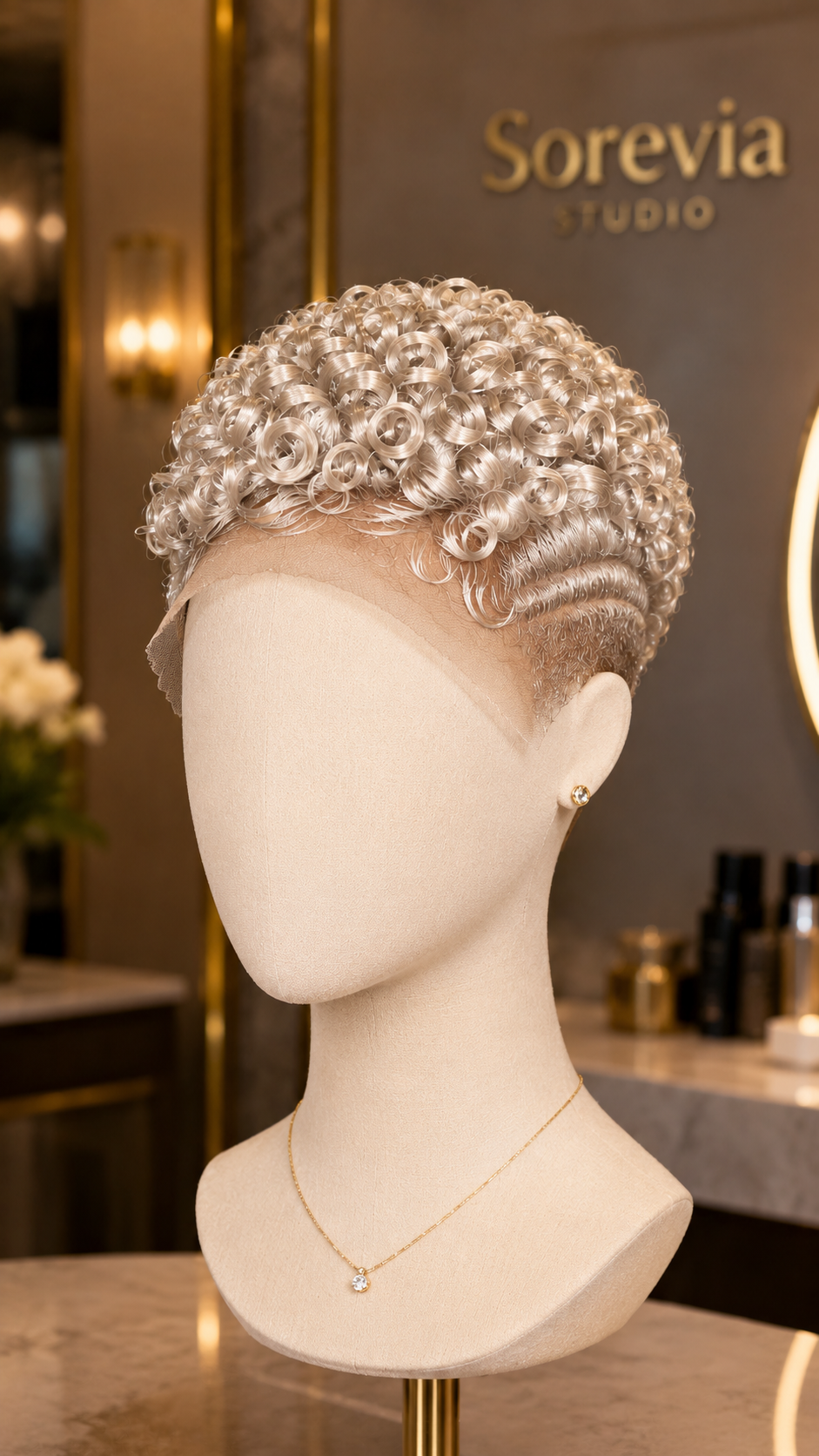
Cool, icy platinum spiral curls with no yellow anywhere in them — that’s the headline here, and it’s harder to achieve than almost anything else in the wig world. The piece is finished with a soft finger-waved section at the temple and an untrimmed lace front, shown pre-install. If you’re weighing whether to buy a platinum piece, this article covers where to find one, realistic pricing, and — crucially — the one decision that will save or cost you hundreds.
The Decision That Comes Before Everything Else: Human Hair Or Synthetic?
Most colors, human hair is the obvious upgrade. Platinum is the exception, and it’s worth understanding why before you spend anything.
To get human hair this pale, you have to strip out virtually all of its natural pigment. That’s several rounds of bleaching, each one weakening the hair’s internal structure. Curly textures suffer most — the tighter the curl, the more fragile it becomes under processing. Push too far and the curls go dry, frizzy, and lose their spring permanently. Push not far enough and you’re left with yellow, brassy tones instead of clean platinum.
Synthetic fiber skips all of it. It’s manufactured white from the start. No bleaching, no damage, no brassiness bleeding through over time — and at roughly a third of the price.
The honest recommendation: if you want platinum for occasional wear, events, or photos, synthetic is not a compromise here — it’s often the better-looking, more reliable choice. Human hair only justifies its premium if you need natural movement for daily, long-term wear and you’re buying from a colorist you genuinely trust.
Pricing
- 100% human hair, custom-lifted to platinum, lace front, with waved temple styling: $280–$550+
- 100% human hair platinum on a full lace base: $350–$650+
- High-quality synthetic, pre-dyed platinum with styled edges: $100–$220
- Basic synthetic platinum pixie, no design work: $50–$130
That gap between human hair and synthetic is wider on platinum than on any other shade, and it’s entirely explained by the bleaching labor and the risk the colorist is absorbing.
Where To Buy A Wig Like This
- Custom colorists specializing in platinum, silver, and icy tones. Non-negotiable if going human hair. Search “platinum curly pixie wig,” “icy white lace wig colorist,” or “custom platinum wig maker” on Google or Instagram. Look for multiple platinum pieces in their portfolio — one clean result could be luck; five means genuine competence in the hardest shade there is.
- Instagram and TikTok wig specialists. The only reliable way to see whether a platinum actually holds up under uncontrolled lighting. Warm indoor bulbs are extremely forgiving of yellow tones; daylight is not.
- Etsy. Good for made-to-order pieces. Prioritize buyer-uploaded review photos over the seller’s staged shots.
- General wig retailers. Genuinely fine for synthetic platinum — this is the one shade where mainstream ready-made pieces can look excellent.
Contact / Order Inquiries: [WhatsApp: +XX XXX XXX XX XX] — attach your reference image and ask directly whether the piece is human hair or synthetic, and if human hair, how many rounds of lift were needed. A colorist who answers openly is one who knows what they’re doing.
The Yellow Problem
Every conversation about platinum comes back to one thing: residual warmth.
Human hair doesn’t go from dark to white in one step. It passes through red, then orange, then yellow. Platinum is achieved by lifting past all of that and then depositing a violet or blue-based toner to cancel out whatever warmth remains. Miss by a fraction and the result is off-white, cream, or straw — not the icy tone you paid for.
How to check before you buy:
- Ask for daylight photos or video. Yellow hides beautifully under warm studio lighting and reveals itself instantly in natural light.
- Ask how long the toner holds. On human hair, toners fade with washing, and brassiness creeps back. A good maker will tell you honestly and recommend a purple shampoo routine.
- Look for evenness around each curl. Patchy toning shows up as yellow pockets scattered through the spirals — far more visible on platinum than on any dark shade.
Synthetic, again, sidesteps this entirely. The fiber is white by manufacture and stays white.
The Curls And The Waved Temple
The curls in this piece are tight, well-formed, and glossy — which, on a platinum, is genuinely notable. Over-processed platinum curls typically look dry and stretched, having lost their bounce. These haven’t, which points either to a careful, well-conditioned lift or to quality synthetic fiber.
At the temple, the hair is worked into a soft finger-waved section — flat, sculpted S-shapes lying close to the head, contrasting with the volume above. Against a platinum base this styling is highly exposed: there’s no dark tone to hide a stiff, crunchy, or uneven wave. Its clean execution here is a good sign of a careful finisher.
The Untrimmed Lace
Shipped uncut, as most lace fronts are. You trim along your own hairline on install.
On a platinum piece this matters more than usual — a pale wig against skin makes any visible lace edge more noticeable than a dark wig would. Fine, well-tone-matched lace is worth insisting on. Cut slowly, leave a small margin, use staggered cuts rather than one straight line, and if you’re new to lace, pay a stylist for the first trim. It’s cheap insurance on a piece that may have cost you several hundred.
Before You Pay
- Human hair or synthetic — and if human hair, how many rounds of lift?
- Can you send daylight video of this exact piece?
- How long before the toner fades and brassiness returns?
- Do the curls still hold their pattern after processing?
- What’s your policy if it arrives yellow rather than platinum?
Search Terms
platinum curly pixie wig, icy white short curly wig, platinum blonde lace front pixie wig, custom platinum wig human hair, white pixie wig with finger waves, and where to buy platinum curly pixie wigs.
Platinum is the most punishing color in the business. It exposes every shortcut — a rushed lift, a lazy toner, weak lace, sloppy edge work. There’s nowhere to hide.
Which is exactly why the human-hair-versus-synthetic question deserves more thought here than with any other shade. Ask yourself honestly how often you’ll wear it. Occasional wear, events, content? Buy synthetic, spend a fifth as much, and get a cleaner white with zero fade risk. Daily wear, want the movement, trust your colorist? Then human hair is worth it — but demand daylight video, ask about the toner, and never take a warm-lit studio photo as proof of anything.