
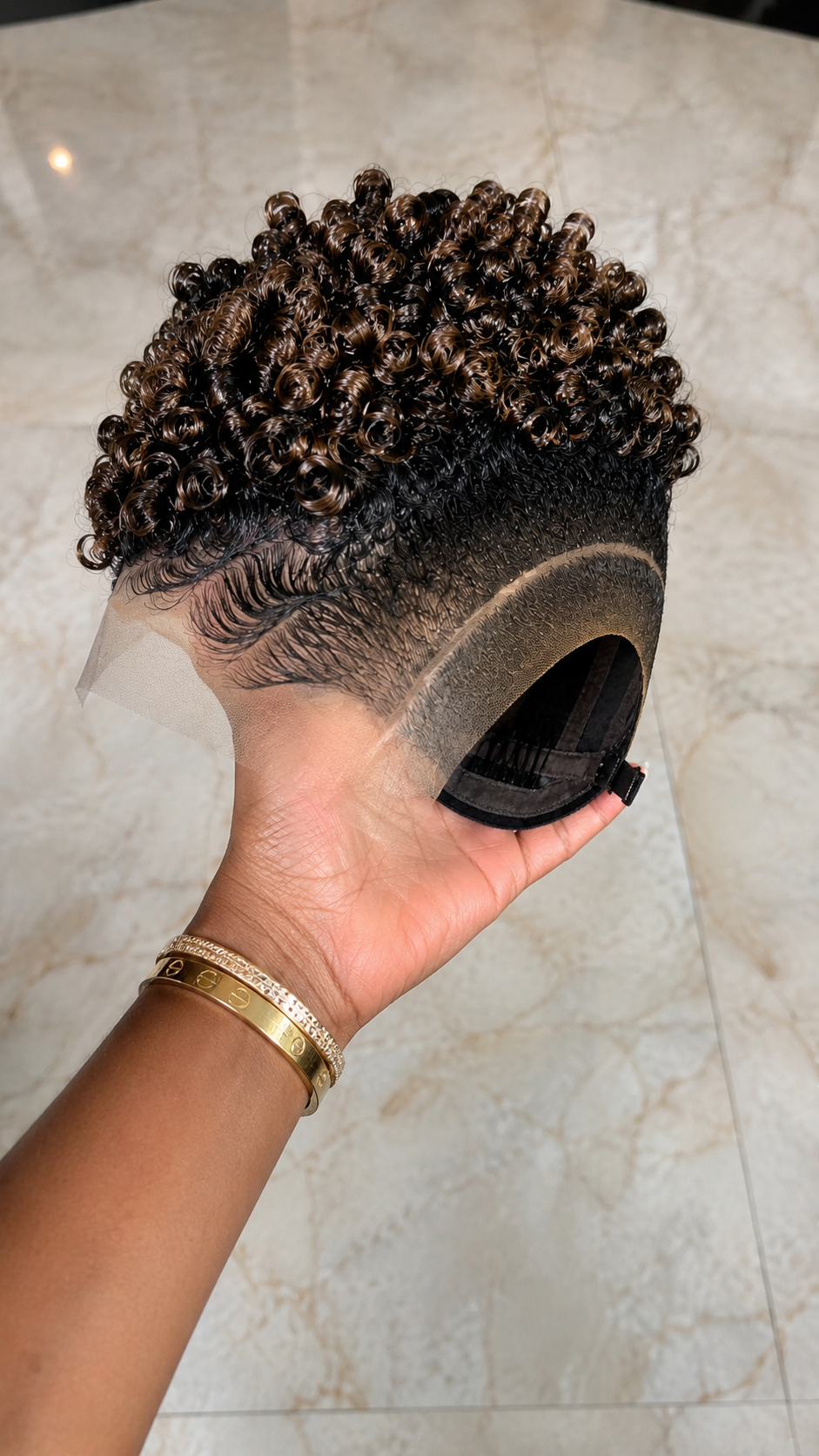
A short curly pixie wig can have beautiful curls, realistic lace, and carefully placed highlights, yet still become uncomfortable or obviously wig-like if the area around the ear is shaped incorrectly.
This is especially important on short styles because there is almost no long hair available to hide the perimeter. The side of the wig is exposed, and the lower edge has to travel naturally around the ear while still connecting with the temple and the back of the unit.
On this black-and-brown curly pixie, the crown remains full while the lower side is cut very close. The ear area forms a large curved opening beneath that short section. That opening is not simply an empty space in the cap. Its height, width, angle, and relationship with the side hair determine how the wig will actually sit when worn.


Before ordering a similar unit, pay attention to ear-opening geometry rather than assuming an adjustable strap can correct every fit problem.
Where To Buy A Short Curly Pixie Wig With Better Ear Fit
Custom wig makers. A custom maker is usually the strongest option when the perimeter around the ear matters. Ask what measurements they require and whether the ear opening is adjusted according to your cap size rather than being produced in one standard position.
Local wig boutiques. Buying locally gives you the advantage of trying the unit near your actual ear position. A pixie can feel comfortable in the crown while still sitting incorrectly around the ear, so test both areas separately.
Instagram and TikTok wig sellers. Ask for a side video of the actual wig on a correctly sized mannequin or model. Handheld videos are useful for seeing the construction, but they cannot fully demonstrate where the opening will sit on a real head.
Etsy wig makers. Independent sellers may offer custom circumference, ear-to-ear measurements, temple placement, lace options, curl pattern, and short-side shaping.
Online wig retailers. Search for short curly pixie wigs, glueless pixie wigs, tapered curly wigs, short lace-front wigs, and curly wigs with exposed ears. Read sizing details carefully.
Amazon, AliExpress, and Temu. Budget units can work, but most use standardized caps. Customer side-view photos are useful for seeing whether the ear opening tends to sit high, low, forward, or backward.
Professional wig salons. A stylist experienced with short wigs may be able to adjust a unit that fits reasonably well but needs minor refinement around the ear.
Wholesale vendors. Wig businesses should inspect several samples because ear-opening placement can vary between production runs even when the general pixie style appears identical.
Order inquiries: WhatsApp [WhatsApp: +XX XXX XXX XX XX]
How Much Does A Short Curly Pixie Wig Cost?
Premium Custom Human Hair: approximately $280–$550+. This can include higher-grade human hair, customized cap measurements, lace construction, hand-set curls, highlighted color work, detailed short sides, and more precise perimeter fitting.
Standard Custom Human Hair: approximately $190–$380. This range can provide good human hair and individualized cap sizing with fewer premium construction features.
Basic Human Hair: approximately $130–$260. These wigs may use more standardized cap geometry and require additional professional adjustment after delivery.
Premium Synthetic: approximately $70–$170. Quality synthetic fibre can hold compact curls extremely well, but the cap and ear opening still need to fit properly.
Basic Synthetic: approximately $30–$90. Budget pixies may reproduce the overall shape while offering fewer sizing choices.
Shipping, customs fees, professional fitting, lace customization, side reshaping, and additional styling can increase the final cost.
The Ear Opening Is Part Of The Haircut
On a long wig, the cap perimeter around the ear is largely hidden beneath hair.
On a pixie, that area is visible.
This means the edge of the cap contributes directly to the silhouette of the haircut.
If the opening follows the ear naturally, the side looks intentional. If the opening sits at an awkward angle, the wearer may feel as though the cap has been cut away rather than shaped as part of the style.
If The Opening Sits Too High
An ear opening positioned too high exposes excessive space above the ear.
The short side may appear unusually narrow, and the wig can look as though it is riding upward on the head.
This can also affect the relationship between the temple, carved design, and lower perimeter.
Before assuming the haircut itself is too short, check whether the entire cap is sitting higher than intended.
If The Opening Sits Too Low
A low opening creates the opposite problem.
The cap or short hair may partially cover the upper ear.
Some wearers find this uncomfortable, especially when wearing the wig for several hours.
The edge may also interact poorly with glasses because the frame arm needs space to travel behind the ear.
A low ear position cannot always be corrected simply by pulling the wig upward because that may move the frontal out of place.
Front-To-Back Placement Matters Too
The opening can have the correct height and still be positioned too far forward or backward.
If it sits too far forward, the rear portion of the ear may press against the cap.
If it sits too far backward, too much space can become exposed in front of the ear.
This is why head circumference alone is not always enough for a highly customized short wig.
Ear-To-Ear Measurements Are Especially Useful
Custom wig makers may request measurements that help determine where the side perimeter should sit.
Follow their measuring method exactly.
Different makers sometimes use slightly different reference points, so do not send a number from an old wig order without checking their instructions.
For a short pixie, measurement accuracy can directly affect how the side design aligns with your face.
The Ear Opening Should Follow A Natural Curve
A human ear is not surrounded by a perfect circle.
The hairline around it normally rises, travels over the upper ear area, and then descends toward the back.
A convincing wig perimeter should respond to that general shape.
An excessively square or sharply cut opening can look mechanical, particularly when the side hair is extremely short.
The Curve Should Connect With The Temple
The front edge of the opening eventually approaches the temple area.
That connection is important.
If the perimeter suddenly drops sharply after the temple, the side profile can look disjointed.
A more convincing design allows the frontal, short temple hair, and ear opening to flow into one another.
The Back Of The Opening Matters Just As Much
Buyers naturally concentrate on the front because it appears in selfies and frontal product photos.
But the rear edge of the ear opening determines how the side transitions toward the nape.
If it ends too abruptly, the wig can develop an obvious corner behind the ear.
Ask for a rear-three-quarter view before buying.
The Side Design Needs Enough Room Above The Ear
This pixie uses a large curved carved line through the short side.
That design occupies space between the crown and ear opening.
If the opening rises too high, there may not be enough short hair left for the design to sit comfortably.
The line can become compressed between the upper crown and lower perimeter.
Good ear placement therefore supports the decorative side work above it.
Do Not Judge The Opening While The Wig Is Being Held
A handheld wig is not under the same tension as a worn wig.
The cap changes shape once it is stretched over a head.
The opening may become slightly wider, narrower, higher, or lower depending on cap tension.
Handheld photos are excellent for construction inspection, but request a worn side view when fit is the main concern.
A Cap That Is Too Small Can Pull The Ear Opening Up
When a wig is too tight, the cap stretches aggressively across the head.
This can raise the lower side and make the opening appear higher than it was designed to sit.
The wearer may then blame the ear cutout when the underlying problem is cap size.
Check the overall fit before altering the perimeter.
A Cap That Is Too Large Can Drop Over The Ear
An oversized cap may slide downward or develop excess material near the side.
This can make the opening sit lower and cause the edge to overlap the ear.
Tightening adjustable straps can help with minor looseness, but straps cannot completely change the geometry of an incorrectly sized cap.
Choose the closest correct size whenever possible.
Glueless Construction Needs Accurate Ear Placement
Glueless pixies depend heavily on cap tension and internal security.
Because adhesive is not being used to force the side into a specific position, the perimeter needs to sit naturally on its own.
Ask whether the unit contains an adjustable elastic band, combs, clips, or silicone grip features.
These should provide security without pulling the ear opening away from its intended position.
Combs Should Not Sit Directly Against The Ear
Internal comb placement matters on short wigs.
A comb positioned too close to the ear can cause pressure or interfere with the natural curve of the cap.
Ask for an inside-cap photograph and look at where the side combs are located relative to the opening.
If you are sensitive to combs, ask whether they can be removed or repositioned.
Glasses Are A Good Practical Test
If you regularly wear glasses, test the wig with them.
The frame arm needs to pass from the temple toward the ear without forcing the cap outward.
An opening that looks perfect without glasses may behave differently once the frame is inserted.
The same applies to sunglasses.
For everyday wear, practical comfort matters as much as photographic appearance.
Earrings Can Reveal Poor Placement
Earrings provide another useful visual test.
With a well-positioned pixie, the ear remains naturally exposed and jewelry sits independently from the wig.
If the cap edge crowds the ear, large earrings may rub against it or repeatedly catch the perimeter.
This can become irritating and may also shorten the life of delicate lace or edge construction.
The Ear Area Moves More Than It Seems
Talking, smiling, wearing glasses, turning the head, and adjusting the wig all create movement around the temple and ear.
A cap that feels acceptable while completely still may become uncomfortable after several hours.
This is why a few minutes of try-on time can be useful when purchasing locally.
Move your head normally instead of standing perfectly still in front of the mirror.
Short Hair Makes Pressure Points Easier To Notice
Long hair can hide small folds or edges around the ear.
A shaved-looking pixie exposes them.
If the cap bunches, rolls, or creates a thick ridge, that irregularity can show directly through the short side.
A properly fitted opening helps the cap remain flatter in this area.
Lace Around The Ear Should Not Be Excessively Bulky
Extra lace is useful before final fitting, but too much material gathered around a curved opening can create unnecessary thickness.
During professional customization, the installer may need to trim excess material carefully while preserving enough structure for durability.
Do not aggressively cut the area yourself without understanding how the cap is assembled.
A wrong cut near the ear can be difficult to repair discreetly.
Do Not Cut Into Structural Seams
This is particularly important when modifying a pre-made unit.
The edge around the ear may contain stitching, reinforcement, elastic, or another part of the cap construction.
Cutting through a structural seam can cause the cap to loosen or unravel.
If major ear adjustment is necessary, a wig stylist or wig maker is safer than experimenting with scissors at home.
Human Hair Gives More Styling Flexibility Around The Ear
With human hair, a stylist can often adjust the visible perimeter by trimming or redirecting some short hairs.
This can help soften the area after the cap itself fits correctly.
However, styling cannot fully correct an ear opening that is structurally several centimeters out of position.
Separate cap-fit problems from hair-styling problems before deciding what needs changing.
Synthetic Pixies Need Careful Modification
Synthetic short hair may already be manufactured into a specific direction and length.
Cutting around the ear can permanently change the factory silhouette.
Some fibres can also become more obvious at very short lengths.
If customization is necessary, choose someone experienced with short synthetic wigs.
Color Can Change How Large The Opening Appears
The black short side on this wig creates a strong outline around the opening.
That makes the shape easy to read.
On a very light blonde or skin-toned side, the boundary can visually disappear more easily.
Therefore, the same physical opening may appear larger or smaller depending on the hair and base color.
Always judge fit independently from color.
The Highlighted Crown Should Not Cover The Ear Area
The brown and caramel ringlets are concentrated above the short side.
If the perimeter curls hang too low, they can partially cover the ear opening and make the side look heavier.
This is different from the structural placement of the opening itself.
First make sure the cap fits correctly. Then evaluate whether lower crown curls need directional styling or a minor trim.
Check Both Ears
A wig can fit beautifully on one side and less accurately on the other.
Head shape is not perfectly symmetrical, and handmade construction can also introduce slight differences.
Inspect both sides before trimming lace or altering the cap.
If one side sits noticeably differently, determine whether the problem is cap positioning, head asymmetry, or construction.
How To Find A Stylist For Ear-Area Adjustment
Search for a pixie wig specialist, custom wig maker, short lace wig stylist, or wig alteration specialist.
Look for portfolios showing short units from the side, not only frontal installations.
Send photographs of the wig on your head and explain whether the issue is pressure, excessive coverage, exposed space, or an opening sitting in the wrong position.
Appointments can generally be requested through phone, WhatsApp, Instagram DM, Facebook, or the salon’s booking page.
What To Tell The Wig Maker
For a custom order, provide the measurements requested by the seller and explain that you want the ear area fully exposed without the cap sitting excessively high above it.
Send a true side-profile reference.
If the wig includes carved side work, also show where you want that design positioned relative to the ear.
Specify whether you wear glasses regularly because that can affect how you evaluate the finished side fit.
Before You Pay
- Can you show the wig worn from a true side angle?
- What measurements do you use to position the ear opening?
- Is the ear area customized for different cap sizes?
- Can you show both sides of the finished wig?
- Where are the internal combs positioned relative to the ear?
- Does the glueless band pull the side upward when tightened?
- Can the opening be adjusted later if it is slightly too low?
- Can you show a rear-three-quarter view?
- Will the side design remain visible above the ear?
- Can I approve the finished unit before shipping?
Trimming Lace Around The Ear
Fit the wig completely before cutting anything around the ear.
Align the center hairline, temples, crown, and nape first.
Then identify where the ear naturally meets the wig.
Trim gradually if the construction is designed to allow ear customization. Do not make one large cut immediately.
Stop frequently and test the fit again.
Most importantly, avoid cutting through reinforced seams or structural cap sections unless you know exactly how the unit was built.
Search Terms
curly pixie wig ear fit · short pixie wig around ears · glueless curly pixie wig · short lace wig ear opening · curly pixie wig for black women · tapered curly pixie wig · pixie wig with exposed ears · short human hair pixie wig · custom pixie wig cap fit · black caramel pixie wig · short curly wig with shaved sides · pixie wig ear tab fit
Final Thoughts
The ear opening may seem like a minor construction detail, but on a short pixie it becomes part of the visible haircut.
If it sits too high, the side can look incomplete. If it sits too low, the cap may overlap the ear. If it is positioned too far forward or backward, the entire temple-to-nape relationship can feel wrong even when the crown and frontal look excellent.
That is why a short wig should be evaluated from the side as carefully as it is from the front.
Ask the seller for worn side views, check both ears, understand how cap size affects the opening, and inspect the internal comb and strap placement before buying.
A good pixie does not simply end somewhere near the ear. Its perimeter follows the ear deliberately and uses that curve to connect the temple, short side, and back into one convincing silhouette.