
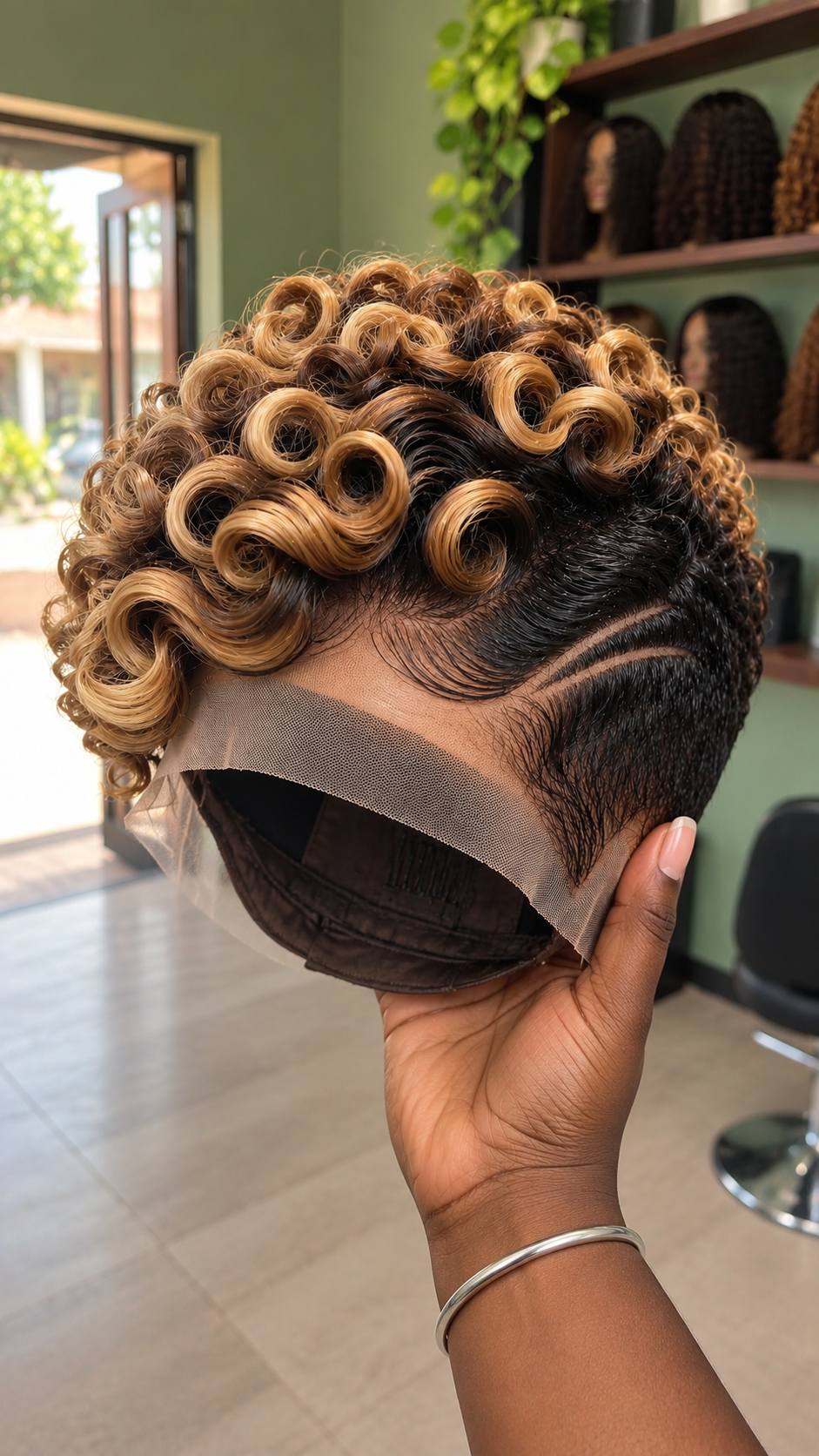
Two closely spaced lines beneath a crown of honey blonde curls give this pixie wig its unmistakable character. The photograph shows a compact, carefully arranged hairstyle with large circular ringlets above a glossy black side panel. The blonde curls are concentrated around the upper section, while the dark hair beneath them follows a backward direction and reveals two curved parting channels near the temple.
The wig is photographed before installation, supported in one hand inside a hair salon. Its extended lace remains untrimmed, and part of the dark interior cap is visible beneath the front opening. This presentation provides an opportunity to examine the relationship between the curls, the dark foundation, the side design, and the construction details that buyers should investigate before purchasing a similar unit.
What distinguishes this hairstyle from ordinary highlighted pixie wigs is the contrast between its rounded curls and the precise arrangement of the lower side. Large honey blonde loops create height and movement, but the closely fitted black hair prevents the silhouette from becoming excessively wide. The two curved channels add a decorative accent without introducing complicated zigzag patterns or additional intersecting lines.


The photograph also reveals considerable variation within the blonde coloring. Some curls appear light honey gold, while others contain deeper caramel and brown strands. The dark base remains visible between several loops, giving the upper hairstyle depth and emphasizing the individual circular openings.
For customers considering a custom wig, these details are more useful than the general description of a blonde curly pixie. The final result depends on preserving the curl diameter, the darker hair beneath the ringlets, and the exact placement of the two temple channels.
A Closer Look at the Honey Blonde Curl Arrangement
The upper section contains numerous sculpted curls arranged in circular and slightly elongated loops. Several large ringlets near the front form recognizable openings, with lighter blonde strands outlining their curved surfaces. Smaller curls occupy the spaces toward the upper rear, producing a full but controlled crown.
The loop arrangement is not completely uniform. Some curls rise higher before bending inward, while others sit closer to the dark foundation. This variation creates visual movement and prevents the hairstyle from appearing like a repeated series of identical circles.
At the visible front, several blonde loops extend slightly beyond the darker hair beneath them. Their curved ends create a decorative frame above the lace hairline without falling into long hanging strands.
The largest ringlets sit near the front and center of the crown. Their circular openings reveal darker hair inside, making the blonde outer surfaces particularly noticeable. Other loops appear to overlap or fold across neighboring curls, creating a layered arrangement.
Because the hairstyle is compact, the relationship between these curls is important. Enlarging the loops too much could increase the crown’s height and width. Reducing their diameter substantially would create a denser, more tightly coiled appearance than the photograph shows.
Why the Open Loops Need Careful Placement
A conventional curly wig may contain spirals of similar length, but the loops shown here have been arranged to retain prominent circular openings. That distinction affects how the hair reflects light and how the crown appears from different angles.
A wig maker attempting to reproduce the hairstyle should examine the orientation of the front curls and the way the smaller ringlets fill the upper section. The goal is not to make every loop identical, but to maintain a balanced distribution of larger and smaller curls.
During a custom order, request an image from slightly above the front. This angle can reveal whether the circular openings remain visible and whether the upper curls have been distributed evenly.
A second side photograph can demonstrate whether the ringlets sit proportionately above the compact dark panel. A beautifully arranged crown may still look different from the reference if it extends too far over the temple artwork.
Honey Gold and Caramel Against Deep Espresso Roots
The blonde coloring contains several warm shades. The brightest curls appear golden honey, with pale amber reflections and sections approaching beige blonde. Other strands are darker caramel or warm chestnut brown.
These colors are concentrated across the raised loops rather than distributed uniformly over the entire wig. Beneath the curls, the roots and side section appear deep espresso brown to black.
This creates a pronounced light-dark contrast. The honey blonde sections provide brightness, while the dark foundation establishes the outline and supports the two curved temple channels.
The photograph does not reveal a perfectly even transition from black to blonde. Instead, the warm colors appear interwoven through the upper curls, with dark strands visible inside many of the openings.
It is important not to confuse the brightest reflected areas with separate platinum highlights. The hairstyle primarily displays warm honey and caramel shades rather than a cool silver or icy blonde palette.
Choosing a Similar Color From a Wig Supplier
When requesting this appearance, describe the color as honey blonde and caramel loop curls over a dark espresso foundation. This gives the seller a clearer reference than simply asking for a blonde pixie.
Commercial color names vary between suppliers. One company’s honey blonde may appear almost golden brown, while another’s may be much lighter and more yellow.
Ask for photographs of the actual hair under neutral daylight. This will help distinguish the warm blonde strands from the golden reflections created by salon lighting.
For custom production, confirm that the dark side panel will remain predominantly black or espresso brown. A completely blonde lower section would reduce the contrast that makes the side artwork noticeable.
If color samples are available, compare the honey and caramel shades before approving the wig. The photograph alone cannot establish how the colors were produced or whether the strands have undergone chemical processing.
The Double Side Lines Are the Hairstyle’s Signature Detail
The visible side contains two narrow, sweeping channels that curve backward through the dark hair. These lines are located beneath the raised blonde curls, within a closely arranged black section.
The upper channel begins near the front temple area and follows a gentle arc toward the rear. The lower channel runs in a similar direction beneath it, with a narrow strip of dark hair separating the two.
The channels appear light brown against the darker strands, making their shape immediately recognizable. Their spacing is relatively consistent through much of the visible design, although the curves are not perfectly straight or mechanically parallel.
This is a double curved-line arrangement rather than a zigzag or intersecting geometric pattern. There are no obvious triangular divisions or crossing channels within the photographed section.
The styling should therefore be described accurately. Adding extra carved lines, sharp corners, or decorative intersections would produce a different wig.
The photograph does not establish whether the lines were made through cutting, controlled parting, specialized hair placement, or another technique. A professional wig maker should explain how the design is produced and whether it can be maintained without damaging the cap.
Why Spacing Between the Lines Matters
The dark strip between the two channels is an essential part of the design. If the channels are placed too close together, the central strip may become difficult to distinguish. If they are separated too widely, the side artwork can appear disproportionate beneath the blonde crown.
The channels should also maintain their gentle curve. Turning them into straight diagonal stripes would alter the hairstyle’s character.
Before a custom unit is completed, ask for a close side photograph showing both lines without the upper curls covering them.
The opposite side is not visible in sufficient detail to establish whether matching artwork appears there. Customers who want identical lines on both sides should explicitly include that requirement in their order.
The Glossy Dark Side Keeps the Pixie Compact
The dark hair beneath the blonde curls is arranged close to the wig’s surface. The strands travel backward from the front transition and gradually become finer toward the lower side.
This compact arrangement provides a strong contrast with the circular crown. While the blonde ringlets extend outward, the black hair lies relatively flat, reducing the overall width of the hairstyle.
The lower side contains closely grouped dark strands rather than an entirely exposed or completely shaved surface. These hairs provide visual coverage beneath the two decorative channels.
The dark foundation also allows the blonde curls to remain the main attraction. Without the compact lower section, the upper loops might blend into a larger curly silhouette and lose some of their sculptural appearance.
When discussing a custom order, the buyer should emphasize the need for a closely arranged side with adequate hair coverage. Excessive trimming may expose unwanted cap material, while leaving the section too full could obscure the double-line pattern.
The Front Hairline Is Understated but Carefully Arranged
Near the front lace, the dark strands follow a backward and slightly curved direction beneath the blonde curls. These hairs create a transition between the exposed mesh and the raised crown.
The hairline does not contain large decorative finger waves extending across the entire forehead. Instead, the styling is more restrained, allowing the honey blonde loops and double curved side channels to remain prominent.
Fine strands are visible near the boundary of the lace. Their placement contributes to the appearance of an organized hairline without creating an additional elaborate pattern.
This distinction matters because some sellers may automatically add dramatic baby hairs or finger waves when customizing a pixie wig. Although such details can be attractive, they would alter the appearance shown here.
For a faithful reproduction, ask the stylist to preserve the relatively simple dark front transition and avoid introducing oversized decorative swoops.
What the Exposed Lace and Cap Actually Reveal
The wig is held before installation, with a broad extension of beige-brown lace visible across the front and along the photographed side. The mesh remains untrimmed, providing material that can be evaluated during fitting.
Its visible edge follows the curved contour beneath the hairline. The mesh appears fine, but the photograph cannot establish its exact classification or manufacturer specifications.
Visible lace should not automatically be described as HD lace. Such a claim requires reliable product information rather than appearance alone.
Inside the wig, a dark brown cap with stitched structural sections is visible. A comb-like fastening component can also be seen within the opening. However, the photograph does not show every part of the interior, and additional attachment hardware should not be assumed to exist.
Before purchasing, request a complete underside photograph. It should show the cap perimeter, lace attachment area, any combs or clips, and all included adjustment mechanisms.
The visible interior does not prove that the wig is suitable for adhesive-free wear. A secure fit depends on the actual cap construction, attachment options, and the wearer’s measurements.
Cap Measurements and the Importance of Temple Placement
Accurate cap sizing is particularly important for a hairstyle with two decorative temple channels. The lines must sit in a suitable position relative to the wearer’s forehead and side of the head.
A cap that sits too far forward may bring the channels unnaturally close to the face. If it sits too far backward, part of the design may become less visible from a normal viewing angle.
Custom wig makers commonly request head circumference, front-to-nape distance, ear-to-ear measurements, and additional dimensions around the temples.
The required measurements may vary according to the maker and cap design. Buyers should follow the supplier’s fitting instructions instead of assuming that one standard size will work for everyone.
During installation, the stylist should establish the correct position before trimming the lace. The relationship between the blonde loops and the double side channels should be evaluated while the wig is properly supported on the head.
Where To Buy This Wig Style
Customers can search for similar designs through specialized pixie wig makers, local wig boutiques, professional hair salons, and online retailers offering custom curly wigs.
The most effective search phrases should describe the unusual combination of elements rather than relying on a broad term such as blonde curly wig.
Useful descriptions include honey blonde loop curl pixie, black-root blonde spiral wig, double curved side parting pixie, and sculpted circular curl lace wig.
A custom wig maker may be particularly helpful when the double-line arrangement must match the reference closely. Ready-made products may offer a similar color and general curl pattern but lack the precise side detailing.
Review the maker’s portfolio for examples of compact circular curls and carefully arranged lower-side artwork. A stylist experienced only with long loose curls may not have demonstrated the necessary skills for this particular design.
No specific supplier, available inventory, or verified price can be established from the photograph alone.
How To Order This Style
Begin by sending the reference photograph to the chosen wig maker. Identify the primary characteristics: warm honey blonde circular loops, darker caramel sections, a deep espresso foundation, and two curved channels along the visible side.
Next, confirm the proposed hair material. The photograph does not establish whether the wig contains human hair, synthetic fibers, or a blend.
Discuss the approximate curl diameter and upper volume. The ringlets should remain prominent without becoming excessively large.
Ask whether the maker can reproduce the double side channels safely on the selected cap and hair foundation. Cutting into an unsuitable wig can permanently damage its construction.
For a custom order, request a side photograph after the lower pattern has been prepared. This allows the channel placement to be evaluated before the final upper styling is approved.
After the curls are arranged, request front, side, and rear photographs. The reference does not fully reveal the back, so additional images are needed to establish its construction and curl distribution.
Before payment, confirm the full quotation, return conditions, expected styling requirements, and whether the wig will arrive ready for installation or require separate salon work.
Comparing Ready-Made, Closure, and Frontal Options
Not every wig construction offers the same degree of hairline flexibility. Buyers should discuss the intended installation method before selecting a base unit.
A ready-made wig may be convenient when the curl arrangement and cap size already meet the buyer’s needs. However, the placement of the temple artwork may be difficult to change without substantial customization.
A closure-based construction may suit some compact hairstyles, but its available lace area and placement must be considered carefully. A detailed side design extending toward the temple may require construction choices that differ from those used for a simple central part.
A frontal construction may offer additional front hairline coverage, depending on its dimensions and design. Nevertheless, a frontal label alone does not guarantee that the wig will reproduce the specific side channels in this photograph.
Glueless installation should also be discussed as a separate fitting consideration. A seller must confirm whether the actual cap has suitable adjustment and securing options for the intended method.
The photographed wig’s exact construction category cannot be established solely from the visible lace and interior opening.
Estimated Prices for Honey Blonde Loop Pixie Wigs
The most significant cost considerations for a similar wig are the preparation of the contrasting colors, the individual curl arrangement, the double-line temple artwork, and the cap construction.
The following USD amounts are illustrative planning ranges rather than verified live prices or quotations for the pictured unit.
| Wig Category | Illustrative USD Range | Possible Purchase Scope |
|---|---|---|
| Premium Custom | $340–$790+ | Individual measurements, carefully arranged honey blonde loops, dark-root color placement, detailed twin-channel side work, and personalized cap preparation. |
| Standard Custom | $180–$390 | Customized blonde-and-espresso pixie styling with raised circular curls and a professionally arranged double-line side. |
| Basic Human Hair | $110–$270 | A human-hair base that may require additional coloring, curl setting, lace fitting, and side customization. |
| Premium Synthetic | $70–$195 | Higher-priced synthetic alternatives with prearranged blonde curls and dark foundations, depending on specifications. |
| Basic Synthetic | $25–$100 | Budget curly pixie options that may resemble the general silhouette but lack the exact loop arrangement or twin side channels. |
The ranges are intended for budgeting, not as guarantees of what a supplier will charge. Prices vary considerably according to market, material, production method, and styling labor.
A pale honey blonde color may require additional processing if a custom unit is made from human hair. The actual cost depends on the starting hair color and the selected coloring method.
Individually arranging the circular curls may also increase the labor charge. A wig containing ordinary loose curls generally involves different styling requirements from one with numerous sculpted openings.
The double side channels may require specialist preparation, particularly if the lower hair is created through a custom construction process.
Ask whether the quotation includes lace trimming, installation, cap alterations, shipping, and future restyling. These services may be charged separately.
The First Installation Should Protect the Side Artwork
When the wig arrives, inspect the ringlets, dark foundation, side channels, and lace before making permanent alterations.
Position the cap on the wearer’s head and examine how the curved lines align with the temple. Their appearance should remain recognizable beneath the blonde curls.
Only after establishing the correct fit should the installer assess how much lace to trim.
The stylist should avoid cutting into the decorative pattern or removing material that supports the hairline.
Any attachment method should be chosen according to the actual cap construction and the wearer’s needs. Adhesive, adjustable attachments, or other suitable options should be evaluated where appropriate.
During fitting, avoid pulling the upper curls downward over the side channels. This can conceal the artwork and alter the intended balance between the blonde crown and compact dark panel.
After installation, minor adjustments to the ringlets may be required if they were disturbed during transport. Such corrections should follow the manufacturer’s instructions for the confirmed material.
Maintaining the Circular Blonde Curls
The upper curls require careful handling because their appearance depends on the placement of individual strands within each loop.
Repeated brushing may separate the circular shapes, increase frizz, or cause neighboring curls to merge. The appropriate maintenance method depends on whether the wig contains human hair, synthetic fibers, or a blend.
If the unit is made from human hair, the maker should explain whether the ringlets require resetting after washing. If the blonde sections have been chemically lightened, their processing history may also influence the recommended care products.
If the wig contains synthetic fibers, confirm heat compatibility before using any heated styling tool. Some synthetic materials can be permanently distorted by unsuitable temperatures.
Avoid applying excessive heavy oils to the ringlets. Product buildup can reduce strand separation and make the circular openings less noticeable.
For the first several wears, the customer may find it useful to inspect the curls after removal and identify which sections experience the most friction or compression.
A Practical Maintenance Schedule
After each wear, check the hairline, cap perimeter, and visible curl arrangement. Remove the wig carefully, supporting the cap rather than pulling on individual ringlets.
Once or twice a week during frequent use, examine the larger loops for displaced strands and look for product buildup around the openings. Do not automatically brush or reshape the entire crown.
Washing frequency should depend on how often the wig is worn, exposure to sweat or products, and the maker’s instructions. A fixed schedule cannot be determined reliably from the photograph.
For occasional wear, inspect the unit before and after each use and store it in a way that protects the upper loops.
When the ringlets lose their original circular arrangement, consult the wig maker about suitable resetting methods rather than applying unfamiliar products or high heat.
Keeping the Dark Temple Lines Recognizable
The two curved channels require a different maintenance approach from the blonde ringlets.
Their appearance depends on the contrast between the pale divisions and the closely arranged dark strands around them. Brushing across the channels can move hair into the exposed areas and reduce their clarity.
Avoid trying to widen the lines using clippers or a razor without professional assessment. The underlying cap construction may not support additional cutting.
If the channels lose their appearance, ask a stylist familiar with the original construction whether they can be refreshed safely.
The lower hair should also remain relatively compact. Excessive styling products may cause the strands to clump or lie differently, changing the visible contrast.
During storage, keep the side away from rough surfaces that could disturb the carefully directed hair.
The Advantages and Tradeoffs of This Pixie Design
The main advantage is its strong visual identity. The honey blonde ringlets immediately attract attention, while the black foundation and double curved temple lines provide a secondary layer of detail.
The compact silhouette also offers an alternative to long highlighted wigs. It concentrates the color and curls close to the head, allowing the ringlet structure to remain the main attraction.
The design offers flexibility in color selection. A custom maker may be able to prepare a darker caramel or lighter champagne variation while preserving the general curl arrangement, depending on the chosen fiber.
However, the decorative ringlets may require more careful handling than ordinary loose curls. The double side lines also create a maintenance consideration because careless trimming or manipulation could change their appearance.
The wig’s suitability for frequent wear depends on fit, construction, fiber, and the wearer’s care routine. Those factors should be confirmed rather than inferred from its polished presentation.
Preserving the Details That Make This Wig Different
The most useful way to evaluate this hairstyle is to recognize that its beauty comes from the balance between three areas: the warm circular curls, the glossy dark foundation, and the gently curved twin temple channels.
A wig that reproduces only the honey blonde color will not necessarily create the same appearance. The circular openings need to remain visible, the dark side should stay compact, and the two lines must follow the intended direction.
For buyers commissioning a similar unit, accurate photographs and clear communication with the wig maker are essential. Confirm the actual product material, cap measurements, lace specifications, and installation requirements before committing to irreversible customization.
The final hairstyle should maintain the rounded upper silhouette without excessive bulk, allowing the lighter curls and lower artwork to complement one another.
With appropriate fitting and careful maintenance, this honey blonde loop-curl pixie can offer a memorable combination of warm color, sculpted circular curls, and precise dark side detailing.
Search Terms
Honey blonde loop curl pixie wig · Double curved side line lace wig · Espresso root blonde ringlet crown · Golden caramel circular curls wig · Black side honey blonde pixie hairstyle · Untrimmed lace twin temple channel wig · Sculpted blonde loop curls dark foundation · Beige lace blonde pixie with interior comb