
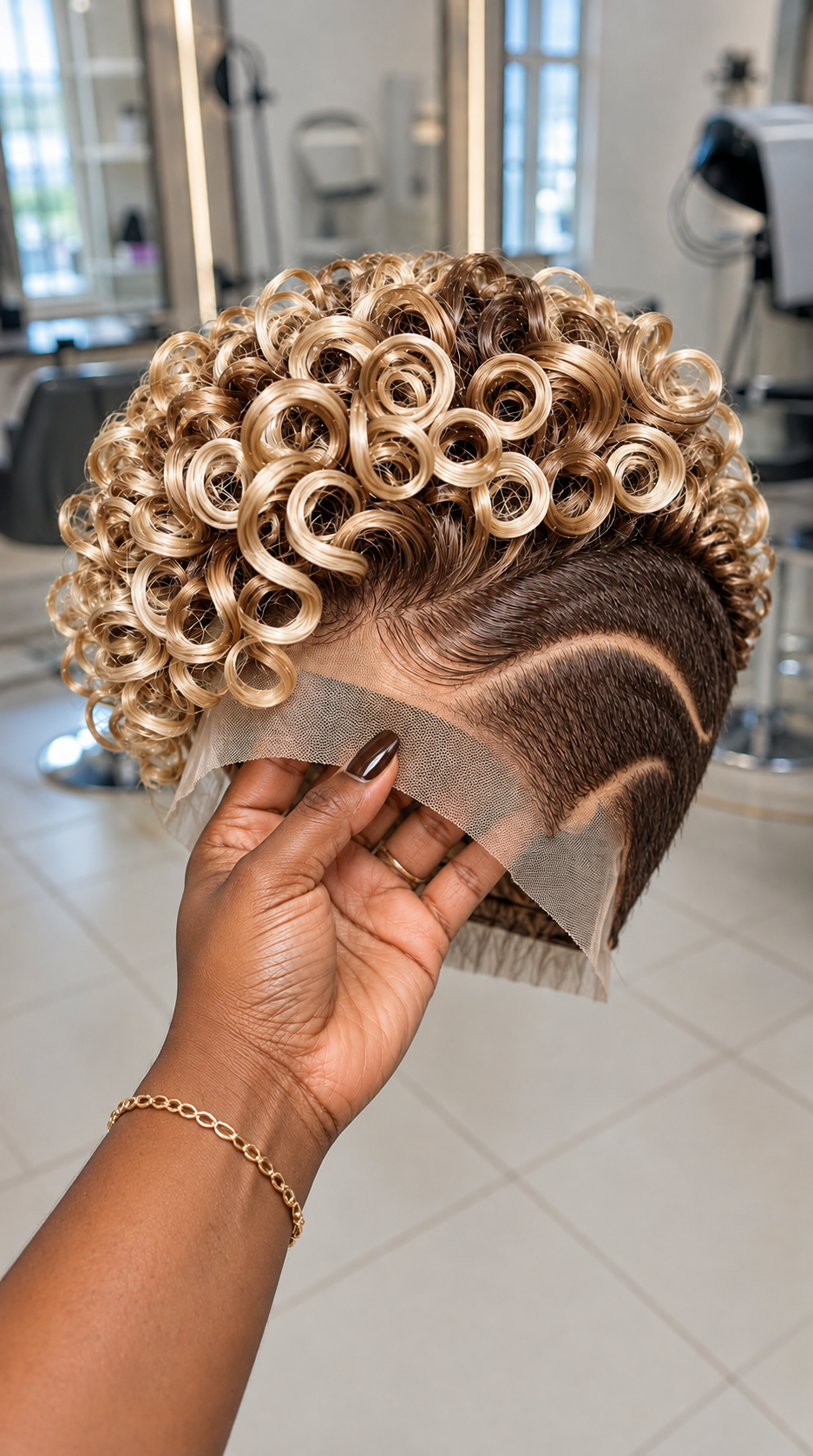
The secret to a memorable blonde pixie wig is not always the brightness of its color. Sometimes the strongest impression comes from combining carefully arranged curls with a contrasting side design. This beautiful wig demonstrates that combination through a crown of golden blonde spiral rings, a deep chocolate-brown side, and two sweeping curved separations that introduce a distinctive geometric detail beneath the curls.
Photographed inside a bright hair salon, the wig is held in one hand before installation. Its upper section contains numerous circular curls in warm golden, honey-blonde, and caramel-brown tones. Several large rings are positioned near the front, while smaller spirals continue across the upper crown. Beneath the curls, the hair changes into a darker, closely arranged section with two clearly visible curved channels following the temple area.
The contrast between the blonde crown and dark side gives the hairstyle a recognizable character. Instead of covering the entire wig with golden curls, the design concentrates the lighter color above the closely arranged lower hair. This creates a strong distinction between the voluminous upper section and the compact side profile.


The photograph also reveals a generous section of untrimmed beige-tan lace extending beyond the hairline. Part of the dark interior cap is visible through the opening, making the image useful for discussing both styling and installation requirements.
For women considering a blonde curly pixie wig, this hairstyle offers an alternative to ordinary finger coils, loose spirals, and uniformly colored blonde wigs. Its appeal depends on three important details: the open circular curls, the darker side foundation, and the double curved temple design.
Golden Blonde Curls Above a Dark Brown Foundation
The upper hair displays warm golden blonde with honey and caramel reflections. Several curls appear especially bright along their outer surfaces, while deeper areas between the rings contain darker brown tones.
The color is not distributed uniformly across the entire wig. The upper crown is predominantly golden blonde, while the visible side appears deep chocolate brown or espresso.
This difference is important because it makes the curls stand out. The lighter rings create a bright upper silhouette, while the dark lower section emphasizes the curved side detailing.
The photograph does not establish an exact root-color formula or confirm whether the blonde sections were created through chemical processing. Some apparent tonal variation may come from lighting, curl overlap, and the direction of the strands.
Nevertheless, the visible contrast is clear. This is not simply a uniformly golden pixie with dark shadows. The lower side has a distinctly deeper appearance than the crown.
Choosing the Right Golden Blonde Shade
Golden blonde can cover a broad range of tones. Some wigs appear bright yellow-gold, while others contain more caramel, honey, or beige reflections.
The photographed curls belong to a warm golden-honey family. Their color appears richer than pale platinum and lighter than a predominantly chestnut-brown hairstyle.
For a similar appearance, request a golden blonde crown with caramel depth rather than a uniformly pale blonde color.
Ask the seller for photographs under neutral daylight. Salon lighting can influence how warm the blonde appears, and a shade that looks golden indoors may appear slightly different outdoors.
A physical color sample is particularly useful for custom orders. Commercial color names are not always consistent between suppliers.
Large Circular Rings Give the Crown Its Beauty
The crown contains numerous rounded spiral curls with clearly visible central openings. Several of the largest rings sit near the upper front, where their curved strands form prominent circular shapes.
Smaller loops fill the surrounding areas, creating a densely arranged crown without making every curl identical.
The curls are not long, freely hanging spirals. They remain relatively close to the upper head, forming a compact pixie silhouette with considerable visual detail.
The front curls project slightly forward, while the upper and rearward loops overlap to create a rounded continuation of the hairstyle.
The warm blonde strands reflect light along their circular surfaces, emphasizing the shape of each ring.
Some openings are broad enough to reveal the darker hair beneath them, producing additional depth within the crown.
Why the Different Ring Sizes Matter
The photograph contains a mixture of large circular rings and smaller surrounding curls. This variation gives the hairstyle a balanced appearance.
If every curl were made excessively large, the crown could become too bulky. If the entire hairstyle consisted of tiny spring coils, the prominent open-ring appearance would be lost.
For custom work, ask the wig maker to maintain several recognizable circular openings near the front, supported by smaller curls throughout the rest of the crown.
The overall height should remain proportional to the lower side.
A photograph from above would help confirm the complete curl distribution. The current angle reveals the front and visible side clearly, but it does not establish every detail of the rear arrangement.
The Double Side Curves Create the Signature Detail
The most distinctive feature beneath the curls is the arrangement of two curved separation channels along the dark temple section.
The upper channel follows a sweeping path beneath the blonde crown. It begins near the forward side and travels backward, creating a boundary between the elevated upper styling and the closely arranged dark hair.
The lower channel sits beneath it and follows a more pronounced curved direction. Together, they divide the visible side into several distinct areas.
The channels appear pale because the underlying foundation is visible between the surrounding strands.
Although their appearance resembles barber-inspired razor detailing, the photograph does not establish that the wig was constructed using an actual razor-cutting technique.
The design should therefore be described as double curved temple separations unless the wig maker confirms the precise method.
Why the Curves Should Not Be Replaced With Straight Lines
The sweeping direction of the side channels is central to the hairstyle. Their curves complement the rounded golden curls above.
Replacing them with two straight horizontal lines would create a different visual effect.
The upper channel follows the boundary beneath the crown, while the lower separation curves around the compact temple section.
For a faithful reproduction, the stylist should preserve the individual path of each channel rather than creating two identical parallel lines.
The spacing also matters. If the channels are too close together, they may visually merge. If they are too widely separated, the middle section may appear disconnected from the overall hairstyle.
A close-up side photograph should be included in any custom-order consultation.
The Dark Temple Section Balances the Blonde Crown
Beneath the raised curls, the hair is arranged much closer to the wig foundation. The strands appear predominantly deep brown, with some areas approaching black.
This lower section has considerably less volume than the upper crown. Its compact shape helps prevent the hairstyle from looking oversized.
The hair between the curved channels is directed backward and downward, following the contour of the side.
Near the lower perimeter, the strands become less visually dense, allowing more of the tan foundation to show through.
This produces a tapered appearance, although the photograph does not verify the precise cutting or construction technique.
The darker section is not merely a background element. It provides the contrast necessary for the golden curls and curved separations to remain visually distinct.
A Sweeping Front Transition Connects the Two Sections
Near the front hairline, fine dark strands sweep backward beneath the golden curls. Their direction creates a gradual transition from the beige lace toward the raised circular rings.
These strands do not form the same large circular shapes as the crown. Instead, they lie relatively close to the foundation and follow elongated curves.
The contrast in styling is important. The upper rings create fullness, while the front transition remains comparatively flat.
If large curls were extended directly onto the front lace, the hairstyle could appear crowded and lose the delicate movement visible beneath the blonde crown.
For custom work, ask the stylist to preserve the front sweep and avoid introducing unrelated decorative curls.
The photograph does not establish whether the hairline has been pre-plucked or customized using a particular technique. Those details should be confirmed with the seller.
What the Exposed Lace Reveals
A substantial section of beige-tan lace extends beyond the front and side hairline. The mesh remains untrimmed, indicating that the wig is being displayed before installation.
The lace is especially visible around the forehead and beneath the curved temple design.
Its presence is useful for fitting, but the photograph does not establish the exact lace grade, dimensions, transparency, or thickness.
The visible mesh should not automatically be advertised as HD lace.
The lace color may also appear different against an individual’s skin than it does in the salon photograph.
Before installation, a stylist should position the wig correctly and assess where the front hairline and temple separations will sit.
Any necessary lace trimming should take place only after fitting. Removing too much material can compromise the hairline and may be impossible to reverse.
Understanding the Dark Interior Cap
Part of the wig’s interior is visible through the opening beneath the lace. The photograph shows a dark cap foundation with fabric sections and stitching.
However, the complete underside is not visible.
The image therefore cannot confirm the full number of attachment combs, adjustable straps, or other fastening elements.
The exposed construction also does not prove that the wig can be worn securely without adhesive.
Before purchasing, request the cap circumference, front-to-nape measurement, and ear-to-ear width.
Ask for a complete underside photograph showing the cap construction and any attachment hardware.
The seller should also confirm whether the product uses human hair, synthetic fibers, or a blend.
How to Order This Style
For a close reproduction, begin by identifying the three most important characteristics: a golden-honey crown with open circular curls, a dark closely arranged side, and two sweeping temple channels.
When browsing online wig retailers, examine the actual product photographs rather than relying exclusively on titles such as blonde pixie wig or curly lace wig.
Many products may match the general color without reproducing the open rings or curved side detailing.
A ready-made wig may be suitable if those characteristics are already present.
A custom wig maker may offer greater control over the curl diameter, crown height, color distribution, and temple-channel placement.
Share the reference photograph and explain which details must remain unchanged.
Request front, side, rear, and underside photographs of the finished product before shipping.
Confirm the fiber composition, cap size, lace specifications, production schedule, shipping arrangements, and return conditions before paying a deposit.
Finding a Stylist for Golden Ringlet Customization
A wig customization specialist experienced in compact circular curls, decorative side partings, and lace preparation is a suitable professional for this design.
When contacting a salon, describe the desired result as a golden blonde ringlet pixie with a deep brown side and two curved temple separations.
Ask whether the stylist has examples of similar work involving raised circular curls and closely arranged lower sections.
During consultation, discuss the desired crown height, ring diameter, front hairline, curved parting positions, and cap fit.
The stylist should understand that the darker side must remain compact beneath the golden crown.
If the wig is purchased separately, schedule fitting after the product arrives so the professional can inspect its actual construction.
Preparing the Wig for Installation
When the wig arrives, inspect the circular curls before making permanent changes.
Check whether the large rings retain their openings and whether the smaller curls remain properly arranged.
The stylist should then position the wig on the wearer and evaluate the alignment of the double side curves.
The darker temple section should follow the head contour without projecting excessively outward.
Only after the fit has been confirmed should the lace be trimmed where necessary.
Any additional styling should preserve the relationship between the blonde crown and the dark side.
The attachment method should depend on the verified cap construction and the wearer’s comfort rather than assumptions based on the photograph.
After installation, examine the wig from the front, side, and rear to confirm that the curls remain proportionate and the two curved channels are recognizable.
Illustrative Prices for Golden Blonde Ringlet Pixie Wigs
The cost of recreating this hairstyle may depend on the selected fiber, warm blonde color, circular curl arrangement, precision of the double side separations, and fitting requirements.
The following USD ranges are illustrative planning estimates, not verified live retail prices or quotations for the photographed wig.
| Wig Category | Illustrative USD Range | Potential Cost Considerations |
|---|---|---|
| Premium Custom | $380–$940+ | Individual cap fitting, specialist golden ringlet placement, dark temple customization, and precise double-curve styling. |
| Standard Custom | $190–$445 | Selected cap options, customized circular curls, and adjustments to the side-channel arrangement. |
| Basic Human Hair | $105–$290 | Human-hair base unit that may require separate coloring, curl setting, and lace preparation. |
| Premium Synthetic | $70–$195 | Higher-grade synthetic alternatives with prearranged curls and material-dependent styling flexibility. |
| Basic Synthetic | $25–$90 | Budget alternatives that may differ in color accuracy, curl construction, and cap quality. |
These categories represent possible purchasing alternatives rather than confirmed classifications of the pictured wig.
The actual material and retail price cannot be established from the photograph.
Custom blonde coloring may increase costs if the desired shade requires additional processing or specialized fiber selection.
The circular curl arrangement and double temple design may also require additional professional labor.
Ask whether the quotation includes the base wig, completed styling, lace preparation, fitting, installation, shipping, and future maintenance.
Maintaining the Golden Curls and Dark Temple
The main maintenance concern is preserving the circular openings of the ringlets.
Repeated brushing, aggressive finger separation, or compression can disturb the curls and change the compact crown silhouette.
Ask the supplier how the curls were formed and whether they can be safely repositioned after cleaning.
The dark temple section requires different attention. Hair crossing the curved separations can reduce their visibility, so maintenance should preserve the direction of the closely arranged strands.
Cleaning methods must follow the confirmed fiber composition.
Synthetic hair should not be exposed to heated tools unless the manufacturer specifically permits them.
Human hair may allow different styling methods, but previous color processing and the condition of the fibers should be considered.
The honey-blonde shade may require different care depending on whether it was manufactured into the fibers or created through chemical treatment.
Do not assume that toners or products intended for bleached human hair are suitable for synthetic wigs.
When storing the wig, use a support that preserves the circular crown without flattening the curls or stretching the lace.
A Distinctive Blonde Pixie Worth Comparing Carefully
This hairstyle brings together warm golden circular curls, dark supporting strands, a close-fitting brown temple section, and two sweeping side separations.
Its identity depends on how those elements interact. A uniformly blonde wig with loose curls or straight temple lines would create a different result.
The exposed lace and partial cap opening provide useful information about the preparation stage, but complete construction details still require confirmation.
Before purchasing, compare the actual curl arrangement, color distribution, cap measurements, and side-channel placement of available products.
With careful selection and appropriate fitting, a similar wig can provide a striking compact pixie appearance that combines warm blonde curls with beautifully arranged dark side detailing.
Search Terms
Golden blonde spiral pixie wig · Double curved temple parting hairpiece · Honey caramel open ringlet crown · Chocolate brown side blonde curl wig · Golden circular curls with dark temple · Untrimmed beige lace blonde pixie · Two sweeping side channels curly wig · Warm honey ringlets with espresso side