
Left and right are not what you think they are when you are looking in a mirror.
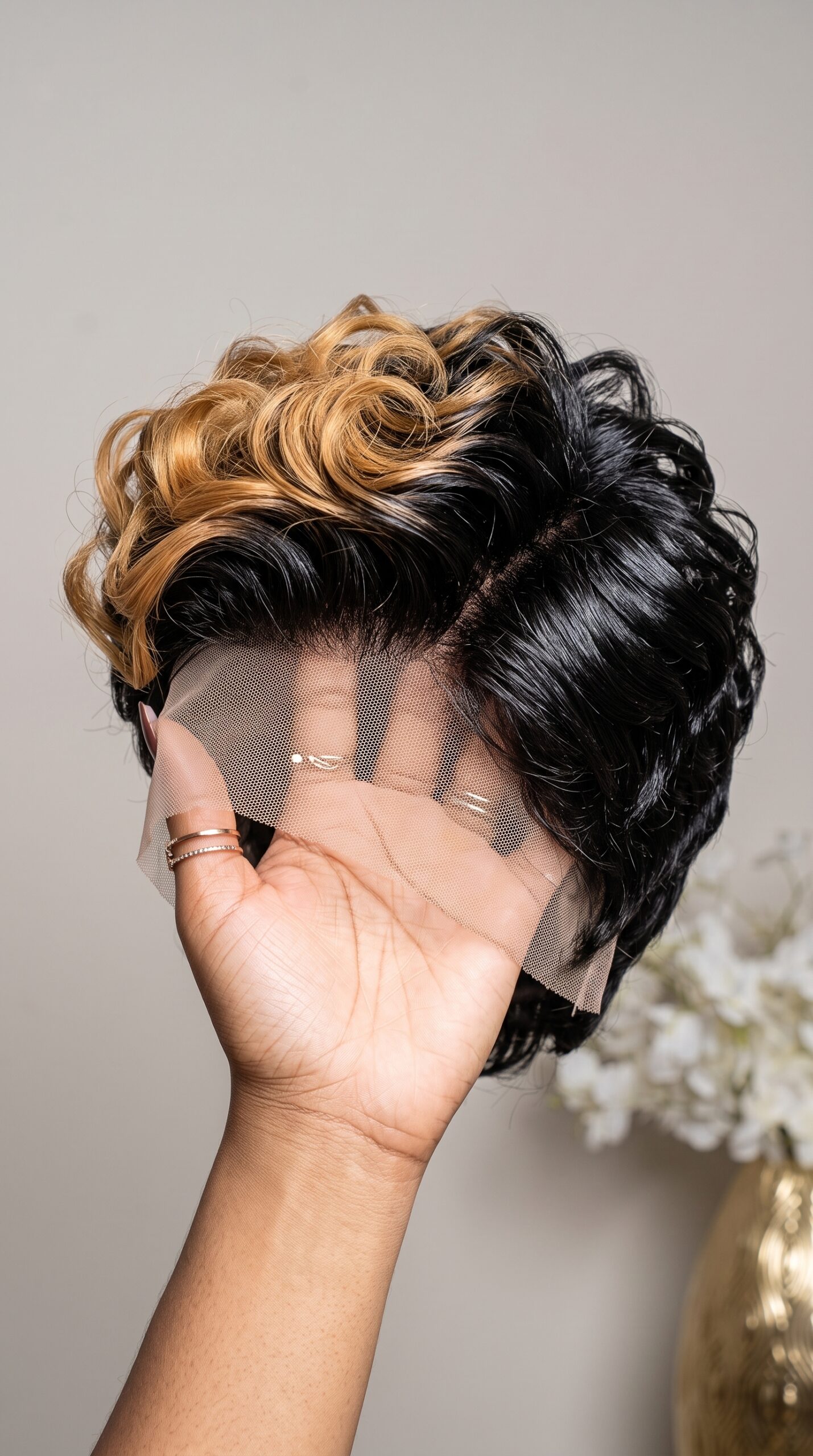
That sentence costs people money every week. This asymmetric pixie wig carries honey blonde across one side only, sweeping forward over the temple, while the rest of the piece stays solid black with a glossy wave running back over the crown. Photographed from the blonde side it is striking. Photographed from the other side it is a plain black pixie. Which of those you see every day depends entirely on getting one instruction right before the piece is built.
Where To Buy A Wig Like This
Single-side colour is a placement job, which means the seller has to be able to take an instruction and act on it.
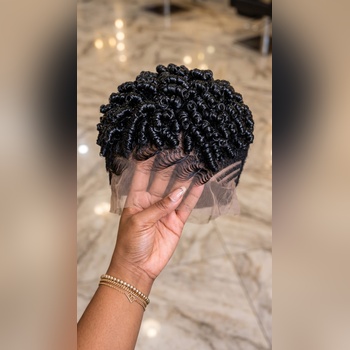
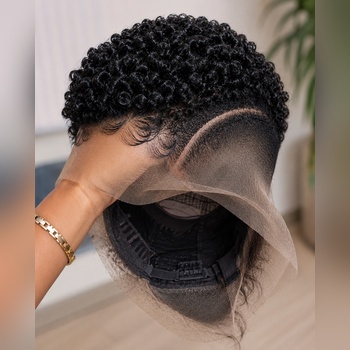
Custom makers and lace studios. The only realistic route. Asymmetric colour cannot be picked from stock because stock is built symmetrically or arbitrarily. Expect one or two people working over WhatsApp or direct message, four to six weeks, deposit up front. This is also the only channel where you can say which side and be confident it will be honoured.
Instagram and TikTok sellers. The largest pool of makers who do this style. Search the terms below plus your city. Watch Reels rather than stills, and specifically look for a video where the model turns her head, since that is the only way to see both sides of an asymmetric piece. An account that only ever shows the coloured side is showing you half a product.
Etsy. Poor fit for this. Listings are built around fixed products and most sellers cannot vary placement. If you order here, assume you will get whichever side the photograph shows and check the returns policy before paying.
Marketplaces such as Amazon, AliExpress and Temu. Synthetic asymmetric pieces exist at low prices and are fine if the placement in the photograph happens to suit you. Nothing here is customisable, and human hair claims in this price band on a coloured piece should be treated sceptically.
Local beauty supply shops and salons. Useful precisely because you can try it on and see which side it sits on before paying, which removes the entire problem this article is about. Prices run roughly a third higher than online. Many salons will place a custom order and handle the fitting.
Vendor or wholesale direct. Minimums of five to ten units, all identical, so only relevant for resale.
Regional note. Independent makers producing asymmetric and contrast short units cluster in Nigeria, Ghana, South Africa, the United States and the United Kingdom, with the busiest concentrations on Instagram in Lagos, Accra, Atlanta and London. Ordering internationally means adding shipping and duty to every comparison.
Vetting a seller. Look for a continuous posting history rather than a burst of content. Ask for buyer photographs. Test them with one precise question about side placement and see whether the answer is specific. Ask for video in daylight showing both sides. Get the returns position in writing.
Red flags. Only ever showing one side of a piece. The same image appearing across several shops. Vague answers about placement. A price well below the ranges below for human hair with a lifted section. Payment only by irreversible transfer.
What to send when you enquire. A reference photograph, your head circumference, your crown-to-nape measurement, which side you part on, which side you want the colour on described in plain words rather than a photograph, and your deadline.
Paying safely. Thirty to fifty percent deposit is standard, balance before shipping. Ask for a photograph of the finished piece with the coloured side clearly identified before releasing the balance. Use a payment method that offers some protection.
Contact / Order Inquiries: WhatsApp is where most independent makers take orders. [WhatsApp: +XX XXX XXX XX XX] — say which side you want the colour on in words, not by sending a mirror selfie.
Getting The Side Right
This is the part that goes wrong, and it goes wrong for a specific reason.
When you look in a mirror, the side of your face that appears on the right of the image is your left side. Most people choose a side by looking at themselves in a mirror, then describe it as it appeared, which reverses it.
Phone cameras add a second layer of confusion. Front-facing camera previews are usually mirrored while the saved photograph is not, so the image you approved and the image you sent can be opposite.
Three ways to avoid it.
Describe it by ear. Say the colour should sit on the same side as your right ear, or your left ear. Ears do not reverse in translation.
Use a landmark. If you have a mole, a scar or a piercing on one side, reference it.
Ask the maker to confirm back in the same terms before they start. A single message reading “colour on the right ear side, confirmed” is worth more than any photograph.
Which Side To Actually Choose
Once you can specify a side accurately, decide which one.
Most people have a side they habitually turn toward people, usually the side opposite their dominant hand, and a side they photograph from. Those are frequently the same.
Consider where you sit at work, in a car, or at a table you use often. Colour on the side facing a wall is colour you paid for and nobody sees.
Consider your parting. Colour on the side the hair sweeps toward is more visible than colour on the side it sweeps away from, because the sweep carries it forward across the face.
On this piece the blonde sits on the side the wave sweeps toward, which is why it reads as deliberate rather than accidental.
The Half That Is Not Coloured
Worth saying plainly: you are buying a black pixie wig with colour on one side. From the uncoloured side, in profile, that is what people see.
That is not a criticism of the design. Asymmetry works because of the contrast between the two halves. But if you expected the piece to look colourful from every angle, it will not.
Ask for a photograph taken from the plain side before you buy, so you know what half your days look like.
How Much It Costs
One-sided colour lifts less hair than an all-over blonde and costs more than an untouched black unit.
The unit itself
Human hair asymmetric pixie wig, honey blonde on one specified side, wave set, sheer lace, glueless cap: $270–$560
The same one side blonde pixie wig built to the maker’s default side rather than yours: $250–$520
Human hair pixie wig with colour on both sides framing the face: $290–$600
Human hair pixie wig, solid black, same construction: $180–$380
Quality synthetic black and honey blonde asymmetric pixie wig: $85–$175
Basic synthetic two tone short wig: $30–$70
What is usually included, and what is not
Included in most quotes: cap, hair, standard knotting, standard lace.
Charged separately by many makers: specifying the side rather than accepting their default ($20–$40), HD or fine lace over standard ($20–$50), bleached knots across the full lace ($15–$40), a built parting ($25–$60), pre-trimmed lace ($25–$50), rush build ($40–$100).
Ask which of these sit inside the quoted figure. Sellers quoting the same number are often quoting different products.
Shipping and duty
Tracked international shipping on a single short unit generally runs $25–$60. Import charges depend on your country and are usually calculated on declared value; allow ten to thirty percent of the item price and check your own rates before agreeing a total.
The costs that come after
Canvas block and stand: $25–$60 once
Satin cover: $5–$15
Toning treatment for the blonde section: $25–$55 per year, lower than an all-over blonde because there is less of it
Colour-safe washing products: $30–$60 per year
Professional first lace trim: $30–$80 once
Professional reset of the wave: $40–$90 per visit, two to four times a year
First year, all in
A mid-range human hair version at $360, plus $45 shipping, plus roughly $60 duty, plus $50 of storage kit, plus $70 in toning and wash products, plus one $50 trim and two $60 resets, comes to around $765 across twelve months.
The synthetic equivalent at $130 with no toning and no resets comes to around $190.
Cost per wear
Worn three times a week over a year, the human hair piece works out near $4.90 per wear and should carry into a second year. The synthetic sits near $1.25 per wear but the wave softens and the contrast dulls well inside twelve months.
What an unusually low price means
Human hair with a lifted section, a lace front and a set wave is difficult to produce under roughly $140. Below that the likely substitutions are machine wefts rather than hand knotting, a fibre blend, unbleached knots, or a colour that has been sprayed rather than lifted.
Deposit structure
Thirty to fifty percent up front, balance before shipping. On an asymmetric build specifically, ask for the pre-shipping photograph to show the coloured side against a described landmark, so you can confirm the side before the piece leaves.
The Wave And The Colour Together
The wave here runs back and across, and the blonde sits on the leading side of that movement.
That pairing matters. A colour section placed against the direction of the wave gets folded under as the hair sweeps, so half of what you paid for disappears into the shape.
Ask whether the colour was placed before or after the wave was set. Placed afterwards, the maker can put the blonde on the surfaces the wave presents outward. Placed before, it lands wherever the set takes it.
Living With A Single Coloured Section
The blonde side is the most processed hair on the piece and it sits on the side that takes most of the handling if it is also the side you push back.
Expect breakage to appear there first. Toning will be needed every few weeks to hold the shade while the black half needs nothing.
Keep heat off the coloured side entirely, and ask the maker what toner was used so you are not matching by guesswork.
Before You Pay
Which side is the colour on, described by ear rather than by photograph?
Can you confirm that back to me in the same words before you start?
Can you send a photograph taken from the plain side?
Was the colour placed before or after the wave was set?
Are the knots bleached where the blonde meets the lace?
Trimming The Lace
Work along your own hairline with short angled cuts, leaving a margin rather than trimming flush.
Specific to this build: the blonde reaches the hairline on one side only, so the front lace has one section where knots sit under pale hair. Cut more conservatively there than on the black side, and check that boundary in daylight before taking any more off.
Have the first cut done by someone experienced, with the piece on your head so the coloured side sits where it will actually fall.
Search Terms
asymmetric colour pixie wig · one side blonde pixie wig · black and honey blonde short wig human hair · side swept pixie wig · half colour pixie wig · one sided highlight short wig · asymmetric pixie wig where to buy
Final Thoughts
Asymmetric colour is one of the few short-wig designs where a single word in the order decides whether the piece works. Say the wrong side and everything else can be perfect and the wig will still be wrong every time you catch yourself in a window.
Describe the side by ear, get it confirmed back in writing, and ask to see the plain half before you pay.
Then accept what you are buying: a black pixie wig that is spectacular from one angle and ordinary from the other. That trade is the design, not a flaw in it.