
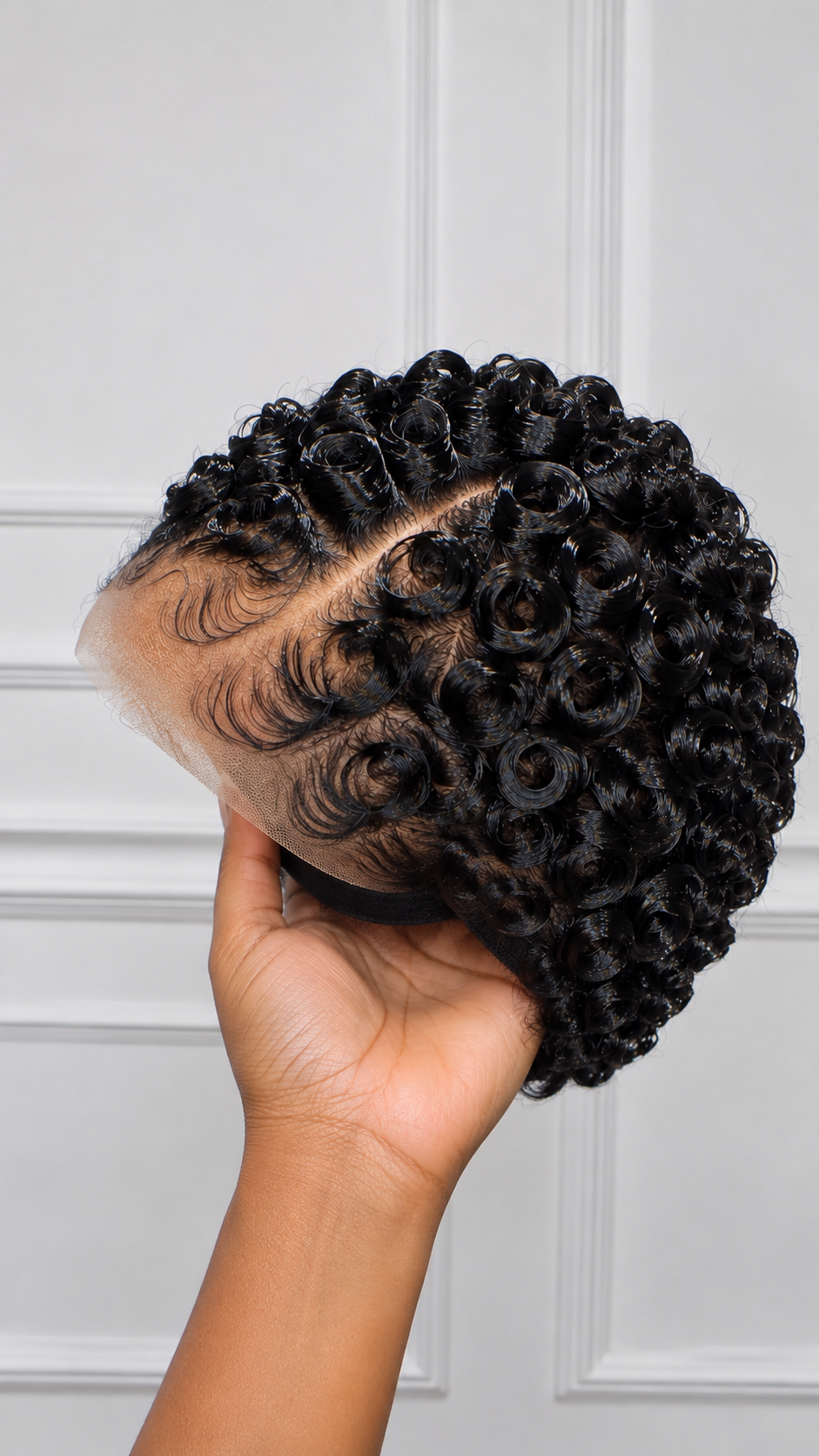
The smallest curls on this black pixie sit right at the hairline. Fine strands curve over the brown lace in loose crescents, with space between each bend. Just above them, the hair folds into much fuller ringlets. Their rounded rims catch the light and their centers stay dark, giving each curl a visible outline even where the hair is closely arranged. The difference in scale makes the front easy to admire up close, while the rounded shape holds together when you step back.
A side part runs at an angle from the front toward the crown. Larger ringlets crowd one side of it, while a narrower group sits across the line. Some curls turn almost upright and show their openings. Others angle down toward the visible side, where the circles become more compact. The hair reads as black throughout. The small flashes of blue and white along the ridges are reflections, and they make the individual turns easier to see.
The short black ringlet wig is supported by a single hand, with a little of the dark interior showing beneath the lace. This angle makes the fine edge work unusually easy to inspect. You can see where the curls begin to lift and where the flatter hairs extend beyond the main body of the style. If you are considering a similar wig, use that distinction to decide what you want fitted to your face and what you want the maker to preserve across the crown.


Let the Small Curls Set the Hairline
The most delicate bends sit close to the exposed edge. Some trace a shallow crescent and end within the surrounding fine hairs. Others arc outward before joining a nearby ringlet. The spaces between these curves give each one a visible outline. If a stylist joins all the fine hair into a continuous wave, the front will look denser and the individual crescents will be less apparent. Point out the areas where you want to keep the little gaps when you show the reference at a consultation.
Decide how much of that detail you want above your brow. On the hand-held unit, the fine hairs extend a noticeable distance beyond the first row of larger ringlets. A stylist can keep that longer arrangement or shorten the bends to leave more forehead visible. Ask to see the unit in position before any lace is cut. Check where the fullest front curl sits relative to your brow, then check the smallest curve near your temple. A change that looks good at one point can move the other farther than you intended.
Eyewear is worth testing at the same appointment. Put on your usual glasses and look at the side in a mirror while moving the frames into their natural position. The temple curl can sit just above the arm or curve around the area where it rests. Let the stylist know whether you wear the frames for a few minutes or most of the day. A small change to the curl on that side may make the hairstyle easier to wear while preserving the longer crescents at the front.
Reading the Ringlets From Front to Profile
Several of the larger curls have enough height for you to see their walls as well as their openings. That gives the set a rounder profile than a pixie made entirely of flat circles. Smaller curls fit around those raised sections and carry the pattern toward the visible lower edge. When you compare finished wigs, ask for a profile at eye level. An overhead view shows the attractive circles, but a profile shows how far those same curls sit away from the head and whether the fullest section lands where you want it.
The diagonal part gives the fullness a direction. In the photograph, the line stays visible between the curl groups, even where a large ringlet sits beside it. If you want a similar effect, ask the maker to leave enough space at the roots to see the line from the front. Some of the larger curls can turn slightly away from it. That adjustment can preserve the size of the ringlets and keep the side part visible without making the exposed area wider.
The finish is glossy, and the brightest reflections follow the rounded curl rims. If you like the pattern but prefer a softer shine, ask the maker to show you a comparable unit under two kinds of light. Indirect daylight reveals how the strands and part read when the reflections are gentle. An ordinary indoor view shows how the black silhouette will look in the setting where you may wear it most. Choose the finish after looking at the curves in both views, since the amount of visible detail can change considerably with the light.
Where To Buy This Wig
For a similar style, start with a short-wig boutique, a beauty supply store that stocks sculpted pixies or a custom wig maker whose portfolio shows both ringlets and fine hairline work. Search for open ringlet pixies and look through the profile photographs. A front view can make several different curl types look alike. From the side, you can see whether the circles sit upright, whether the crown is rounded and whether the front has fine, separate bends like the ones pictured.
If you want the maker to reproduce the arrangement, send the image with a short written brief. Specify black hair, the direction of the side part, a rounded crown and a few distinct crescents along the front edge. Use your own left and right for the part and mark the reference if there is any chance the picture was mirrored. Add your preferred height at the top and say how much forehead you normally show. Discuss the back separately so you can choose the nape length and decide how far the curls should continue around it.
Ask to see the front, both profiles, the back and the complete inside of the proposed unit. For a finished wig, request a short video of the actual piece. Confirm the fiber, cap size, lace shade, usable parting area and whether the lace comes trimmed. For a custom order, get the turnaround time, delivery cost and alteration terms in writing. Ask when you will be able to approve the curl arrangement and whether changes to the front crescents are included at that stage.
If you are booking a salon fitting, send the reference and photos of the wig you plan to bring. Ask whether the appointment will cover lace trimming and edge styling or whether you need to reserve time for a curl set. For a similar hairstyle on your own hair, look for a short-hair specialist who works with sculpted sets. A consultation gives the stylist a chance to check whether your current length can form the larger circles and whether the fine front bends will sit as close as you want.
Match the Cap to the Way You Will Wear the Part
Brown lace is visible around the front of the pictured unit, but only part of the dark interior can be seen. Ask a seller to show you where the usable lace ends behind the hairline and near the temple. A lace-front wig can suit the look if that area supports the full length of the angled part and the smaller curls at the edge. A frontal may offer more working room across the front and toward the temples, depending on its dimensions. Have the maker point out where the longest crescent will sit on the proposed cap.
A closure can be a practical choice when you want a fixed part and the line sits within the usable area. Ask how the maker would finish the temple on that construction, especially if you want the curved detail to extend toward the ear. Full lace can offer more options if you expect to change the part or redirect the curls later. For an elaborate set you intend to wear in one direction, fit and the placement of the visible front may matter more to you than the ability to part the hair elsewhere.
For a glueless installation, ask how the adjustable straps, elastic band and other attachments hold the unit. Follow the maker’s sizing instructions for circumference and any measurements from ear to ear or front to nape. At the fitting, turn your head and look down to see whether the front moves. Then take the wig off and put it back on yourself. If the smallest curls land in different places each time, ask the stylist to check the cap size and attachment position before making permanent changes to the edge.
An adhesive installation is an option for a compatible lace unit when you prefer additional hold. Have the stylist show you where the front will sit and how much lace will be trimmed before they secure it. Ask which remover matches the adhesive and how to release the edge without pulling on the fine hairs. Mention how often you want to remove the wig. That helps you compare the time needed for installation and removal with the way you plan to wear it through the week.
Choose Finished Curl Height Alongside Hair Length
The strands must be long enough to travel around the circle, even though the finished wig looks short. An advertised hair length gives you one measurement, while a profile shows the height of the finished set. Compare both. If you want to keep the broad openings with less lift, ask the stylist to angle some loops toward the side. If you want more height, discuss placing the largest curls near the upper crown while keeping the smaller circles close around the ear.
Density affects the spacing as much as it affects volume. With too much hair packed near the part, neighboring ringlets can cover the line or hide their own open centers. The front calls for a lighter distribution so the crescent shapes stay distinct. If you are ordering custom work, tell the maker which area you want to look fullest. Ask for an eye-level photograph and another from slightly above before approving it. The two views show whether the outline feels balanced and whether the part remains visible between the curls.
Budgeting for the Wig and the First Fitting
These USD ranges are illustrative planning figures. The fiber, cap, retailer and amount of salon work will affect the final price. Ask which services are included before comparing two quotes. A ready-made unit may already have the right crown but require separate edge work, while a custom quote may include the part and crescents as part of the set. Delivery and fitting can also be billed separately.
| Tier | Illustrative Price Range | Potential Scope |
|---|---|---|
| Budget | USD 20–45 | Ready-made synthetic pixie with a fixed curl pattern and a simple edge. |
| Value | USD 45–110 | Pre-styled synthetic unit with more distinct ringlets or a visible side part. |
| Mid | USD 95–185 | Short human-hair base with fitting, edge work or a full curl set potentially priced separately. |
| Premium | USD 170–320 | Custom styling on a standard cap with an agreed part direction and tailored front curls. |
| Salon-Grade | USD 320–625+ | Made-to-measure construction with individually arranged ringlets and a hairline fitted to the wearer. |
Decide which part of the style you would pay to have made for you. If the crown matters most, an existing wig with the right ringlet shape may leave enough of your budget for a fitting and a few front adjustments. If the precise crescent placement is the reason you chose this look, find out whether the proposed base provides room for those changes. Ask the stylist to check the lace dimensions and fiber before you buy. For a custom piece, record the agreed crown height and hairline placement so you can use them to review the approval photos.
Protect the Front First When Taking the Wig Off
After wearing the unit, check the smallest curls before you put it away. A crescent can straighten slightly where glasses or a scarf touched it even while the crown stays intact. Lift the wig by the sturdier parts of the cap and use your fingertips to guide any displaced curl along its existing curve. Work on the area that moved. A brush drawn across the whole front can pull separate bends together and leave more hair lying across the exposed lace.
If you wear the wig frequently, inspect the lace and the inside of the cap weekly for perspiration and residue. The wash interval depends on actual wear and the manufacturer’s care instructions. When washing is due, support the lace, avoid rubbing the curls together and blot excess moisture gently. Let the unit dry on a stand that supports the cap and leaves the front free of pressure. If you used adhesive, follow the directions for the compatible remover before cleaning the lace.
A human-hair unit may allow a wet reset or another method suited to its condition. Ask the stylist what they used to create the crown curls and whether the small front bends need a separate product. With synthetic fiber, use the care method specified for the unit and check its limits before using heat or steam. Book a professional touch-up when several circles lose their shape or when the crescents begin to merge. Repeated layers of product can cover the fine strand detail and make later cleaning harder.
Store the wig away from prolonged direct sunlight, with room around the sides and above the tallest ringlets. If you order a colored variation, ask for instructions suited to its fiber and color treatment. For travel, use a firm case with enough clearance for the crown and light support inside the cap. Keep the lace edge unfolded and inspect the front when you unpack. A pair of photographs taken after your first fitting, one from the front and one from the side, gives your stylist a record to work from if the original set needs restoring.
What This Pixie Is Like to Wear
The short shape keeps hair clear of the shoulders and leaves space for earrings. The crown brings fullness, while the angled part keeps the silhouette from reading as a single rounded shape. At arm’s length, the rings and side part are likely to be the first things you notice. In a close conversation, the small bends at the front come into view. That makes the style a good option if you enjoy detail without wanting long hair near your face.
The trade-off is that the fine edges and raised curls take different kinds of care. Tight headwear can press down the crown, while repeated contact at the temple can change a single crescent. A fixed part also limits how far you can redirect the style. If you want to wear the wig often, try putting it on without the stylist’s help before you leave the fitting. Check that the part stays open, the largest curl sits where you like it and the smallest bends feel comfortable around the temple. That trial will give you a better idea of what the style asks of you on an ordinary morning.
Search Terms
black pixie with kiss curls · glossy open ringlet wig · angled part black curly pixie · short lace wig with crescent edges · rounded crown black ringlets · black pixie with fine temple curls · sculpted ringlets with side part · short black curl wig with scalloped hairline