
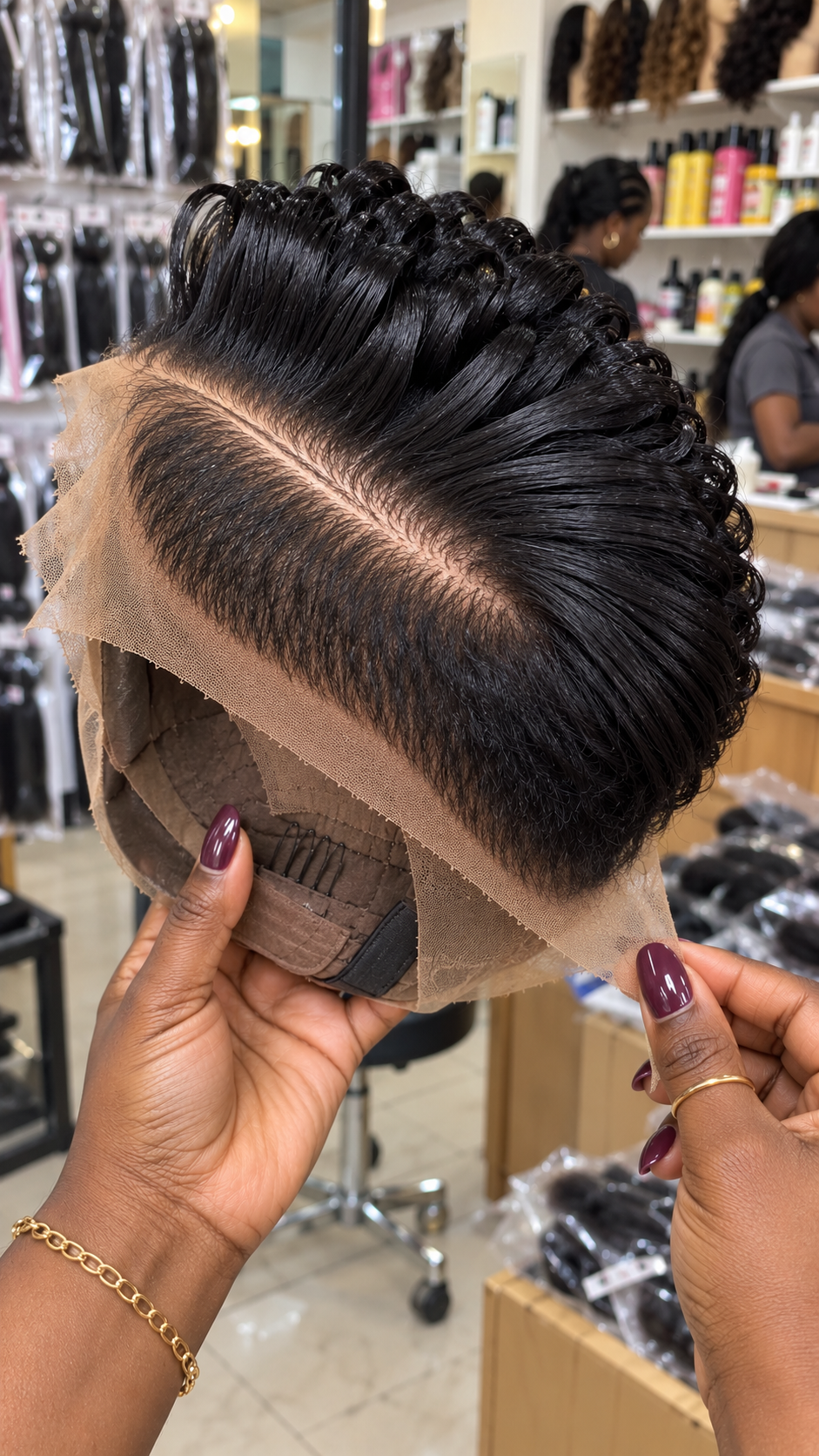
An all-black hairstyle can look remarkably detailed when its impact comes from construction rather than contrasting color. This wig demonstrates that idea through a raised sequence of glossy loops, a long side separation and a densely worked lower panel that follows the contour of the unit. The photograph is especially useful for examining the design because the wig is being held before installation, exposing the lace perimeter, interior cap and relationship between the upper styling and the side area.
The first impression comes from the height at the upper front. Large sections of black hair rise from the root before bending backward into open loops. Those sections continue toward the crown, where their size gradually decreases and their direction becomes more compact. Instead of forming a round mass of curls, the hair follows a deliberate route. The silhouette begins with height, travels backward and settles closer to the head toward the rear.
The absence of blonde, copper or burgundy accents makes strand placement particularly important. Light reflecting from the glossy black surface reveals every bend. Darker spaces between the loops create natural separation, allowing the pattern to remain visible even though the entire hairstyle stays within one color family.
The Swept Crown Creates Height Without Extra Length
The upper structure is the dominant styling element. Hair near the front rises almost vertically before curving backward. Farther along the crown, the sections lean progressively toward the rear. This produces height where it has the greatest visual effect while keeping the overall silhouette compact.
Look closely at the individual sections and they behave more like broad ribbons than ordinary ringlets. Several strands travel together, bend as one unit and create a reflective surface across each loop. The result depends on maintaining organized strand direction from the root all the way through the curve.
This distinction matters when ordering a custom version. Describing the wig simply as curly could lead to a completely different result. A stylist needs to understand that the requested crown consists of elevated loop sections with broad surfaces rather than loose curls scattered across the head.
The front sections should retain enough height to establish the silhouette. The middle should begin the backward transition, while the rear should become tighter and more compact. Reproducing that progression is more important than making every individual loop identical.
A Single Separation Line Directs the Entire Composition
A long visible separation runs beside the raised crown. It acts almost like a boundary between two styling systems. Hair above it rises into the sculpted upper sequence, while the section below remains much closer to the surface.
The line travels diagonally rather than crossing the unit horizontally. That orientation gives the design forward-to-back movement. The eye naturally follows the separation toward the crown, making the hairstyle appear longer and more directional even though the physical hair remains compact.
This placement also determines the proportions of the lower side panel. If the separation were moved substantially upward, the side would become narrower and the crown would dominate more aggressively. Moving it downward would reduce the visual height of the lower panel and change the balance of the entire wig.
For a made-to-order unit, the stylist should receive a side reference photograph like this one rather than only a front-facing inspiration picture. The location and angle of the separation are structural decisions, not minor finishing details.
The Broad Side Panel Gives the Upper Loops Their Contrast
One particularly important characteristic of this reference is what the side does not contain. There are no obvious decorative shaved channels running through the lower panel. Instead, the side is presented as a broad field of closely packed black hair.
That restraint gives the elevated crown more visual authority. The low side remains dark and compact while the upper hair catches the light. The difference in height becomes the contrast.
The side density also appears to soften as it approaches the lace perimeter. This creates a more gradual relationship between the fuller interior area and the exposed mesh. A custom maker recreating the look should pay attention to this transition rather than producing one uniformly heavy block of hair from top to bottom.
For buyers, this is worth specifying clearly. If decorative lines are added to the side, the finished wig will belong to a different design family. The photograph calls for a largely uninterrupted side panel beneath the main separation.
Black-on-Black Styling Relies on Reflection
Color contrast often makes complicated hairstyles easier to read, but this wig achieves separation through sheen. Salon lighting reflects differently from every curved section. The upper surfaces appear brighter while the recessed spaces between the loops remain deep black.
This means strand organization becomes unusually visible. A section that twists in the wrong direction can interrupt the reflective pattern. For that reason, recreating an all-black sculptural wig can require just as much precision as working with several colors.
The photograph also shows why excessive product could become a problem. The hair needs enough control to hold the sculpted formation, but an overly coated surface could make separate strands merge visually. Product choice should therefore be based on the actual fiber and the setting method used by the wig maker.
A professional stylist can determine whether the final surface needs a setting product, heat work, molding technique or another approach. Buyers should avoid experimenting with unknown products before learning what material the unit contains.
The Front Lace Is Still in Its Pre-Installation Stage
Visible lace extends beyond the hair area around the front and side of the wig. That excess perimeter shows that the unit has not yet received its final on-head trimming. It provides room for fitting and allows the installer to decide exactly where the finished edge should fall.
The photograph does not provide enough information to verify a specific commercial lace grade. For that reason, the material should not automatically be described as HD lace. A buyer interested in ordering the style should ask the maker what lace type is actually used, what shade is available and how much coverage the construction provides.
Lace color can also appear different in photographs because of lighting and whatever surface sits behind the mesh. A professional fitting gives a better basis for deciding whether tinting or another adjustment is necessary.
Before any excess material is removed, the installer should confirm placement around the forehead, temples and ears. Cutting first and attempting to correct the position afterward leaves far less room for adjustment.
Cap Construction Adds Practical Support Beneath the Styling
The underside visible in the image shows that the unit contains more than decorative hair and lace. An interior cap supports the construction, and a small comb can also be seen inside. These elements matter because a heavily shaped crown needs a stable foundation to maintain its intended position.
However, a photograph alone cannot establish every fastening component or determine whether the unit is intended to be worn without adhesive. Anyone purchasing a similar piece should request a photograph of the complete interior and ask the seller exactly which combs, straps, elastic components or other attachment methods are included.
Cap size is equally important. If a unit is too loose, the directional separation may shift away from the intended temple position. If it is too tight, the lace and side area can sit under unnecessary tension. Accurate sizing supports both comfort and visual alignment.
The Rear Transition Prevents the Crown From Becoming Bulky
The front receives the largest loops, but the stylist does not continue that same scale indefinitely. As the design approaches the rear, the loops become more compact and numerous. This transition helps the hairstyle settle into a controlled back profile.
Maintaining large upright sections all the way to the rear could create excessive volume. The gradual reduction keeps the visual emphasis near the front and middle while allowing the back to close the shape naturally.
This detail should be included in a custom order because photographs taken only from the front may not communicate it. Ask for the front elevation to remain prominent while the crown moves into smaller rear formations. That instruction gives the stylist a clearer map of the intended silhouette.
Choosing a Stylist Who Can Reproduce the Section Work
This is not a design where color alone can hide inconsistent construction. The success of the wig depends on controlled sectioning, root direction and repeated loop formation. A stylist whose portfolio contains precision molded wigs, sculptural sets or similar directional work is likely to understand the reference more accurately.
Before booking, send the photograph and ask specifically whether the crown can be reproduced with the same broad loop scale. Discuss the location of the long side separation and point out that the lower panel should remain largely uninterrupted rather than receiving additional decorative channels.
If the stylist is also producing the wig, request progress photographs before the final setting is locked in. A side photograph can reveal whether the crown height and separation angle are developing correctly. It is much easier to adjust these proportions during construction than after the unit has been completed and shipped.
A Useful Order Sheet Should Describe Shape Before Color
Because the color is visually straightforward, the written order should devote more attention to structure. Begin with the black shade, then document the elevated front loops, backward crown direction, diagonal separation and compact side treatment.
Include accurate head measurements requested by the maker. Depending on the cap system, these may include circumference, front-to-nape, ear-to-ear and temple measurements. Do not substitute estimated measurements if the unit is being custom built.
The buyer should also establish what is included in the quoted price. Ask whether the unit arrives fully styled, whether lace preparation is included, whether installation costs extra and whether the seller provides later reshaping services.
If purchasing remotely, request photographs of the actual finished unit rather than relying solely on an inspiration image. A front view, side view and crown view provide a useful three-angle check before shipment.
Installation Should Preserve the Original Direction
Directional designs require accurate placement because even a small rotation can change their appearance. The long separation needs to sit in the intended position, and the raised crown should point backward rather than drifting sideways after installation.
An installer can first place the unit without permanently securing it, examine the relationship between the lace and natural hairline area, and check both sides. The position of the ears is particularly useful for detecting rotation.
Once the placement is correct, the installer can proceed according to the actual construction and chosen attachment method. The appropriate technique should be determined by the professional and by the specifications supplied by the wig maker.
This staged approach is especially useful for a design whose visual balance depends on asymmetry. Preserving the original orientation protects the relationship between the low side panel and the elevated upper structure.
Keeping the Loop Formation Intact After Wear
Storage deserves extra attention with a raised crown. Compressing the top can collapse the large front loops or push them in different directions. A stand with enough clearance around the upper hair is preferable to forcing the unit into a confined space immediately after use.
The sculpted sections should not be combed as though they were loose hair. Doing so can separate the grouped strands that form each loop. If the surface needs attention, follow the maker’s instructions or return the unit to a stylist familiar with the original setting technique.
Moisture and heat should also be approached according to the actual fiber. Human hair and synthetic materials do not necessarily tolerate the same temperatures or products. The photograph cannot establish which material was used, so the seller should provide that information before the buyer attempts restyling.
When transporting the wig, protect the crown from pressure. The goal is to keep the large front loops standing in their intended orientation while preventing the smaller rear sections from being crushed.
Price Expectations for a Custom Sculpted Unit
Actual pricing depends on hair or fiber quality, cap construction, lace material, density, labor and the amount of hand setting required. The following ranges are general planning estimates rather than a quotation for the wig in the photograph.
| Category | Typical Planning Range | What May Influence the Cost |
|---|---|---|
| Premium Custom | $450–$900+ | Higher-grade human hair, personalized cap measurements, advanced lace work and extensive hand-shaped crown setting |
| Standard Custom | $280–$450 | Custom sizing, directional crown work, lace preparation and professional black color selection |
| Basic Human Hair | $180–$300 | Human-hair foundation with styling, fitting or customization potentially billed separately |
| Premium Synthetic | $110–$220 | Higher-grade fiber, structured setting, lace coverage and additional shaping labor |
| Basic Synthetic | $60–$120 | Standard synthetic fiber with fewer custom construction and reshaping options |
Questions Worth Asking Before the Wig Is Shipped
Before approving a custom unit, confirm whether the finished crown matches the requested height and whether the loops reduce gradually toward the rear. Ask for a side photograph showing the complete separation line and lower panel. This angle is particularly important for the hairstyle shown here.
Confirm the fiber type, cap measurements, lace specification, lace shade, attachment components and care requirements in writing. If the seller describes the unit as ready to wear, ask exactly what that means for the particular construction. Some units may still require lace trimming, fitting or professional adjustment.
It is also useful to ask how the wig will be packed. A sculptural crown can arrive distorted if the upper sections are compressed during transport. A seller experienced with shaped units should be able to explain how the loops are protected.
Why This All-Black Version Has Its Own Identity
The strongest quality of this design is its restraint. Instead of combining multiple colors and carved side patterns, it concentrates attention on silhouette and movement. The large black loops rise from the long separation, sweep backward and gradually reduce toward the crown. Beneath them, the dense side panel provides a quiet visual foundation.
That relationship makes the wig suitable for someone who wants an expressive shape without relying on bright color. The glossy surface creates its own variation as light moves across the curved strands, so the hairstyle can appear highly detailed while remaining completely black.
For the closest custom interpretation, show the stylist this exact side view and identify the characteristics that should remain unchanged: monochrome black hair, broad elevated loops, backward directional flow, long diagonal separation, dense uninterrupted side panel and visible lace perimeter before fitting. Confirm the actual lace and fiber specifications directly with the seller rather than assuming them from the photograph.
Those details give the maker a far more precise brief than simply requesting a black curled wig. The personality of this unit comes from the way every section has been positioned, and preserving that architecture is the key to reproducing the look successfully.
Search Terms
monochrome black loop crown wig · black swept ribbon loop unit · deep side separation lace wig · glossy black elevated crown hair · uninterrupted side panel wig · backward sculpted loop hairstyle · black directional crown lace unit · graduated rear loop wig