
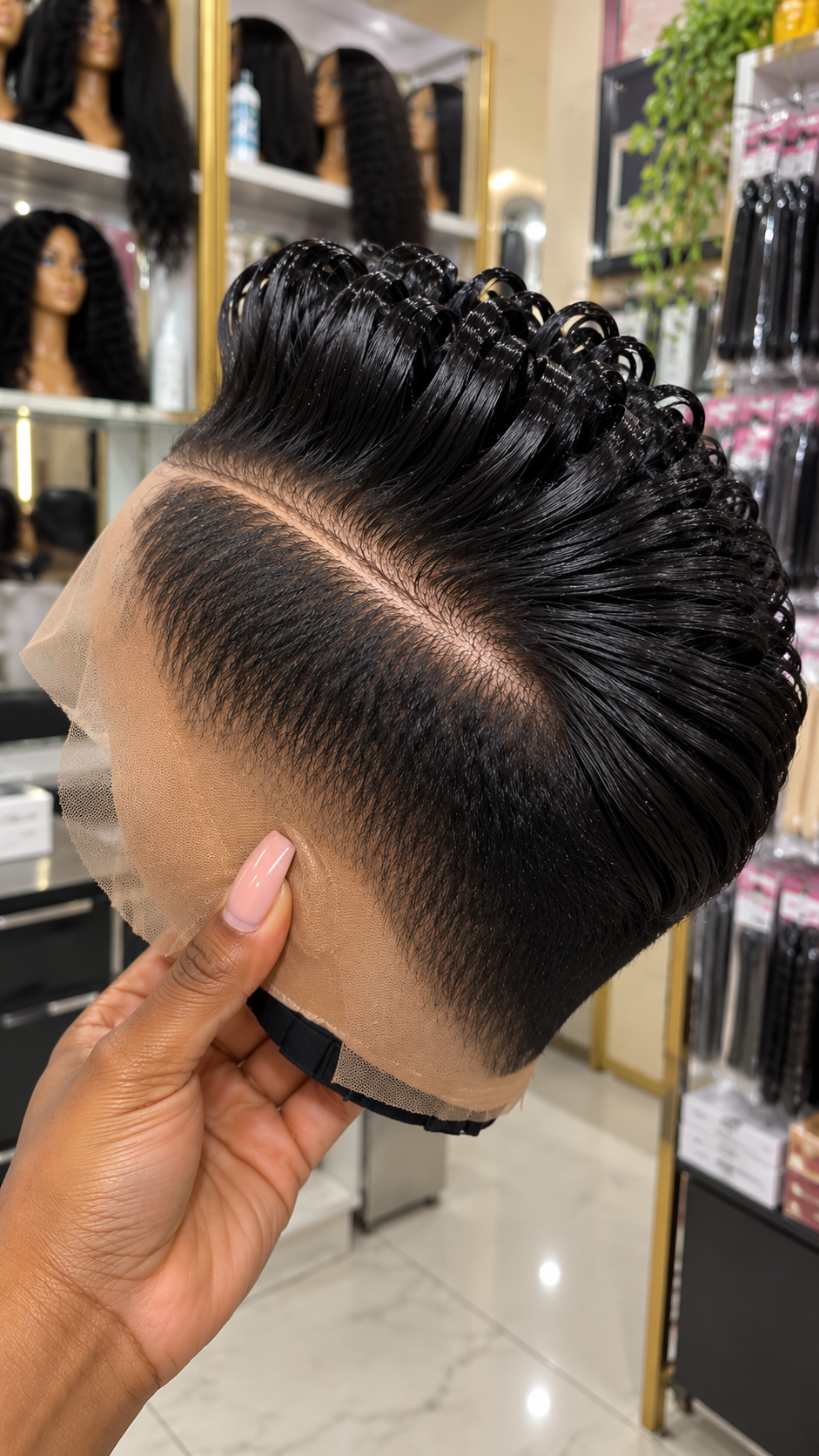
This black sculpted wig is a strong example of how shape can carry an entire hairstyle without relying on contrasting color. The photograph shows a monochrome construction built around an extended diagonal part, closely packed side hair and a sequence of glossy raised loops that travel from the front toward the crown. Because every section stays within the same dark palette, the eye is drawn toward the direction of the strands, the spacing between the loops and the dramatic change in height across the upper surface.
The unit is being held before installation, which makes several construction details easier to examine than they would be on a finished portrait. Lace extends beyond the perimeter, the side density is visible, the major parting route can be followed from front to crown, and the upper hair can be seen rising directly from that structural division. This makes the image especially useful as an ordering reference for anyone who wants a custom wig with sculptural height rather than a conventional loose curl pattern.
Monochrome Black Puts the Architecture in Control
There are no obvious copper, blonde, burgundy or silver ribbons competing for attention in this unit. The hair reads as a rich black throughout the visible construction. That single-color approach changes the character of the hairstyle considerably. Instead of using highlights to separate individual sections, the stylist relies on reflected light and strand direction to reveal the pattern.
The result is particularly noticeable across the raised crown. Light catches the curved surfaces of the black hair and creates natural bands of brightness without introducing another color. The valleys between those sections remain darker, producing enough contrast for the loop sequence to remain readable.
This is useful information when commissioning a similar wig. A buyer who wants the appearance shown here should be careful about adding unnecessary highlights. Even subtle contrasting streaks would shift attention away from the sculptural black silhouette. A single dark shade allows the shape, sheen and directional setting to remain the main visual story.
The Front Elevation Sets the Scale of the Hairstyle
The upper front is noticeably elevated. Broad sections rise almost vertically before curving backward into large open loops. This gives the wig a strong profile without requiring long hanging hair. The height is concentrated above the major part rather than distributed evenly across the whole head.
That placement is important because it prevents the silhouette from becoming round and uniform. The front carries more visual weight, while the back gradually settles into smaller, tighter formations. Seen from the side, the upper edge therefore moves through a controlled progression rather than maintaining one identical height from front to back.
When showing this photograph to a stylist, it would be useful to describe the crown as a graduated sculpted loop set. The front sections should remain broad and elevated, the middle sections should begin bending backward, and the rear should transition into more compact loops. Simply requesting a curled wig would not communicate this structure accurately.
A Long Diagonal Division Organizes the Upper and Lower Zones
One of the clearest visual elements in the photograph is the long parting line running diagonally through the wig. It separates two very different styling zones. Above the division, the strands are lifted into the large loop sequence. Below it, the hair stays considerably closer to the surface.
This creates a strong architectural boundary. The part is not merely a place where the hair happens to separate; it determines how the entire composition moves. The upper strands rise away from it, while the lower section follows the contour of the side.
The direction also gives the wig a sense of length without adding physical hair length. Because the eye follows the part diagonally toward the crown, the hairstyle appears to travel across the head. That movement is one of the reasons the unit looks sophisticated even though the palette remains entirely black.
For custom work, the position of this division should be discussed before construction begins. Moving it significantly higher or lower would alter the proportions of both the elevated crown and the dense side panel.
The Side Panel Depends on Density Rather Than Decoration
Unlike designs that use multiple carved channels or dramatic contrasting patterns along the temple, this image shows a broad dark side area with closely packed hair. Its purpose is to provide a visual counterweight to the elevated loops above it.
The density appears strongest near the upper portion and gradually becomes finer toward the perimeter. That transition helps the side avoid looking like a solid block. It also creates a more believable relationship between the dense interior hair and the lace surrounding the unit.
This restrained side treatment is an important part of the design. Adding several decorative lines would create a different hairstyle. Here, the visual tension comes from the contrast between the low, compact side and the tall, sculpted crown.
A custom maker should therefore be shown the entire photograph rather than only a crop of the upper loops. The lower section determines how dramatic the crown appears once both zones are viewed together.
The Loop Sequence Needs Consistent Strand Control
The upper hair has been arranged into broad ribbon-like sections rather than separated into small ringlets. Each section contains strands moving together in the same direction. That organization gives the surface its polished reflective appearance.
The loops are also not random. At the front, they are larger and more upright. Moving backward, their orientation changes and the hair begins to sweep more strongly toward the rear. Near the crown, the loops become smaller and more numerous.
This progression requires careful sectioning during styling. If every loop were identical, the unit could look repetitive. If the sections varied too much, the pattern would lose continuity. The visual appeal comes from controlled variation: the loops belong to the same family but gradually change in scale and direction.
Anyone recreating the look should pay particular attention to the base of each loop. The photograph shows the strands leaving the root area in an organized direction before they bend. That root-to-loop transition is what prevents the upper sections from appearing disconnected from the rest of the wig.
The Lace Perimeter Should Be Evaluated Before Cutting
The photograph clearly shows lace extending around the front and side perimeter. This excess material is expected before fitting and trimming. It gives the installer room to position the unit and determine where the final edge should sit.
The exact commercial grade of the lace cannot be confirmed from an image, so it would be inappropriate to label it HD lace without information from the maker. Buyers should instead ask direct questions about the material: what type of lace is used, what color it is, how far it extends and whether the unit is intended for adhesive, glueless or another installation method.
The color of the lace in a photograph can also be misleading because salon lighting, camera processing and the background beneath the mesh all influence its appearance. Matching or tinting should therefore be decided against the wearer’s actual skin rather than from a screen alone.
Why Fitting Matters More With an Asymmetrical Structure
A highly directional wig gives an installer less room for careless positioning than a symmetrical curly unit. If this wig rotates slightly during installation, the long diagonal part may no longer sit where intended. The side panel can also shift in relation to the temple and ear.
Before trimming the lace, the installer should position the unit, check both ears, confirm the front placement and examine the diagonal division from several angles. Once the proportions look correct, the excess perimeter can be addressed according to the construction and installation method.
This is also why accurate measurements are important for custom orders. Circumference is useful, but ear-to-ear, front-to-nape and temple measurements can provide additional guidance. A custom maker should explain which measurements are required for the specific cap being produced.
Ask for Sculptural Setting, Not a Generic Curl Request
Terminology can make or break a custom order. Asking for “black curls” leaves enormous room for interpretation. The photograph shows something much more specific: broad sections shaped upward and backward into repeated loops with a graduated crown.
When speaking with a stylist, describe the desired result in terms of construction. Mention the elevated front, ribbon-like strand grouping, open loop formation, diagonal separation and compact rear transition. Sending the image alongside those notes is even better.
A stylist who has experience with molded or sculptural wig setting will be better positioned to reproduce the shape than someone whose portfolio focuses primarily on long bundles, loose waves or conventional lace installations. Look through previous work before booking and pay attention to whether the stylist can control strand direction as precisely as the reference requires.
Booking the Right Professional for This Unit
This hairstyle combines wig construction, precision setting and lace fitting. Depending on the salon, one person may handle the complete process or different professionals may perform separate stages.
Before making an appointment, send the photograph and ask whether the stylist can reproduce the upper loop structure at approximately the same scale. Ask whether the quoted service includes preparation of the unit, shaping, installation and later maintenance. If the wig is being ordered remotely, request photographs from the side before shipment so the diagonal architecture and crown height can be checked.
It is also worth asking whether the unit will arrive already set or whether final shaping must be completed after delivery. A sculpted style can be affected by packaging, so the seller should explain how the crown will be protected during transport and whether minor reshaping is expected after unpacking.
Human Hair and Synthetic Fiber Change the Styling Options
The photograph itself does not establish the fiber type, so buyers should confirm this with the seller rather than assuming. The distinction matters because human hair and synthetic fibers behave differently during reshaping, washing and heat styling.
A human-hair version may offer greater flexibility if the wearer eventually wants the upper sections reset, but the exact treatment depends on how the original style was created. Synthetic fiber can hold a preset shape effectively, yet its heat tolerance varies widely. Some fibers permit controlled heat while others can be permanently damaged.
Ask for written care instructions with the finished unit. The correct temperature range, products and washing method should be based on the actual material used rather than general wig advice.
Preserving the Raised Crown Between Wears
The most vulnerable part of this hairstyle is its three-dimensional crown. Compressing the loops can change their height and interrupt the progression from front to back. Storage should therefore give the upper sections enough space to remain upright.
A properly sized wig stand can help maintain the silhouette. Avoid pushing the unit into a small bag immediately after wear, and do not place heavy objects over the crown. If the wig must be transported, the loops should be protected so they are not flattened against the packaging.
Routine care should also avoid unnecessary brushing through the sculpted sections. These loops were intentionally arranged into grouped strands. Pulling a brush through them can separate the sections that create the visible pattern.
If individual strands begin escaping from the formation, a stylist can usually assess whether localized resetting is sufficient. Reworking only the affected area may preserve more of the original construction than dismantling the entire crown.
What to Confirm Before Paying for a Custom Order
A reference image is useful, but an order should still contain written specifications. Confirm the primary black shade, cap size, lace type, lace color, density, location of the diagonal part and approximate crown height. Make sure the stylist understands that the broad loops should decrease in scale as they move toward the rear.
Request clarification about what arrives completed. Some custom prices include coloring, cutting, setting and hairline work, while others cover only the base unit. Installation may also be priced separately.
For online purchases, ask for current photographs of the actual unit whenever possible. Front, side and crown views can reveal far more than one promotional photograph. They also provide an opportunity to catch major differences before shipping.
Custom Wig Price Planning
Pricing varies according to fiber, cap construction, lace specification, labor, density and the amount of hand styling required. The figures below are broad planning ranges rather than prices for the photographed wig or quotations from a particular seller.
| Category | Estimated Range | Main Cost Considerations |
|---|---|---|
| Premium Custom | $450–$900+ | High-grade human hair, custom cap work, precision lace preparation, extensive sculptural setting and personalized fitting |
| Standard Custom | $280–$450 | Custom sizing, black hair selection, directional parting, crown shaping and lace preparation |
| Basic Human Hair | $180–$300 | Base human-hair unit with additional styling potentially charged separately |
| Premium Synthetic | $110–$220 | Higher-grade fiber, structured preset crown, lace coverage and specialist shaping |
| Basic Synthetic | $60–$120 | Standard fiber, simpler cap construction and fewer customization options |
The Detail That Separates This Wig From Similar Black Units
At first glance, the absence of contrasting color may make this design appear simpler than multitone wigs. A closer inspection shows the opposite. Because there are no bright highlights to create artificial separation, the construction itself has to do all the visual work.
The extended diagonal part provides direction. The dense lower panel anchors the side. The broad front loops introduce height, and their gradual reduction toward the rear controls the silhouette. Meanwhile, the glossy black strands reveal each curve whenever they catch the salon light.
That combination makes this reference particularly useful for someone who wants an expressive hairstyle while staying with an all-black palette. The interest comes from shape rather than color.
For the closest custom result, avoid reducing the order to a generic description such as a black curly wig. Give the maker the reference photograph and specify the diagonal architecture, elevated ribbon loops, compact rear transition and visible lace perimeter. Confirm the actual lace specification and fiber with the seller, then arrange fitting with a wig stylist who understands directional sculptural work. Those decisions are what preserve the identity of this particular design from the order stage through final installation.
Search Terms
black sculpted loop lace wig · all black elevated crown wig · diagonal part ribbon loop wig · glossy black directional wig · black raised loop crown unit · asymmetrical lace perimeter wig · black graduated loop hairstyle · deep diagonal part black wig