
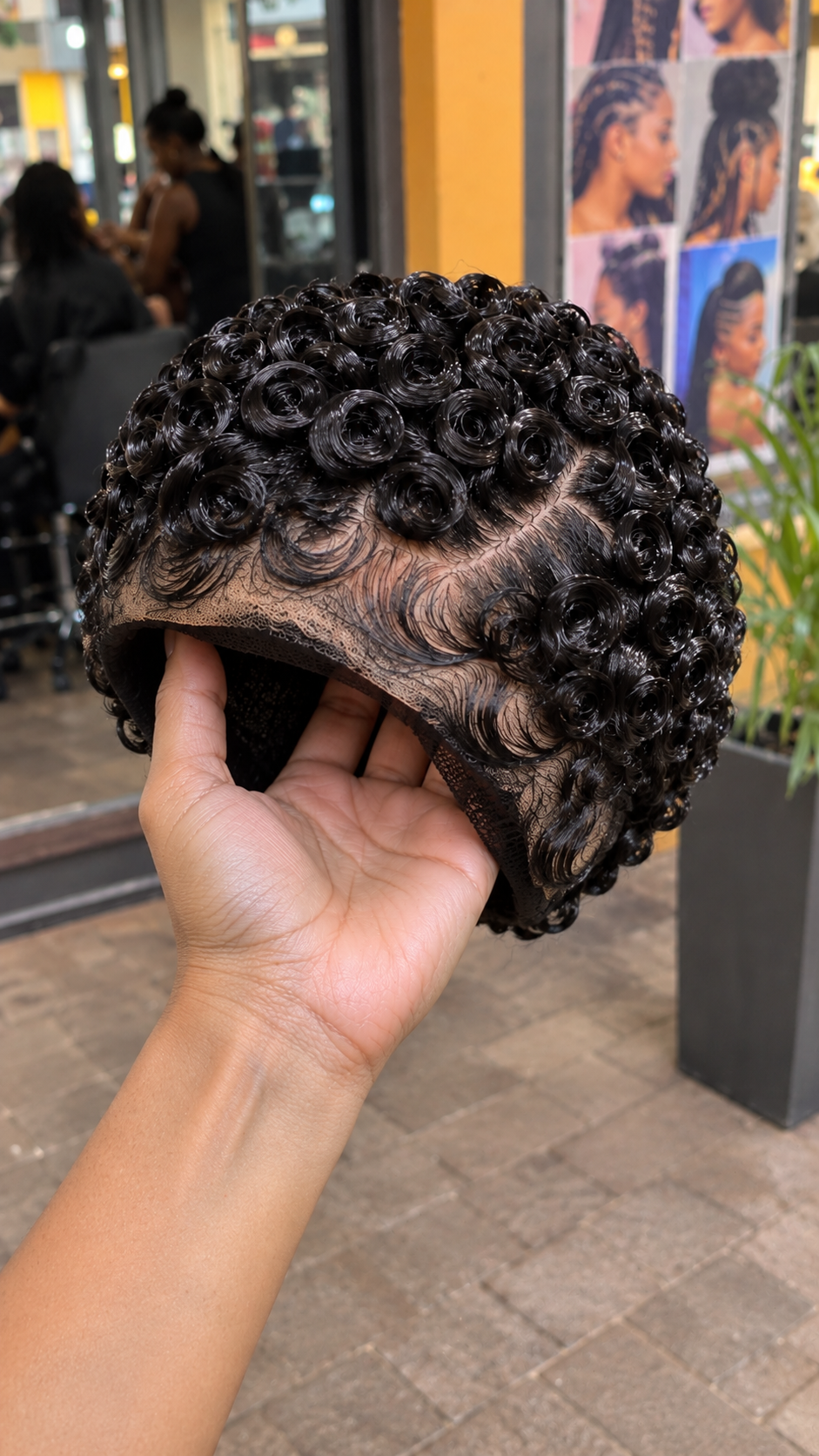
Some of the most memorable pixie hairstyles achieve their impact through the arrangement of the curls rather than dramatic coloring. The black wig in this photograph is a striking example. Its upper surface is covered with glossy circular rosettes, while an exposed diagonal parting and sweeping hairline waves introduce movement across the front. The result is a compact hairstyle with considerable visual detail and an unmistakably sculpted appearance.
The wig is photographed outside a working hair salon, supported in one hand with the front lace and part of the dark interior cap visible. This pre-installation view offers valuable information for anyone considering a similar design. The circular curls remain clearly visible across the crown, while the flatter hairline sections reveal how carefully directed strands can create a decorative appearance without contrasting highlights or shaved geometric artwork.
Unlike wigs dominated by loose curls, this hairstyle relies on compact spiral formations with recognizable circular openings. Several rosettes near the upper front are relatively broad, while smaller coils fill the surrounding spaces. Beneath them, fine black strands follow curved paths across the lace, creating an elegant transition toward the forehead and visible temple.


The photograph cannot establish whether the wig contains human hair, synthetic fibers, or a blend. It also does not confirm the exact lace technology or every cap component. However, the visible styling provides a useful starting point for selecting a custom wig maker, comparing construction options, and planning professional installation.
The Rosette Formation Is the Most Important Detail
The crown contains numerous circular curls resembling carefully arranged rosettes. Many of the curls have tightly wound centers surrounded by broader circular strands, producing a decorative, almost floral appearance.
The ringlets are positioned close together, creating a dense crown without making the hairstyle excessively tall. Several large circular openings appear near the upper center, while smaller loops fill the surrounding areas.
The individual curls are not perfectly identical. Some face directly toward the camera, revealing rounded openings, while others tilt sideways and appear slightly elongated.
This variation helps the hairstyle maintain a layered appearance. The circular curls overlap, but their individual shapes remain recognizable.
The glossy black strands reflect light along their curved paths, emphasizing the concentric arrangement of the rosettes.
For customers seeking a similar wig, these details matter more than simply choosing a black curly pixie. A unit containing ordinary loose ringlets or tiny spring coils may have a similar length but produce a substantially different result.
Why the Curl Centers Should Remain Visible
The visible centers create depth and help separate the circular formations from one another.
If the curls are pressed too closely together, the openings may disappear and the crown can appear like a dense mass of hair.
If they are spaced too widely, the hairstyle may lose fullness.
A custom wig maker should therefore consider curl diameter, density, and orientation together.
Ask for medium circular rosette curls with recognizable openings and smaller loops filling the gaps.
A photograph taken slightly above the crown can help establish whether the finished curl arrangement matches the reference.
The Diagonal Parting Creates an Asymmetrical Front
A visible diagonal parting runs through the upper front portion of the wig. The light channel contrasts with the surrounding black hair and separates groups of curls that follow different directions.
On one side of the parting, raised rosettes gather across the crown. Beneath it, fine strands transition into flowing waves along the forehead.
The parting appears slightly curved rather than perfectly straight. Its direction creates movement and helps organize the surrounding curls.
Several ringlets sit close to the division, giving the hairstyle an integrated appearance rather than a harsh separation between the upper and lower sections.
The photograph does not establish the exact construction method used to create the scalp-like parting. Different wig-making techniques can produce similar visual results.
Customers should ask the seller whether the parting position can be customized and how it is constructed.
Confirming the Parting Orientation
The direction of the parting influences how the hairstyle frames the face once installed.
A reversed parting may still look attractive, but it will not precisely reproduce the reference.
When ordering, specify the desired orientation from the wearer’s perspective rather than relying solely on the left or right side of the photograph.
A frontal approval photograph can help establish whether the parting and surrounding curls follow the intended direction.
Sweeping Finger Waves Create the Decorative Hairline
The front hairline contains several carefully arranged waves formed from fine black strands. These sections follow elongated curves across the exposed lace, creating a graceful transition beneath the raised curls.
The waves remain flatter than the rosettes above them. Their strands travel in closely aligned groups, producing narrow reflective highlights along the curved paths.
Near the center front, several sections sweep toward the visible temple. Lower down, additional curves become more elongated and closely arranged.
One decorative section near the lower side forms a rounded curl that extends toward the edge of the cap.
These details are more elaborate than a few ordinary baby hairs. The strands create a coordinated styling pattern that contributes directly to the hairstyle’s identity.
There are no clearly visible shaved geometric channels or razor-carved designs in the photographed hairline. The decorative appearance comes from the direction of the strands.
Why the Waves Need Careful Placement
The front waves should remain visible beneath the circular curls without occupying too much of the forehead.
If the upper rosettes extend too far forward, they may cover the delicate waves.
If the waves are positioned too low, they may sit unnaturally once the wig is installed.
The correct placement depends on the cap measurements and the wearer’s natural hairline.
During fitting, the installer should establish the final cap position before trimming the lace or adjusting the decorative strands.
Deep Black Color With Reflective Charcoal Depth
The hair appears predominantly deep black, with subtle charcoal and brown-black reflections visible along the curved surfaces.
The brightest reflections follow the outer edges of the circular rosettes, creating narrow highlights that emphasize their spiral construction.
The front waves produce longer reflective bands because the strands lie closer together and follow elongated curves.
There are no clearly identifiable blonde, copper, burgundy, or silver color sections. The lighter areas appear primarily to result from reflected light rather than intentional highlights.
This gives the hairstyle visual depth without introducing additional colors.
Customers seeking a similar appearance should ask for a rich black shade and confirm whether the available product is natural black, raven black, or jet black.
A daylight photograph of the actual wig can help establish the color before purchasing.
The glossy appearance does not prove that the hair is human hair. Synthetic fibers, human hair, styling products, and lighting can all produce reflective surfaces.
The Side Curls Maintain the Compact Pixie Shape
The visible side contains numerous circular curls continuing downward from the crown. Several larger rosettes sit near the upper side, while smaller coils gather toward the lower edge.
This arrangement creates a full but controlled silhouette.
The curls remain close to the head rather than hanging into long strands.
Near the lower portion, the curls become more compact and blend into the decorative hairline waves.
The side is not completely shaved or bare. Instead, the circular curls provide visible coverage around the photographed edge.
Customers commissioning a similar wig should preserve this fullness rather than introducing an aggressive taper or carved side design.
The complete rear is not visible, so additional photographs should be requested before assuming the same curl density continues around the entire head.
The Exposed Lace Reveals the Pre-Installation Stage
The wig is displayed with a section of beige-brown lace extending beyond the front hairline. The mesh remains untrimmed, indicating that the unit has not yet been fitted to an individual wearer.
Fine black strands emerge near the lace boundary, where the sweeping hairline waves begin.
The lace follows the front contour and continues toward the visible side.
However, the photograph cannot establish the exact lace classification or how naturally it would blend with a particular complexion.
It would be inaccurate to identify the mesh as HD lace without reliable product specifications.
The photograph also does not prove that the wig is designed for adhesive-free installation.
Before purchasing, ask the seller to confirm the lace type, available dimensions, cap size, and recommended attachment method.
Understanding the Visible Cap Construction
Part of the dark interior cap is visible beneath the lace opening. The structure appears black to dark brown, with fabric sections supporting the styled hair.
However, the photograph does not reveal the complete underside. The presence and placement of all combs, clips, adjustable straps, or other securing components cannot be confirmed.
Ask the supplier for a photograph showing the entire cap perimeter and all included attachment hardware.
Cap sizing is particularly important because the diagonal parting and decorative front waves must align with the wearer’s forehead and temples.
Common measurements requested by wig makers include head circumference, front-to-nape distance, ear-to-ear distance, and temple placement.
An unsuitable cap size can shift the hairline and change how the hairstyle appears after installation.
Where To Buy This Rosette Curl Pixie Style
Similar hairstyles may be available through specialized pixie wig makers, professional salons, online wig boutiques, and retailers offering sculpted curly lace wigs.
Useful search descriptions include black rosette curl pixie wig, circular spiral lace wig, finger-wave curly pixie, and sculpted black ringlet hairstyle.
A custom wig maker may be particularly useful when the exact rosette arrangement and diagonal parting are essential.
Ready-made alternatives may provide a similar rounded crown but differ in curl diameter or front-wave placement.
Review previous examples of the maker’s work, especially wigs containing circular rosettes and detailed hairline waves.
No verified seller, current inventory, or live product price can be established from the photograph alone.
How To Order This Hairstyle
Begin by sending the reference photograph to the selected wig maker.
Explain that the hairstyle requires a compact rounded crown of glossy black circular rosettes, a diagonal parting, and sweeping waves across the front hairline.
Discuss the desired curl diameter and crown density. The circular openings should remain recognizable without excessive volume.
Confirm the parting orientation from the wearer’s perspective.
Ask whether the maker can reproduce the front waves using techniques compatible with the proposed hair material and cap construction.
Provide accurate head measurements and confirm the available cap size.
For custom production, request a photograph of the parting and waves before final styling approval.
After completion, ask for front, side, and rear photographs along with a complete underside view.
Finally, confirm whether the quotation includes styling, installation, lace preparation, shipping, and future adjustments.
Ready-Made, Closure, Frontal, and Glueless Options
The appropriate construction depends on the desired hairline coverage, cap fit, and installation preferences.
A ready-made curly pixie may provide a general resemblance, but its parting and front-wave arrangement may differ from the reference.
A closure-based unit may be suitable for some compact hairstyles, although the available lace area and parting flexibility should be evaluated carefully.
A frontal construction may provide additional front hairline coverage, depending on its dimensions and design.
However, the photographed wig’s exact construction category cannot be established solely from the visible mesh.
Glueless installation should be considered separately. A suitable cap fit and secure fastening components are necessary for adhesive-free wear.
Ask the seller whether the actual cap supports the preferred attachment method.
Estimated Prices for Black Rosette Pixie Wigs
The cost of a similar wig may depend on the hair material, cap construction, curl density, and styling labor required to create the circular rosettes and decorative front waves.
The following USD figures are illustrative planning ranges rather than verified live product prices or quotations for the photographed wig.
| Wig Category | Illustrative USD Range | Possible Purchase Scope |
|---|---|---|
| Premium Custom | $325–$785+ | Individual cap measurements, detailed circular rosette styling, customized diagonal parting, and personalized hairline preparation. |
| Standard Custom | $170–$380 | Custom black pixie styling with organized rosette curls, side parting, and professionally arranged front waves. |
| Basic Human Hair | $100–$260 | A human-hair curly base that may require additional rosette formation, hairline styling, and fitting. |
| Premium Synthetic | $70–$190 | Higher-priced synthetic alternatives with prearranged circular curls and decorative hairline styling, depending on specifications. |
| Basic Synthetic | $25–$100 | Budget black curly pixie wigs that may resemble the general silhouette without reproducing every circular rosette. |
The labor required to create numerous circular curls may influence the final quotation.
The decorative hairline waves can also increase styling costs, especially when their direction must match a specific reference.
Ask whether installation, shipping, cap adjustments, and future restyling are included.
The photograph does not establish whether the displayed wig contains human hair, synthetic fibers, or a blend. These categories describe possible purchasing options rather than verified product characteristics.
Installing the Wig Without Disturbing the Waves
When the wig arrives, inspect the rosette curls, diagonal parting, front waves, and lace condition before making permanent alterations.
The installer should position the cap correctly on the wearer’s head and evaluate how the waves align with the forehead and temple.
Only after confirming the fit should the lace be assessed for trimming.
Removing too much material near the decorative strands may interfere with their arrangement.
The securing method should be selected according to the actual cap construction and the wearer’s needs.
During fitting, avoid flattening the rosette curls or pulling the front waves into different directions.
Any minor adjustments should use methods compatible with the confirmed fiber.
Maintaining the Circular Rosettes
The upper curls require careful handling because their appearance depends on strands remaining arranged in circular paths.
Aggressive brushing may separate the loops, increase frizz, or cause neighboring rosettes to merge.
Before washing, confirm the actual hair material and obtain the maker’s recommended care instructions.
If the wig is human hair, washing may loosen the original curl arrangement and require resetting.
If the wig is synthetic, heat compatibility must be confirmed before using heated tools.
Heavy styling products can accumulate inside the circular openings and reduce strand separation.
Support the cap rather than pulling on individual curls during handling.
Protecting the Front Hairline
The decorative front waves depend on fine strands remaining aligned along controlled curved paths.
Repeated rubbing, aggressive combing, or careless handling may disturb their direction.
If the waves begin losing their appearance, consult a stylist familiar with finger-wave techniques.
Do not automatically apply strong heat or unfamiliar products without confirming the material and recommended procedures.
For storage, use an appropriately sized wig stand that supports the cap without compressing the upper curls or rubbing against the front hairline.
The Advantages of This Black Pixie Design
One advantage is its strong visual identity without additional colors. The circular rosettes and flowing hairline waves create elaborate detail within a compact hairstyle.
The diagonal parting introduces asymmetry, while the smaller side curls preserve a rounded outline.
The deep black color emphasizes the curl construction rather than distracting from it.
However, the intricate styling may require more attentive maintenance than ordinary loose curls.
Customers should ask whether the rosettes and front waves need periodic professional resetting.
The suitability of the wig for frequent wear depends on cap fit, actual fiber, construction quality, and the wearer’s care routine.
A Pixie Hairstyle Built Around Elegant Hair Artistry
The most distinctive quality of this hairstyle is the relationship between the circular rosette crown and the flowing front-wave arrangement.
The raised curls provide decorative fullness, while the diagonal parting organizes their direction.
The sweeping hairline waves complete the design with an elegant transition toward the forehead.
For customers seeking a close reproduction, the main considerations are accurate curl placement, parting orientation, front-wave styling, and suitable cap sizing.
Before purchasing, confirm the actual material, construction, installation requirements, and maintenance expectations.
With careful customization, professional fitting, and appropriate care, a similar black rosette pixie wig can offer a beautifully balanced hairstyle combining glossy circular curls, graceful hairline waves, and a compact rounded silhouette.
Search Terms
Black rosette curl pixie wig · Curved lace hairline finger waves · Diagonal side part spiral curls · Glossy black circular coil crown · Sculpted forehead wave pixie hairstyle · Untrimmed beige lace black curls · Compact black rosette wig with side sweep · Deep black concentric ringlet hairstyle