
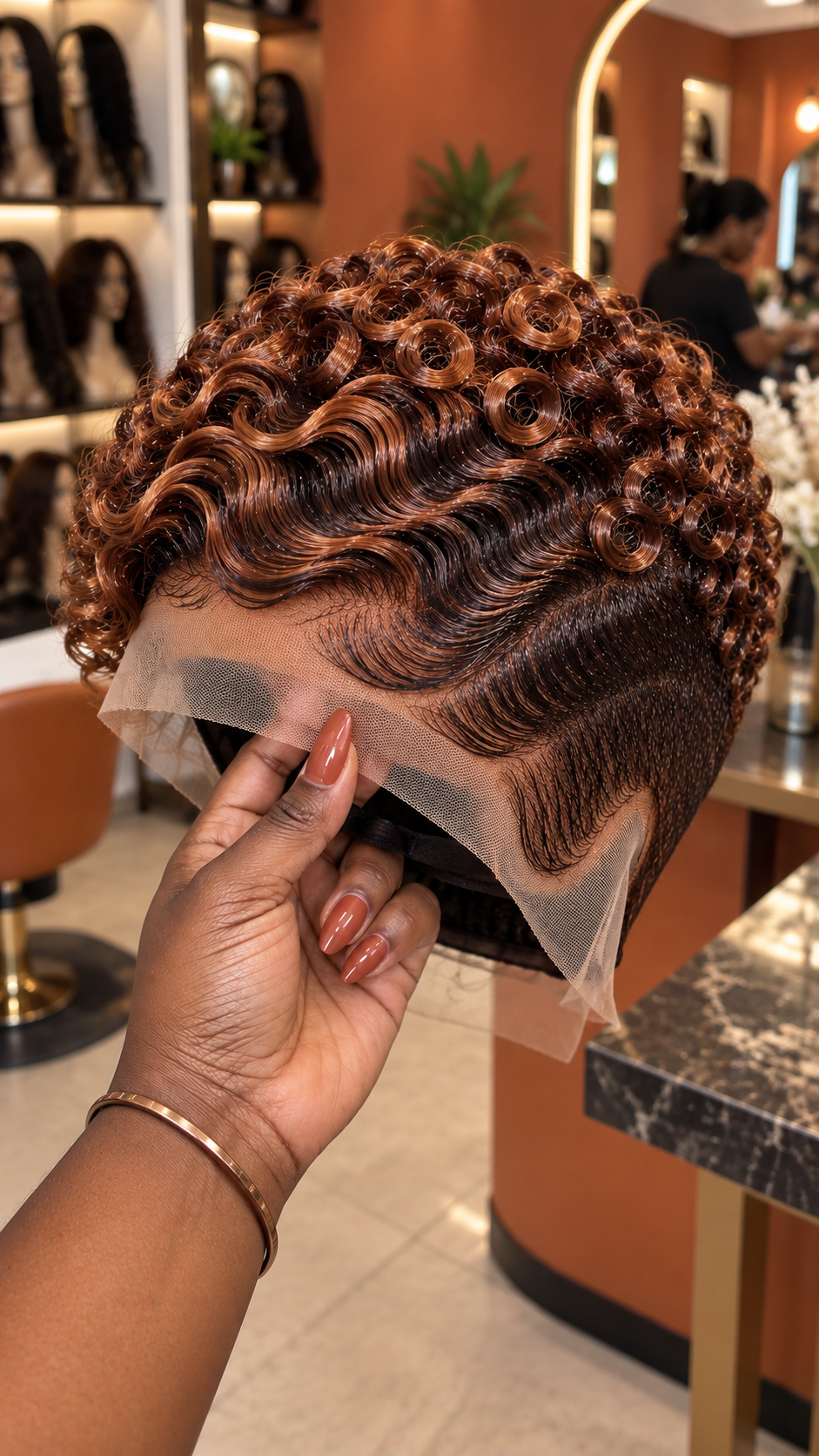
Some pixie wigs attract attention through their curls, while others stand out because of their carefully arranged waves. This copper-brown lace wig brings both styling approaches together in an especially striking way. A rounded crown of glossy circular ringlets rises above broad, flowing finger waves, while a closely arranged dark side provides contrast beneath the decorative upper sections. The hairstyle feels expressive without relying on excessive length, bright contrasting highlights, or elaborate shaved patterns.
The photograph shows the wig being held inside a warmly decorated hair salon. Its beige frontal lace extends beyond the hairline, and part of the dark interior cap is visible beneath the styling. The wig has not yet been installed, making this a useful reference for customers who want to examine the hair arrangement before deciding how a similar unit should be purchased, customized, or fitted.
The upper curls display rich copper, chestnut, and reddish-brown reflections, with darker strands visible beneath several circular formations. Across the front, the hair forms broad S-shaped waves that travel from the fuller crown toward the temple. The lower side is considerably darker and more compact, creating a distinctive contrast between the ornamental curls and the closely directed hair beneath them.


For buyers considering a similar hairstyle, the important details are the rounded copper ringlets, the depth of the frontal waves, the darker side section, and the untrimmed lace. Understanding how these components work together makes it easier to choose a wig that resembles the reference rather than simply sharing its color.
The Frontal Waves Make This Hairstyle Different
The most recognizable element of this wig is the series of large, sweeping waves across the front. Unlike ordinary side-swept hair, these strands follow deliberate curves that create distinct ridges between the crown and the hairline.
Several waves travel in an S-shaped direction, turning gently as they move across the frontal area. The upper wave sits immediately beneath the circular curls, while additional curved sections flow below it and toward the visible temple.
The waves appear relatively broad, with closely aligned strands forming glossy surfaces. Their arrangement creates movement without requiring the hair to hang freely across the forehead.
This construction gives the hairstyle a different appearance from a conventional curly pixie. In an ordinary curly wig, the same curl pattern may continue from the crown to the front. Here, the circular curls transition into elongated waves, producing a more sculpted silhouette.
Customers ordering a similar style should explain that the frontal waves are essential to the design. A wig containing beautiful copper curls but lacking these broad curves would not reproduce the photographed appearance.
Why the Waves Should Remain Broad
The width of each frontal wave affects how the hair looks from the front and side. Narrow waves may produce a finer, more intricate arrangement, while broad sections create a stronger visual flow.
In this reference, the frontal waves are substantial enough to remain noticeable beneath the curls. Their curved ridges extend across a significant portion of the upper hairline.
A custom wig maker should preserve this scale rather than replacing the waves with tiny decorative curls.
The strands should also remain closely aligned. Excessive separation could make the waves appear loose or disorganized, while too much styling product may weigh them down.
The original setting technique cannot be established from the photograph. Buyers should ask whether the waves are formed using appropriate setting products, controlled styling methods, or another technique suitable for the selected fiber.
Copper Circular Curls Across the Rounded Crown
Above the sculpted frontal section, numerous circular ringlets form a compact, rounded crown. The curls appear in different orientations, with several facing outward and displaying their open centers.
Some rings sit higher on the crown, while others overlap neighboring curls or lean toward the visible side. This variation creates depth and prevents the upper section from appearing completely uniform.
The circular shapes are particularly noticeable toward the central and rear-visible upper areas. Several larger rings occupy prominent positions, while smaller loops fill the surrounding spaces.
The curls are closely arranged but do not form an excessively tall hairstyle. Their rounded distribution creates a full crown that remains proportional to the compact side.
Unlike long spiral curls that hang downward, these ringlets remain close to the head and appear deliberately positioned into decorative circular formations.
How Curl Placement Affects the Silhouette
The position of the curls matters as much as their diameter. If all the ringlets are concentrated in the center, the crown may become too high or narrow. If they are distributed too widely, the hairstyle may lose its compact pixie character.
The photograph shows a relatively balanced arrangement, with circular curls occupying the upper head and continuing toward the visible rear.
Customers should request a rounded crown with recognizable ringlets rather than maximum volume.
A photograph taken from above can help evaluate the distribution of the curls. A frontal image can then confirm whether the hairstyle maintains the intended proportions.
For a custom commission, buyers should discuss the approximate curl diameter, crown density, and placement of the larger rings before production begins.
The Copper-Brown Shade Has Rich Dark Undertones
The photographed hair displays a warm copper-brown color with chestnut, cinnamon, and subtle auburn reflections. The color appears particularly luminous across the upper ringlets, where the curved strands reflect the salon lighting.
Some curls contain lighter copper surfaces, while darker strands remain visible around their bases and within the openings.
The frontal waves combine copper-brown reflections with deeper espresso tones. This creates a gradual visual transition into the darker side section.
The lower side appears predominantly deep brown to nearly black, although warm reflections remain visible in certain areas.
The result is not a conventional blonde ombré or a brightly highlighted copper wig. Instead, the hairstyle relies on closely related warm brown shades and a darker foundation.
This distinction is important when purchasing. A wig advertised as copper may contain far brighter orange or red tones than the reference.
Choosing Between Copper, Auburn, and Cinnamon Brown
Hair-color terminology varies significantly between suppliers. Copper can refer to bright orange, rich ginger, or muted orange-brown shades. Auburn may lean toward red, while cinnamon brown often contains a mixture of warm copper and deeper brown tones.
In this photograph, the upper hair appears closest to rich copper brown with warm auburn reflections.
Customers should request photographs under daylight before approving a precise color match. Warm salon lighting can intensify the reddish and golden reflections of copper hair.
A color sample may also be useful when comparing the proposed copper shade with the darker foundation.
For custom production, the seller should understand that the lower side is noticeably darker than the most reflective portions of the crown.
The Dark Side Creates a Strong Visual Balance
Beneath the copper waves, the visible side contains closely arranged strands that follow the contour of the wig. This section appears flatter and darker than the upper styling.
The hair gradually narrows toward the lower edge, producing a compact, tapered-looking profile without clearly exposing a shaved skin fade.
There are no prominent decorative razor channels visible across this lower side. The styling relies primarily on hair direction, density, and the contrast between the fuller curls and the closely arranged lower section.
This is an important detail because adding shaved-looking stripes or additional partings would change the original design.
The lower side provides a restrained area beneath the ornamental waves. Its compact appearance prevents the hairstyle from becoming excessively full around the temples.
Preserving the Side Without Removing Too Much Hair
A common customization mistake is assuming that a tapered-looking side requires aggressive cutting.
For a wig, removing too much hair can expose the underlying cap or create gaps that are difficult to repair.
The photographed side retains visible strands throughout much of its surface. A custom wig maker should therefore preserve adequate density while arranging the hair close to the underlying foundation.
Buyers should ask whether the intended side appearance can be achieved through styling and suitable construction rather than unnecessary cutting.
A close side-view photograph of the completed unit can help confirm that the lower section remains proportional to the fuller crown.
How the Ringlets and Finger Waves Work Together
The beauty of this hairstyle comes from the relationship between two different types of movement. The upper curls form rounded loops, while the frontal strands travel through elongated waves.
The transition is gradual rather than abrupt. Several copper sections bend from the upper ringlets into broader curves, connecting the ornamental crown with the hairline.
This continuity is important because it prevents the hairstyle from appearing divided into unrelated sections.
The darker lower side provides a visual foundation, allowing the copper curls and waves to remain the primary attractions.
The combination also creates a changing appearance depending on the viewing angle. From above, the circular ringlets may dominate. From the front, the sweeping waves become more noticeable.
Customers commissioning a custom unit should provide reference photographs from more than one direction whenever possible.
The Frontal Hairline Contains Fine Curved Strands
Near the exposed lace, several fine strands follow curved paths along the frontal edge. These strands appear smaller and less elevated than the broad finger waves above them.
The hairline transitions gradually from the decorative waves into the beige mesh, creating a layered frontal arrangement.
One visible curved section travels toward the temple, where the hair becomes darker and more closely arranged.
The photograph does not establish whether the hairline was customized through plucking, individual ventilation, or another specialist method.
Buyers should therefore avoid assuming that the wig includes a particular hairline technology based only on its appearance.
When ordering a similar unit, ask whether the frontal styling arrives completed or requires additional work during installation.
Get the Details on This Wig
The photograph provides useful information about the hairstyle but leaves several purchasing specifications unverified.
The wig is being held before installation, and a broad section of beige lace extends beyond the frontal hairline. Part of the dark interior cap is visible beneath the mesh.
However, the photograph does not establish whether the strands are human hair, synthetic fiber, or a blend.
It also does not confirm the exact lace grade, cap circumference, complete attachment system, or manufacturer.
Before purchasing, request a written product description from the seller and compare it with photographs of the actual wig being offered.
The most important questions concern the fiber composition, curl-setting method, cap measurements, lace dimensions, and whether the finger waves will retain their shape during normal wear.
Why the Untrimmed Lace Matters
The extended beige lace is clearly visible across the front and toward the temple. It has not yet been cut to follow an individual wearer’s hairline.
This is useful for buyers because it shows the hairpiece before its final fitting.
The lace appears relatively fine, but the image does not provide enough information to identify it as HD lace or another specialized grade.
Likewise, visible lace does not establish that the wig is designed for adhesive-free installation.
Those specifications require confirmation from the seller or manufacturer.
The lace color should also be evaluated against the intended wearer’s complexion rather than judged solely from the photograph.
Trimming Lace Without Disturbing the Waves
The frontal waves extend close to the lace boundary, making careful trimming particularly important.
A professional installer should first position the wig on the wearer’s head and check the placement of the hairline.
The stylist can then determine how much excess lace needs to be removed.
Cutting too close to the decorative hairline could interfere with the fine strands supporting the frontal arrangement.
For that reason, lace trimming should be conservative and performed only after the wig’s position has been checked.
Choosing the Right Cap for a Comfortable Fit
The interior of the wig is only partly visible in the photograph. Dark cap material can be seen beneath the lace, but the complete construction remains concealed.
The image does not verify the number of attachment combs, the presence of adjustable straps, or the full cap dimensions.
Buyers should request an underside photograph showing the cap opened flat.
This allows the seller to demonstrate available fastening components, seams, elastic sections, and any adjustment mechanisms.
The cap circumference should be compared with the customer’s actual head measurements.
A secure fit is particularly important for this hairstyle because the decorative waves need to remain positioned correctly relative to the forehead and temple.
Where to Find a Stylist for Copper Finger Waves
Women interested in this hairstyle should look for salons experienced in sculpted pixie wigs, finger-wave styling, and lace-front installation.
A custom wig maker with experience arranging circular ringlets and broad frontal waves may be particularly useful.
When reviewing a stylist’s previous work, examine photographs showing both crown curls and frontal wave arrangements.
A stylist who primarily works with loose curls may not necessarily have experience reproducing the broad, carefully directed waves visible in this reference.
It is also worth discussing whether the hairstyle will be delivered fully styled or whether additional work must be completed after purchase.
Booking a consultation before ordering can help determine whether the desired result is realistic for the proposed material and cap construction.
Preparing for the Appointment
Send the reference photograph to the stylist before the appointment and explain which details matter most.
For this particular wig, those details are the copper circular curls, broad S-shaped frontal waves, dark lower side, and proportionate crown.
Ask whether the stylist can preserve the upper curl arrangement while fitting the lace.
Discuss the intended attachment method, scalp comfort, and any necessary hairline adjustments.
If the wig is being custom-made, request photographs during the approval stage before the unit is shipped.
Ready-Made Wigs Compared with Custom Styling
A ready-made copper curly pixie may be convenient when its color and curl arrangement already resemble the reference.
However, many ready-made wigs contain ordinary spiral curls without the broad finger-wave styling shown here.
Custom production can provide greater control over the curl diameter, frontal wave placement, side density, and cap fit.
The right purchasing route depends on how accurately the customer wants to reproduce the hairstyle.
A broadly similar ready-made unit may be suitable for someone who primarily wants copper curls and a compact pixie silhouette.
Someone seeking the pronounced frontal S-waves may benefit from commissioning a specialist who can reproduce the arrangement deliberately.
Before purchasing a basic wig for customization, ask whether its material and density are suitable for the required work.
Estimated Prices for Copper Pixie Wigs with Finger Waves
The cost of a similar hairstyle may depend on the fiber composition, copper color preparation, circular curl setting, frontal finger-wave styling, and cap construction.
Broad, carefully arranged finger waves may require additional specialist labor compared with an ordinary curly pixie.
The following USD figures are illustrative planning ranges, not verified current retail prices or quotations for the photographed wig.
| Wig Category | Illustrative USD Range | Purchasing Considerations |
|---|---|---|
| Premium Custom | $310–$740+ | Individually arranged copper ringlets, elaborate frontal S-waves, personalized color placement, and possible custom lace fitting. |
| Standard Custom | $170–$380 | Customized circular crown and sculpted finger-wave styling with selected cap and hairline adjustments. |
| Basic Human Hair | $100–$245 | A possible human-hair foundation requiring additional copper coloring, curl setting, and specialist frontal styling. |
| Premium Synthetic | $75–$185 | A potentially pre-styled alternative containing compact ringlets and decorative waves. |
| Basic Synthetic | $30–$90 | A lower-cost curly pixie alternative that may approximate the color and silhouette without matching the detailed wave arrangement. |
These categories describe possible purchasing options rather than the confirmed composition of the photographed unit.
Actual prices may differ substantially depending on the supplier, country, material quality, construction complexity, and included services.
Before accepting a quotation, confirm whether the price covers the completed curls, finger-wave styling, lace preparation, and cap adjustments.
Installation, shipping, and future restyling may be charged separately.
Protecting the Circular Curls Between Wears
The copper crown depends on its circular formations remaining visible. Repeated brushing, pulling, or compressing the ringlets may disturb their shape.
Customers should avoid unnecessarily separating the individual curls.
Before washing or applying styling products, confirm the fiber composition and follow the manufacturer’s instructions.
Synthetic fibers may have specific heat limitations, while human hair that has undergone color processing may require more careful treatment.
The photograph does not establish which material has been used, so a universal heat-setting or washing routine would be inappropriate.
If the ringlets begin losing their circular structure, consult a stylist familiar with the original styling method before attempting extensive reshaping.
Keeping the Frontal Waves in Position
The broad finger waves require a different type of maintenance from the circular crown.
Their appearance depends on the strands remaining closely aligned along the curved ridges.
Excessive brushing, rubbing, or heavy product application may disturb the waves and reduce their visual separation.
Ask the original stylist which compatible products can be used to preserve the arrangement.
When removing the wig, avoid gripping the frontal waves or pulling directly on the lace.
A suitable support can help preserve the overall shape between wears, provided it does not stretch the cap or compress the curls.
Caring for the Warm Copper Color
Copper hair can appear different under daylight, warm indoor illumination, and cooler artificial lighting.
Product buildup and inappropriate treatments may also influence the appearance of the strands.
If the wig contains color-treated human hair, further chemical processing should be approached carefully because previously colored sections may respond differently from untreated strands.
If the wig is synthetic, conventional hair dye may be unsuitable.
Customers should confirm the material before attempting toning, coloring, or heat styling.
The goal is to preserve the warm copper-brown appearance while keeping the ribbon-like curls and finger waves intact.
A Distinctive Choice for Women Who Love Sculpted Curls
This copper pixie wig offers a particularly attractive combination of rounded circular curls, flowing finger waves, and a compact dark side.
The crown provides volume through numerous ringlets, while the broad frontal waves introduce an elegant directional movement. The darker lower section prevents the hairstyle from appearing overly full.
The untrimmed beige lace also makes professional fitting an important consideration before the wig is worn.
For customers seeking a similar result, the best approach is to prioritize accurate curl arrangement, rich copper coloring, careful frontal wave placement, and suitable cap construction.
Request actual photographs of the unit being purchased, confirm the material and lace specifications, and discuss any customization with an experienced wig stylist.
A successful reproduction should retain the warm copper ringlets, broad S-shaped waves, deep brown side, and compact pixie proportions without adding unnecessary decorative lines or excessive volume.
The appeal of this hairstyle lies in the movement of the strands. The circular curls and sweeping waves create two distinctive patterns that work together, making the wig memorable from both the front and side.
Search Terms
Copper pixie wig with finger waves · Cinnamon brown circular ringlet crown · Deep side wave lace wig · Auburn spiral curls with dark sides · Copper brown sculpted S waves · Beige untrimmed lace pixie wig · Glossy chestnut curl crown hairpiece · Copper finger wave frontal hairstyle