
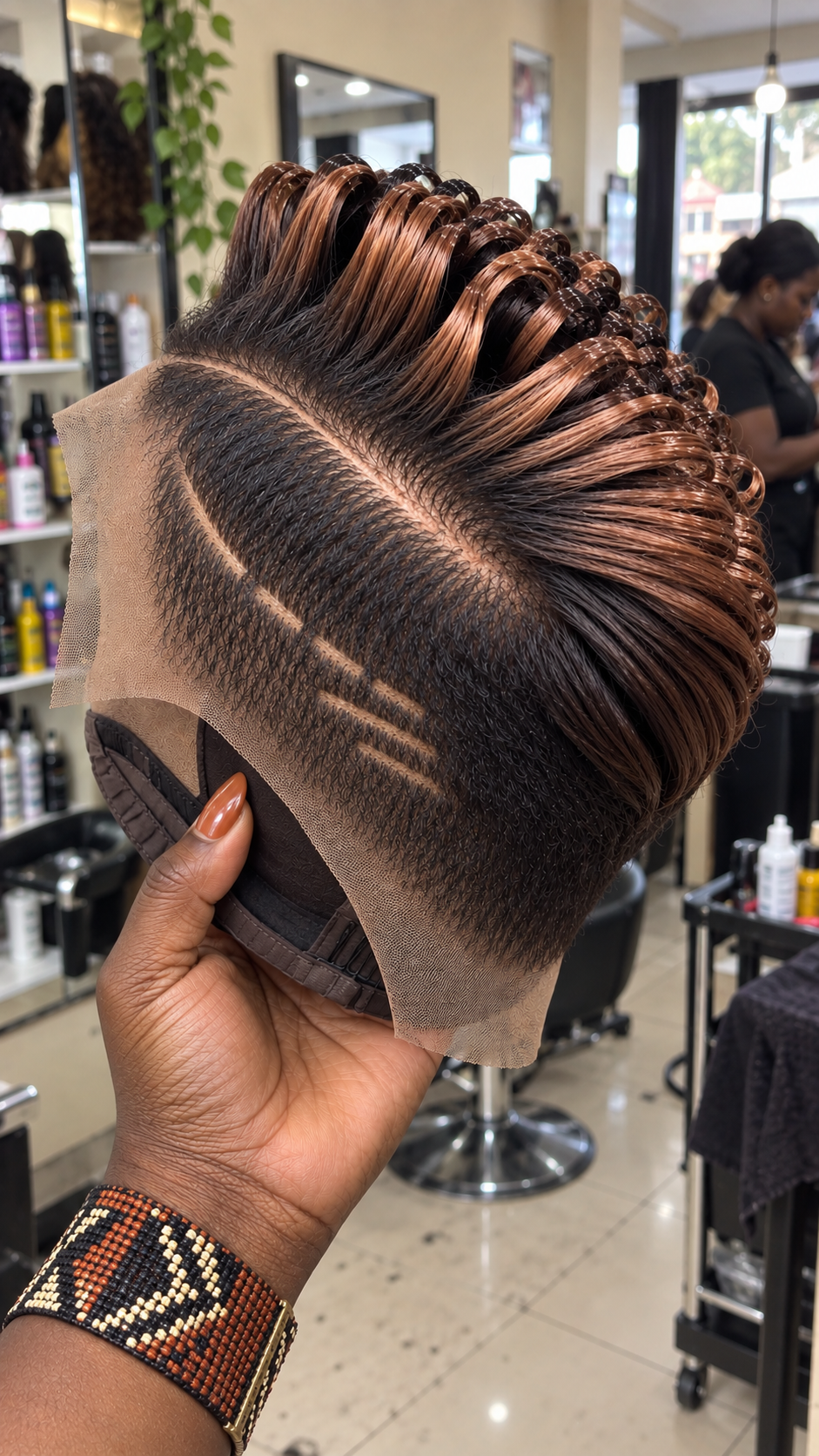
This wig earns attention through contrast, but not simply because copper appears against a darker base. Its character comes from where that copper is placed and how the upper hair has been constructed. Long ribbon-like sections sweep from the crown toward the back, folding into repeated loops, while the lower side remains extremely compact. Between those two areas sits a carefully exposed boundary, followed by two narrow parallel lines cut into the darker side section. The result is a design in which color, direction and geometry work together.
The photograph is especially useful for examining the unit before installation. Excess lace remains visible around the perimeter, the cap can be seen underneath, and the side detailing has already been incorporated into the wig. That means a buyer can study far more than the finished silhouette. The image reveals how the color is distributed, how the crown connects to the lower section and which details need to survive fitting and customization.
Although lace is clearly present, the photograph alone does not establish that it is HD lace. A responsible product description should therefore describe what can actually be seen rather than assigning a premium lace category without confirmation from the maker.
Copper Is Being Used as a Structural Color
The copper tone is not applied as an even all-over shade. Dark brown-to-black hair remains visible beneath and between the brighter sections, giving the crown depth. The copper strands dominate the outer surface of many loops, while darker strands appear through the interior and around their roots. This placement makes each individual section easier to distinguish.
That distinction matters when requesting a similar wig. Ordering merely by saying “copper and black” leaves too much room for interpretation. A supplier could produce chunky highlights, scattered streaks or a half-and-half color pattern and technically satisfy that description while missing the appearance of this reference completely.
A better customization brief would explain that the darker foundation should remain visible while copper is concentrated through the sculpted upper ribbons. The contrast needs to follow the crown’s movement instead of appearing as unrelated streaks. Asking for photographs before shipment is particularly valuable with this kind of color placement because errors are much easier to identify before the unit has been cut or installed.
The Upper Hair Behaves Like Interlocking Ribbons
Instead of conventional loose curls, the crown contains broad strands gathered into elongated bends. They rise from the base, travel backward and curve into loops. Repetition creates a sequence across the head, yet the individual pieces do not all sit at precisely the same angle. That variation keeps the crown from looking like a rigid row of identical curls.
The front sections stand more upright before bending backward. Moving toward the rear, the direction gradually follows the rounded contour of the cap. This transition is important. If every loop were positioned vertically, the wig would become unnecessarily tall; if every section were pressed backward, much of the sculptural quality would disappear.
A stylist working on the crown should preserve those changes in direction rather than combing all of the hair into one continuous surface. The spaces between the ribbon sections contribute almost as much as the strands themselves because they expose glimpses of the darker foundation and make the copper pattern readable.
The Side Design Has Its Own Visual Hierarchy
The lower portion deserves separate attention from the crown. Hair in this area is kept close to the base and appears substantially finer and denser than the large upper loops. Above it is a long curved separation that follows the shape of the wig. Below that boundary, two slimmer parallel lines travel in a similar direction.
Those three visual paths are not interchangeable. The upper separation is broader and acts as the principal division between the sculpted crown and compact side. The two lower lines function as secondary accents. Together they create a layered geometry rather than a single decorative stripe.
This distinction is worth mentioning to a barber or custom wig maker. Asking simply for “lines on the side” could result in different spacing, additional lines or a pattern that runs in the wrong direction. The reference shows a deliberate arrangement: one prominent curved division with two narrower parallel accents underneath it.
The lines also need to remain proportionate after the wig is fitted. A design positioned beautifully on a loose unit can sit differently once the cap is placed on a particular head. That is why additional cutting should ideally happen after fit and alignment have been checked.
Why the Dark Foundation Matters More Than It First Appears
The darker hair is doing several jobs simultaneously. At the crown, it creates shadow between copper sections. Along the side, it provides a strong field against which the carved geometry can be seen. Near the roots, it prevents the brighter shade from visually overwhelming the entire piece.
This also gives the wig a useful styling advantage: the copper can remain prominent without requiring every visible strand to carry the same bright tone. From different angles, the ratio between copper and dark hair changes naturally. A front-biased view may emphasize the lighter ribbons, while a side view reveals much more of the dark foundation and line work.
When comparing units from different sellers, buyers should therefore examine more than the copper shade itself. The proportion of dark hair is part of the design. A wig that replaces most of the dark base with copper may still be attractive, but it will no longer reproduce this particular construction.
Reading the Lace Before Any Scissors Are Used
The lace extends beyond the hair-bearing area and has not yet been trimmed to a final hairline. This is useful because it shows the unit at a stage when fitting decisions can still be made. The front boundary contains finer strands before density increases toward the main body of the hair.
A wig stylist should first establish where the cap needs to sit on the wearer. Only then should the lace be cut. Trimming too close while the unit is being held in the hand can remove useful material or create a front edge that does not correspond correctly with the wearer’s natural placement.
The visible lace has a beige-brown appearance under the lighting in this photograph, but camera exposure and salon light can alter perceived color. Anyone ordering the piece online should ask which lace shades are actually available rather than choosing a shade solely from the photograph.
It is equally useful to ask whether the lace arrives uncut. Some buyers prefer a ready-to-wear unit, while others want their own stylist to determine the final perimeter. For a design with detailed sides, professional fitting offers more control because front placement influences where the side geometry lands.
Building an Order Specification a Seller Can Actually Follow
A reference-based order should separate the wig into several requirements. Start with the dark foundation and copper upper placement. Then describe the broad looped crown construction. Add the compact side section, the major curved separation and the two narrow parallel accents. Finally, specify that the lace and cap measurements need to suit the wearer.
Ask the seller whether these elements are produced as part of the wig or added after the base unit is manufactured. This can reveal whether the quoted price includes the labor required for the crown and side work. It can also prevent a situation where a basic wig arrives with the expectation that a local stylist will complete all of the detailing.
For custom purchases, a useful approval process is to request photographs before final dispatch. The first photograph should show the copper distribution across the top. A second should show the side at an angle where all three lines can be evaluated. A third should show the front lace and hairline. If the seller cannot provide those views, clarify the return or adjustment policy before paying for extensive customization.
Local wig salons may also be able to source an appropriate base unit and perform the detailing themselves. This route can be worthwhile when precise fit is more important than receiving a fully completed wig by mail. A consultation allows the stylist to assess cap size, lace placement and how the side design should align with the client’s head.
Pricing the Labor Hidden Inside the Design
Length is unlikely to be the main cost driver here. The value lies in controlled color placement, crown formation, lace construction and precision side work. A lower-priced unit may reproduce the general copper-and-dark palette without investing the same labor in the ribbon sections or line geometry. A higher quotation should ideally explain which of those services are included.
| Wig Category | Estimated Range | Relevant Value for This Design |
|---|---|---|
| Premium Custom | $300–$520+ | Detailed color placement, extensive crown shaping, individualized side geometry, fitting options and higher-grade hair. |
| Standard Custom | $190–$320 | Custom copper placement with prepared crown sections and deliberate side-line work. |
| Basic Human Hair | $120–$210 | A workable human-hair foundation that may require separate salon shaping and barber detailing. |
| Premium Synthetic | $75–$145 | A pre-set interpretation capable of retaining sculpted loops with less frequent resetting. |
| Basic Synthetic | $40–$85 | A lower-cost option where color distribution, lace work and side precision may be less individualized. |
These figures should be treated as broad shopping guidance rather than fixed retail pricing. Custom labor varies by market, and shipping, lace upgrades, cap adjustments, coloring and salon installation can be charged independently. Before comparing two quotes, ask both sellers to itemize what they are providing. A $200 unfinished base and a $300 fully customized unit are not equivalent purchases simply because both are wigs.
Maintenance Should Protect the Copper Sections Individually
The crown should not be treated like ordinary loose hair during daily care. Brushing straight through the upper portion risks pulling several ribbon sections together and weakening their intended spacing. Each major section should instead be handled according to the direction in which it has been set.
If the unit is human hair, ask the maker what temperature range is appropriate before using heated tools. Copper-colored hair may have undergone processing, and repeated excessive heat can affect both appearance and condition. When refreshing the crown, the objective should be to restore the existing bends rather than creating an entirely different curl pattern.
For synthetic versions, heat should never be assumed safe. Fiber specifications need to be confirmed first. A pre-set synthetic crown may require very little manipulation beyond careful storage and occasional adjustment with approved products.
Washing also deserves restraint. Product should be removed without aggressively rubbing the sculpted sections against one another. After cleaning, allow the lace and cap to dry properly and reconstruct the crown in its original direction before storage. Placing the wig on a suitable stand can help prevent the copper loops from being crushed.
Color Care Is Part of Preserving the Design
Because the copper sections occupy highly visible positions, fading can alter the balance of the entire wig. Human-hair units should be cleaned with products appropriate for color-treated hair, and unnecessary exposure to intense heat should be minimized. If the shade eventually needs refreshing, a professional colorist should inspect both the copper sections and darker base before applying additional color.
A blanket recoloring process could erase the deliberate contrast at the roots and between the loops. Any color refresh should therefore respect placement, not merely match a copper swatch. The dark areas are intentionally part of the finished appearance.
With synthetic fiber, conventional hair dye may not work at all and can damage the material. In that case, replacing or professionally altering the unit may be more realistic than attempting a home recoloring method.
Coordinate the Barber and Wig Stylist Before Final Detailing
This piece sits at the intersection of wig construction and barber-inspired design. A wig specialist can concentrate on cap position, lace trimming and crown control, while someone experienced with precision line work can evaluate the lower geometry. If two professionals are involved, they should agree on placement before either makes irreversible cuts.
Bring the reference photograph to the appointment. The goal is not merely to show the copper shade; it is to preserve the relationship among the crown, broad separation and twin lower lines. The stylist can also photograph the completed unit from the same side angle. That image becomes a useful maintenance reference for future appointments.
Booking a fitting rather than requesting immediate installation can be worthwhile for a custom piece. The first session can establish size and alignment, while final detailing can be completed once everyone is satisfied with where the wig sits. This approach is particularly helpful when the side pattern is a major reason for choosing the design.
The Best Version Will Preserve the Relationship Between Color and Geometry
What distinguishes this wig is not any single component in isolation. Copper alone would not produce the same effect. Neither would the carved side lines or looped crown by themselves. The design succeeds because brighter ribbons occupy the upper movement while the dark compact side provides a visual foundation for the curved geometry.
That gives buyers a clear priority when comparing listings: look for structural similarity before focusing on minor shade differences. Examine the direction of the crown, count and position the side accents, check how much dark foundation remains visible and inspect the lace before customization. If those elements are correct, a stylist has a strong base from which to complete the fit.
For wig businesses, presenting these details clearly can also reduce misunderstandings with customers. Multiple angles, accurate descriptions of the lace, honest information about fiber type and a clear explanation of which customization services are included make it easier for a buyer to understand what is being purchased. With a design this specific, precision in the listing is every bit as important as precision in the styling.
Search Terms
copper ribbon crown wig · dark root copper loop wig · double carved side line wig · copper lace front wig · sculpted backward ribbon crown · curved side separation wig · dark base copper contrast wig · parallel side detail lace wig