
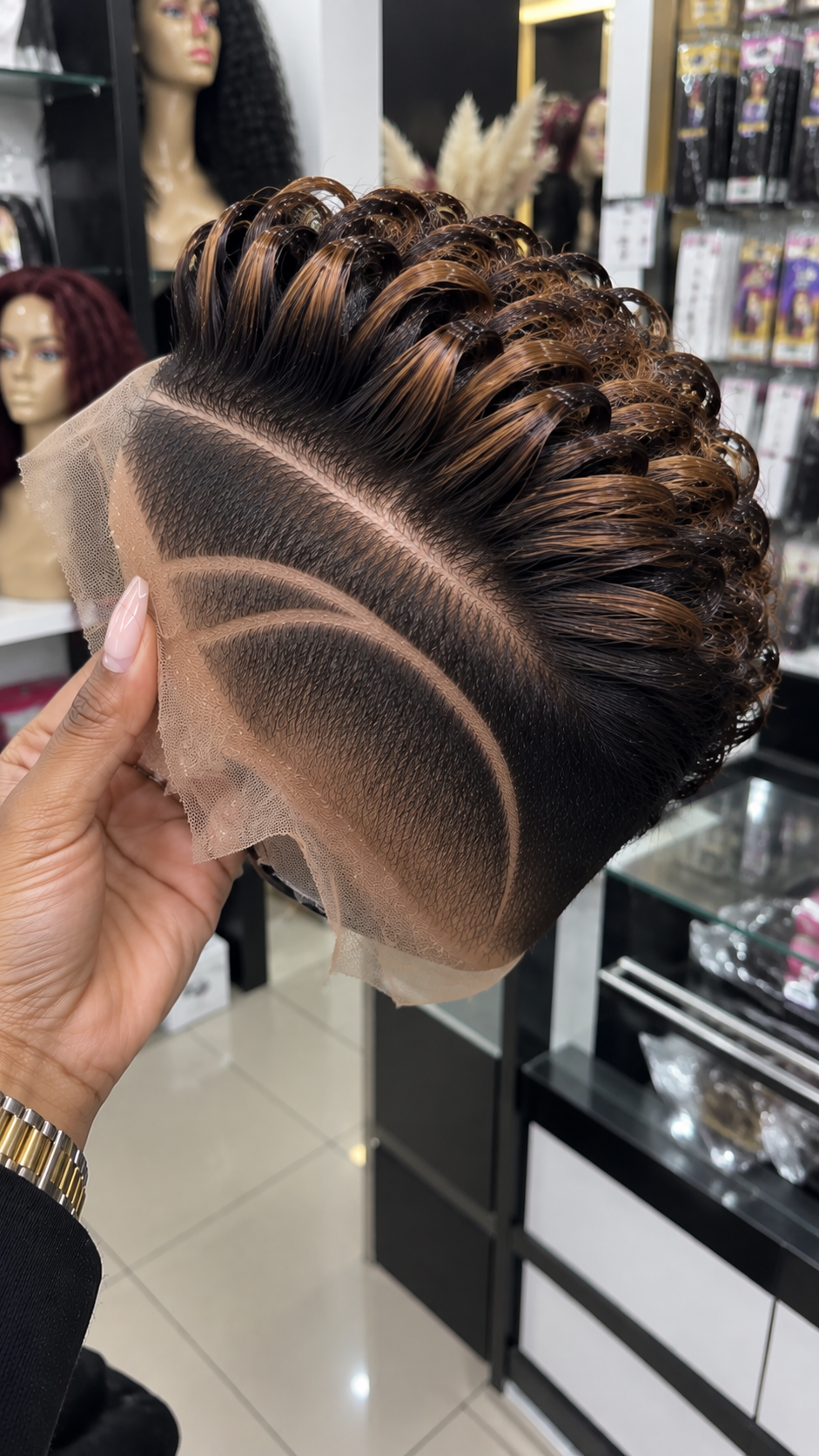
The first thing that separates this wig from an ordinary two-tone piece is the relationship between its bronze-brown highlights and the sweeping side artwork. The color does not sit across the entire unit in an even layer. Instead, narrow bronze sections travel through a much darker foundation and become especially visible where the crown bends into large loop formations. On the lower side, the visual language changes completely: the hair sits extremely close to the base while three curved pathways travel across it in a coordinated pattern. This creates a wig that needs to be evaluated from the side as much as from the top.
The photograph captures the unit before final fitting. Lace extends beyond the hair-bearing perimeter, and portions of the cap construction are visible underneath. This unfinished installation stage is useful for a buyer because it exposes details that would normally disappear after the lace has been trimmed. What cannot be established from the photograph is a specific premium lace classification. Lace is clearly present, but there is not enough evidence to call it HD lace, so that term should only be used if the manufacturer confirms the material.
The Side Artwork Establishes the Main Identity
Many sculpted wigs use a single separation to divide the crown from a closely cropped lower section. This piece goes considerably further. A long upper pathway begins near the front and sweeps around the side following the rounded contour of the unit. Beneath it, two additional curved lines create a layered pattern. Their spacing and lengths are not identical, which prevents the design from becoming three mechanically copied stripes.
The upper line acts as the strongest boundary. It separates the compact side hair from the heavier crown and continues toward the rear. The middle line begins below it and travels through the side area, while the lowest line creates another arc closer to the perimeter. Together they form a flowing side composition that becomes one of the most recognizable parts of the wig.
This geometry is important when commissioning a custom version. A description such as “three lines on the side” is too vague. A barber could interpret that as three straight parallel cuts, three disconnected marks or lines placed at equal distances. None of those choices would reproduce what is visible here. The reference should be supplied so the maker can follow the actual curvature, spacing and relationship between the three pathways.
Bronze Strands Reveal the Movement of the Crown
The highlighted sections have another purpose beyond adding color. Because bronze-brown strands sit against a very dark foundation, they reveal exactly how the upper hair travels. Individual sections rise from the crown, bend backward and return toward the base in broad loops. The contrasting strands trace those bends almost like directional markers.
Near the front, several loops are larger and more open. Moving toward the rear, the arrangement becomes increasingly compact and intricate. Smaller curled elements appear between and behind the broader front sections. This gradual change in scale gives the crown depth without requiring excessive height.
The bronze shade itself carries a warm brown character rather than appearing bright yellow or pale blonde. Dark roots remain clearly visible. Buyers trying to reproduce this appearance should therefore concentrate on the combination of a deep foundation and warm bronze-brown ribbons instead of selecting a uniformly light wig.
Placement is just as important as the exact shade. If the same bronze color were distributed randomly through straight hair, the result would have little resemblance to this unit. Here, the highlighted strands follow the loop construction, allowing the eye to read every bend and change in direction.
The Rear Crown Becomes More Intricate
A useful detail in this image is the transition toward the back. The front half of the crown is dominated by broad, recognizable loops, but the rear contains a denser network of smaller curled strands. These finer pieces occupy the spaces around the larger sections and create a more complex surface near the back of the head.
This means the crown should not be described or ordered as a row of identical loops. Its construction changes as it travels backward. Reproducing only the large front arches while ignoring the smaller rear work would leave the back looking comparatively empty.
When approving a custom unit remotely, ask for a rear three-quarter photograph rather than relying exclusively on front and side views. That angle should show whether the smaller curled elements have been included and whether the bronze distribution continues naturally through the back.
Density Control Makes the Side Pattern Readable
The close side area demonstrates why density can be as important as length. Hair here is kept extremely compact, providing a dark field around the carved pathways. If this section were left fuller, the curved lines could become obscured and the distinction between the lower area and sculpted crown would weaken.
At the same time, the side should not simply be stripped of hair. Fine strands remain visible throughout the dark sections, giving the surface the appearance of intentionally controlled density rather than an empty cap. Recreating that balance requires careful cutting and may be better handled by someone experienced in both wig work and barber-inspired detailing.
A buyer should also remember that the final position of these lines depends on fit. If the cap is too large, too small or positioned incorrectly, the arcs may sit higher or lower than intended relative to the temple and ear. Cap sizing is therefore part of the design rather than an unrelated technical specification.
The Uncut Lace Leaves Room for Personal Fitting
The photograph shows substantial lace extending beyond the front and side perimeter. Because it has not yet been trimmed against a wearer, a stylist still has room to determine the most appropriate boundary during installation. Cutting this material before checking the fit would remove that flexibility.
Fine hair is visible near the transition from lace into the denser sections. During an appointment, the wig stylist can assess how this area sits against the client’s own hairline and decide where the excess lace should be removed. The process should account for both the front appearance and the location of the side artwork.
Buyers ordering online should ask for the actual lace shade options offered by the seller. Photographs taken under salon lighting can make lace appear lighter, warmer or more transparent than it will under daylight. A supplier’s shade description or physical sample, when available, is more useful than guessing from screen color.
Choose the Base Unit by Construction, Not Just by Photograph
There are two practical ways to obtain a wig in this family. The first is to purchase a fully customized unit in which the color placement, crown loops and side artwork are already completed. The second is to purchase a compatible base and have a local wig stylist and barber complete the remaining work.
A finished custom unit can be convenient, particularly when the seller has demonstrated that they can reproduce the reference accurately. However, remote customization makes measurements important. The buyer should provide circumference and any additional measurements requested by the maker rather than assuming a universal cap size.
Local customization offers a different advantage. The side arcs can be positioned after the base has been checked against the client’s head. The stylist can also assess how much crown height suits the final placement before setting the larger loops. This route may involve more than one appointment, but it gives the professionals direct access to the wearer during the most sensitive stages.
A Better Way to Request This Wig From a Seller
When requesting a quotation, break the design into visible components. Describe the deep dark foundation first. Then specify warm bronze-brown ribbons concentrated through the sculpted crown. Mention the larger forward loops, the increasingly intricate rear curls, the compact lower side and the three sweeping side pathways. Finally, ask about lace shade, cap sizing and whether the unit arrives with excess lace for professional fitting.
This kind of specification makes it easier to compare quotations. One seller may be pricing only a colored base wig, while another may include all crown shaping and side customization. Without asking what the quotation covers, the cheaper option can appear better even though considerably more salon work will be required afterward.
If possible, request approval photographs before shipment. Ask specifically for top, side and rear three-quarter views. The side photograph should clearly reveal all three curved lines, while the top image should show the bronze distribution through the loops. The rear view can confirm that the smaller curled work has not been omitted.
What Different Budgets May Purchase
Pricing should reflect material and labor rather than being based only on the compact dimensions of the wig. A design like this can require coloring, deliberate crown setting, density work, lace construction and precision cutting. Those processes explain why a highly customized piece can cost considerably more than a basic unit with similar overall length.
| Category | Approximate Range | Likely Level of Work |
|---|---|---|
| Premium Custom | $310–$540+ | Higher-grade hair, planned bronze placement, detailed crown formation, personalized side artwork and advanced fitting preparation. |
| Standard Custom | $195–$330 | Custom color distribution with prepared loops and deliberate side-line construction, with some fitting work potentially completed locally. |
| Basic Human Hair | $120–$215 | A human-hair starting point that may need additional coloring, crown setting and side carving after purchase. |
| Premium Synthetic | $80–$150 | A quality pre-set interpretation where the crown may retain its arranged shape with relatively little daily manipulation. |
| Basic Synthetic | $40–$90 | A budget alternative that may simplify the bronze placement, lace construction or precision of the side artwork. |
These ranges are estimates for comparison and not fixed market prices. Location, hair quality, fiber type, cap construction, lace selection and the amount of hand labor can move the final price significantly. Shipping and professional installation may also be separate costs.
Before paying a deposit, ask whether color work, side detailing and crown setting are included. If they are separate services, request individual prices. This makes it much easier to determine whether buying a completed custom wig or finishing a base unit locally provides better value.
Preserving the Large Loops Requires Targeted Care
The crown should be maintained section by section. Pulling a brush through the entire upper area can combine neighboring loops and reduce the visible spaces between them. Those spaces are essential because they allow the dark foundation to appear between the bronze ribbons.
When a section begins to lose its intended bend, it should be reset in the direction established by the original construction rather than turned into a new curl. Human-hair units may permit controlled heat work, but the appropriate temperature depends on the hair and any previous color processing. The maker or stylist should provide guidance before heated tools are used.
Synthetic units require even more caution. Some fibers tolerate limited heat while others can deform permanently. The safest approach is to identify the fiber first and follow its care instructions rather than experimenting on the most visible part of the crown.
Storage should provide enough room for the loops to remain open. A wig stand or appropriately sized mannequin head is preferable to placing the unit flat beneath other items. The lace should also be kept free from heavy residue, especially around the front where repeated adhesive buildup can make future fitting more difficult.
The Carved Side Should Not Be Recut Automatically
The side pattern does not require cutting every time the wig is worn. Repeatedly deepening the lines can gradually widen them and change their spacing. Maintenance should focus first on keeping the surrounding compact hair controlled. Actual recutting should be reserved for situations where the pattern has genuinely become difficult to see.
When refinement is needed, the original photograph can serve as a map. The barber should pay attention to the broad upper arc, the shorter middle pathway and the lower sweeping curve rather than treating them as interchangeable stripes. Preserving their different lengths is central to retaining the original side composition.
If a wig stylist and barber are working separately, scheduling the lace fitting first can be sensible. Once the unit has a reliable position on the head, the barber can evaluate the line placement without guessing where the cap will ultimately sit.
Use the Reference as an Approval Checklist
Before accepting a completed custom order, compare the finished wig with the reference in stages. First examine the crown and confirm that the bronze strands trace the loops rather than appearing as random highlights. Next inspect the rear to make sure the smaller curled elements create the expected depth. Then turn to the side and check the number, curvature and spacing of the carved pathways.
After those visual elements are confirmed, examine the practical construction: cap size, lace perimeter and front density. This sequence prevents a striking color match from distracting attention from structural differences that may be much harder to correct later.
The strongest version of this design is one where every area has a distinct role. The bronze crown provides movement, the dark foundation supplies contrast, the intricate rear adds depth, and the three sweeping side lines establish the profile. Keeping those relationships intact is more important than simply matching a color name. For customers ordering through a wig business, detailed reference photographs, clear customization instructions and a fitting plan are the most reliable route to receiving a unit that preserves the personality of the original.
Search Terms
bronze loop crown lace wig · dark root bronze ribbon wig · triple curved side line wig · sweeping carved side wig · bronze black sculpted crown wig · intricate rear loop wig · untrimmed lace bronze wig · three arc side design wig