
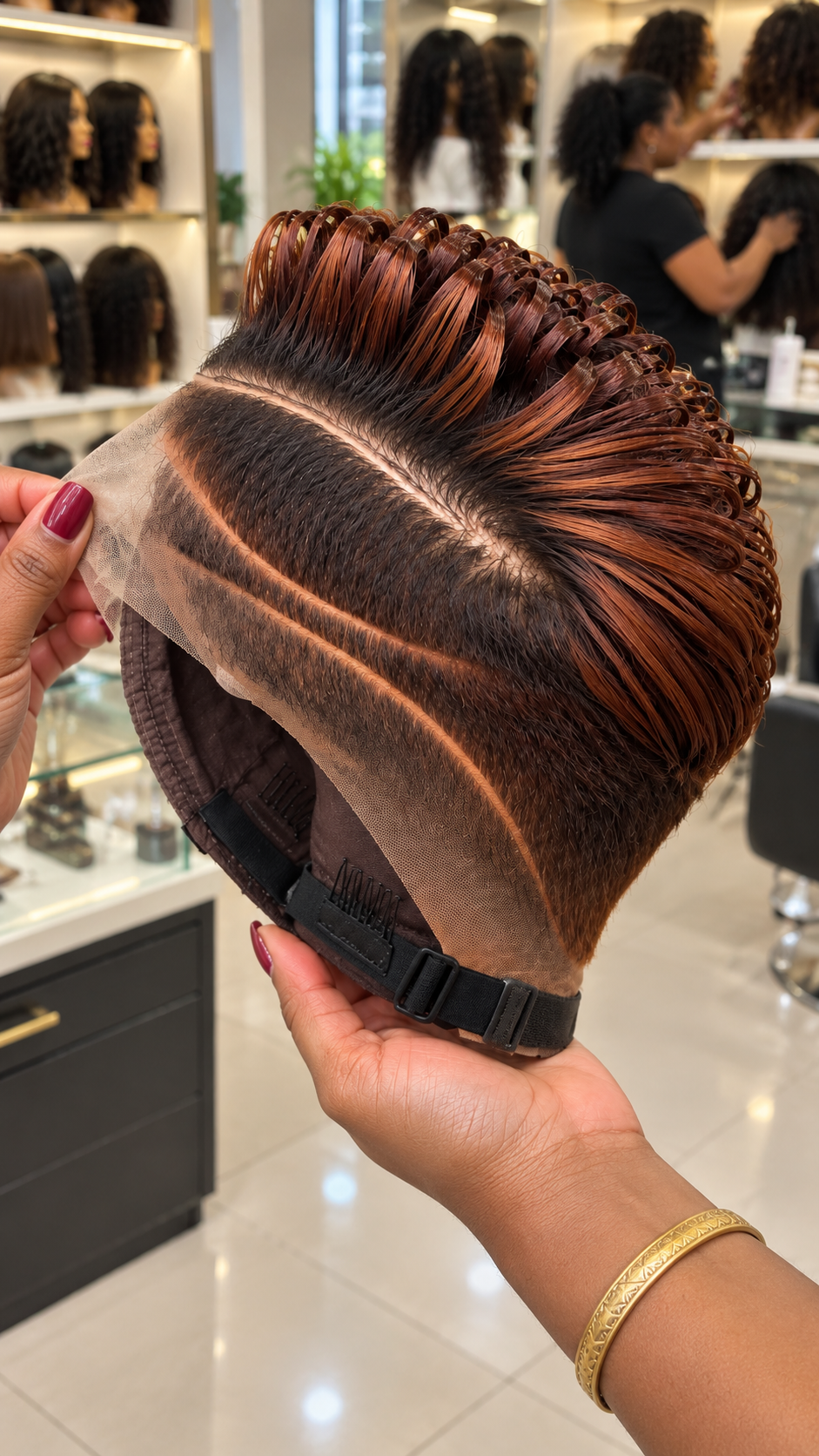
A short pixie wig can make a striking impression when warm copper coloring meets carefully arranged hair and precise side detailing. This beautifully sculpted hairstyle combines a raised crown of glossy copper loops, a deep side parting, and two sweeping lines across a closely styled dark brown side. The contrast between the lifted upper section and the compact lower hair creates a distinctive look that celebrates creative short hairstyling.
The photograph shows a customized wig held in two hands inside a professional hair salon. The crown contains elongated copper-brown strands shaped into raised loops that gradually sweep backward. Along the visible side, two curved separations divide the closely arranged dark hair into carefully controlled sections. A beige lace perimeter extends beyond the hairline, while the exposed interior reveals a dark cap with an adjustable strap and securing components.
Unlike a conventional curly pixie filled with small circular ringlets, this hairstyle emphasizes longer, sweeping loop formations. The copper strands rise from the front and curve backward, creating movement across the crown. Their glossy surfaces reflect the salon lighting, while the darker roots and side sections add depth.
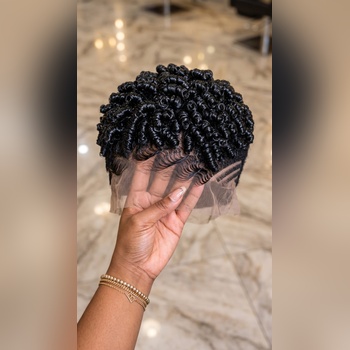
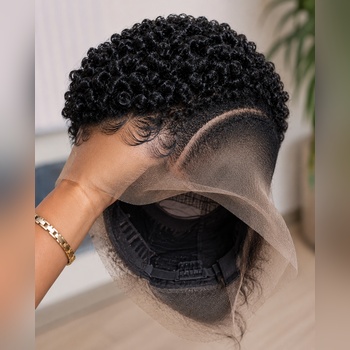
For women who appreciate short copper pixie wigs with artistic side details, this hairstyle offers an appealing combination of bold color and precise styling. Its compact silhouette makes it an attractive option for special occasions, professional beauty photography, and everyday wear for customers who enjoy structured short hair.
Raised Copper Loops Create a Distinctive Crown
The upper section is the hairstyle’s most recognizable feature. Instead of forming numerous small circular curls, the hair rises into elongated loops that sweep backward across the crown.
These formations begin near the front hairline and gradually curve toward the back. Some loops remain broad and open, while others fold more tightly into the surrounding hair.
The variation creates depth and gives the crown a flowing appearance without requiring long hanging strands.
The raised sections also introduce height at the front, producing a shape that resembles a carefully sculpted short quiff. However, the visible loop formations distinguish the design from an ordinary brushed-back pixie.
For custom production, the stylist should preserve this combination of height and backward movement. Replacing the elongated loops with tiny finger curls would create a completely different hairstyle.
Rich Copper Coloring Adds Warmth and Dimension
The crown displays warm copper-brown coloring with brighter reddish reflections across the raised strands. Darker areas remain visible beneath the upper loops, creating an attractive contrast between the hair’s surface and roots.
The copper color is especially effective because it emphasizes the direction of each strand. As the loops rise and curve backward, light catches their rounded surfaces and reveals the careful arrangement.
The color also creates a strong visual relationship with the dark brown lower side. Rather than making the entire wig uniformly copper, the deeper side coloring provides a contrasting foundation.
Women seeking a similar appearance should request warm copper or auburn-brown tones with darker roots. Exact shades should be confirmed using actual hair samples, since salon lighting can change how copper appears in photographs.
Double Side Lines Give the Pixie Its Character
Two sweeping lines run through the closely arranged side hair. The upper separation begins near the front and follows a long curved direction toward the back. A second line sits below it, creating a coordinated decorative pattern.
These separations are among the most important elements of the hairstyle because they distinguish it from an ordinary copper pixie.
The lines expose narrow areas of the underlying foundation while the surrounding strands remain closely arranged. Their curved shape complements the movement of the raised crown.
The upper separation also helps establish the boundary between the copper loops and the dark lower section. This creates a deliberate contrast in both height and color.
When ordering a similar wig, customers should provide a clear side-view photograph and specify the desired spacing between the two lines.
A skilled stylist should plan the design before permanently trimming or repositioning the surrounding hair.
The Sleek Lower Side Balances the Upper Volume
The lower section looks considerably flatter than the raised crown. Fine dark brown strands follow a backward and downward direction, creating a compact appearance beneath the decorative lines.
This contrast prevents the hairstyle from becoming excessively bulky.
The raised copper loops provide height and movement, while the closely arranged side creates definition and structure.
The lower hair also gradually follows the curved shape of the wig foundation, producing a tapered visual effect.
Although the side resembles a short haircut, the photograph shows a constructed wig rather than hair growing directly from a person’s scalp. A similar appearance can be achieved through different wig-making and styling techniques.
Customers should ask the wig maker how the side detailing will be reproduced and whether the design requires permanent cutting.
A Swept-Back Shape with a Compact Finish
One attractive characteristic of this style is the way the crown changes direction. The front strands rise prominently, while the upper hair gradually sweeps backward and settles into a more compact shape toward the rear.
This creates movement without requiring a long hairstyle.
The visible ends blend into the surrounding copper-brown sections rather than hanging loosely over the face.
Such an arrangement can be useful for women who prefer short hairstyles with additional height across the crown.
However, maintaining the lifted appearance requires appropriate styling and careful handling. The raised loops may flatten if compressed during storage or repeatedly brushed.
The Dark Roots Create a Natural-Looking Transition
The copper upper sections emerge from darker hair near the base. This darker coloring creates depth and connects the raised loops visually with the closely arranged lower side.
The contrast is subtle in some areas and more noticeable where the lifted strands expose the hair beneath them.
Unlike a sharply divided two-tone hairstyle, the transition appears integrated into the direction of the strands.
Customers who appreciate copper coloring but prefer darker roots may find this arrangement particularly attractive.
For a custom unit, the root color should be planned alongside the final curl-setting method so that the darker sections remain visible in appropriate areas.
Understanding the Visible Lace Foundation
The photograph reveals beige-toned lace extending beyond the front and lower side hairline. This untrimmed perimeter indicates that the wig is being displayed before final installation preparation.
The lace supports the hair-bearing sections and provides material for fitting the unit to the wearer.
Its visible mesh also reveals how carefully the lower side hair has been arranged.
Although the lace appears fine, the photograph does not confirm that it is commercially classified as HD lace or any other particular grade.
Buyers should request the supplier’s actual construction specifications rather than assuming that every fine-looking lace foundation is identical.
The Interior Cap and Adjustable Components
The underside of the wig is partially exposed. A dark interior foundation supports the hairstyle, and an adjustable strap is visible along the lower edge. Small securing components also appear inside the cap.
These details are useful when evaluating how a wig may fit and remain positioned during wear.
However, the visible components do not establish whether the unit is guaranteed to be suitable for adhesive-free installation.
Customers should ask for a complete underside photograph showing the available adjustment system, attachment points, and construction.
The cap must fit comfortably while keeping the raised crown and decorative side lines correctly positioned.
Choosing a Suitable Wig Construction
Similar short hairstyles can be manufactured using different foundations, including lace-front, frontal, closure, and other cap constructions.
The most appropriate option depends on the desired hairline appearance, the location of the decorative side partings, and the customer’s preferred installation method.
A lace-front foundation may provide sufficient styling flexibility for certain versions, while more extensive lace coverage may be useful for particular custom arrangements.
The photograph alone does not establish the exact commercial category of the displayed construction.
Before purchasing, customers should ask the supplier to explain which foundation supports the requested design and what styling limitations it may have.
Can This Wig Be Worn Without Glue?
Women who prefer removable wigs may be interested in a glueless version of this copper pixie.
Some wigs include adjustable straps, elastic components, or securing combs that help stabilize the foundation without adhesive.
However, wearing comfort and security depend on the actual cap construction and individual head measurements.
The presence of an adjustable strap does not automatically guarantee that the unit will fit every customer without glue.
When ordering, explain whether adhesive-free installation is a priority. The supplier should confirm which fastening methods are available and whether the cap is intended for that use.
Choosing the Correct Hair Density
The raised crown requires enough hair to create broad loops with a full appearance. However, excessive density can make the hairstyle heavy and obscure the individual formations.
The flatter side requires a different distribution because its closely arranged strands must leave the decorative separations visible.
A customized density arrangement is therefore more important than choosing the highest advertised percentage.
Customers should request photographs of the finished hairstyle from above and from the side.
These views help determine whether the crown has sufficient fullness without overwhelming the compact lower section.
Hair Length Matters for the Sweeping Loops
The hair appears short in its finished shape, but the raised loops require sufficient starting length to curve backward.
Strands that are too short may not form complete elongated loops, while excessively long strands can create unwanted bulk toward the rear.
The crown and lower side therefore require different styling lengths.
The professional wig maker should determine the starting measurements according to the desired height, loop diameter, and backward direction.
Customers should focus on the finished proportions rather than selecting a single uniform hair length.
Human Hair and Synthetic Fiber Choices
A similar wig may be produced using human hair, synthetic fibers, or a blend. The photograph does not establish the actual material.
Human hair may provide greater flexibility for professional curl resetting and future adjustments, depending on its quality and processing history.
Some synthetic fibers can preserve pre-set sculpted loops effectively, but their heat tolerance varies.
Customers should verify the fiber type before applying heated styling tools or attempting chemical treatments.
The ideal choice depends on budget, expected wearing frequency, and whether the customer intends to change the hairstyle regularly.
Where To Buy This Wig
Women interested in this hairstyle can explore specialist wig boutiques, custom wig makers, professional beauty supply shops, and salons experienced with sculpted short wigs.
Ready-made copper pixie wigs may offer a starting point, but they may not include the raised loop formations and double side lines.
For a close recreation, custom production may be preferable.
Before purchasing, request actual photographs of the finished product. The seller should be able to show the crown, side detailing, front hairline, back, and interior foundation.
Buyers should also confirm the hair material, cap size, lace specifications, color, delivery arrangements, and return policy.
How To Order This Style
When contacting a supplier through WhatsApp, Instagram direct messages, telephone, or a business website, provide the reference photograph.
Describe the hairstyle as a short copper-brown pixie with a raised, swept-back loop crown, darker roots, and two curved side separations.
Specify that the upper hair should remain sculpted rather than forming small circular finger coils.
Customers should also confirm whether the unit will arrive completely styled or require additional salon customization.
Ask about available installation methods, cap measurements, and total cost before placing the order.
Finding a Professional Stylist
Recreating the hairstyle requires experience with structured short hair, sculpted loops, and carefully positioned side partings.
A stylist who specializes only in ordinary curly wigs may not automatically reproduce the raised crown correctly.
Customers should review examples of previous pixie styling work, paying attention to the direction of the strands and the quality of the side detailing.
During consultation, explain the importance of preserving both the lifted copper loops and compact dark side.
A clear photograph showing the profile will help communicate the intended shape.
Booking Installation and Customization
A completed wig may need only fitting, lace preparation, and small styling adjustments before wear.
An unfinished foundation may require more extensive work, including crown shaping, loop setting, side detailing, and installation.
When booking a salon appointment, ask which services are included.
Clarify whether washing, conditioning, styling, lace trimming, and fitting carry separate charges.
The stylist should also explain how to preserve the raised crown after installation.
Understanding these details before the appointment can help avoid unexpected expenses or unrealistic styling expectations.
Estimated Prices for Custom Copper Pixie Wigs
Pricing depends on the hair material, cap construction, coloring, density, and the labor required to create the sculpted crown and side pattern. The following figures are illustrative budgeting estimates in US dollars rather than verified prices for the photographed wig.
| Price Tier | Estimated Price Range | Typical Features |
|---|---|---|
| Budget | $45–$100 | Basic synthetic short pixie with copper coloring and simplified swept styling. |
| Value | $100–$190 | Improved synthetic or blended wig with more carefully shaped loops and side detailing. |
| Mid | $190–$340 | Selected human-hair or higher-grade alternatives with professional crown styling and dark-root coloring. |
| Premium | $340–$550 | Custom foundation, individually shaped copper loops, precise side lines, and professional finishing. |
| Salon-Grade | $550–$880+ | Personalized construction, specialist hand styling, fitting, and advanced customization services. |
Actual prices may vary by supplier, location, material quality, shipping, taxes, and installation requirements.
Daily Care for the Raised Copper Crown
The sculpted upper loops require gentle handling because their raised formations can flatten with excessive pressure.
After wearing the wig, inspect the crown for displaced strands or collapsed loops.
Avoid brushing through the entire hairstyle without considering how the loops were originally formed.
Small adjustments may restore minor changes, while extensive reshaping may require professional attention.
Use styling products compatible with the confirmed fiber and avoid excessive buildup that could weigh down the raised sections.
Washing Without Flattening the Style
Washing frequency should depend on wearing habits, environmental exposure, and product buildup.
Use a suitable cleanser for the wig’s actual fiber composition and avoid vigorous rubbing.
Heavy manipulation can disturb the elongated loops and alter their backward direction.
After cleaning, allow the wig to dry without placing pressure on the raised crown.
Some materials may require professional resetting to restore the original shape.
Always follow the manufacturer’s instructions before using heat or other styling methods.
Maintaining the Copper Color
Warm copper tones may require appropriate care to preserve their original appearance.
For human-hair wigs, the condition of the color depends on the original dyeing process, washing routine, and exposure to heat and sunlight.
Some synthetic fibers are manufactured in their finished color and should not be treated with conventional permanent dyes.
Customers should confirm how the hair was colored before attempting adjustments.
When professional recoloring is possible, reference photographs can help preserve the intended balance between the warm copper crown and darker roots.
Keeping the Side Lines Neat
The two curved separations require careful maintenance because their appearance depends on precise spacing and the direction of the surrounding strands.
Brushing the lower side aggressively may disturb the hair and reduce the visibility of the lines.
If the pattern has been created through permanent trimming, additional cutting may widen the separations.
A professional stylist should examine the original arrangement before making changes.
Maintaining the compact lower hair helps preserve the contrast with the raised crown.
Storing the Wig Between Wears
A suitable wig stand or mannequin head can help preserve the hairstyle’s raised silhouette.
Avoid compressing the loops beneath heavy objects or stacking the wig with other hairpieces.
The front and side lace should also be protected from unnecessary stretching.
Ensure that the wig is fully dry before extended storage.
For transportation, use packaging with enough space around the crown.
Careful storage reduces the likelihood of flattening and can help minimize the need for professional restyling.
Advantages of This Copper Pixie
The hairstyle combines several attractive qualities, including warm coloring, lifted crown volume, precise side lines, and compact overall proportions.
The swept-back loops create movement without requiring long extensions.
The darker roots and side sections add contrast, while the copper coloring gives the upper hair a distinctive appearance.
A removable wig also allows women to experiment with a closely styled pixie without permanently cutting their natural hair.
For customers who appreciate structured hairstyles, the design offers an interesting alternative to ordinary curly pixies.
Potential Limitations to Consider
The raised loops require more deliberate maintenance than loose, freely falling curls.
Excessive brushing, compression, or unsuitable products may flatten the crown.
The curved side lines also require precision during restoration.
Custom coloring and detailed styling may increase the purchase price compared with a basic short wig.
Women who prefer frequently changing their hairstyles may find a less structured design easier to maintain.
These considerations should be balanced against the desired appearance and maintenance preferences.
A Striking Combination of Copper Color and Sculpted Detail
This copper-brown pixie demonstrates how raised loop styling and carefully arranged side separations can create a distinctive short hairstyle. The crown offers height and flowing movement, while the darker lower section provides a compact contrast.
The two sweeping side lines give the design its artistic character without overwhelming the sculpted upper hair. Dark roots add depth, allowing the warm copper coloring to stand out across the lifted loops.
For women considering a similar wig, the most important details are the shape and direction of the crown, the placement of the side lines, the color transition, and the construction of the foundation.
With appropriate professional customization and careful maintenance, this hairstyle offers a beautiful combination of warm copper shades, expressive crown styling, and precise short-hair craftsmanship.
Search Terms
copper swept loop pixie wig · short auburn sculpted crown · copper brown quiff wig · double side line pixie hairstyle · dark root copper short wig · raised loop crown lace wig · swept back copper pixie · short copper wig with curved side partings