
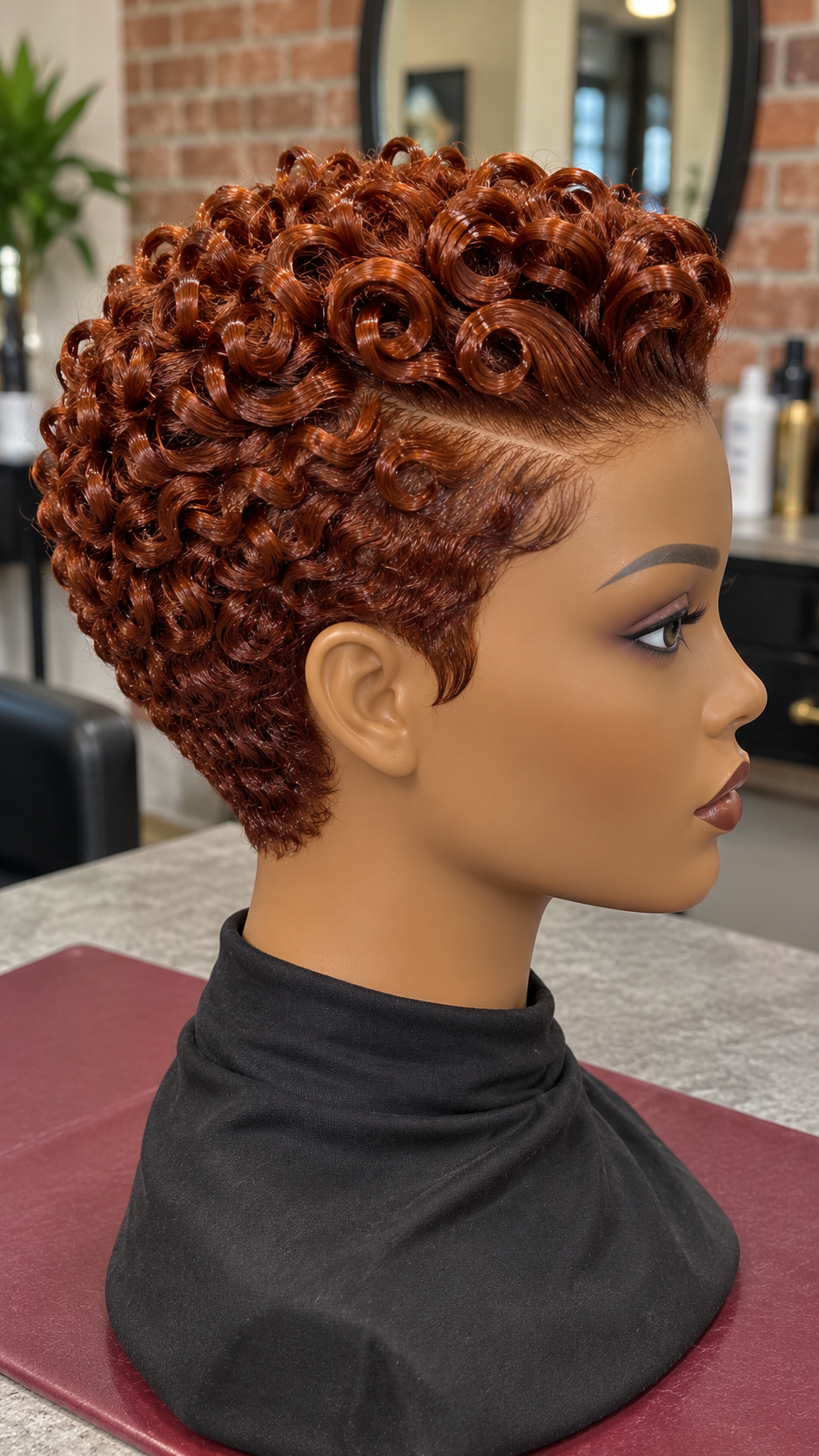
A side-profile photograph can reveal qualities that are easy to miss when shopping for a sculpted curly wig. In this cinnamon-copper style, the circular crown, carefully arranged temple curls and compact nape form a continuous silhouette. The hairstyle does not depend on multiple carved barber lines or contrasting blonde highlights. Instead, its identity comes from the way large, glossy spirals gradually become smaller toward the ear and back of the neck.
Displayed on a female mannequin in a salon, the wig has a rich copper-brown appearance with cinnamon and auburn reflections. The crown contains individually rolled curls with visible circular openings, while the side incorporates flatter directional strands and a small spiral positioned above the temple. The ear remains uncovered, and the lower hair follows the shape of the head rather than extending into long hanging curls.
For someone looking to purchase or recreate this hairstyle, the most valuable detail is its progression from prominent upper spirals to compact lower curls. This transition controls the silhouette, determines how the hairstyle frames the face and influences the amount of professional styling needed to maintain the original arrangement.
The Side Profile Reveals the Real Proportions
The mannequin is photographed almost directly from the side, providing a clear view of how the curls occupy the crown, temple and nape. This angle is especially useful because it reveals the height of the upper hair and the degree to which the lower curls follow the head.


The largest spirals sit along the upper crown, where their circular openings become individual focal points. As the hair approaches the ear, the curl sizes decrease and the arrangement becomes denser.
Near the nape, the strands are substantially smaller and closer to the neck. This gradual reduction creates a compact silhouette without making the lower area appear completely shaved.
A custom stylist should preserve this relationship. Increasing the size of every curl would make the side too bulky, while removing excessive lower hair would create a much sharper undercut than the reference.
Cinnamon Copper Creates Warmth Without Blonde Highlights
The entire visible hairstyle belongs to a warm copper-brown color family. Its raised surfaces show bright cinnamon, auburn and reddish-copper reflections, while deeper chestnut tones appear inside the spiral openings and around the roots.
There is no clearly visible platinum, honey-blonde or sharply contrasting black-highlight pattern. The color variation comes largely from differences in brightness and the direction of the curled strands.
For purchasing, this distinction matters. A copper wig with obvious blonde streaks could appear considerably different from the reference even when the crown construction is similar.
A useful color request would describe rich cinnamon copper with auburn depth and a glossy reddish-brown finish. The buyer should ask for a neutral-light photograph of the available hair before approving the final shade.
Warm salon lighting can intensify orange reflections, so color should not be judged entirely from one indoor photograph.
The Crown Uses Open Circular Spirals With Varied Diameters
The upper crown contains numerous tubular ringlets. Several have prominent hollow centers, particularly toward the top and forward section. Their strands curl inward in compact circular paths rather than hanging downward as ordinary loose ringlets.
The spirals vary in diameter. Larger formations provide the main visual detail, while smaller curls occupy the spaces between them and help maintain a rounded shape.
This variation prevents the crown from appearing like a rigid collection of identical circles. It also allows the hairstyle to remain compact despite the substantial number of curls.
When commissioning a similar wig, the stylist should understand that the individual openings are part of the intended appearance. Filling every gap with more hair could reduce the circular structure that makes the crown recognizable.
The Forward Curls Form a Gentle Elevated Crest
Several large copper spirals rise along the forward upper crown before turning inward. Their arrangement creates a slight crest above the forehead without forming an elongated fringe.
The crown retains fullness, but its height is controlled. It does not project into an exaggerated vertical shape.
The largest curls also sit at different orientations. Some openings face forward, while others are angled toward the side or upper rear. This creates visual movement through the changing reflections on their surfaces.
For a custom reproduction, a side photograph should be included in the approval process. The buyer can use it to verify the height of the forward crown and the way the spirals transition toward the temple.
The Temple Curl Is the Most Recognizable Side Accent
One of the clearest individual details is a small circular curl positioned above and slightly forward of the ear. It sits within a flatter section of hair and forms a distinct spiral against the surrounding copper-brown strands.
This accent creates a transition between the large crown ringlets and the more compact lower side. Unlike decorative razor artwork, its shape comes from the arrangement of a curled strand rather than exposed carved lines.
The curl is deliberately smaller than the major crown spirals. Enlarging it could make the temple appear overly decorated, while removing it would eliminate an important part of the visible design.
A stylist should therefore preserve its size, direction and position when recreating the hairstyle.
The Front Hairline Uses Fine Sweeping Strands
Near the forehead, fine copper-brown strands lie close to the mannequin’s hairline. These strands follow a backward and slightly curved direction before joining the heavier styling above.
The arrangement creates a gradual visual transition from the face into the dense spiral crown.
It is different from placing the largest curls directly against the forehead. The finer strands provide space beneath the upper hair and help establish the side profile.
During a custom wig installation, the stylist should evaluate the front hairline carefully. Any perimeter adjustment should preserve the directional appearance where it contributes to the final hairstyle.
The Side Is Sculpted Without Decorative Shaved Channels
The visible side does not contain multiple exposed stripes, lightning patterns or elaborate barber-carved artwork. Instead, the curls become progressively smaller and sit closer to the head.
This makes the side visually quieter than the crown. The hairstyle still has detail around the temple, but it does not compete with the large upper spirals.
For buyers seeking this exact design, the absence of carved channels should be part of the order specification. Adding them would create a different hairstyle rather than improve the original.
The desired result is a compact, closely curled side with a small temple spiral and uninterrupted copper-brown coverage.
The Ear Remains Visible
The photograph clearly shows the mannequin’s ear rather than concealing it beneath long curls. This is an important part of the hairstyle’s profile.
The upper curls sit high enough to avoid covering the ear, while the smaller side curls follow the head and create a compact outline around it.
This arrangement can make the wig appear lighter in profile than a style whose curls extend over the ears.
For fitting, the stylist should confirm that the wig is positioned correctly so the side hair follows the intended placement. A cap sitting too low could change the relationship between the curls and the ear.
The Nape Has a Closely Arranged Curled Finish
At the back of the neck, the copper curls become smaller and more compact. The hair follows the contour of the nape without forming a long tail or hanging section.
This lower area is essential to the overall silhouette. It allows the dense crown to transition naturally toward the neck.
A stylist should avoid leaving the rear as full as the upper crown. Doing so could produce excessive projection near the nape.
Equally, trimming the lower curls too aggressively might create a visibly bare section that does not match the reference.
The appropriate goal is a gradual reduction in curl size and outward volume.
The Rear Curl Distribution Should Be Verified Before Ordering
The side photograph shows much of the rear silhouette, but the exact arrangement across the entire back is not completely visible.
For a made-to-order wig, a rear photograph should therefore be requested before final approval.
That image can demonstrate whether the curls continue consistently across the back and whether the nape maintains the same compact character.
An elevated crown photograph is also useful for checking whether the circular formations retain visible openings and balanced spacing.
The Mannequin Photograph Cannot Confirm Cap Construction
The wig is displayed on a mannequin rather than being held open. Its interior foundation and attachment components are not visible.
Consequently, it is not possible to confirm the cap type, lace grade, attachment system or whether the wig can be installed without adhesive.
Buyers should request a separate photograph of the unit removed from the mannequin, including its interior.
If the seller advertises lace construction, ask for the exact material specification. A natural-looking front hairline is not sufficient evidence to identify HD lace.
Cap Size Influences the Side Profile
The crown and temple styling are attached to the wig foundation. If the cap is positioned too far forward or backward, the visible arrangement changes.
This is particularly relevant because the reference includes a distinct temple spiral and an uncovered ear.
For custom construction, the buyer should follow the maker’s measurement guide and provide all requested dimensions.
Depending on the cap, circumference, front-to-nape and ear-to-ear measurements may be important.
A professional wig stylist can assist with these measurements before purchase.
Where to Find a Stylist for This Spiral Construction
Specialist wig makers, custom hairpiece studios and salons experienced in sculpted finger coils are practical places to begin.
The maker should understand how to create large open circular spirals while maintaining smaller curls around the temple and nape.
Experience with ordinary loose curls is not automatically sufficient, because this style depends on individually rolled formations and controlled placement.
When reviewing a portfolio, look for photographs from the side and rear rather than only frontal portraits.
Buying a Ready-Made Wig Versus Commissioning the Style
A ready-made cinnamon-copper wig can be convenient when the crown, temple and nape already match the desired appearance.
However, a generic copper curly wig may have longer hanging curls, a different side arrangement or less precise circular formations.
A custom commission gives the buyer more control over curl diameter, color depth and crown height.
Before ordering, ask whether the seller can reproduce the specific compact nape and temple spiral. These details should be confirmed independently from the copper color.
The Most Useful Search Terms for Finding Comparable Units
When shopping online, start with descriptions emphasizing sculpted copper finger coils, compact spiral crowns and tapered curly pixie wigs.
Search results containing loose curls may not reproduce the same circular construction. The buyer should therefore examine product photographs carefully rather than relying only on listing titles.
Custom wig studios may also accept reference-based orders. Send the photograph and ask whether the required curl setting, color and lower silhouette can be produced.
Before paying a deposit, confirm the expected production time, cap specification and whether the unit will arrive fully styled.
Booking a Salon Appointment for Customization
The required appointment depends on whether the wig has already been styled.
A finished unit may need fitting and minor adjustments. An unfinished foundation could require coloring, spiral setting, temple shaping and nape refinement.
When booking, explain that the desired result includes large open crown spirals, a small temple curl and a compact lower section.
This helps the salon allocate enough time and identify a stylist with appropriate experience.
Color Selection Should Account for Copper’s Reflective Appearance
Copper-colored hair can look different depending on light source and strand direction. In this photograph, the raised curls display bright reddish reflections while the recessed sections appear deeper auburn.
A buyer should request a neutral-light color photograph before confirming a custom order.
The desired shade should maintain rich cinnamon-copper depth rather than becoming uniformly bright orange or pale golden blonde.
If the wig is made from human hair, the seller should explain whether the color was created through processing and how that may affect future maintenance.
Estimated Pricing for a Cinnamon Copper Spiral Wig
The cost of this design is influenced by the number of individually arranged spirals, the warm copper coloring, the compact side construction and any professional cap preparation.
The absence of elaborate shaved artwork may reduce one category of labor, but the crown and lower curl transitions still require careful styling.
Illustrative Wig Prices by Construction Category
| Category | Estimated Price Range | Potential Scope |
|---|---|---|
| Premium Custom | $315–$575+ | Higher-grade hair, personalized sizing, rich cinnamon-copper coloring, hand-arranged circular spirals, temple curl styling and compact nape refinement. |
| Standard Custom | $190–$345 | Prepared copper spiral crown, coordinated side curls and standardized cap options. |
| Basic Human Hair | $115–$210 | A human-hair foundation requiring additional coloring, spiral setting, side shaping and professional fitting. |
| Premium Synthetic | $75–$155 | A pre-colored and pre-set interpretation with potential benefits for retaining the compact spiral construction. |
| Basic Synthetic | $35–$90 | A budget alternative where curl definition, color depth, temple detail or cap construction may be simplified. |
These prices are illustrative planning estimates rather than verified quotations for the mannequin’s wig. Actual costs depend on material, seller, location, customization labor, cap construction, shipping and installation.
Ask whether the quoted price includes the completed crown, temple styling and nape work. An inexpensive foundation requiring substantial professional customization may cost more overall than a finished unit.
Human Hair Allows Professional Spiral Resetting
A human-hair version may allow individual crown spirals to be reset when they loosen, depending on hair quality and processing history.
Copper-colored hair may have undergone chemical processing, so future heat should be chosen carefully.
Selective curl restoration can reduce unnecessary manipulation when only a few sections have shifted.
A professional should assess the condition of the hair before attempting extensive restyling.
Premium Synthetic May Preserve the Pre-Set Curl Pattern
A quality synthetic version can be useful for customers who want the hairstyle to remain close to its original form.
Pre-set synthetic coils may require less frequent professional reconstruction, although their heat tolerance varies.
Conventional permanent hair dye should not be assumed compatible with synthetic fibers.
Buyers should confirm the material before selecting heated tools or coloring products.
Care Should Protect the Larger Crown Spirals
Before washing, photograph the crown from above and from the side. These images record the placement and size of the main ringlets.
During cleansing, avoid aggressive rubbing that can intertwine neighboring curls and obscure their circular openings.
Use care methods appropriate for the confirmed hair or fiber.
After drying, restore only the sections that have moved rather than automatically reconstructing the entire crown.
The Temple Curl Should Be Maintained Separately
The small spiral above the temple is one of the wig’s identifying details. If it loses its shape, the side can appear noticeably different.
Rather than enlarging the curl or creating several new accents, a stylist should preserve its original size and direction.
Heavy product should be used cautiously around this fine section because residue can cause it to stick to neighboring hair.
Protect the Nape From Excessive Trimming
The lower rear curls are compact but still visible. They should not automatically be shaved away during routine maintenance.
Because wig hair does not naturally grow back, repeated cutting can gradually reduce the density and change the original nape shape.
If some strands become displaced, controlled repositioning may be sufficient.
The goal is to maintain the gradual transition from large crown spirals into smaller lower curls.
Preserve Copper Depth During Color Refreshing
If a human-hair version eventually needs color maintenance, the deeper auburn sections should remain part of the design.
Applying one bright orange-copper shade throughout the entire unit could remove the tonal depth visible inside the spirals.
A professional colorist can evaluate which areas require refreshing while preserving darker root and interior sections.
Synthetic versions should follow their confirmed fiber-specific coloring limitations.
Avoid Heavy Styling Product Buildup
The copper spirals already reflect light strongly. Excess oils and waxes can cause neighboring strands to adhere together and conceal the circular openings.
Residue may also make the color appear darker or less dimensional.
Use products sparingly and according to the confirmed material.
When buildup becomes visible, appropriate cleansing may restore the appearance more effectively than additional shine product.
Storage Should Preserve the Compact Side and Raised Crown
A suitable wig stand or mannequin head can support the hairstyle between wears.
The raised crown needs enough space to retain its circular openings, while the lower side and nape should remain free from compression.
Store the unit only when the hair and cap are fully dry.
For travel, choose packaging that protects the spirals without flattening the upper silhouette.
The Value of This Wig Lies in Its Graduated Curl Construction
This cinnamon-copper wig demonstrates how a compact sculpted hairstyle can create visual interest through curl placement rather than elaborate side carving. Large circular spirals form the crown, finer directional strands frame the forehead, a small temple curl adds detail and closely arranged curls complete the nape.
For buyers, the most important quality checks are spiral diameter, visible circular centers, copper color depth, temple-curl placement, uncovered ear, compact lower density and the continuity of the rear styling.
For wig businesses, a direct side-profile photograph is particularly effective because it reveals how the curl sizes change across the head. Additional overhead, rear and underside images can help customers understand the finished style and verify practical construction details.
A faithful reproduction should preserve the rounded crown, warm copper shade and gradual reduction in curl size without adding unnecessary carved patterns or exaggerated volume. The hairstyle’s identity comes from the controlled relationship between prominent upper spirals and compact lower curls.
Search Terms
cinnamon copper spiral pixie wig · auburn circular coil crown · copper brown temple curl wig · tapered nape ringlet hairpiece · rich copper sculpted curls