
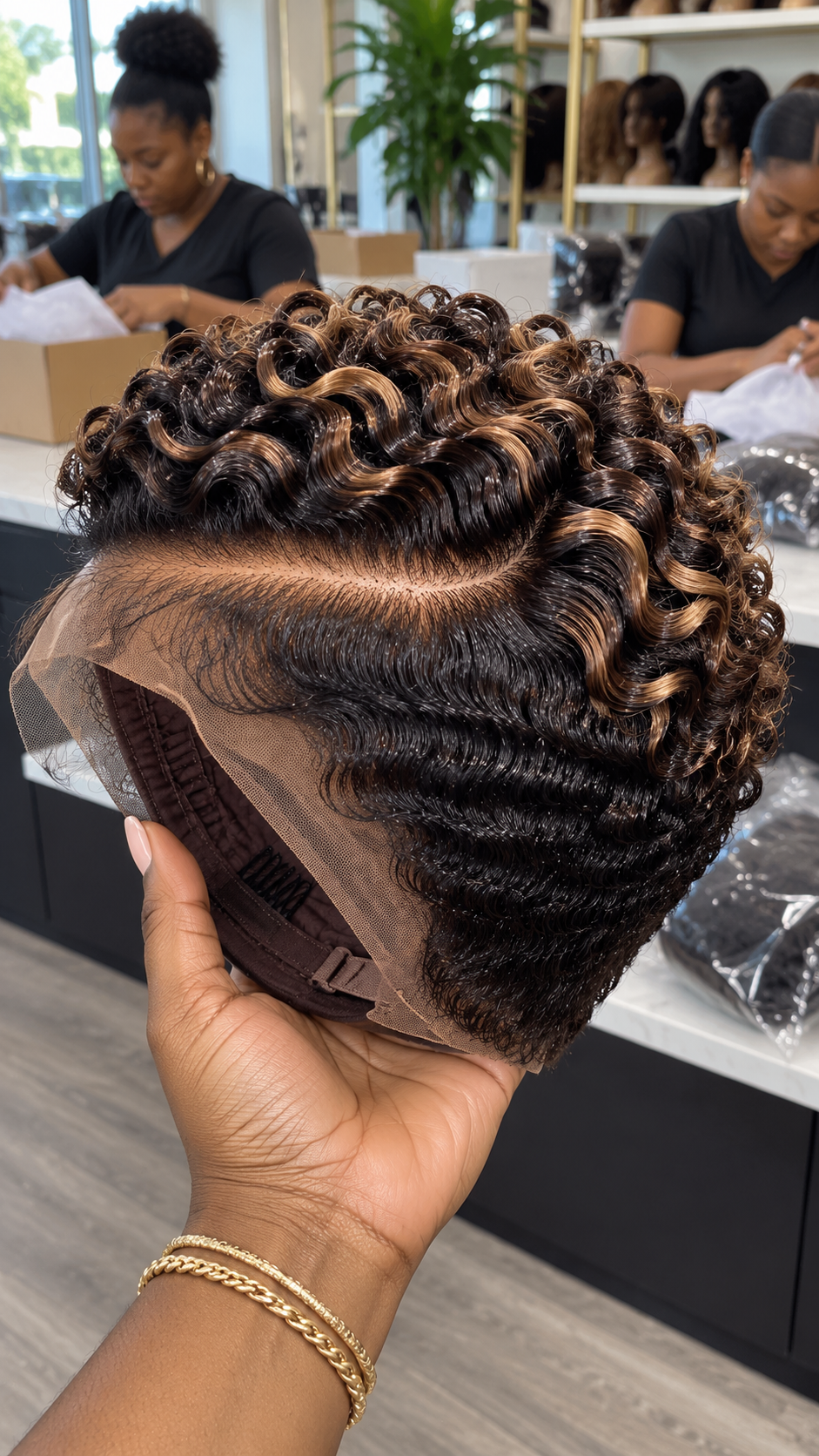
The most interesting detail in this salon photograph is the way the hair changes character as it travels downward. At the top, caramel-highlighted ribbons form open loops and sculpted curls. Beneath them, the strands become darker, flatter, and more closely arranged, eventually forming several sweeping finger-wave ridges along the visible side. A pale diagonal parting separates the upper curls from the lower styling, making the transition especially noticeable.
The wig is being supported in one hand before installation. Its beige-brown lace remains untrimmed, while part of a brown interior cap and its adjustment hardware can be seen beneath the hair. This view allows a prospective buyer to study the styling and construction without assuming that the wig has already been fitted to a particular person.
Unlike a conventional curly pixie, this design does not depend on circular ringlets covering every section. Its character comes from the contrast between elevated caramel ribbons, an exposed side part, and dark finger waves that descend toward the lower edge. Reproducing those transitions accurately is more important than simply choosing a wig with brown highlights.


A Haircut Concept Built Around Three Distinct Surfaces
The uppermost section contains a collection of broad, glossy curls. Several have circular openings, while others resemble folded ribbons or elongated arches. Their directions vary, producing a layered appearance rather than a uniform row of identical ringlets.
Immediately beneath the curls, the hair is directed backward from a visible parting. The strands lie closer together and form a reflective surface with narrower curves.
Farther down, the hair changes into a series of closely arranged waves. These ridges follow the rounded contour of the side and gradually become smaller toward the lower edge.
This progression gives the wig its distinctive silhouette. The upper curls provide height and decorative volume, while the lower waves create a compact side profile without requiring shaved geometric artwork.
A customer commissioning a similar unit should make this difference clear to the stylist. Replacing the lower waves with an ordinary taper would change the appearance, just as covering the entire crown with small spiral coils would remove the broad ribbon structure.
The Caramel Color Follows the Curves Rather Than Covering the Entire Wig
The upper hair contains warm caramel, golden brown, and deeper chocolate tones. The lighter strands are most visible along the curved surfaces of the ribbons, where they catch the salon lighting.
Some curls display relatively broad caramel sections, while others remain predominantly dark. The lighter color is not distributed evenly across the entire hairstyle.
The foundation appears espresso brown to nearly black, especially around the side part and lower waves. This dark base creates contrast with the brighter curls above it.
Several highlighted sections travel through the open loops, emphasizing their curved paths. The combination creates depth without producing an entirely blonde crown.
The photograph also contains bright reflections on dark strands. Those reflections should not automatically be interpreted as additional highlights. The actual color placement needs to be confirmed with the seller.
Choosing a Brown Shade That Matches the Reference
Customers should distinguish caramel brown from honey blonde, copper, and light chestnut. The reference contains warm golden-brown accents, but its overall appearance remains substantially dark.
A useful ordering description is deep espresso hair with caramel ribbons concentrated through the upper curls.
Ask the seller for photographs under natural daylight. Indoor salon lighting can make warm brown strands appear more golden or orange than they actually are.
If commissioning a custom unit, request confirmation of the highlight distribution before final styling. A maker who colors the entire upper section light brown may produce a different result from one who preserves the darker spaces between the ribbons.
The photograph cannot establish whether the lighter strands were chemically colored, incorporated as precolored hair, or produced through another method.
The Diagonal Side Part Organizes the Upper Hairstyle
A visible pale parting travels diagonally beneath the raised curls. Fine dark strands emerge along its edges, creating a separation between the upper ribbon arrangement and the lower side styling.
The parting is not a decorative shaved line within a closely cropped panel. It functions as a boundary between two sections whose strands follow different directions.
Above the part, several curls rise into open loops. Beneath it, the hair is directed backward and downward, eventually forming the finger-wave arrangement.
This directional difference makes the parting particularly important. Without it, the upper curls and lower waves could appear less organized.
When requesting a custom reproduction, the customer should identify the position and angle of the part rather than simply asking for a side-parted wig.
A slightly elevated side photograph can help establish whether the part follows the intended direction and remains visible beneath the curls.
The Upper Curls Combine Open Loops and Flowing Ribbons
The crown contains several different curl shapes. Some sections form recognizable circular openings, while others travel through elongated S-shaped curves before folding backward.
The curls are not arranged into a perfectly symmetrical pattern. Larger loops occupy prominent positions near the upper center, while smaller curls fill the surrounding spaces.
Several caramel-highlighted ribbons appear to cross over darker sections, creating an interwoven visual effect without forming actual braids.
The upper silhouette remains rounded but relatively compact. The curls provide noticeable height without extending into long hanging strands.
Fine flyaway hairs are visible around some of the loops, particularly near the upper edges. These strands contribute to the photographed detail, although the main curl arrangement remains clearly recognizable.
What to Check Before Approving the Curl Arrangement
A custom maker should preserve the variation between broad ribbons and smaller loops. If every curl is made the same size, the hairstyle may lose its layered appearance.
The direction of the curls is equally important. Several sections rise and bend backward rather than falling forward across the hairline.
Ask for photographs from the front, side, and slightly above the crown. These angles help reveal whether the loops remain separated and whether the highlighted sections follow the intended paths.
The maker should also explain how the curls are formed and whether they require professional resetting after washing.
The appropriate care method depends on the confirmed hair material and styling technique, neither of which can be established from the photograph alone.
Dark Finger Waves Create the Lower Side Profile
The lower portion of the visible side contains several closely arranged wave ridges. These strands follow sweeping paths that curve backward and downward toward the lower edge.
The waves are predominantly dark espresso brown, with glossy reflections emphasizing their direction.
Unlike the upper curls, these sections lie relatively close to the cap. Their compact arrangement prevents the wig from appearing excessively wide.
The wave ridges become progressively smaller toward the lower side, creating a gradual transition rather than an abrupt change in length.
There are no clearly visible shaved geometric channels or razor-carved temple lines in this section. The decorative appearance comes from the direction of the hair itself.
This distinction matters for customers seeking a faithful reproduction. Asking for shaved side artwork would introduce a different design element that is not present in the reference.
Why the Lower Waves Need a Separate Styling Technique
Creating elevated curls and closely arranged finger waves may require different methods. The upper sections need volume and separation, while the lower hair must retain its flowing ridges.
A stylist experienced with sculpted pixie wigs should understand how to maintain both areas without allowing one to interfere with the other.
The lower waves should remain visible beneath the caramel curls. If the upper hair falls too far downward, it may conceal the directional styling.
During fitting, the stylist should examine the side from approximately eye level to confirm that the waves follow the intended contour.
Any restyling should use techniques appropriate for the actual fiber rather than assuming that heated tools are safe.
The Exposed Lace and Brown Cap Offer Practical Buying Information
The photograph shows a broad section of beige-brown lace extending beyond the front and visible side. The mesh remains untrimmed, indicating that the unit is being presented before final fitting.
Fine strands emerge near the lace boundary, while the lower waves approach the perimeter.
The underside reveals part of a brown cap structure with stitched fabric sections. An adjustment component is visible near the lower opening.
These details provide useful construction clues, but they do not establish the complete cap type, fiber material, or securing system.
The photograph does not verify HD lace or prove that the wig can be worn securely without adhesive.
Before purchasing, request a complete underside photograph showing the cap perimeter, any included combs or straps, and the available lace area.
Ask the seller to confirm the cap measurements, lace specifications, and recommended installation method.
Choosing Between a Ready-Made Wig and a Custom Order
A ready-made highlighted pixie may offer a similar color combination, but reproducing the specific ribbon curls and lower finger waves could require substantial customization.
Customers seeking a close match should consider a custom wig maker experienced with sculpted curls and finger-wave styling.
When contacting a salon, send the reference photograph and identify the three principal styling areas: the caramel-highlighted upper curls, the diagonal parting, and the dark lower waves.
Ask whether the maker can reproduce the arrangement using the proposed hair material and cap construction.
For a ready-made purchase, request photographs of the actual available unit rather than relying exclusively on promotional images.
The seller should also explain whether the wig can be restyled and whether any alterations will affect the return policy.
Finding a Professional for Installation and Hairline Preparation
Look for a wig stylist specializing in lace pixie units, sculpted ribbon curls, and finger-wave hairlines.
A professional experienced only with ordinary loose curly wigs may not have the skills needed to reproduce the lower wave arrangement.
When booking, explain that the wig contains decorative side waves that should remain visible after installation.
The appointment should begin with a cap-fitting assessment. The stylist can check whether the parting and lower waves align appropriately with the wearer’s head.
Only after the correct position is established should the lace be evaluated for trimming.
Because cutting lace is difficult to reverse, the installer should avoid removing material unnecessarily close to the styled hairline.
The securing method should be selected according to the confirmed cap construction and the wearer’s needs.
Illustrative Prices for Caramel Ribbon Pixie Wigs
The following USD amounts are illustrative planning ranges, not verified live prices or quotations for the photographed wig. Actual costs depend on hair material, cap construction, color preparation, styling labor, and installation services.
| Wig Category | Illustrative USD Range | Possible Purchase Scope |
|---|---|---|
| Premium Custom | $325–$735+ | Individual cap sizing, detailed caramel ribbon placement, sculpted upper curls, and professional finger-wave side styling. |
| Standard Custom | $170–$365 | Customized espresso and caramel coloring, arranged upper loops, and a tailored lower wave section. |
| Basic Human Hair | $100–$250 | A human-hair pixie base that may require separate coloring, curl setting, and side-wave customization. |
| Premium Synthetic | $70–$180 | Higher-priced synthetic options with contrasting brown shades and prearranged curls, subject to manufacturer specifications. |
| Basic Synthetic | $25–$90 | Budget highlighted pixie alternatives that may resemble the general silhouette without reproducing the detailed wave arrangement. |
One significant cost variable is the combination of different styling techniques. Producing broad upper curls and closely arranged lower waves may require more labor than preparing a wig with a single curl pattern throughout.
Color preparation can also influence the quotation. The caramel sections need to remain visible against the dark foundation without overwhelming the lower waves.
Ask whether the price includes cap adjustments, lace preparation, shipping, installation, and future restyling.
The photograph does not establish whether the displayed wig is human hair, synthetic, or a blend. The table describes possible purchasing categories rather than confirmed product characteristics.
Preserving the Contrast Between Curls and Waves
The upper curls and lower waves should not be maintained in exactly the same way. The ribbons depend on separation and height, while the finger waves rely on closely directed strands.
Aggressive brushing through the upper section may separate the loops or cause neighboring curls to merge.
Brushing across the lower waves may disturb their ridges and change the intended direction.
Before washing, confirm the fiber type and obtain the maker’s recommended care procedure.
If the wig is human hair, repeated washing and heat styling may gradually affect the curl and wave arrangement. If the caramel highlights were produced through chemical lightening, the processing history may influence care requirements.
If the wig is synthetic, heat compatibility must be verified before using heated tools.
Avoid applying excessive heavy products to the curls. Product buildup can reduce strand separation and make the highlighted ribbons appear less distinct.
Storage and Handling for a Sculpted Pixie
Support the wig by its cap rather than pulling on individual curls or the fine strands near the parting.
When storing the unit, use a suitably sized stand that maintains the cap shape without compressing the upper loops.
Avoid placing the wig against rough surfaces that could disturb the lower waves or catch the lace.
For transportation, protective packaging should provide enough clearance above the crown to prevent the curls from being flattened.
If the styling loses its arrangement, consult a professional familiar with ribbon curls and finger-wave techniques.
Who Will Appreciate This Caramel and Espresso Combination?
This hairstyle is particularly suitable for customers who want a compact pixie with visible color variation but prefer a predominantly dark foundation.
The caramel ribbons provide warmth and movement, while the espresso finger waves create a carefully arranged lower silhouette.
The diagonal part adds another layer of detail without introducing shaved geometric artwork.
Its appearance is most successful when the upper curls remain elevated but controlled, the parting stays visible, and the lower waves retain their flowing direction.
Customers seeking minimal daily styling should ask how frequently the curls and waves may require professional resetting.
A faithful reproduction depends on preserving the contrast between the three styling areas rather than simply selecting a highlighted curly wig.
With accurate cap measurements, careful color placement, and professional preparation, a similar unit can offer an elegant combination of caramel ribbon curls, dark espresso waves, and a distinctive side-parted pixie silhouette.
Search Terms
Caramel ribbon curl side parted pixie wig · Espresso finger wave lace front hairstyle · Golden brown sculpted S curl crown · Dark chocolate side waves highlighted wig · Beige untrimmed lace caramel pixie · Diagonal side part ribbon curl wig · Brown cap adjustable caramel wave unit · Black root toffee ribbon curls with finger waves