
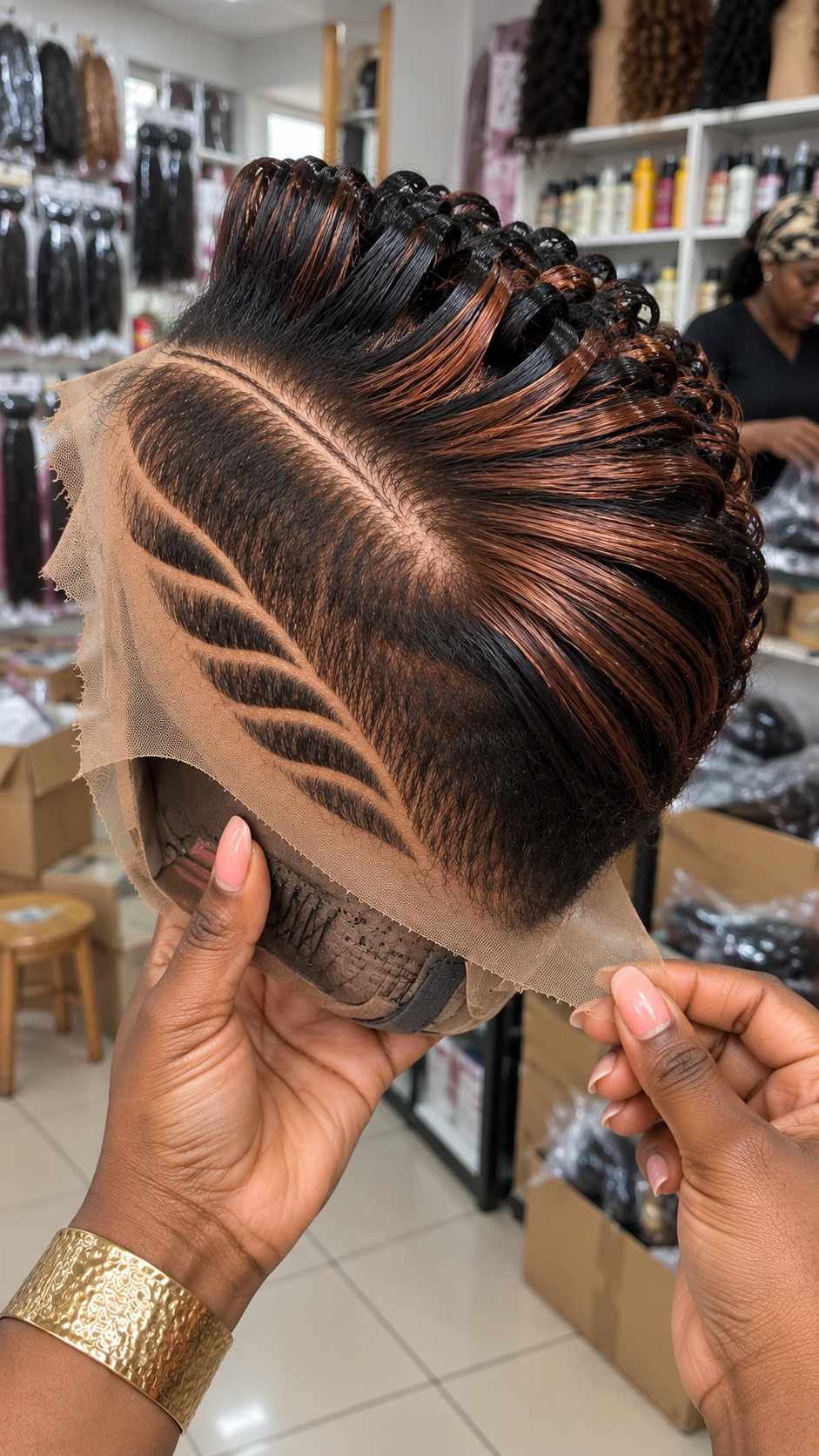
This black and copper pixie wig combines long sculpted sweep curls, a closely cropped side panel, three curved shaved-style lines and an extended lace perimeter. Unlike compact finger-coil pixies where the crown is covered with small circular curls, this design creates its character through elongated sections that sweep backward from the parting before transitioning into tighter curls toward the rear.
The color placement is equally important. A deep black base dominates the roots and cropped area, while warm copper strands run through selected upper sections. Because the copper is concentrated through the longer swept hair rather than evenly distributed throughout the unit, the contrast emphasizes the direction of every section.
Elongated Sweeps Give the Crown Its Distinct Shape
The upper hair is arranged into broad, separated sections that rise from the base and curve backward. Each section remains sleek near the roots before bending into a controlled loop or curl farther toward the crown.
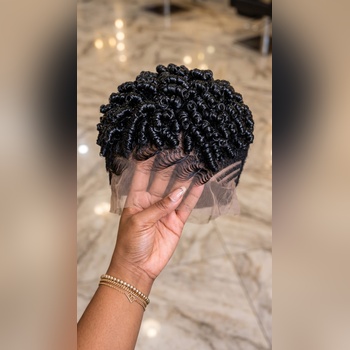
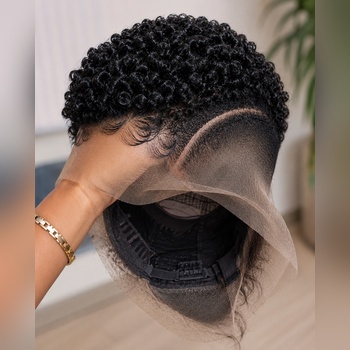
This creates considerably more directional movement than a traditional all-over curly pixie. The front and side portions appear almost sculpted into ribbons, while the rear contains tighter curled elements that complete the silhouette.
When requesting this look from a wig stylist, specify elongated backward sweep curls rather than small uniform coils across the entire crown. That distinction matters because using the wrong curl size would completely alter the profile of the wig.
Copper Highlights Follow the Direction of the Hair
The warm copper tone is not applied as a solid block of color. Instead, narrow copper sections appear alongside the black strands, particularly through the longer upper portions. This creates a striped dimensional effect without turning the wig into an evenly blended brown shade.
The darkest color remains concentrated around the roots, cropped side and underneath the upper styling. As the hair sweeps backward, the copper becomes more noticeable and catches the light across the curved surfaces.
For a custom order, photographs are more reliable than simply requesting “black and copper hair.” Ask for a black base with directional copper ribbon highlights through the swept crown so the placement remains connected to the hairstyle.
A Deep Diagonal Part Controls the Entire Layout
A clearly visible diagonal part separates the upper styling from the cropped side. The longer sections emerge alongside this part and travel backward, creating a strong visual boundary between the two areas.
The part should remain narrow enough to resemble a deliberate scalp line rather than a large exposed section. Its direction also needs to coordinate with the side pattern below it. Together, these details create the structured geometry visible in the design.
A wig maker recreating the unit should establish the parting before completing the final curl placement. Trying to add the part after the upper sections have already been formed can disturb their direction and spacing.
Three Curved Side Lines Add the Barber-Inspired Detail
The cropped panel contains three separate curved shaved-style lines. Rather than running perfectly parallel from beginning to end, the lines follow the rounded contour of the side and gradually change direction.
The upper line is positioned closest to the diagonal part, while two additional lines sit beneath it with visible spacing between them. Because the surrounding fibers are extremely low, every line remains easy to see.
This detail should be specified clearly when ordering. Asking only for “lines on the side” could result in straight parallel lines, a single hard part or another pattern. Reference the triple curved arrangement and its position underneath the longer swept section.
The Cropped Panel Needs Genuine Low Density
The side section has a distinctly different length from the upper hair. It resembles a very low tapered cut rather than longer strands that have simply been combed downward.
This contrast is essential. The dramatic upper sweeps would lose much of their impact if the side remained full. At the same time, the cropped fibers provide enough coverage to support the three-line pattern without exposing the underlying wig construction excessively.
For this reason, customization should ideally be handled by someone comfortable with both wig construction and precision clipper-style shaping.
Extended Lace Allows Final Hairline Customization
The unit is shown before final installation, with lace extending beyond the front and side perimeter. This gives the installer additional material to work with when positioning and trimming the wig.
The visible lace also makes it easier to examine where the styled hair begins. Buyers ordering a similar unit should ask whether the lace arrives uncut and whether hairline customization is already included.
Do not assume that an unfinished lace perimeter will look identical once installed. The final result depends on cap fit, lace placement, trimming and how naturally the perimeter is finished against the wearer’s skin.
Why the Side Area Requires Careful Lace Placement
The cropped design makes installation accuracy particularly important. Longer hairstyles can conceal small differences around the perimeter, but this unit deliberately exposes the temple and side area.
If the lace sits too far forward or backward, the relationship between the diagonal part, cropped panel and curved lines can appear misplaced. The cap therefore needs to fit securely before excess lace is removed.
For a first installation, having a professional wig stylist perform the fitting can reduce the risk of trimming too much lace around these exposed areas.
Gloss Is Essential for Showing the Copper Contrast
The hairstyle relies heavily on reflected light. The black sections have a deep polished appearance, while the copper strands become brighter as they bend through the longer sweeps.
For a similar photographic finish, aim for mirror-like glossy hair, a silky reflective surface, healthy wet-look shine without greasy buildup, individually visible strands and highly detailed curl separation.
The goal is not simply maximum shine. Individual fibers should remain visible throughout the copper and black sections. Excessive product can merge them into thick strips and reduce the dimensional effect.
How the Rear Curls Complete the Silhouette
The elongated front and side sweeps gradually transition into tighter curved sections toward the back. This prevents the hairstyle from looking unfinished when viewed from an angle.
Those rear curls also help connect the highlighted upper area with the darker base. Their placement should remain compact so the wig keeps its pixie proportions instead of developing a long or bulky back section.
When ordering remotely, request photographs from the front, side and rear three-quarter angle before approving the finished unit. This is especially helpful for confirming how smoothly the elongated sections transition into the back curls.
Finding a Stylist for This Type of Custom Work
A standard wig installation appointment may not include the cutting and sculpting necessary for this design. Search for a custom pixie wig maker, precision wig stylist, cropped wig specialist or stylist experienced with barber-inspired wig detailing.
Show the stylist the complete reference rather than describing individual elements separately. The diagonal part, swept crown, copper placement and triple side lines are designed to work together.
If buying a basic unit first, discuss its suitability with the stylist before ordering. The density and construction need to provide enough hair for the elongated upper sections while still allowing the side to be cut extremely low.
Ordering a Similar Black and Copper Unit
When contacting an online wig maker, begin with the cap size and desired hair material. Then specify the black base, copper highlighted sections, diagonal part, elongated crown sweeps and triple curved side pattern.
Ask whether the seller can provide progress photographs before shipment. Side photographs are particularly valuable because they reveal whether the cropped panel and three lines have been reproduced accurately.
Also confirm whether the lace will arrive uncut, whether the perimeter has been customized and whether the upper curls are permanently set or intended to be restyled after delivery.
Price Guide for a Sculpted Two-Tone Pixie
| Category | Typical Price Range | Possible Specification |
|---|---|---|
| Premium Custom | $480–$950+ | Premium human hair, customized lace, directional copper coloring, hand-sculpted crown and precision side work |
| Standard Custom | $270–$520 | Custom color placement, swept curls, cropped side panel and triple-line detailing |
| Basic Human Hair | $140–$320 | Human-hair pixie base suitable for professional cutting, coloring and restyling |
| Premium Synthetic | $85–$200 | Higher-grade fiber with pre-colored sections and stronger curl retention |
| Basic Synthetic | $40–$95 | Budget base with more limited options for heat reshaping and precision customization |
Prices can vary substantially according to hair material, lace construction, cap size, color work and the amount of hand styling required. A customized two-tone unit with precision side detailing will generally involve more labor than a basic pre-curled pixie.
Booking the Final Fitting
Tell the salon in advance that the wig includes an exposed cropped side and extended lace. This allows the stylist to reserve enough time for fitting, lace trimming and any final adjustments around the temple.
Bring or send reference photographs that clearly show the side pattern. If the copper sweeps have shifted during shipping, ask whether curl reshaping is included with the installation.
For online appointments, confirm measurements according to the wig maker’s own sizing instructions rather than relying only on a general small, medium or large cap designation.
Maintaining the Swept Sections After Styling
The upper sections should be handled individually rather than brushed through as one mass of hair. Gentle finger positioning can help preserve their separation and backward direction.
Store the unit on an appropriately sized wig stand so the crown is not compressed. The copper sections should remain aligned with the black strands to preserve the intentional highlighted pattern.
Pay particular attention to the cropped side. Repeated friction or aggressive combing can disturb the low fibers around the decorative lines and reduce their visibility.
Search Terms
Black Copper Swept Pixie · Triple Curved Side Lines · Diagonal Pixie Parting · Copper Ribbon Highlights · Cropped Side Wig Panel · Extended Lace Perimeter · Sculpted Backward Curls · Black Copper Lace Pixie