
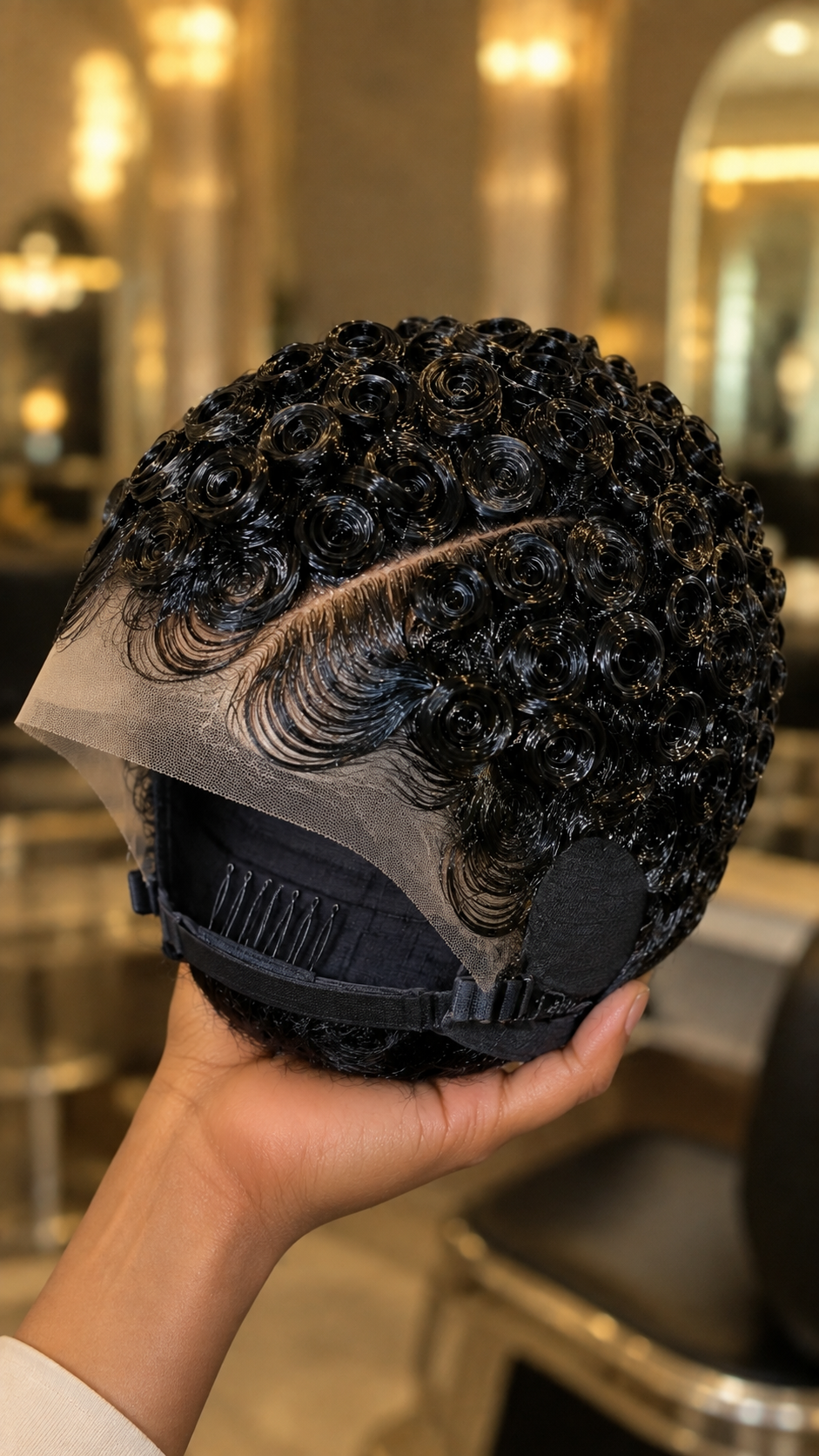
A wig can feel loose, so the obvious response is to pull the adjustable strap tighter. On a long wig, a little extra tension may be difficult to notice from the outside. On a short sculpted pixie like this one, the consequences can show almost immediately.
Look at the construction rather than only the glossy ringlets. The unit has a compact cap, an adjustable strap running across the back, an internal comb, exposed lace around the front and sides, and carefully molded waves sitting extremely close to that lace boundary. All of those components are connected.
When the strap is tightened, it does not create grip in isolation. It changes the tension running through the cap. Too much tension can pull the front lace backward, alter the position of the temple area, compress the nape and make sculpted edge work sit differently from the way it did when the wig was photographed.
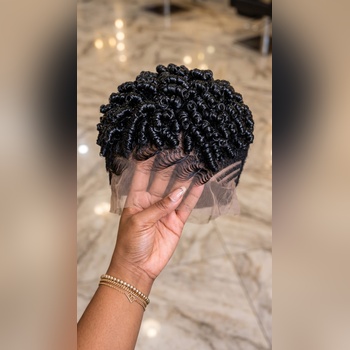
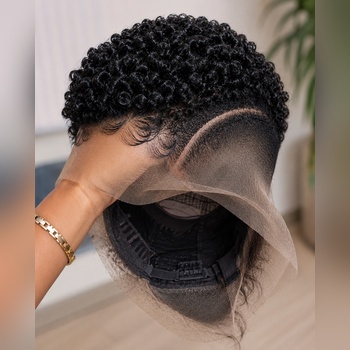
That makes strap tension a fitting decision, not simply a security setting.
Where To Buy A Sculpted Curly Pixie Wig
Custom wig makers.
A custom maker is one of the strongest options for a short unit with this much molded work. Ask whether the cap can be made to your actual circumference instead of relying on a standard cap plus an aggressively tightened strap.
Specialist pixie wig sellers.
Look for sellers whose catalog contains multiple genuinely short units. A seller accustomed to long lace wigs may not necessarily understand how visible cap tension becomes when there is no long hair covering the perimeter.
Local wig boutiques.
Trying the unit on before buying has a major advantage here. You can check whether the cap stays secure before touching the adjustment strap. If it already fits properly, the strap should only need minor adjustment.
Black-owned hair and beauty stores.
Stores serving customers who regularly wear lace units often carry short curly and finger-wave styles with more realistic cap construction than generic costume-style wigs.
Independent wig stylists.
A stylist can sometimes source the base unit and then create the compact ringlets and molded front work separately. This can be useful when you need a particular cap measurement.
Salon-made custom units.
If the hairstyle is the priority, take reference photographs showing the front, crown, sides and back. The inside of the wig matters too. Ask the stylist to show the cap before the final styling is completed.
Human-hair wig vendors.
Human hair is useful when you expect to wash and re-style the ringlets. However, confirm whether the molded waves can realistically be recreated after washing.
Premium synthetic wig sellers.
A good synthetic unit can make sense for a heavily set style because the fiber may hold compact curls longer. The trade-off is reduced freedom with heat and restyling.
Online wig marketplaces.
Do not judge a unit from one glamorous photograph. Ask for an inside-cap photo showing the strap, combs, seams and lace.
Social-media wig businesses.
Request an unedited handheld video. Ask the seller to rotate the wig slowly and show the underside. This is especially useful for seeing whether the cap has been built cleanly or whether the photograph is hiding bulky seams.
Made-to-measure wig services.
For a style this short, paying for correct measurements can be more valuable than paying for additional density. A properly sized cap needs less corrective tension from the strap.
How Much It Costs
Prices vary heavily according to hair type, lace, hand work, location and whether the unit is made from scratch.
Basic synthetic units.
These are usually the lowest-cost option. They can reproduce the general compact-curly silhouette, although the lace, cap and molded side details may be simpler.
Premium synthetic units.
Higher-quality fiber can produce cleaner shine and more consistent ringlets. For a style that depends on a fixed set, premium synthetic hair can be surprisingly practical.
Basic human-hair units.
The price rises because the hair can be washed, conditioned and restyled. Check whether the quoted price includes the finished curl set or only the base wig.
Standard custom human-hair units.
Expect additional cost when the maker has to shape the crown, mold the front waves and construct a close-fitting short perimeter.
Premium custom units.
Fine lace, individually ventilated areas, bleached knots, custom measurements and extensive hand styling can push the price considerably higher.
HD lace upgrades.
HD lace can help around an exposed hairline, but thin lace is not a substitute for correct fit. Stretching fine lace aggressively with an overtightened strap can defeat the reason you paid for it.
Custom cap sizing.
This may add to the initial price, but it can solve a problem that straps cannot. A strap adjusts tension; it cannot transform a fundamentally oversized or incorrectly shaped cap into a truly custom fit.
Restyling costs.
The compact ringlets and molded waves are part of the value of this unit. Ask what a professional refresh would cost after washing before deciding whether the purchase fits your long-term budget.
Shipping, Delivery, And What To Expect After Ordering
A sculpted pixie should be packed so the crown is not crushed. Compact ringlets can arrive flattened if the wig is squeezed into a small shipping bag for too long.
When the package arrives, resist the temptation to tighten everything immediately.
First place the wig on your head with the strap at a neutral or relatively loose setting. Position the front lace where it naturally belongs. Then evaluate the cap around the crown, ears and nape.
Only after the wig is positioned should you adjust the strap gradually.
This sequence matters because tightening the strap first and then dragging the wig into position can put unnecessary tension across the lace.
If the seller accepts returns, read the conditions before trimming lace, removing tags or altering the straps. Once lace has been cut, many sellers treat the unit as used or customized.
The Strap Changes More Than Tightness
The adjustable strap visible inside this unit is designed to fine-tune the fit.
The important word is fine-tune.
It should not have to compensate for a cap that is dramatically too large.
Imagine the cap as a flexible structure surrounding the head. Pulling the rear adjustment points toward one another increases tension through that structure. Depending on the cap design, some of that tension can travel toward the sides and frontal.
On a simple long wig, minor movement may disappear beneath the hair.
Here it cannot.
The molded waves sit directly beside exposed lace. The ringlets are short. The perimeter is visible. There is almost no spare length available to disguise distortion.
If tightening the strap causes the lace to wrinkle, lift, pull backward or change the direction of the molded waves, you have gone beyond useful adjustment.
More Tension Does Not Automatically Mean More Security
This is one of the easiest mistakes to make with a glueless wig.
The wig moves, so you tighten the strap.
It still feels uncertain, so you tighten it again.
Eventually the cap feels firmly attached, but the pressure is being created in the wrong way.
Real security comes from several components working together: correct cap circumference, appropriate cap shape, sensible strap tension and properly positioned internal grip.
The comb visible inside this unit is part of that system.
A comb provides localized grip. The strap provides adjustable rear tension. The cap provides the overall fit.
One component should not be forced to perform the entire job.
If the cap is significantly too large, maximum strap tension can bunch material at the back while simultaneously pulling the frontal backward. The wig may technically feel tighter while actually fitting worse.
Watch The Sculpted Waves While Adjusting
This particular hairstyle gives you a useful visual indicator.
Look at the molded waves around the front and side.
Before tightening the strap, note how those curves sit. Then tighten one adjustment level and look again.
They should remain in approximately the same position and retain the same shape.
If a wave that originally flowed naturally toward the temple suddenly looks stretched backward, tension is influencing the styling.
The same test applies to the hairline.
A correctly adjusted cap should become more secure without visibly redesigning the front of the wig.
That distinction is especially important with highly sculpted pixies because their edge work is intentional. You paid for those curves. The fitting system should support them rather than pull them out of position.
Check The Lace For Wrinkles
Fine lace usually looks most convincing when it lies flat with minimal mechanical stress.
Excessive strap tension can create two opposite problems.
In one area the lace may become overly stretched. Somewhere else it may buckle or wrinkle because the cap is being pulled unevenly.
Neither is ideal.
Before trimming the lace, put the wig on and experiment with the strap settings. Examine the frontal straight on and from both sides.
Do not only ask whether it feels secure.
Ask whether the lace is still lying naturally.
A slightly looser setting that produces flat lace can give a more convincing result than maximum tension that creates ripples around the perimeter.
Cap Size Comes Before Strap Adjustment
Measure your head before ordering.
Use a flexible measuring tape and follow the seller’s measurement instructions. Circumference is important, but custom makers may also ask for front-to-nape, ear-to-ear and temple measurements.
That matters because two people can have similar circumferences and still have differently shaped heads.
If the base cap matches your head reasonably well, the adjustable strap becomes what it was intended to be: a small adjustment system.
If the cap is much too large, the strap becomes a rescue mechanism.
Those are not the same thing.
When shopping online, ask for the unstretched cap circumference and the recommended head-size range rather than accepting labels such as “average size” without measurements.
Why Short Pixie Wigs Expose Fit Problems Faster
Length hides construction.
A long bob can cover the ears, sides and nape. A shoulder-length wig can conceal a surprising amount of cap behavior beneath the hair.
A pixie cannot.
Every millimeter around the perimeter contributes to the finished silhouette.
That is why a short unit can look spectacular in a product photograph and disappointing after installation even when the hair itself is identical.
The problem may not be the curls.
It may be how the cap is sitting underneath them.
This also explains why copying the exact strap setting used by somebody else makes little sense. The correct setting depends on the wearer’s head measurement and the particular cap.
Glueless Should Still Feel Comfortable
A secure glueless wig should not require pain.
If the strap leaves strong pressure around the back of your head, causes a headache, or makes you want to remove the wig after a short period, reconsider the fit rather than assuming discomfort is the price of security.
The cap should sit close to the head without feeling as though it is being mechanically squeezed into place.
This becomes even more important for all-day wear.
A wig that looks perfect for ten minutes in front of a mirror but becomes uncomfortable after several hours is not functioning well as an everyday unit.
Before You Pay
- Can you tell me the actual cap circumference rather than only saying small, medium or average?
- Can you show me the inside of the wig with the adjustable strap completely visible?
- Does the wig remain secure when the strap is only moderately tightened?
- Can you show the frontal and temple area while the wig is being worn rather than only on a mannequin?
- Are the comb, strap and lace included exactly as shown in the product photographs?
Trimming The Lace
Fit the wig before cutting anything.
Start with the strap relatively loose, position the wig correctly, and then increase tension gradually until the cap feels stable.
Check the front and both temples after every adjustment.
Once you have found the setting that secures the unit without pulling the hairline backward or wrinkling the lace, you can judge where the lace actually needs to be trimmed.
Use small cuts rather than cutting one perfectly straight line across the frontal. Leave yourself a little room on the first pass.
With sculpted waves this close to the lace boundary, rushing is particularly risky. Cutting into ventilated hairs can permanently change the edge design.
And remember that trimming lace cannot correct a badly fitting cap. If the lace only lies flat when the strap is painfully tight, investigate the cap size before removing more material.
Search Terms
black ringlet pixie wig adjustable strap · sculpted wave lace pixie wig · glueless short curly wig with comb · black finger wave curly pixie wig · adjustable strap lace front pixie · glossy ringlet pixie wig human hair · short sculpted curl glueless wig · black curly pixie wig cap construction
Final Thoughts
The adjustable strap inside a wig looks like a minor hardware detail, but on a short sculpted unit it can influence what happens all the way around the perimeter. The goal is not to tighten the strap as far as possible. The goal is to use only enough tension to stabilize a cap that already fits reasonably well.
With this kind of glossy ringlet pixie, watch the lace and molded waves while you adjust it. If the wig becomes more secure while the hairline stays flat and the sculpted curves remain where they were designed to sit, the system is doing its job. If tightening starts changing the front of the wig, the strap is no longer solving the fit — it is reshaping it.