
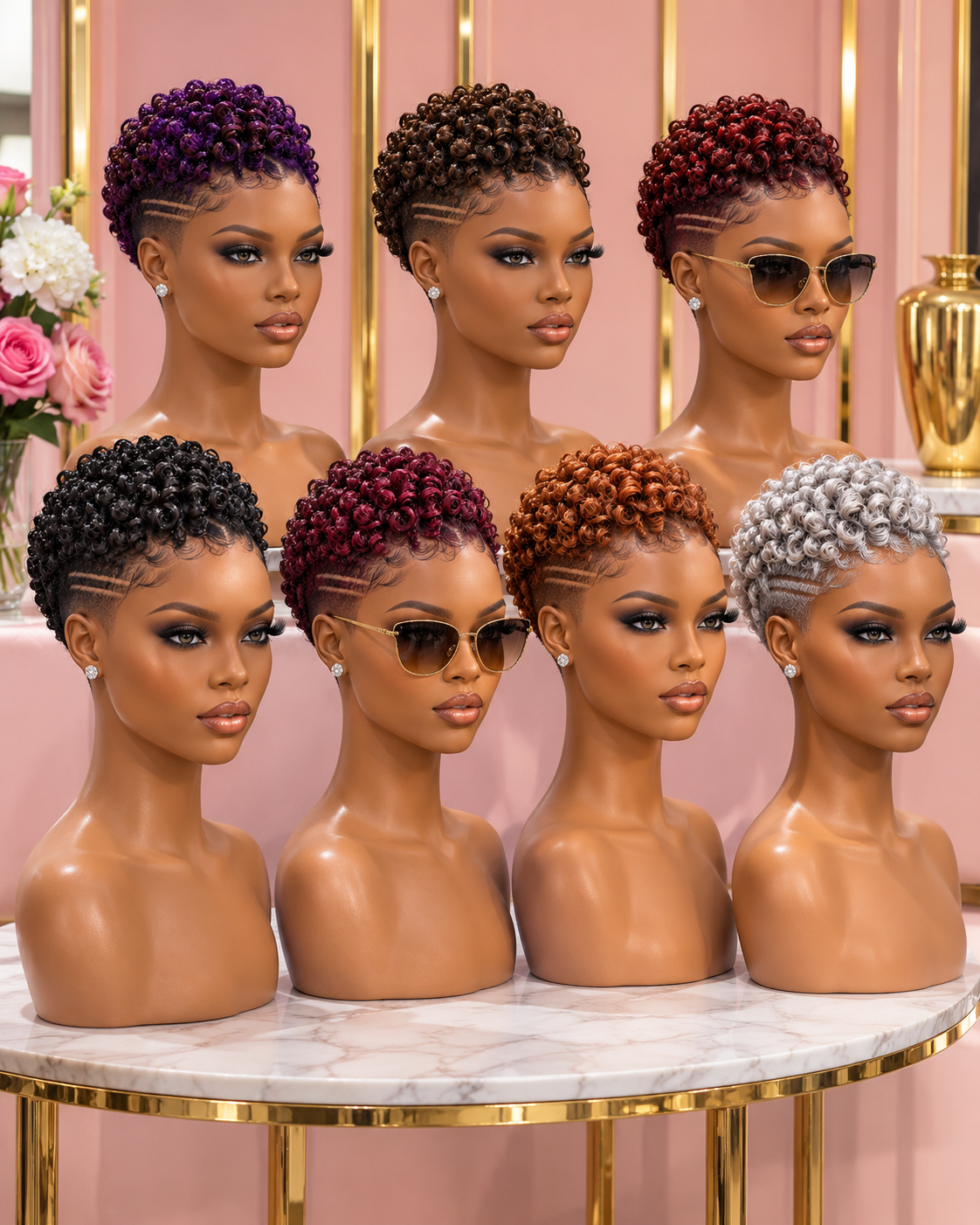
These curly pixie wigs with double side lines offer a useful reference for anyone who likes a short haircut with visible detail. Their appeal depends on proportion: enough curl height to create a rounded crown, close sides that follow the head, and parallel lines placed where they remain clearly visible. Choosing a similar wig involves more than finding the right shade. The fit, construction, finishing service, and care routine all influence how successfully the hairstyle translates from a display head to everyday wear.
A Fuller Crown Above Closely Cropped Temples
The most noticeable contrast is between the curled upper section and the close temple area. Small ringlets cover the crown and continue toward the front, creating a rounded outline. Below them, the hair becomes much shorter around the visible side. This gives the curls room to stand out without making the entire wig appear equally wide. When discussing the reference with a maker, describe that relationship. Asking simply for a full curly wig could produce a very different silhouette.


The curls themselves are compact spirals with recognizable centers. They are smaller and more upright than broad rolled waves, and they create detail through repetition rather than a few oversized sections. A seller might describe similar work as finger coils, small ringlets, or a curly tapered pixie. Those names are useful for searching, but the photographs should determine whether a product matches your preference. Loose curls or a brushed-out top will not create the same closely arranged appearance.
The lower sections also need attention during a consultation. A well-shaped crown should connect naturally with the back and nape rather than sitting above an unfinished lower edge. This photograph emphasizes front and three-quarter views, so request additional angles before purchasing. Ask how closely the back will follow the head and whether its finish matches the short sides. A cropped hairstyle should remain balanced when the wearer turns around, not only when photographed from its strongest angle.
Double Lines That Sit in the Right Place
Two pale-looking parallel lines cross the visible temple section on each display. They sit beneath the curls and above the ear, creating a small graphic detail within the close cut. Their narrow spacing makes them read as a pair. Reproducing that effect requires attention to both placement and width. If one line is much wider than the other, or the gap changes dramatically, the side will have a different character even when the upper curls look similar.
Because these are displayed wigs, the photograph does not establish a particular cutting technique or prove that the lines are shaved into natural hair. Ask the maker how the effect is achieved within the proposed unit. You should know whether the detail is supported by the construction, created during styling, or maintained through a combination of both. That information matters when the wig is cleaned or taken to another stylist for later adjustments.
Placement should be checked against the wearer’s own head. The pattern needs to remain visible without landing awkwardly near the ear or being hidden by the upper curls. A correctly sized cap makes that easier. Ask for a fitting before the final finish whenever possible, and bring your usual glasses. Their arms may sit near the same area. Comfort and a clear view of the lines should be considered together rather than addressed after customization is complete.
Black and Brown for an Everyday Starting Point
The black wig at the lower left gives a clear view of the haircut without a bright shade becoming the main attraction. Its glossy curls contrast with the shorter temple area, making the two lines easy to distinguish. Black can be a useful starting point if you want to focus on shape, fit, and maintenance before exploring another color. Request daylight footage so you can assess the curls and coverage without depending entirely on strong reflections.
The brown wig in the upper middle offers a warmer dark alternative. Its curls show brown highlights where the light catches their edges, while the closely cropped side remains visually deeper. If this shade appeals to you, ask for the supplier’s actual color reference. Chocolate, coffee, and chestnut can describe different results. Also confirm whether the color is consistent throughout or includes lighter strands. A specific sample gives a clearer agreement than a broad color name.
For either shade, inspect the spaces between curls and the transition into the shorter side. Strong shine does not establish material quality, and dark hair should still reveal its structure under ordinary lighting. Ask to see the unit rotated slowly rather than relying on one still photograph. The maker should be able to show that the crown remains proportionate, the side detail stays readable, and the lower sections provide the coverage promised in the description.
Red, Burgundy, and Copper Bring Different Warmth
The red version at the upper right has a rich reddish appearance with darker spaces between the curls. It is visually distinct from the deeper burgundy wig below it. If you want the red version, identify it clearly instead of asking for a general wine or red shade. The supplier should explain whether their proposed color leans toward bright red, reddish brown, or a darker cherry tone. Those differences become especially noticeable in daylight.
Burgundy, positioned in the front row, has a deeper wine-colored finish. It offers a visible change while retaining a dark overall impression. The small curls allow brighter reflections to appear across the crown without making every section look equally light. Ask whether the seller can show their burgundy beside their red under the same lighting. Side-by-side comparisons are more useful than separate promotional photographs with different backgrounds and exposure.
Copper creates a warmer orange-brown version of the cut. Its lighter appearance emphasizes the individual ringlets and makes the short front curves easier to follow. Specify whether you prefer a copper that is more brown, more orange, or more red. Do not assume that every product carrying the same shade name will look alike. For custom work, agree on the root color and how the chosen shade continues through the cropped sides and back.
Silver and Purple Change the Mood of the Cut
The silver wig at the lower right introduces a pale contrast against the mannequin while keeping the small curls visible through their shadows. Its close side appears gray, allowing the two lighter lines to remain part of the design. If you choose a similar option, ask whether the supplier’s shade is silver, white, platinum, or a blend. The photograph shows a cool pale appearance, but it cannot establish an exact color code or formula.
The purple wig at the upper left offers a more saturated alternative. The color appears deeper in the shorter side and brighter across the raised curls. Someone ordering this version should specify the depth they want. A dark purple and a bright violet can create very different results. Ask for daylight video of the actual unit or an approved sample. The goal is to agree on a wearable shade, not simply select a color word from a list.
When choosing between these more noticeable colors, imagine the wig on its own with your usual clothes and accessories. The complete display is appealing partly because several shades appear together, but your purchase needs to work independently. Consider how often you expect to wear it and whether you want color to be the first thing people notice. You can appreciate the full range while choosing one version that suits your own routine.
How To Order This Style
Start with wig makers and boutiques whose portfolios include tapered curly pixies, small coil sets, and close side detailing. Search phrases such as “curly pixie wig with side lines,” “short coil wig with cropped sides,” and “tapered ringlet pixie wig” can help identify suitable examples. Inspect the actual work behind the listing. A product name may sound relevant while its photographs show larger curls, longer sides, or a completely different crown shape.
A useful inquiry should identify the features you want preserved. Send the reference and specify the selected color, small crown curls, close temple areas, double parallel lines, and fine front waves. Ask whether the supplier has a finished unit available or needs to create one. Request the verified fiber, cap measurements, construction, styling inclusions, and complete cost. Also ask how the unseen side and back will be finished so the order covers the whole hairstyle.
For a ready-made purchase, request a rotating video of the exact wig that will be supplied. For custom work, ask for examples of comparable completed units and agree on any review photographs before dispatch. A maker who understands the style should be able to discuss crown height, line placement, and the transition into the nape. Specific answers are more useful than a general promise that the result will look exactly like the image.
Read return and alteration terms before paying, particularly if the unit will be individually colored or cut. Confirm the expected completion window and whether fitting is included. Keep the reference and written specification together with the seller’s answers. If an adjustment becomes necessary, those records help you identify the actual issue, such as lines placed too low or a crown that is fuller than agreed, rather than relying on a vague comparison.
Cap Choices for a Close-Fitting Pixie
The display shows the outside of the wigs, so it cannot verify their interior construction. Ask for an inside-cap photograph and a written explanation of the lace and wefted areas. A closure-based unit may provide a limited front or parting area, while a frontal offers a broader section for customization. The right choice depends on how the hairline and side detail are created. Ask the supplier to explain why their proposed construction suits this particular haircut.
If you want flexibility in the front, establish what can actually change. Some units are designed around a fixed arrangement, while others provide more room for adjusting placement. Even where lace offers options, moving the hair can still require restyling. Do not assume that every short wig can be rearranged freely. A consistent preset look may suit you perfectly, provided its limitations are understood before purchase and its final layout matches your preferences.
For regular removal, ask whether an appropriate glueless option is available and how the cap stays secure. That cannot be verified from these mannequin photographs. If you prefer an installed finish, discuss the method with a wig stylist and follow the relevant product instructions. Either approach should include handling and removal guidance. The securing method should keep the temple detail consistently positioned without requiring uncomfortable tightness or repeated adjustment during the day.
Length and Density Should Serve the Outline
The curls create fullness through their shape, so the highest density is not automatically necessary. Too much hair can widen the crown, hide the short sides, or reduce the visibility of the lines. Ask the maker how they will provide coverage while keeping the outline compact. Use photographs of the finished set as your main comparison. Density percentages alone do not describe curl spacing, hair thickness, cap shape, or the amount of styling used.
Length measurements also need clarification. A listed figure may refer to stretched strands or the base before cutting rather than the height of the completed curls. Explain that your priority is the cropped silhouette shown here. If you are buying a base for a local stylist to finish, consult them first. They can assess whether it has enough length and the right construction for the crown while allowing the lower sections to be shaped appropriately.
A Five-Tier Price Plan
The table below uses illustrative budget bands in US dollars. These are planning examples, not verified prices for the pictured wigs or a current market price list. Actual quotations depend on documented materials, construction, color, cutting, setting, and included appointments. They may fall outside these bands. Compare complete offers and demonstrated workmanship before deciding what represents value, especially when a purchase combines the base wig with several salon services.
| Price Tier | Illustrative Budget | Purchase Route | What to Confirm |
|---|---|---|---|
| Budget Base | Under $75 | A stock cropped unit or basic base for additional preparation | Whether the small curls, close sides, and double lines are included |
| Ready-Styled Stock | $75–$150 | A preset style in a standard color and cap size | The exact unit, verified material, measurements, and care directions |
| Salon-Customized Option | $150–$300 | A suitable base combined with cutting, setting, or fitting | Which shaping and front preparation tasks are covered by the price |
| Individual Custom Order | $300–$500 | A project with agreed color, fit, crown height, and line placement | The construction, review process, completion terms, and alterations |
| Premium Bespoke Package | Above $500 | An individually specified unit or package with additional services | The materials, workmanship, fitting, and aftercare supporting the total |
Compare the amount required to reach the same wearable result. One supplier may include the cut, set, and fitting, while another quotes only for an unfinished base. Delivery, taxes, lace customization, installation, and future resetting may be separate. Request a written breakdown if several services are involved. If you need to simplify the order, prioritize cap fit and accurate shaping before optional extras. Packaging does not correct an oversized crown or poorly positioned side detail.
Allow for maintenance if you expect a professional to restore the curls after cleaning. Ask whether the original maker offers that service and whether a local stylist can work with the verified material. You do not need an arbitrary appointment schedule before trying the unit, but you should understand the likely process. A detailed short style becomes easier to own when its upkeep fits your budget and suitable help is available when needed.
Book a Stylist Who Can Shape the Sides
Look for a wig stylist whose portfolio includes short coil sets, tapered cuts, or detailed cropped sides. Send the reference before booking and explain whether you need a complete unit, fitting, installation, or restyling. If you already own the base, provide its material information and current photographs. The stylist needs enough detail to assess feasibility and reserve appropriate time. A general curl appointment may not cover the shaping required around the temples and nape.
During consultation, establish the overall outline before refining the lines. Agree on crown height, side closeness, and the back finish, then check where the parallel detail should sit. Ask whether you can review the fit before the final set is completed. Bring your usual glasses and earrings if they affect the area around the ears. A practical fitting should reflect how you intend to wear the wig, not only how it looks on a salon stand.
Measure using the supplier’s instructions and fit the unit over your regular hair preparation. Uneven hair beneath the cap can alter the apparent crown height or push the short sides outward. Check the front, both temples, ear-area edges, and nape together. Turn your head and look down to assess stability. If excess lace is present, settle the position before trimming. A cap should feel secure and comfortable, rather than simply tight.
Keep the Curls Rounded Between Wears
Begin with the supplier’s written directions for the actual material. The photograph cannot establish human hair, synthetic fiber, or a blend. Ask whether the curls are an underlying pattern, a temporary salon set, or a combination of both. Find out how the double side detail is maintained after cleaning. These answers determine the care routine more reliably than the hairstyle’s appearance or a general claim that the wig is easy to manage.
Before each wear, inspect the crown for compressed curls and check that the front remains arranged. After wearing, look for residue or displaced sections before storage. Cleaning frequency should follow the product directions and condition of the unit, considering wear and product use. Ask what it is expected to look like after washing and whether a reset is needed. Plan that step before an occasion when you want the complete finish ready.
Avoid brushing through the entire crown as one mass. That can separate the small curls and change the outline. Support the cap when lifting the wig, and ask the stylist to demonstrate an appropriate correction for one displaced section. Use finishing products only as directed for the verified material. If heat is permitted, follow the specific instructions supplied. The glossy finish in the photograph is not a reason to add more oil or spray before every wear.
Store the unit on a suitable support with space around the crown. Avoid stretching the cap over an oversized form or pressing the curls against nearby objects. For travel, protect the top from compression and keep the front from folding beneath other items. Follow drying directions fully before enclosed storage. Once the fitting and set are right, take front, side, and back photographs as a reference for future maintenance.
The Appeal and the Commitment
The main benefits are a compact length, an open neckline, and a hairstyle with clear character from several angles. Small curls give the crown dimension, while the close temples and paired lines prevent the cut from looking uniformly rounded. Color offers another way to personalize the result without adding length. The commitment lies in maintaining those proportions. Compression, unsuitable brushing, or a shifted cap can affect both the curls and the visibility of the side design.
Before accepting a finished purchase, inspect the shade, curl size, crown height, side lines, and cap fit in ordinary light. Request views of the back and opposite side if they have not already been supplied. For delivered units, complete the inspection before alterations that may affect return terms. A successful version will preserve the balance that makes this collection appealing: a lively curled crown above close temples, with two precise lines adding a distinctive finishing detail.
Search Terms
curly pixie wigs · double side line wig · short finger coil wig · tapered curls with temple lines · burgundy curly pixie · copper cropped curls · silver short curl wig · black pixie with close sides