
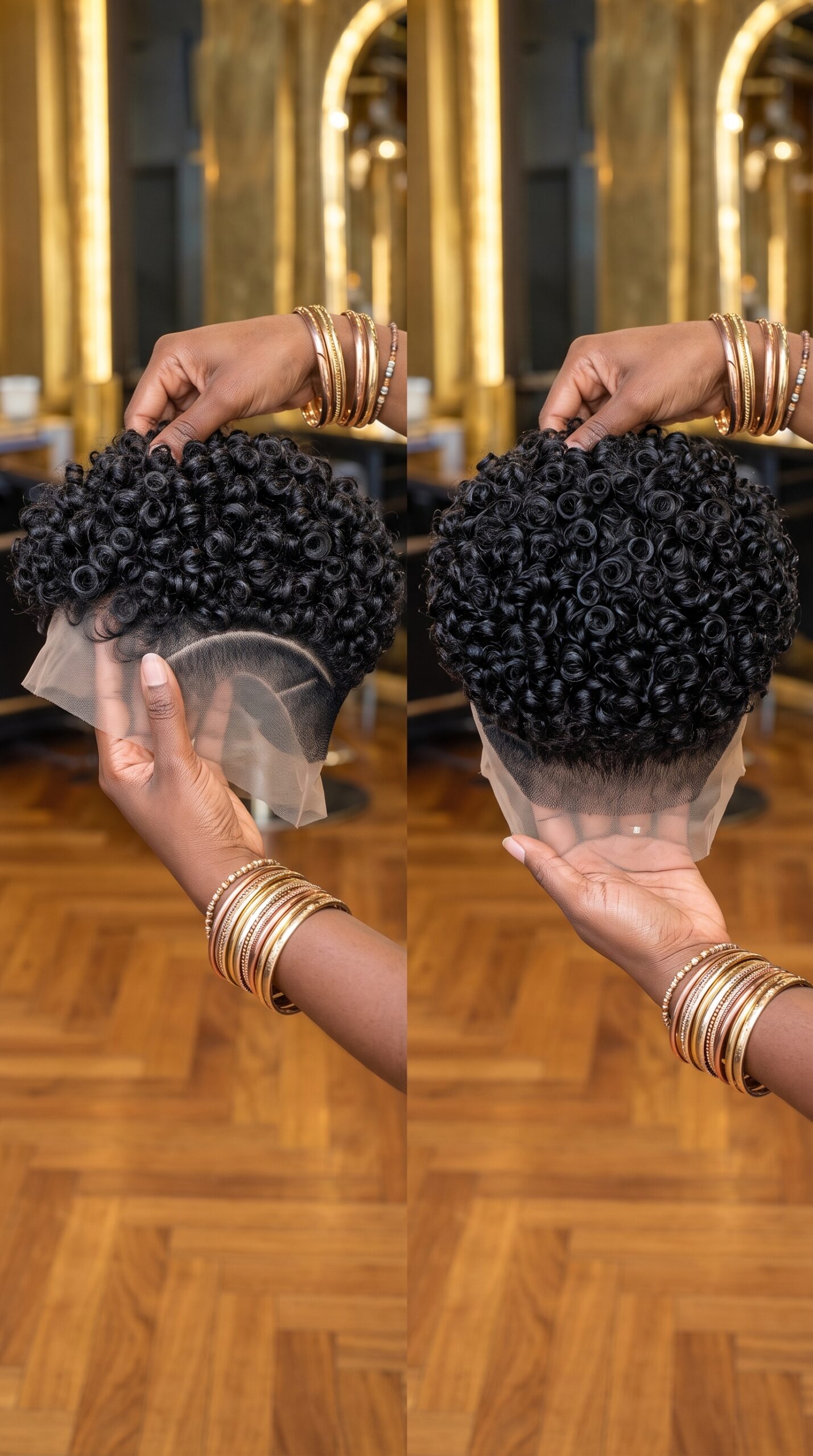
A short curly pixie can look beautifully tapered from the side and still fail when you turn it around. That is because the fade is not one small decorative panel beside the temple. It has to travel around the head and eventually meet the nape.
This black ringlet pixie gives a useful two-view comparison. One image exposes the faded side and carved detail, while the second reveals the full back of the crown and lower perimeter. Together they show something buyers rarely inspect carefully: whether the side taper continues naturally into the rear or whether the haircut seems to restart when it reaches the back.
On a convincing short wig, the fade should feel continuous. Density, height, and length can change as the perimeter travels around the head, but those changes should look planned.
Where To Buy A Curly Pixie Wig With A Good Wraparound Fade
Custom wig makers. Send both a side and back reference. If you provide only the decorative side, the maker still has to guess how that taper should travel toward the nape.
Instagram and TikTok sellers. Ask for one continuous rotation from the side to the back. That is more useful than separate polished photographs because you can actually watch the transition happen.
Etsy. Independent makers may offer more control over fade height, nape length, crown density, and perimeter shape. Ask specifically whether the rear taper is customized along with the side.
Marketplaces like Amazon, AliExpress, and Temu. Product images often concentrate on the side design. Search customer reviews for rear views because inexpensive units may look tapered beside the temple but become much heavier around the back.
Local beauty supply shops and salons. Place the wig on a mannequin head and slowly rotate it. Do not inspect the side and back as two independent pictures. Follow the same lower boundary around the entire unit.
Vendors and wholesalers direct. Ask for current-stock side, rear three-quarter, and direct-back images. If you buy multiples, make wraparound taper consistency part of the approved sample specification.
Regionally. Wig makers in Lagos, Accra, Atlanta, London, and major South African hair markets may use terms such as tapered, faded, undercut, barbered, or low-cut pixie differently. A rotation video communicates the desired perimeter more accurately than terminology alone.
Vet the seller. Favor sellers who willingly show where the crown ends and the lower taper begins at the back. The rear should not be treated like a hidden area.
Red flags. Be cautious if the fade looks very high at the temple but suddenly drops into a thick dark block behind the ear, if the nape becomes unexpectedly long, or if the seller never shows the rear three-quarter angle.
When you order, send. Provide your cap size, side-fade reference, rear reference, preferred nape height, crown curl length, and whether you want the taper to stay high or gradually descend toward the back.
Contact / order inquiries: WhatsApp [WhatsApp: +XX XXX XXX XX XX]
How Much It Costs
Premium custom human hair. A carefully constructed short human-hair curly pixie with refined lace, a balanced crown, and a detailed wraparound taper can commonly range around $240–$460 depending on hair quality, ventilation, cap construction, and finishing labour.
Standard custom human hair. Around $180–$320 can cover many strong short units. At this level, pay close attention to whether the seller spends the same amount of effort on the rear as on the camera-facing side.
Basic human hair. Around $150–$240 may buy a simpler version with more generic rear tapering or less control over the side-to-back transition.
Good synthetic. Around $60–$150 can provide a convincing short silhouette if the cap and fibre are preset carefully. Synthetic production can also reproduce the same perimeter consistently across several units.
Basic synthetic. Around $25–$70 is common for budget pieces. Look closely for a back section that is simply cut short at one length rather than gradually tapered.
What the price may exclude. Custom sizing, lace tinting, knot work, carved details, rear taper correction, and professional fitting may all cost extra.
Shipping and duty. International delivery, customs charges, and local taxes can increase the final cost substantially. Compare the complete landed price rather than only the listing amount.
Ongoing costs. Human-hair crowns may need curl refreshing while the lower taper may need occasional reshaping so longer crown strands do not begin hanging over the short rear section.
First-year total. Include curl products, lace care, possible perimeter corrections, and professional restyling if the rear transition becomes less organized after repeated washing.
Cost per wear. A unit that looks convincing from the back usually gives better value than one you constantly adjust because the rear feels bulky or unfinished.
What a very low price may signal. It can indicate that styling labour was concentrated on the front and side while the back received a faster, more generic finish.
Deposit structure. Custom makers commonly request around 30–50% upfront and the remainder before shipping. Request your side-to-back rotation video before paying the final balance when possible.
Shipping, Delivery, And What To Expect After Ordering
Inspect the wig before cutting the lace. Start from the side, identify the fade boundary, and slowly rotate the unit toward the rear.
Watch where the short section rises or falls. A small gradual change is normal because the shape of the head changes. What you do not want is an abrupt jump in length or density.
Then inspect the nape directly. It should feel like the final stage of the same taper rather than a separate patch added underneath the crown.
The Fade Is A Route Around The Head
It is easy to think of a fade as a side detail because that is where sellers usually photograph it.
In reality, the short section occupies a three-dimensional perimeter. It begins around the temple, continues behind the ear, moves across the lower rear, and eventually reaches the nape.
Every point along that route affects the silhouette.
A good pixie therefore needs a fade plan, not merely a beautiful side panel.
The Side Can Be Higher Than The Back
A wraparound taper does not need to remain at one perfectly level height.
In many short haircuts, the fade sits higher near the temple and gradually drops as it approaches the nape.
That descent can make the silhouette feel more natural because the crown itself becomes deeper toward the rear.
The important word is gradually.
If the height falls suddenly behind the ear, the wig can look as though two different cutting templates were joined together.
The Rear Needs More Coverage Than The Temple
The side of the head can tolerate a very exposed fade because that area is naturally narrow and highly visible.
The back covers a larger curved surface.
If the rear is made equally sparse without enough crown coverage above it, the cap or lace can become easier to see.
That means the taper may need slightly more visual density as it moves backward while still remaining short.
Consistency does not mean identical density everywhere. It means controlled adjustment.
Behind The Ear Is The Most Important Transition Point
The area immediately behind the ear is where many short wig constructions begin revealing their compromises.
The front-facing side has usually received careful fading because it appears in photographs. The rear has enough hair to hide some imperfections.
The narrow zone between them has nowhere to hide.
If the side fade and back taper were built independently, you may see a sudden dark patch, a hard length jump, or an awkward ridge there.
Ask for a rear three-quarter photograph specifically to inspect this zone.
The Crown Should Not Hang Over The Fade Like A Shelf
Another common problem occurs at the upper boundary of the taper.
If the ringlet crown remains too long immediately above a very short lower section, the curls can form a heavy ledge.
From the side, that may look dramatic and intentional. From the back, it can resemble a bowl sitting on top of the fade.
The strongest units gradually shorten the lower crown curls as they approach the taper.
This creates a softer structural connection without erasing the contrast between full curls and short hair.
Curl Density Can Hide A Bad Rear Taper
Dense ringlets make the crown visually powerful.
That can distract buyers from looking lower down.
A seller may show a spectacular back view filled with glossy curls while the actual fade underneath receives very little attention.
Train your eye to separate the two zones.
First inspect the crown. Then ignore the curls and look only at the lower inch or two of the rear.
That lower zone tells you whether the haircut was actually completed.
The Nape Should Be The Final Step Of The Gradient
The nape is not an unrelated finishing edge.
On a tapered pixie, it should feel like the last stage of the fade.
Hair generally becomes shorter, flatter, and closer to the neck as it descends.
If the nape suddenly becomes longer than the section directly above it, the taper direction reverses and the haircut can look strange.
Likewise, if it is cut into an extremely hard block while everything above is soft, the lower perimeter may feel disconnected.
Side Carving Makes Wraparound Quality Easier To Judge
The side view in this image contains a carved graphic line inside the fade.
That design attracts attention to the side, but it also gives you a useful landmark.
Once the carved zone ends, follow the surrounding short hair toward the rear.
Does the fade continue with the same visual quality?
Or does the workmanship suddenly become much simpler once the decorative line is no longer visible?
A strong wig should not spend all its craftsmanship on the decorated side.
The Back Should Not Look Like A Different Haircut
When viewed directly from behind, you should still recognize the same pixie.
The crown may appear rounder and the side design may disappear from view, but the relationship between full curls and short perimeter should remain consistent.
If the side suggests a high undercut while the back resembles a full curly bob, something has gone wrong in the wraparound design.
Different angles should reveal different aspects of the same haircut, not different haircuts.
A True Fade Has More Than Two Lengths
A very cheap imitation taper may use one long crown length and one short side length.
That gives you contrast, but not much gradient.
A convincing wraparound fade contains intermediate lengths.
Those transitional hairs are what soften the boundary between the crown and the shortest perimeter.
From a distance, you may not consciously see every stage, but your eye notices whether the shift feels gradual or abrupt.
Rear Lighting Can Hide Or Reveal The Gradient
Black hair is especially difficult to judge in dark lighting.
The shortest rear hairs can visually merge into the cap, while dense curls above form one dark mass.
A seller can therefore make a rough taper look smoother simply by photographing it in shadow.
Ask for neutral or bright indoor light.
You want to see enough reflection on the short hairs to understand where one length changes into another.
Do Not Judge The Rear Only From Above
A high camera angle is flattering for curls because it fills the image with the crown.
It is less useful for evaluating the perimeter.
The camera should come down closer to head level for at least one rear photograph.
That angle shows how low the crown sits, how the taper wraps around the back, and how the nape actually finishes against the neck.
Without that view, you still have incomplete information.
Cap Position Can Fake An Uneven Fade
Before assuming the taper is badly built, make sure the wig is sitting correctly.
If the cap is rotated slightly, one side of the fade may appear higher and the opposite side lower.
If the unit sits too far back, the side design and nape relationship can also change.
This is why wraparound evaluation should happen only after the cap is centered and aligned.
Construction and placement are separate variables.
A Good Rear Taper Helps The Wig Sit Smaller
Short hair around the lower back removes unnecessary bulk.
That can make the entire unit look more compact and closer to the skull.
Leave too much hair at the rear and the wig begins projecting outward.
Even if the crown curls are beautifully shaped, the head can look larger simply because the lower perimeter carries too much mass.
A controlled taper therefore affects more than realism. It affects perceived head size.
The Gradient Should Survive Normal Movement
A product photograph can be arranged so crown curls sit perfectly above the faded area.
Real wear introduces movement.
Ask the seller to tilt or rotate the wig slightly. Watch whether long curls immediately fall over the taper and hide it completely.
Some overlap is normal, but the basic short-to-long structure should remain readable.
If the fade exists only after every upper curl has been manually lifted out of the way, the everyday result may differ from the listing.
Human Hair May Need Rear Reshaping After Washing
Once a human-hair pixie is washed, crown curls may loosen or change direction.
That can affect the fade even though the short hairs themselves have not changed.
Longer curls may begin dropping lower over the rear perimeter, making the fade look less visible.
The solution is not necessarily cutting the fade again.
First restore the intended crown curl placement and then reassess the lower transition.
Do Not Keep Cutting The Rear Every Time It Looks Heavy
Repeated trimming can permanently destroy a well-built taper.
If the back suddenly looks bulky, ask why.
Has the crown relaxed?
Has product buildup made the curls heavier?
Is the cap sitting lower than usual?
Only cut the actual rear hairs when the length itself is the problem.
Styling problems should be solved with styling before scissors become involved.
Synthetic Units Can Preserve The Wraparound Shape Better
A quality synthetic pixie can hold preset crown length and lower-perimeter direction very consistently.
That can make the side-to-back gradient easier to maintain with minimal styling.
The tradeoff is repairability.
If the synthetic fade becomes heat-damaged or permanently deformed, recreating the original graduation may be much harder than working with human hair.
Choose according to whether low maintenance or restyling flexibility matters more to you.
For Wholesale Buyers, Rear Consistency Matters
If you sell short pixie wigs, the wraparound taper should be part of your quality-control checklist.
A batch can appear consistent from the front while rear taper heights vary noticeably between units.
Request group photos from behind or a quick rotation of several sample units.
Your customers will wear the wigs in three dimensions, so your product consistency should be judged in three dimensions too.
Before You Pay
- Can you show one continuous rotation from the carved side around to the direct back?
- Does the fade gradually lower toward the nape, or is it intended to stay high all the way around?
- Can you show the area directly behind the ear where the side and back taper meet?
- Are the crown curls shortened gradually above the fade, or do they form a heavy shelf over it?
- Can you show the rear at head level so I can judge the nape and lower gradient clearly?
Trimming The Lace
Before trimming the lace, center the wig and check the wraparound taper from both sides and the back.
The fade should sit where it was designed to sit without requiring the cap to be rotated or pulled unusually high.
Once the crown, ear areas, and nape all align correctly, trim the lace gradually.
If one side-to-back transition only looks right when the cap is worn crooked, solve the fit or construction problem before making the lace cut permanent.
Search Terms
curly pixie wig side and back · wraparound fade pixie wig · black tapered pixie wig back view · short curly wig rear taper · fade to nape pixie wig · carved side curly pixie back · 360 tapered pixie wig · black ringlet pixie nape
Final Thoughts
The fade on a short pixie should not be judged only where the seller placed the carved design or where the camera sees the temple. It has to continue around the head, connect behind the ear, travel across the lower rear, and finish naturally at the nape.
That wraparound continuity is what turns several attractive sections into one believable haircut.
When you inspect a short wig, follow the fade instead of simply looking at it. If the taper still makes sense after you move from the side all the way to the back, the maker has thought about the entire head rather than only the photograph.