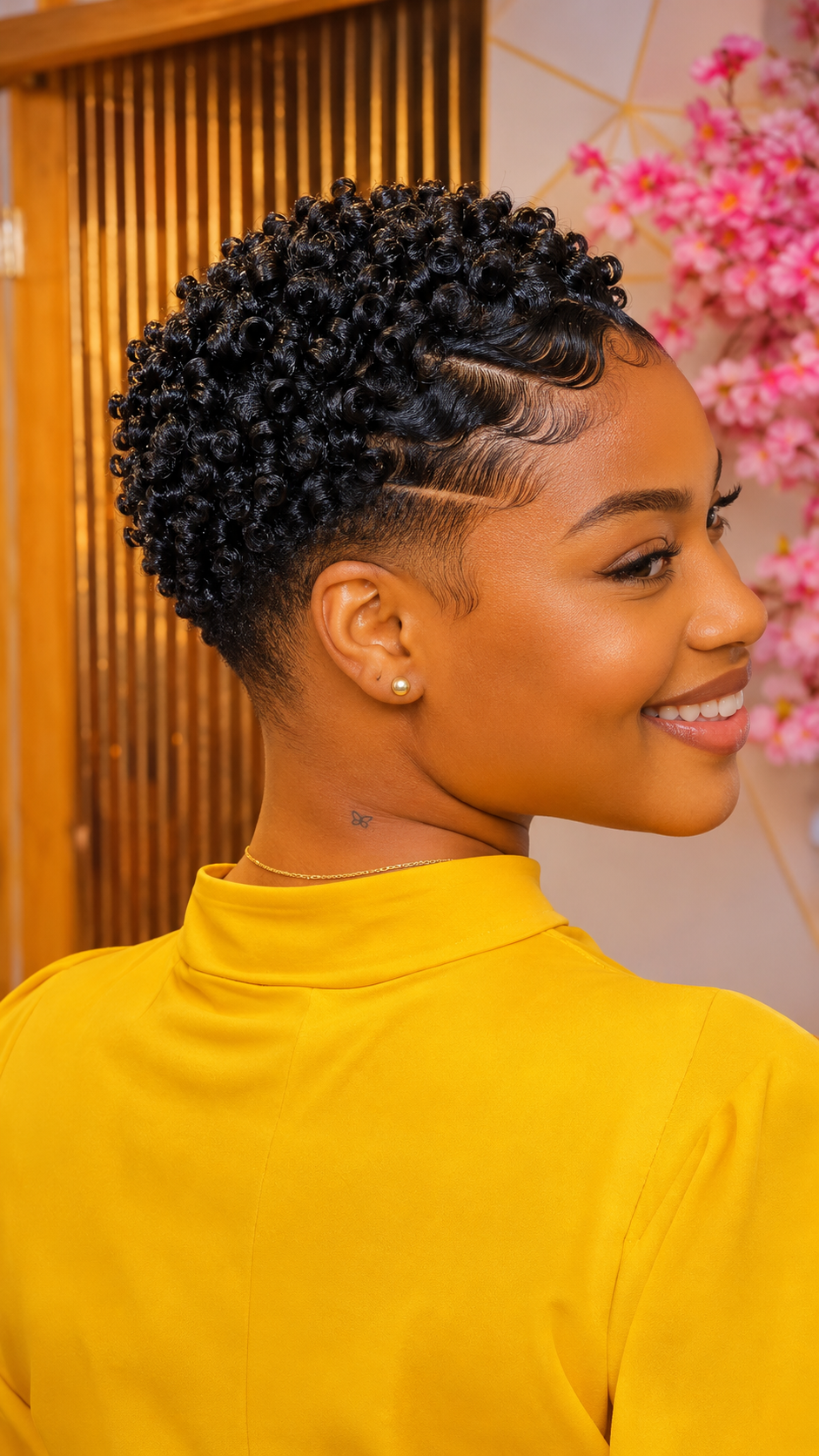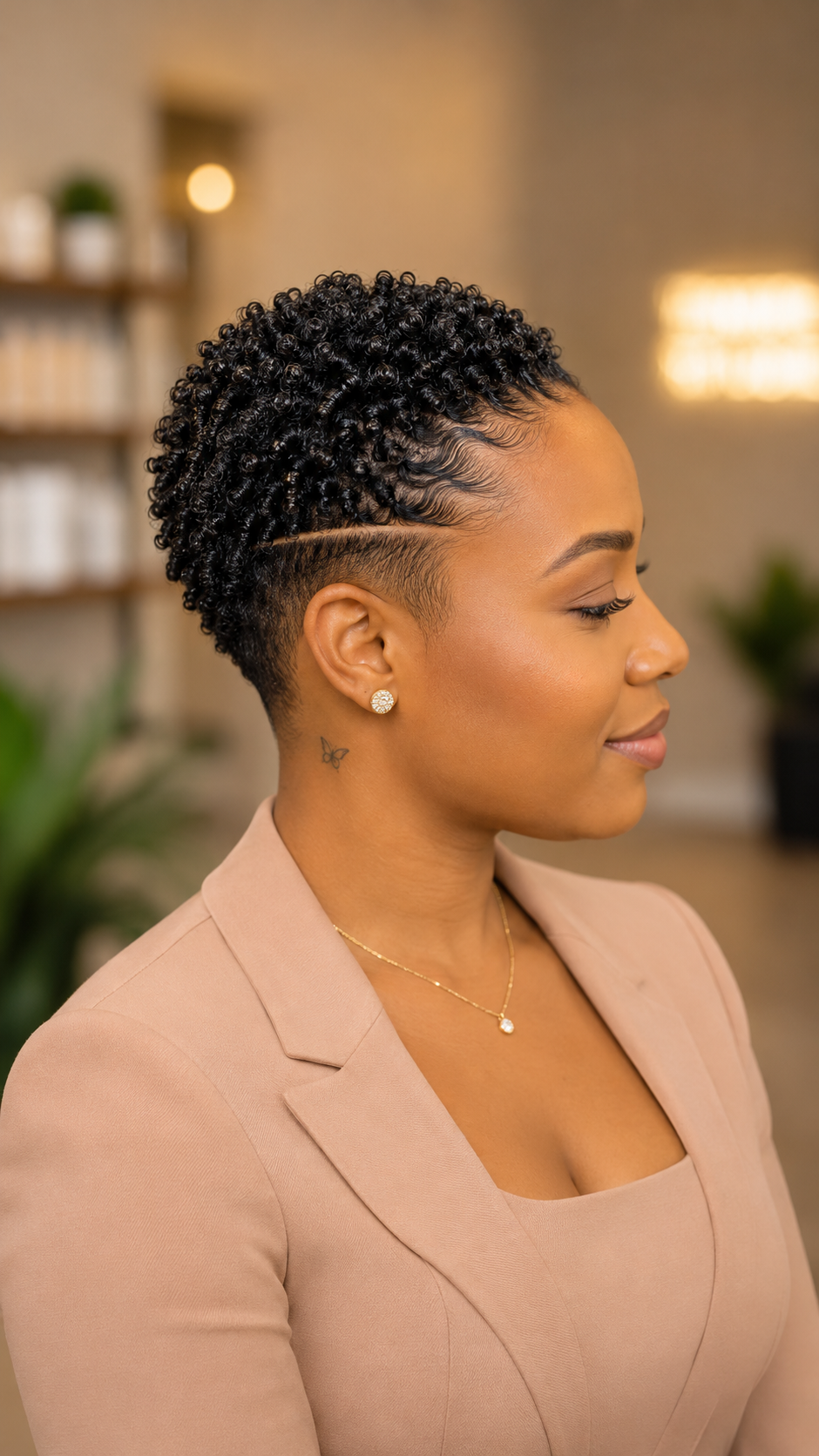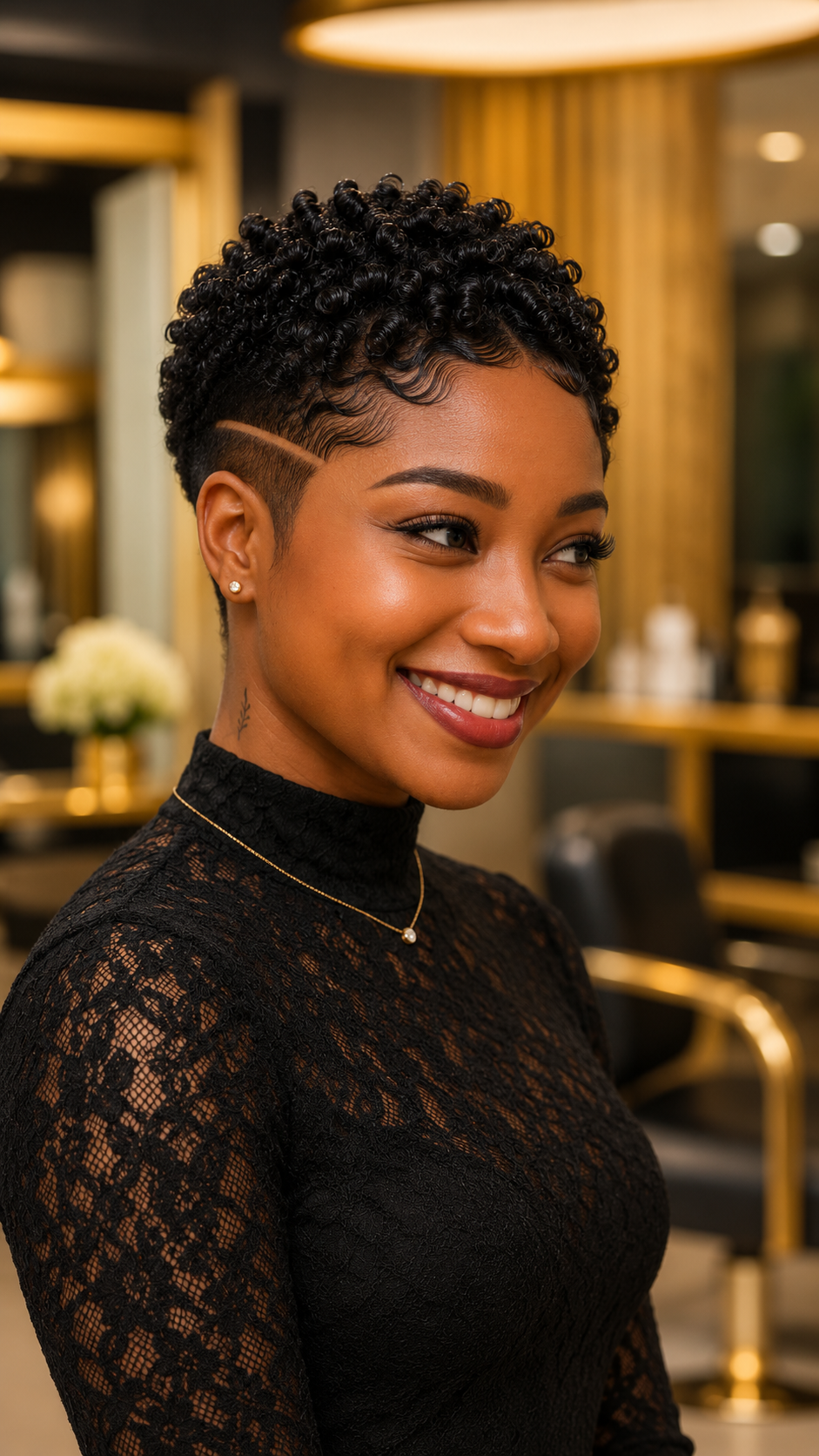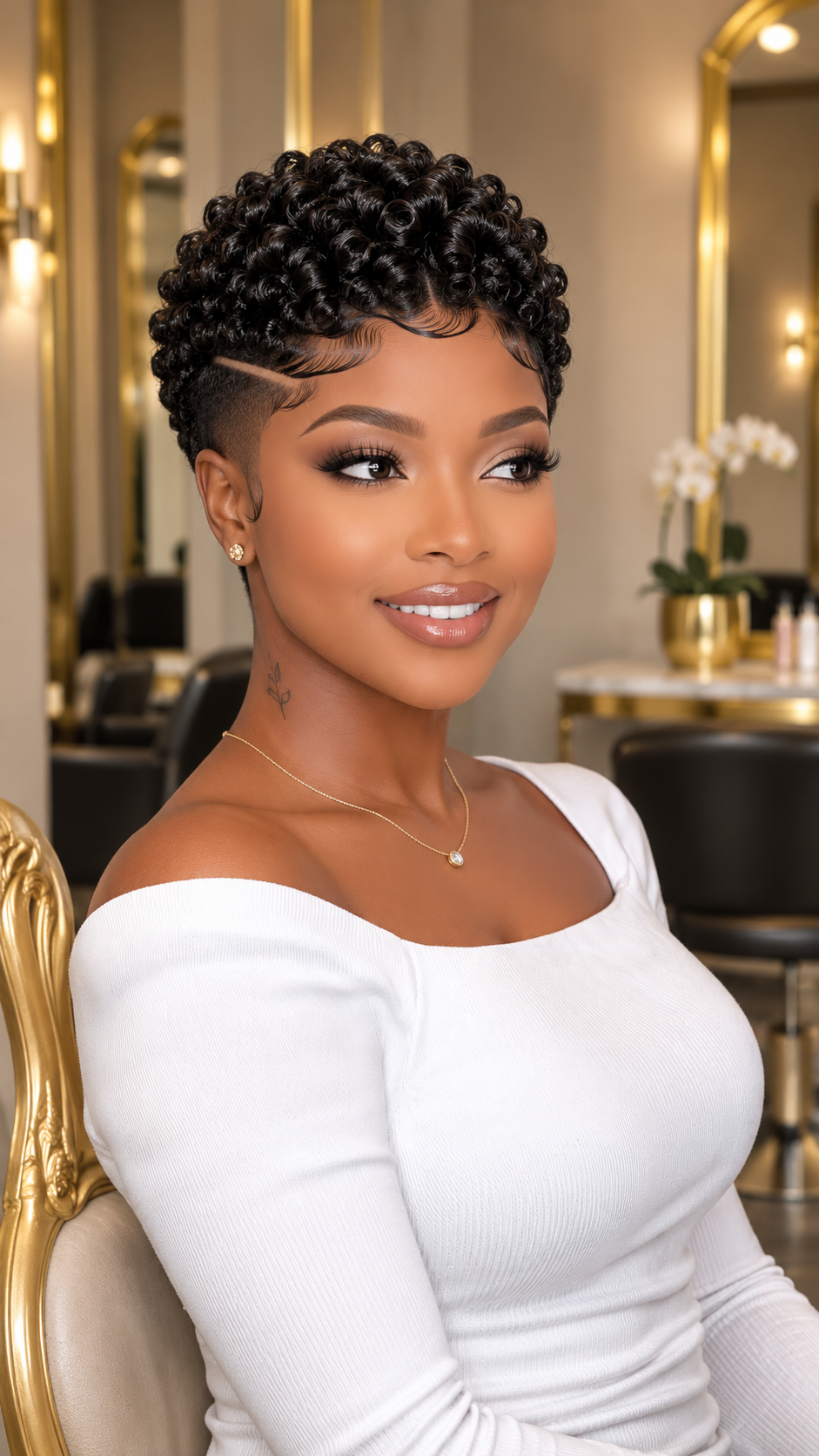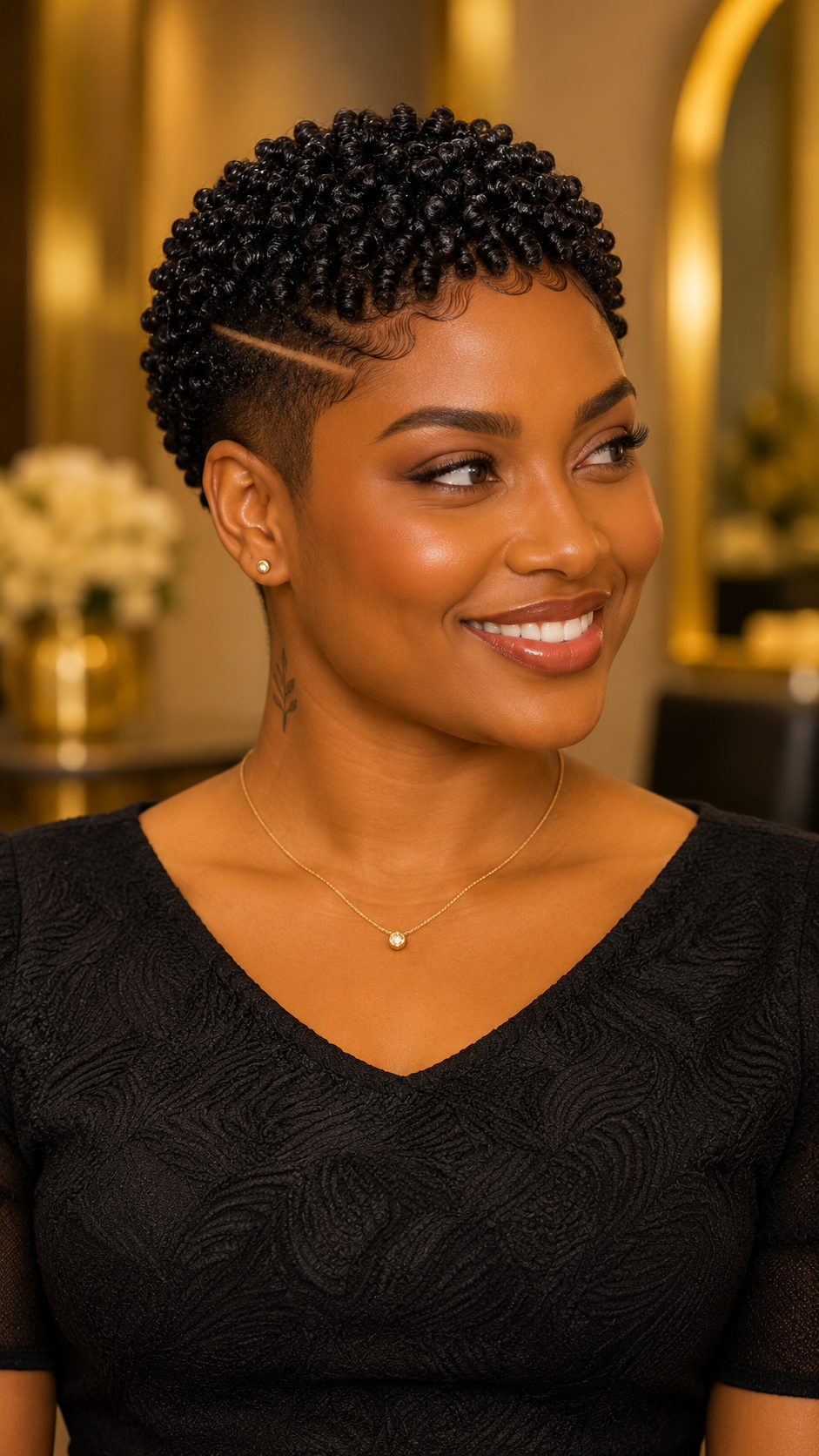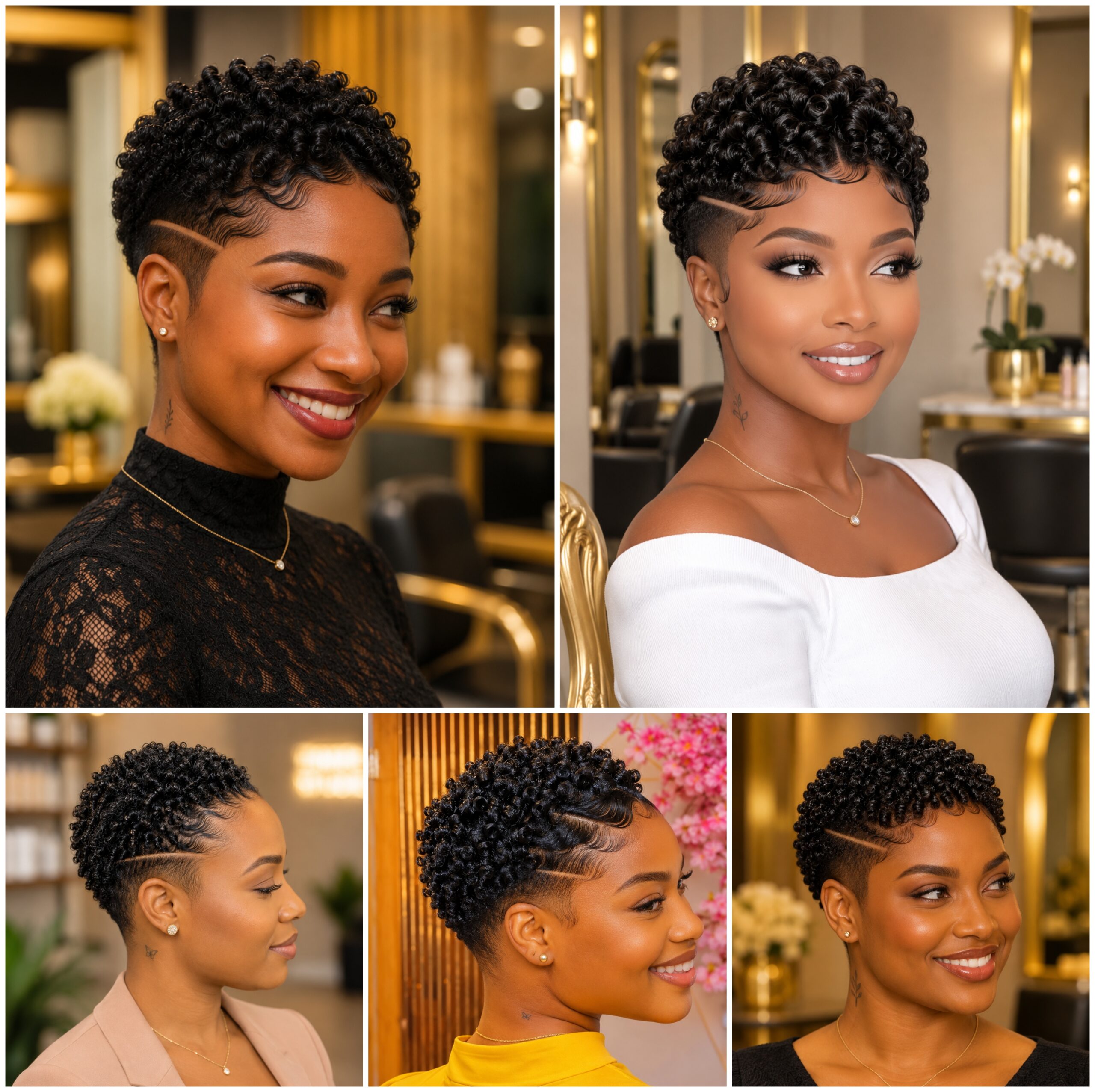
A curly fade pixie becomes especially distinctive when the softness of its curls meets the precision of parallel shaved lines. This hairstyle combines a rounded curly crown, closely tapered sides, and carefully spaced linear accents that bring structure to an otherwise playful silhouette. The result is a compact haircut that balances volume, definition, and barber-inspired artistry without relying on excessive length or complicated accessories.
For women who enjoy expressive pixie hairstyles, this combination offers an appealing alternative to traditional cropped curls. The upper hair provides movement and fullness, while the faded lower sections create a close-fitting profile. Parallel shaved lines introduce an additional visual element, drawing attention toward the temples and emphasizing the contrast between the curly crown and shorter sides.
The exact appearance can vary considerably. Some versions use tightly arranged finger coils, while others have small spiral curls or naturally coiled hair. The parallel accents may be positioned above one temple, along the lower side, or near the transition between the crown and fade. Their spacing, length, and direction should be planned according to the wearer’s preferred appearance.
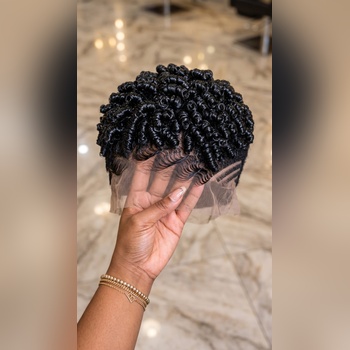
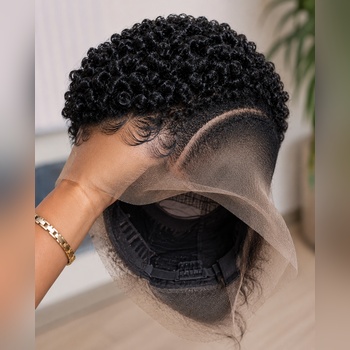
This hairstyle can be created directly on natural hair by an experienced barber or hairstylist. It can also inspire a custom wig, although reproducing shaved-looking lines on a wig requires appropriate construction and careful attention to the underlying cap. Not every ready-made curly pixie can safely accommodate this type of detailing.
The Relationship Between Curls and the Fade
The most important structural decision is how much contrast to create between the upper curls and the lower sides. A fuller crown makes the fade more noticeable, while a relatively compact crown produces a restrained silhouette.
On natural hair, the barber may reduce the length gradually toward the temples and nape. The transition should complement the shape of the head rather than create an abrupt, bulky edge beneath the curls.
For wigs, the faded appearance may be achieved through carefully controlled strand density, shorter hair placement, or specialist cutting. The exact method depends on the construction of the unit.
A convincing curly fade pixie should retain enough coverage around the lower sections to avoid unwanted gaps. This is particularly important for wigs, where excessive cutting may expose the foundation.
Choosing the Right Crown Volume
The upper curls can be relatively low and compact or slightly elevated for greater presence. Neither approach is automatically better.
A lower crown may appeal to women who prefer a lightweight appearance that sits close to the head. A fuller crown creates stronger contrast against the faded sides and can emphasize the hairstyle’s rounded outline.
Before choosing the volume, consider the size of the curls. Tiny finger coils create a different surface from broader spiral ringlets, even when both hairstyles have similar overall height.
When ordering a wig, ask the supplier for front, side, and overhead photographs. These views can help establish whether the curl size and crown volume match the intended design.
Parallel Shaved Lines Bring Precision to the Temple
Parallel shaved lines are one of the defining characteristics of this hairstyle. Usually arranged as two or three narrow channels, they introduce a geometric contrast against the organic movement of the curls.
The lines may follow a diagonal direction toward the rear of the head or curve slightly with the shape of the temple. Their placement influences how prominent they appear from the front and side.
Even spacing is particularly important. When the channels remain separate and follow a consistent direction, the design looks deliberate. Irregular spacing or excessively wide separations can change the hairstyle’s character.
The surrounding hair should remain sufficiently dense to distinguish the channels from one another.
Two Lines or Three?
Double parallel lines create a relatively restrained accent. They can be a good choice for someone who wants a decorative side without making the pattern the central attraction.
Triple parallel lines create a stronger visual statement, especially when positioned beneath a dense curly crown.
More lines are not necessarily better. The available temple area, hair density, and intended placement should determine the arrangement.
A barber should assess the natural growth pattern before cutting. For a wig, a specialist should confirm that the foundation can support the proposed design without unwanted exposure.
Once hair has been removed from a wig, it cannot grow back, making careful planning essential.
Finger Coils, Spiral Curls, and Natural Coily Crowns
The curly portion of the pixie can take several forms. Each produces a different balance of shape, movement, and maintenance requirements.
Compact Finger Coils
Finger coils are formed by organizing small sections into individual curls. They can create a closely arranged crown with recognizable spiral shapes.
When paired with faded sides, compact finger coils produce a cohesive rounded silhouette. Their small diameter allows the curls to sit relatively close together.
On natural hair, styling results depend on the existing curl pattern, length, products, and technique. On wigs, the appearance depends on the fiber and how the coils were formed.
Open Spiral Ringlets
Spiral ringlets generally create a more noticeable curled surface. Their openings may be larger, and some sections can rise farther above the crown.
This option may suit women who enjoy a fuller, more decorative upper hairstyle.
However, larger ringlets can require additional attention to preserve their individual shapes.
Natural Coily Texture
A natural coily crown can create a softer, less individually sculpted appearance. The hair may retain its own curl structure rather than being arranged into uniform circular formations.
This option can work particularly well for women who prefer a natural-hair haircut rather than a highly sculpted wig.
The most appropriate styling method depends on the hair’s condition and individual curl pattern.
Color Choices That Complement the Design
Color affects how clearly the curls and shaved lines appear. Dark shades often emphasize the contrast between glossy curls and exposed channels, while lighter colors can make individual curl formations more noticeable.
Jet black and natural black provide a classic appearance that keeps attention on the shape and side detailing.
Deep chocolate brown can offer a slightly warmer alternative without introducing dramatic contrast.
Copper, burgundy, and caramel shades can make the upper curls more expressive, especially when combined with darker roots or sides.
For a highlighted wig, buyers should decide whether the colored strands should remain concentrated in the crown or extend into the lower sections.
A darker side may make the parallel channels easier to distinguish, but the final effect depends on the actual construction and styling.
Where to Get This Hairstyle Done
Women who want this design on their natural hair should look for a barber or hairstylist experienced in curly pixie cuts and precision line work.
The appointment may involve cutting, tapering, curl styling, and creating the side accents. Depending on the salon, these services may be performed by one professional or require collaboration between a barber and stylist.
For a wig version, search for a wig maker who specializes in compact curly units and customized side designs.
Ask to see previous examples of their work, particularly hairstyles combining curls with exposed linear patterns.
A good portfolio should demonstrate consistent curl placement and careful handling of the wig foundation.
Preparing for a Salon Consultation
Bring clear reference photographs showing the preferred crown and temple pattern. A side photograph is especially valuable for establishing the number, spacing, and direction of the parallel lines.
Explain whether you want the curls to remain tightly arranged or have a fuller, more open appearance.
Discuss how closely the lower hair should be tapered.
If you are considering a wig, ask the stylist whether the desired appearance can be created on the available cap construction.
Confirm the full service price and whether future maintenance appointments will be necessary.
Ordering a Similar Curly Fade Pixie Wig
Finding a suitable ready-made wig can be more complicated than locating an ordinary curly pixie. Many products offer the correct crown shape but have plain sides without decorative lines.
Other units include side accents but use a different curl pattern or a much fuller silhouette.
For a close match, search for curly fade pixie wigs, finger coil taper wigs, and custom pixie units with parallel temple detailing.
When contacting sellers through WhatsApp, telephone, or direct message, explain the exact arrangement you want.
Ask whether the side channels are incorporated during production or added afterward.
Request photographs of the actual finished unit rather than relying only on promotional examples.
Important Product Questions
Before paying for a wig, confirm the fiber composition, available cap sizes, construction type, and fastening components.
Ask whether the hairstyle arrives fully curled and whether the side design is already completed.
Request photographs of the front hairline, crown, both sides, rear, and entire underside.
If the unit includes lace, ask the supplier to identify its actual specifications and available shades.
Do not assume that visible lace is HD lace or that a wig can be worn without adhesive unless the manufacturer confirms those properties.
Also establish the return policy, production timeline, shipping charges, and any customization costs.
Ready-Made Versus Custom Pixie Wigs
A ready-made unit may be suitable if its curl pattern, cap fit, and side arrangement already match your preferences.
Ready-made options can also reduce the need for extensive customization.
However, products with decorative temple channels may offer fewer variations in line placement.
Custom wigs can potentially provide greater control over the crown height, curl diameter, color, and side geometry.
The main advantage is the ability to discuss the hairstyle before construction begins.
Nevertheless, custom production does not guarantee an identical result. The maker should explain any limitations imposed by the selected hair material and cap.
Ask for photographs of the completed wig before dispatch whenever possible.
Illustrative Pricing for Curly Fade Pixies
The following USD amounts are illustrative planning ranges, not verified live retail prices. Actual costs vary by supplier, location, fiber, construction, curl styling, and the complexity of the parallel side accents.
| Wig Category | Illustrative USD Range | Typical Cost Considerations |
|---|---|---|
| Premium Custom | $340–$850+ | Individual cap sizing, custom curl placement, precision side channels, personalized hairline work, and specialist finishing. |
| Standard Custom | $180–$450 | Selected cap options with customized curls, tapered sides, and planned parallel detailing. |
| Basic Human Hair | $105–$300 | A human-hair starting unit that may require professional cutting, curl setting, and additional side work. |
| Premium Synthetic | $75–$220 | A manufactured curly pixie with preformed curls and possible decorative temple styling. |
| Basic Synthetic | $30–$100 | A budget curly unit that may have limited customization options or simplified side detailing. |
These estimates concern possible wig purchases rather than natural-hair salon services.
For natural hair, the cost may depend on the haircut, curl styling, line design, and any additional treatment requested.
For custom wigs, the precision of the temple accents can influence labor costs. Creating narrow, evenly spaced channels without weakening the foundation requires planning.
Installation, shipping, taxes, color processing, and future maintenance may be charged separately.
Request an itemized quotation before placing an order.
Installation Options and Cap Comfort
Cap fit should be established before any permanent lace trimming or side customization.
A wig that shifts during wear may cause the parallel accents to sit at an unintended angle.
Correct sizing also helps the curls maintain their intended position above the forehead and temples.
Depending on the verified construction, the unit may support adhesive installation, adjustable fastening, or another securing method.
Glueless wear should be considered only when the actual cap and fastening system are suitable.
If excess lace is present, a stylist should establish the final wearing position before trimming.
Removing unnecessary strands around the decorative channels should be avoided because those changes are generally irreversible.
Maintaining the Curls Without Disturbing the Fade
The curly crown and faded sides have different maintenance requirements.
The upper section needs careful handling to preserve its curl structure. Repeated brushing can stretch individually formed coils and alter the rounded silhouette.
The lower section should maintain its close-fitting appearance without losing necessary coverage.
On natural hair, maintenance may involve scheduled barber appointments and curl refreshing appropriate to the hair’s texture and condition.
For wigs, the supplier’s recommended care routine should guide washing, reshaping, and styling.
If the wig contains human hair, professional curl resetting may be possible using appropriate techniques.
If the unit contains synthetic fibers, confirm heat compatibility before using heated styling tools.
Protecting the Parallel Side Channels
On natural hair, shaved lines gradually become less visible as the hair grows. A barber can advise on an appropriate touch-up schedule.
On wigs, the situation is different. Removed strands do not regrow, and repeated cutting may gradually widen the channels.
If the pattern becomes less visible because nearby strands have shifted, consult a wig specialist before attempting further trimming.
Maintaining the spacing between the lines is more important than making them increasingly deep or wide.
Careful handling can help preserve the intended geometric appearance.
Styling for Everyday Wear and Special Occasions
This hairstyle can work in casual, professional, and occasion-focused settings, depending on the selected color and the prominence of the side pattern.
A black curly fade with two narrow accents may create a relatively restrained appearance.
A brighter copper or burgundy crown with three diagonal lines can produce a more expressive result.
The compact length allows the hairstyle to remain visually focused around the head rather than extending over the shoulders.
However, women who frequently wear hats or head coverings should consider whether compression may affect the curl arrangement.
For special occasions, a stylist can assess whether the crown needs refreshing before the event.
Advantages and Considerations Before Choosing This Pixie
The hairstyle offers several practical and aesthetic advantages. It combines a compact silhouette with decorative detailing, allows different crown curl patterns, and can be adapted through color and line placement.
The parallel accents give the side a recognizable identity without requiring extensive length.
However, precision patterns may need regular attention when cut into natural hair.
Custom wigs can involve additional production costs, and not every cap supports carved-looking side designs.
Intricately styled curls may also require careful maintenance to retain their shape.
Before deciding, consider whether you prefer a natural-hair cut or removable wig, how frequently you intend to wear the hairstyle, and whether specialist maintenance is available locally.
Choosing the Right Curly Fade for Your Lifestyle
The appeal of this hairstyle comes from balancing the rounded movement of the curls with the deliberate precision of parallel shaved lines.
A successful interpretation should preserve a clear distinction between the upper crown and tapered sides while keeping the decorative accents properly spaced.
For natural hair, work with a barber who understands curly cutting and detailed line placement. For wigs, choose a maker who can explain how the design will be constructed without damaging the cap.
Confirm the preferred curl diameter, crown height, line count, direction, color, and maintenance expectations before booking or ordering.
Whether styled on natural hair or recreated as a custom wig, this curly fade pixie offers a distinctive combination of compact curls and geometric temple detailing. The best result will be one that respects the intended design while remaining comfortable and practical for regular wear.
Search Terms
Curly fade pixie with parallel lines · Finger coil pixie side shave · Double stripe tapered curly haircut · Triple temple line pixie hairstyle · Black spiral coil fade wig · Close tapered sides with curls · Barber line design curly pixie · Sculpted coil crown with shaved accents