
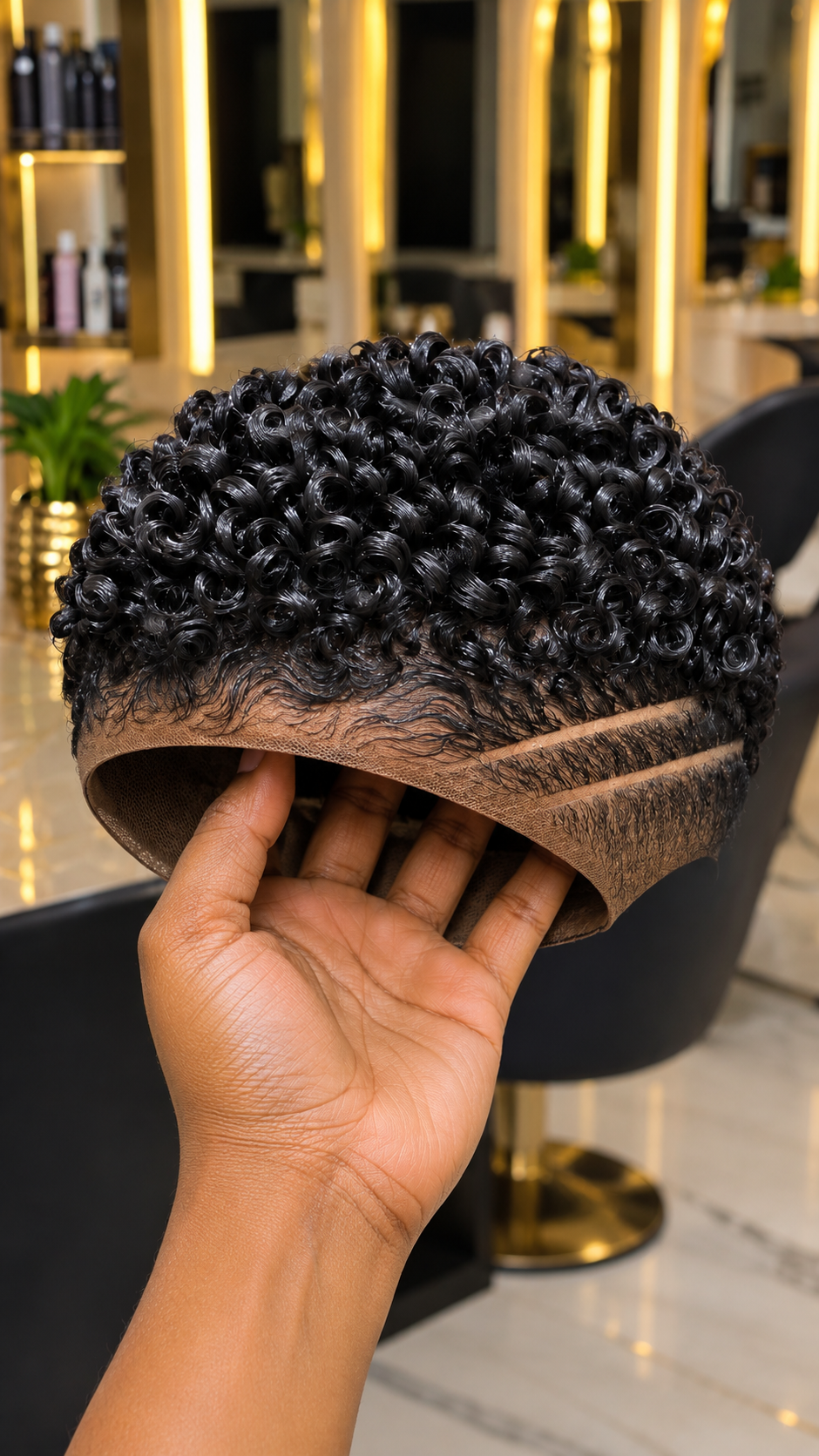
A beautifully arranged short hairstyle can offer just as much personality as a dramatic long-haired look, especially when glossy curls and precise side detailing come together. This gorgeous black pixie wig captures that balance through its tightly clustered ringlets, softly arranged frontal waves, and distinctive double temple lines. The result is a compact, beautifully rounded hairstyle that combines playful curls with the precision of a carefully styled short haircut.
The photograph presents the wig being held inside an elegant beauty salon, where warm golden lighting illuminates the individual curls. The upper crown contains numerous small, circular ringlets arranged closely together, creating a dense yet carefully shaped surface. Each curl catches the surrounding light, revealing glossy black strands wrapped into delicate loops. The rounded crown gradually transitions into a flatter lower section, maintaining an attractive pixie silhouette.
One of the hairstyle’s most distinctive characteristics is the contrast between the curly crown and the closely arranged temple area. Beneath the upper ringlets, fine strands follow the front hairline in gentle, sweeping movements. Along the visible side, two narrow diagonal lines create a decorative accent that adds definition without overwhelming the hairstyle. Their placement complements the compact shape and gives the lower section a carefully finished appearance.


The wig is shown before installation, with a beige-toned lace foundation visible along the front and side. This allows a closer look at the placement of the hairline strands and the carefully arranged side design. Although the photograph reveals several construction details, the exact lace grade, hair material, and full cap configuration cannot be confirmed from appearance alone.
For women interested in short black pixie wigs with miniature ringlet curls and double temple lines, this hairstyle provides an attractive combination of elegance, practicality, and intricate salon styling. Its full rounded crown and compact lower section make it particularly appealing for those who appreciate short hairstyles with carefully sculpted details.
The Beauty Behind the Miniature Ringlet Crown
The defining characteristic of this hairstyle is its collection of closely arranged miniature ringlets. Unlike loose curls that fall around the face, these small circular formations remain gathered across the crown, creating a full and rounded appearance.
Each ringlet consists of strands wrapped into a compact loop. Some curls form almost complete circles, while others appear slightly elongated or partially overlapping. Their varied positions give the crown an attractive layered quality.
The ringlets are distributed densely across the upper section, creating visual fullness without requiring excessive length. Their small dimensions allow numerous curls to occupy the crown while maintaining a neat overall silhouette.
One particularly appealing detail is the way the curls reflect light. The outer surfaces appear glossy, while the centers and spaces between neighboring loops remain darker. This natural contrast makes the individual curls more recognizable.
When recreating the hairstyle, the curl diameter is essential. Larger curls would change the crown’s appearance and reduce the number of visible ringlets. Extremely fine coils could produce a different surface without the clearly rounded loops shown in the photograph.
The ideal reproduction preserves the small circular shapes, closely grouped placement, and gently elevated crown.
A Rounded Pixie Silhouette with Balanced Volume
Although the upper section contains numerous curls, the hairstyle maintains a compact shape that follows the natural contour of the head.
The ringlets create fullness across the central crown and extend toward the upper sides. Beneath them, the hair becomes progressively flatter, producing an attractive distinction between the raised curls and the closely styled lower section.
This difference in volume is essential to the pixie appearance. If the lower sides were equally full, the hairstyle might resemble a small curly afro rather than a neatly arranged pixie.
The rounded crown also contributes to the hairstyle’s versatility. It provides enough height to create a distinctive appearance without extending into an exaggeratedly tall shape.
For custom wig orders, the completed dimensions should be discussed before production. Hair length alone does not explain the final appearance because strands become visibly shorter when formed into tightly arranged ringlets.
Ask the maker about the intended crown height, curl diameter, and side proportions. The finished shape should remain compact while allowing the curls to retain their individual formations.
Rich Black Hair Creates a Beautiful Reflective Surface
The wig features a deep black appearance that makes its numerous spiral curls particularly striking.
Under the warm salon lights, the curved strands display glossy reflections that emphasize their circular arrangement. Some areas appear almost jet black, while the reflected light introduces subtle silvery highlights along the hair surfaces.
These reflections should not be confused with intentionally colored streaks. The hairstyle appears predominantly black throughout the crown and sides.
This monochromatic appearance allows the curl pattern to remain the central feature. Instead of relying on contrasting colors, the design creates depth through the arrangement and shine of the individual ringlets.
Black also complements the fine frontal waves and the darker temple section. The consistent coloring helps connect the different styling elements into one harmonious hairstyle.
Women ordering a similar wig should confirm the supplier’s color designation. Natural black and jet black may appear slightly different under daylight, particularly when one contains subtle brown undertones.
A photograph of the actual wig in neutral lighting can help establish the desired shade.
The Delicate Front Waves Soften the Hairline
Beneath the densely arranged ringlets, the front hairline contains numerous fine strands styled into soft, flowing waves.
These strands lie closer to the lace foundation than the upper curls, creating a graceful transition between the rounded crown and the forehead.
The waves follow gently curved paths rather than forming large decorative loops. Some sweep sideways before turning slightly downward, while others remain close to the base of the ringlets.
This arrangement creates a feathered appearance that complements the full upper section.
The difference in scale between the small ringlets and the even finer hairline strands is particularly attractive. The crown provides rich volume, while the forehead styling introduces delicate movement.
For women who want an accurate reproduction, the front should not be overloaded with thick baby-hair curls. Heavy styling could conceal the light, carefully aligned strands visible in the photograph.
The most suitable approach preserves the soft sweeping direction and allows the front waves to remain relatively flat.
Double Temple Lines Add a Distinctive Signature
Two narrow diagonal lines form the most recognizable detail along the visible side of the hairstyle.
The lines run through the closely arranged lower section, creating a precise contrast with the miniature curls above.
They are positioned relatively close together and follow a slightly angled direction. This produces a refined decorative effect without covering a large portion of the side.
The surrounding hair remains dark and closely arranged, making the lighter-looking channels clearly distinguishable.
These accents introduce a subtle barber-inspired quality to the wig. They make the design feel more personalized while preserving the soft, rounded appearance of the crown.
For natural hair, a skilled barber may be able to recreate similar lines using precision cutting techniques. On a wig, however, the method depends on the construction and placement of the hair.
Cutting into an existing wig without understanding its foundation could expose the cap or permanently damage the hairpiece.
For this reason, buyers should discuss the temple lines during the custom-order process rather than attempting to add them afterward.
The Closely Arranged Side Maintains the Short Shape
The lower side provides a carefully controlled contrast to the raised ringlets.
While the crown contains numerous compact curls, the side hair lies close to the foundation. The strands appear arranged in a consistent direction, creating a relatively flat surface.
This allows the double temple lines to remain visible and helps preserve the short pixie silhouette.
The transition from the upper curls into the side section is gradual. Small ringlets appear along the boundary, while the lower hair becomes noticeably flatter.
This creates a visual connection between the sections without making them identical.
For custom production, the relationship between crown fullness and side volume should be carefully discussed.
Excessive side density could make the wig appear wider and conceal the decorative channels. Conversely, an overly sparse lower section might expose the cap and change the intended appearance.
The hairstyle works best when the upper curls remain full and the lower side remains compact.
How the Front and Side Details Work Together
The hairstyle gains much of its personality from the relationship between the front waves and the double temple lines.
Both elements are positioned beneath the raised crown, but they introduce different forms of movement.
The forehead strands create soft, flowing curves. The temple lines form narrow diagonal accents that appear more structured.
Together, they create a balanced transition from the delicate front to the closely styled side.
The ringlets above provide another contrasting shape through their small circular formations.
This mixture of curves, circles, and diagonal lines makes the hairstyle visually interesting without requiring additional coloring or accessories.
When reproducing the design, it is important not to introduce unrelated patterns. Additional carved lines, oversized front curls, or altered partings could change the appearance significantly.
A professional stylist should preserve the relationship between the original design elements.
The Visible Lace Foundation Before Installation
The photograph shows a beige-toned lace area extending along the front and visible side of the wig.
The mesh remains untrimmed because the hairpiece is being displayed before installation.
Fine strands are arranged near the lace edge, forming the delicate front waves that contribute to the hairstyle’s finished appearance.
The lace provides a foundation for these details, but its exact commercial classification is not evident from the photograph.
HD lace, transparent lace, and Swiss lace are terms associated with different materials and specifications. Their use should be verified through the supplier rather than inferred solely from an image.
Before purchasing, ask about the lace material, dimensions, and available colors.
The correct shade and construction can help the wig blend more naturally with the intended wearer’s complexion after professional fitting.
Trimming should be performed only after the hairline has been positioned correctly to avoid disturbing the delicate front styling.
Interior Cap Details and Proper Fit
The open lower portion of the wig shows that the hairpiece has a separate supporting cap.
The visible construction suggests a flexible foundation intended to fit around the wearer’s head, although the complete interior is not shown.
The photograph does not establish the exact number of securing combs, adjustable straps, elastic bands, or other attachment components.
For buyers, understanding the interior is just as important as examining the curls.
A wig that fits too loosely may shift during wear, affecting the placement of the front waves and temple lines.
A cap that is too tight can create uncomfortable pressure around the hairline and temples.
Before ordering, take the measurements requested by the supplier and compare them with the available cap sizes.
Ask for a complete underside photograph and confirm which adjustment features are included.
Where To Get This Hairstyle Done
Women interested in a comparable look can consult salons specializing in short curly hairstyles, professional wig customization, and precise hairline styling.
For natural hair, the stylist should evaluate the existing length, density, texture, and condition before deciding whether the small ringlets can be recreated.
The crown requires a method capable of producing numerous compact circular curls. The sides require controlled styling or cutting to maintain their close-fitting appearance.
A barber experienced in decorative temple designs may be needed if the hairstyle is recreated directly on natural hair.
For wig installations, look for a professional familiar with lace-front preparation and sculpted short hairstyles.
Before booking, share the reference photograph and explain that the desired hairstyle includes a full black ringlet crown, delicate front waves, and two diagonal temple lines.
Ask whether the salon can customize an existing wig or whether a specially constructed hairpiece would provide a closer match.
Where To Buy Similar Black Pixie Wigs
Specialized wig boutiques, beauty supply stores, online hair retailers, and independent wig makers are suitable places to begin searching.
Useful descriptions include short black ringlet pixie wig, glossy mini curl lace-front wig, sculpted black pixie hairpiece, and curly pixie with double temple lines.
When comparing products, examine the actual hairstyle rather than relying entirely on the advertised name.
Some products described as curly pixies contain loose curls that fall downward. Others use very fine coils that do not form the same circular openings.
The photographed hairstyle depends on a dense crown of distinct miniature ringlets and a closely arranged lower section.
Ready-made products may offer a similar general appearance, but the decorative temple lines and feathered frontal waves may require customization.
The photograph does not identify the original manufacturer or confirm the current availability of the exact unit.
Before purchasing online, request recent photographs or videos of the product being offered.
Get The Details On This Wig
A custom order should begin with a clear explanation of the hairstyle’s essential characteristics.
Send the reference photograph to a wig maker experienced in short, sculpted curl designs.
Explain that the crown should contain numerous tightly arranged miniature ringlets with distinct circular openings.
Specify the rich black color and ask the maker to avoid introducing contrasting highlights.
Describe the front hairline as softly feathered, with fine waves lying close to the lace.
Point out the two diagonal temple lines and confirm which side should display them.
Discuss the finished crown height, lower-side density, hair material, lace construction, and cap measurements.
Before approving the order, request photographs showing the front, both sides, crown, rear, and underside.
Confirm the complete price, shipping arrangements, payment terms, and any available alteration policy.
Ready-Made Wigs Versus Custom-Made Hairpieces
Ready-made short curly wigs can be practical for women who want a generally similar appearance without commissioning an entirely new hairpiece.
They may involve simpler purchasing arrangements and lower initial costs.
However, the precise combination of miniature ringlets, delicate front waves, and double temple lines may not be common in standard wig collections.
Custom construction provides greater control over the curl diameter, crown shape, density, and side styling.
It may also allow the wig maker to position the decorative lines according to the intended wearer’s measurements.
Specialist construction can require additional labor, making the finished unit more expensive.
Before deciding, consider which details matter most.
If the general black curly pixie silhouette is sufficient, a ready-made product may work well. If the original ringlet arrangement and temple lines are essential, customization may be more appropriate.
Human Hair and Synthetic Fiber Considerations
The hairstyle could potentially be recreated using suitable human hair or synthetic fibers, depending on the maker’s methods.
Human-hair wigs may offer flexibility for professional curling, washing, and selected styling adjustments.
However, compact sculpted ringlets may require resetting after washing, depending on how they were formed.
Some synthetic wigs contain manufactured curl patterns that are designed to retain their shape after appropriate cleaning.
Such materials may appeal to women who want consistent ringlets with fewer styling adjustments.
However, heat tolerance varies considerably among synthetic fibers.
The photograph does not confirm whether the pictured wig contains human hair, synthetic material, or a blend.
Ask the supplier to identify the material and explain the recommended cleaning and restyling process before purchase.
Glueless Installation and Other Attachment Methods
Short curly wigs can be constructed for different installation preferences.
Some are designed for glueless wear, using appropriate sizing and securing features to keep the hairpiece in place.
Others may use adhesive systems or require professional fitting.
The visible lace and cap do not establish that this particular wig is fully glueless.
For adhesive-free wear, confirm that the selected cap is specifically designed for secure glueless installation.
Ask whether the wig includes adjustable straps, an elastic band, combs, or other attachment components.
The fit should remain comfortable without excessive tension on the wearer’s natural hairline.
If adhesives are used, follow the manufacturer’s instructions for application and safe removal.
Regardless of the method, the front waves and temple design should remain correctly positioned after installation.
Closure, Frontal, and Lace-Front Construction Choices
Comparable pixie wigs may be available with closure, frontal, or other lace-front constructions.
A closure generally provides a smaller lace area, while a frontal may offer more coverage along the front hairline.
The best option depends on the desired styling flexibility and the placement of the decorative details.
For this hairstyle, the front waves and visible temple lines should be considered together when choosing the construction.
Some cap designs may allow a greater range of hairline styling, while others are intended for more limited arrangements.
A full frontal is not necessarily required for every version of the hairstyle.
The appropriate choice should be determined by a professional maker after reviewing the reference.
Ask for details about the actual lace dimensions and cap features rather than relying exclusively on a product title.
Choosing the Ideal Ringlet Density
The crown contains a substantial number of curls, creating a full surface without losing the individual ringlet shapes.
Density is therefore an important consideration for custom production.
Too little hair could create visible gaps between neighboring loops.
Too much hair might cause the curls to overlap heavily, making their circular formations difficult to distinguish.
The side section requires comparatively less visible volume because the temple lines need to remain noticeable.
This means the crown and sides should not necessarily be styled with the same level of fullness.
Ask the wig maker to recommend density based on the completed hairstyle rather than selecting a percentage without considering the intended curl arrangement.
Examples of previously finished pixie wigs can help demonstrate whether the proposed density is suitable.
Illustrative Prices for Sculpted Ringlet Pixie Wigs
The price of a comparable wig depends on the hair material, cap construction, lace specifications, curl-setting labor, and complexity of the decorative temple details.
The following US dollar amounts are illustrative budgeting ranges, not verified current retail quotations for the photographed wig.
| Wig Tier | Illustrative Price Range | Possible Features |
|---|---|---|
| Budget | $35–$110 | Basic synthetic short curly wigs with simplified circular curls and standard cap construction. |
| Value | $90–$215 | Higher-grade synthetic pixies with compact glossy ringlets and selected front styling. |
| Mid | $175–$390 | Selected human-hair or premium alternative wigs with professional curl setting and partial hairline customization. |
| Premium | $350–$780 | Custom miniature ringlet crowns, feathered frontal waves, double temple accents, and selected cap adjustments. |
| Salon-Grade | $650–$1,300+ | Specialist custom construction with individual measurements, precise curl placement, detailed side styling, and professional fitting preparation. |
Actual selling prices may differ considerably according to the retailer, location, fiber material, and services included.
Professional installation, shipping, lace preparation, and future maintenance may involve additional charges.
Always request a detailed quotation before committing to a custom order.
Preparing the Wig for Professional Installation
Before installation, inspect the curls, front lace, temple lines, and interior cap.
Check that the ringlets retain their compact shape and that the hairline styling has not been disturbed during transportation.
Position the wig correctly before trimming the excess lace.
This is particularly important because the feathered front waves extend close to the lace edge.
The stylist should avoid pulling or flattening the upper ringlets during fitting.
Any adjustments to the front hairline should preserve the existing curved movement.
If the wig is designed for adhesive installation, follow the product manufacturer’s instructions and use appropriate removal methods.
For glueless wear, confirm that the unit remains secure without uncomfortable pressure.
Before leaving the salon, request care instructions suited to the actual hair material.
Maintaining the Miniature Ringlets
The small circular curls require delicate handling to preserve their glossy, sculpted appearance.
Aggressive brushing may separate the strands and cause the ringlets to lose their rounded shapes.
Before washing, determine whether the curls are manufactured into the fiber or professionally set afterward.
Some synthetic wigs may retain their original curl pattern after suitable cleaning.
Human-hair ringlets may require professional resetting depending on the original styling technique.
Use cleaning and conditioning products recommended for the confirmed hair material.
Applying excessive styling product can create buildup that makes the curls heavy or less reflective.
Avoid stretching individual ringlets unnecessarily.
If the crown begins to flatten, consult a professional before using heated styling tools.
Keeping the Frontal Waves Neatly Arranged
The delicate front strands require a different approach from the raised crown curls.
Their appearance depends on remaining aligned along the original curved paths.
Repeated rubbing or aggressive washing may disturb the feathered arrangement.
When cleaning the lace, avoid excessive friction close to the styled hairline.
For human-hair wigs, a professional stylist may be able to refresh the waves using suitable setting techniques.
For synthetic wigs, follow the manufacturer’s guidance on heat and styling products.
Heavy gel buildup can make the fine strands appear stiff or uneven.
Preserving the soft front movement helps maintain the contrast between the delicate hairline and the full ringlet crown.
Protecting the Double Temple Lines
The diagonal temple accents depend on the surrounding hair remaining closely arranged.
During handling or washing, loose strands may shift across the narrow channels and make the lines less noticeable.
For wig maintenance, avoid attempting to deepen the channels by cutting additional hair without specialist guidance.
Removing too much hair may expose the cap or permanently damage the design.
Ask the original maker how the side detailing should be refreshed.
The aim is to preserve the two existing lines without introducing extra accents or changing their angle.
How to Store the Wig Correctly
Compact ringlets can become compressed when a wig is stored beneath heavy objects.
A suitable wig stand may help maintain the rounded silhouette without unnecessarily stretching the cap.
For travel, use packaging that protects the curls from excessive pressure and friction.
Avoid rough fabrics that could catch individual strands.
After washing, allow the hairpiece to dry according to the manufacturer’s instructions before putting it away.
Keep the wig away from excessive heat and unsuitable environmental conditions.
Before wearing it again, inspect the ringlets, front waves, lace, and temple detailing for sections requiring attention.
Everyday Wear and Maintenance Expectations
The compact pixie silhouette may be convenient for women who prefer hair that does not extend around the neck and shoulders.
However, the carefully sculpted ringlets require more delicate handling than many ordinary loose-curl hairstyles.
Frequent wear may introduce friction, styling-product buildup, and changes in the position of individual curls.
Women who wear the wig occasionally may find that careful storage helps preserve the original arrangement.
Those who wear it regularly should monitor the condition of the lace, cap, and securing components.
The appropriate cleaning schedule depends on the hair material, installation method, climate, and frequency of use.
There is no universal maintenance interval suitable for every wig.
Ask the supplier for recommendations based on the specific construction.
Fashion Ideas for a Short Black Ringlet Pixie
The rich black color offers plenty of opportunities to coordinate clothing and accessories.
White and cream outfits can create a striking contrast with the dark curls.
Earth tones such as chocolate brown, beige, and caramel may produce a softer appearance.
Bright African print fabrics can add energy while allowing the dark hairstyle to remain a prominent feature.
Gold earrings can complement the warm reflections created by salon or daylight illumination.
Silver jewelry can introduce a cooler contrast against the glossy black ringlets.
The compact pixie shape also allows the ears to remain relatively unobstructed, making small hoops and studs attractive choices.
Because the curls and temple lines already provide intricate details, elaborate hair accessories are unnecessary.
Advantages and Practical Considerations
One of the hairstyle’s greatest advantages is its combination of short length and beautifully arranged curl volume.
The miniature ringlets create a full rounded crown, while the flatter sides maintain a compact silhouette.
The feathered front waves soften the hairline, and the double temple lines introduce an attractive decorative element.
The black color is also easy to coordinate with different outfits.
However, maintaining the individual curls may require careful handling and professional resetting depending on the material.
Custom temple detailing and precise hairline styling can increase production costs.
The cap must fit correctly to maintain the placement of the front and side designs.
Before purchasing, consider how frequently the wig will be worn, the preferred installation method, maintenance requirements, and available budget.
Additional Photographs Worth Requesting
The reference photograph provides a detailed view of the crown, front hairline, visible side, and part of the interior cap.
However, several important areas remain unseen.
A direct front photograph would reveal the complete forehead wave arrangement.
An opposite-side image would establish whether similar temple lines appear on the other side.
A rear photograph would show how the miniature ringlets transition toward the nape.
A complete underside photograph would help verify the cap construction and securing features.
A short video taken under neutral daylight could provide a clearer impression of the curl dimensions, color, and overall proportions.
These views are particularly useful when commissioning a custom wig remotely.
Short Ringlets with Beautifully Crafted Temple Details
This gorgeous black pixie demonstrates how carefully sculpted curls and precise side styling can transform a compact hairstyle into something truly distinctive.
The crown contains numerous small glossy ringlets arranged into a full, rounded shape. Their circular formations create depth and movement while preserving the short silhouette.
Beneath the curls, the hairline transitions into delicate sweeping waves that soften the forehead. Two diagonal temple lines provide a striking contrast with the raised ringlets and add an understated barber-inspired accent.
The visible lace and supporting cap offer useful insight into the hairpiece before installation, although the exact construction specifications should be confirmed with the supplier.
For a faithful reproduction, the most important details are the rich black color, compact miniature ringlets, rounded crown, feathered frontal waves, and paired diagonal temple lines.
Preserving these elements without adding unrelated colors, oversized curls, or excessive volume will help maintain the hairstyle’s original character.
Whether chosen as a custom-made wig or recreated through specialist short-hair styling, this beautiful pixie offers a memorable combination of intricate curls, carefully crafted side detailing, and elegant everyday beauty.
Search Terms
Black miniature ringlet pixie wig · Short glossy ringlet crown hairstyle · Black pixie wig with double temple lines · Sculpted black curly pixie with feathered baby hairs · Compact circular coil lace front wig · Tapered black ringlet wig with diagonal side accents · Short black spiral pixie with rounded crown · Miniature glossy curls with double temple stripes