
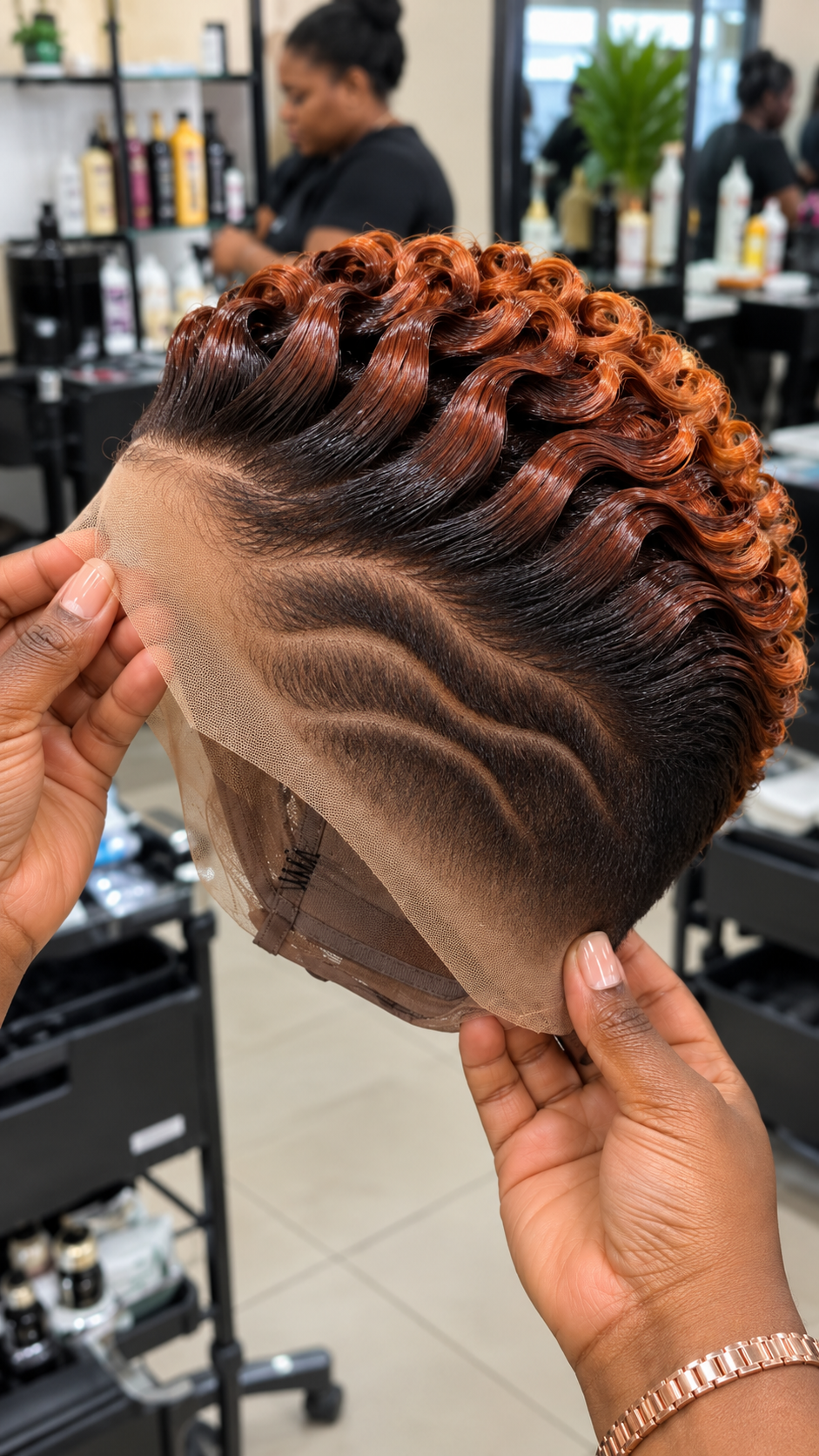
Some short hairstyles make an impression through their color, while others attract attention through the beautiful arrangement of individual strands. This captivating copper and dark-brown pixie combines both qualities, creating a striking hairstyle with raised flowing waves, warm copper reflections, and carefully sculpted curves along the sides. Its distinctive shape brings together the elegance of traditional wave styling and the expressive character of a contemporary short haircut.
The hairstyle features a dramatic arrangement of glossy waves extending backward across the crown. The upper strands rise into smooth, flowing formations before bending into closely arranged curls toward the rear. Rich copper highlights illuminate the elevated sections, while the darker brown and black foundation provides depth and contrast. Beneath these waves, the shorter side area displays several gracefully curved separations that follow the contour of the head.
Unlike conventional pixie hairstyles with loosely arranged curls, this design emphasizes precision and direction. Each elevated wave follows a recognizable path, creating a continuous flowing pattern that leads the eye toward the back. The smooth lower sections complement the larger formations above them, giving the hairstyle an attractive balance between fullness and close-cut detailing.


The photograph shows the wig being held by two hands inside a professional beauty salon. The untrimmed beige lace is clearly visible around the front and lower side, while part of the internal wig cap can be seen through the opening. The style is presented before installation, making the arrangement of the strands and the construction around the hairline particularly easy to examine.
For women who enjoy short hairstyles with carefully arranged waves, this design offers an expressive alternative to ordinary curly pixies. Its copper color adds warmth, while the structured side sections create an artistic contrast that remains attractive from multiple viewing angles.
The Beauty of Raised Copper Waves
The most noticeable feature of this hairstyle is the series of elevated waves stretching across the upper crown. These formations do not lie completely flat against the foundation. Instead, the strands rise smoothly before bending into soft curves that continue toward the rear of the hairstyle.
The arrangement creates a beautiful sense of movement. Each wave appears to flow into the next, producing a continuous pattern rather than a collection of unrelated curls.
The copper highlights follow the raised surfaces, emphasizing their graceful shape. Darker strands remain visible near the roots and beneath the waves, creating additional depth.
The upper formations also vary slightly in height. Some rise more prominently near the front, while others become smaller as the hair approaches the back.
This gradual change contributes to the hairstyle’s balanced proportions. The waves provide noticeable fullness without making the crown appear excessively tall.
Women requesting a similar hairstyle should explain that they want broad, flowing sculpted waves rather than miniature spiral coils or ordinary loose curls.
Why the Copper and Dark-Brown Combination Works
The contrast between copper highlights and a darker foundation is one of the defining characteristics of this hairstyle. The lighter strands are concentrated across the raised upper sections, while the roots and lower sides maintain a predominantly deep brown appearance.
This placement allows the waves to remain clearly recognizable. The copper strands catch the light, emphasizing each bend, while the darker hair beneath them creates shadow and visual separation.
The result is a warm hairstyle with significant depth. It does not depend on an entirely light-colored crown to attract attention.
Compared with a uniform copper hairstyle, the darker foundation gives the upper waves a more dimensional appearance.
The color transition is also important for connecting the raised crown to the closely shaped sides. Because the lower sections remain darker, the decorative curves become more noticeable without competing with the copper highlights.
When ordering a similar wig, customers should request copper accents over a dark-brown or black-brown base rather than a completely copper-colored unit.
Flowing Waves Create a Beautiful Crown Shape
The upper crown contains several broad wave formations that follow a coordinated backward direction. Their arrangement creates fullness while preserving a relatively short hairstyle.
At the front, the hair rises smoothly from the roots. The strands then bend into elegant curves before transitioning into shorter curled sections toward the back.
This continuous direction gives the hairstyle a distinctive swept-back appearance.
The waves also create a layered effect. Some formations sit slightly above neighboring sections, producing a gently elevated surface without excessive height.
A successful reproduction should maintain the relationship between these layers. If the waves are flattened completely, the hairstyle may lose much of its character.
On the other hand, adding too much volume can change the design into a taller curled hairstyle.
The desired result is a compact crown with raised flowing waves that retain smooth, clearly separated strands.
The Sculpted Side Curves Are an Artistic Highlight
Beneath the full crown, the side contains several curved separations arranged in a flowing pattern. These lines are not completely straight or horizontal. Instead, they bend gently and follow the shape of the lower hair.
The pattern begins near the front side and moves backward, creating a visually coordinated arrangement beneath the elevated waves.
The surrounding hair is closely shaped, allowing the lighter channels to stand out against the dark strands.
Some of the curves run almost parallel, while their spacing changes slightly as they approach the lower section.
The result is an artistic side design that complements the movement of the copper waves above.
On natural hair, a professional barber may recreate comparable detailing through precision shaping and cutting. On a wig, the appearance may involve specialized strand placement or custom construction.
The photograph does not establish the exact technique used to create these separations, so customers should discuss the construction method with their chosen stylist.
A Beautiful Transition Between Waves and Short Sides
The hairstyle’s balance depends on the contrast between its elevated upper sections and its flatter lower sections.
The crown contains long, flowing wave formations, while the side hair becomes progressively shorter and more closely arranged.
This creates a distinctive silhouette with fullness above and a compact appearance below.
The shorter sections also provide enough visual space for the curved decorative channels to remain noticeable.
If the lower hair were too full, the pattern could become concealed. Conversely, excessive removal of hair could create an overly dramatic contrast that changes the design.
The photograph demonstrates a carefully coordinated relationship between the two sections.
Women interested in recreating this appearance should request a gradual transition from the raised waves into the closely shaped lower side.
Achieving that balance may require professional customization, especially when the hairstyle is constructed as a removable wig.
The Role of the Deep Side Separation
A clearly visible separation near the upper side helps establish the direction of the hairstyle. It distinguishes the raised crown from the carefully shaped lower sections.
The separation follows a gentle diagonal path, allowing the hair above it to move backward while the shorter strands beneath it follow their own curved arrangement.
This distinction contributes to the hairstyle’s organized appearance.
Without the separation, the crown and lower side could appear to blend into a single continuous mass of hair.
The curved boundary creates an attractive contrast while reinforcing the direction of the larger waves.
For a custom wig, the placement should be agreed upon before styling begins. Moving the separation too high or too low can change the proportions of the upper and lower sections.
The most suitable location depends on the desired crown fullness and the position of the decorative curves.
Warm Copper Highlights and Their Different Undertones
Copper hair colors can range from soft reddish brown to bright orange-gold shades. The photographed hairstyle displays warm copper reflections over a substantially darker foundation.
Some raised strands appear brighter where they catch the salon lighting, while others retain deeper reddish-brown tones.
This variation creates dimension throughout the upper waves.
Customers seeking a similar color should compare copper brown, cinnamon copper, auburn copper, and warm ginger shades.
Although these colors share reddish undertones, their brightness and depth can differ significantly.
The most accurate approach is to examine genuine hair samples or photographs taken under consistent lighting.
Salon lighting may emphasize warm reflections, making a shade appear brighter than it would outdoors.
When requesting customized coloring, explain that the darkest strands should remain visible beneath the highlighted upper waves.
Choosing the Right Wave Size
The elevated formations are broader than conventional finger coils. Their graceful curves extend across noticeable sections of the crown rather than forming numerous tiny spirals.
This difference is essential to the overall appearance.
Very small curls would create a more densely coiled crown, while loosely arranged large curls might produce a softer hairstyle with less precision.
The pictured design relies on smooth, sculpted waves with clearly aligned strands.
Several of the upper formations curve into compact loops toward the rear, introducing additional dimension without changing the primary wave structure.
For custom styling, customers should provide close-up reference photographs showing the width and direction of the waves.
A professional can then recommend appropriate hair length, setting techniques, and finishing methods.
The finished shape matters more than an arbitrary curl size or styling-tool measurement.
How Hair Length Influences the Finished Look
Although this hairstyle has the overall appearance of a short pixie, the strands forming the elevated waves may require more length than their finished shape suggests.
Hair bends upward and backward before returning toward the crown, reducing the visible length of each strand.
Choosing hair that is too short may prevent the broad waves from forming properly.
Excessively long strands, however, may create unnecessary fullness or require additional cutting.
The ideal starting length depends on the desired wave height and the amount of curvature involved.
The exact length cannot be determined reliably from the photograph.
A professional wig maker should evaluate the reference and recommend the appropriate length for the finished silhouette.
For ready-made wigs, customers should prioritize photographs of the styled unit rather than relying entirely on advertised strand measurements.
The Importance of Controlled Hair Density
Hair density affects how full the crown appears and how clearly the sculpted waves remain visible.
The featured hairstyle has generous fullness across the upper section, but the waves remain distinct rather than merging into an undefined mass.
This balance is important because the styling depends on visible separation between neighboring formations.
Insufficient density could make the crown appear sparse, particularly between the raised waves.
Excessive density might make the upper section bulky and difficult to arrange into smooth curves.
Some wig sellers offer density choices such as 130%, 150%, and 180%, but the photograph does not establish the density of the displayed unit.
A professional maker should recommend a suitable density based on the hair material, wave size, and intended crown height.
The goal is attractive fullness without sacrificing the graceful direction of the strands.
Understanding the Visible Lace Construction
The photograph clearly shows beige lace extending beyond the front and side portions of the hairstyle. The mesh has not yet been trimmed for installation.
This visible lace provides an important clue about the wig’s construction, although it does not establish every technical specification.
The hair appears carefully arranged above the lace foundation, with the front strands sweeping backward into the raised crown.
The mesh continues around the visible lower side, where the decorative curves are positioned.
Customers should examine the lace coverage carefully when selecting a similar product.
The exact lace type, grade, thickness, and dimensions cannot be confirmed from the photograph alone.
Rather than assuming a particular premium lace classification, ask the seller for written specifications and underside photographs.
The appropriate construction should support the desired hairline and decorative side styling.
The Interior Cap and Fitting Considerations
Part of the internal wig cap is visible beneath the lace. The foundation appears brown, with darker attachment components and stitching visible inside.
These details indicate that the unit has an internal structure designed to support the styled hair.
However, the photograph does not reveal the entire cap or confirm every securing feature.
Customers should request additional photographs showing the underside before purchasing.
Ask whether the unit includes adjustment bands, combs, elastic components, or other retention features.
Accurate head measurements are important because the decorative side curves need to sit in the correct position when the wig is worn.
A cap that is too loose may shift, while an excessively tight cap can cause discomfort.
A professional fitting can help establish the appropriate size and installation method.
Can This Hairstyle Be Worn Glueless?
Some women prefer glueless wigs because they want the flexibility to remove their hairpieces without using adhesive.
Whether this particular hairstyle can be installed glueless depends on the complete cap construction, measurements, and securing components.
The visible interior does not provide enough information to establish whether the wig is specifically designed for adhesive-free installation.
Customers should confirm the intended wearing method directly with the seller.
A secure fit is particularly important for this design because the raised crown and decorative side curves need to remain correctly positioned.
Some custom wigs can be fitted with suitable retention features, depending on construction.
A professional wig maker can explain which options are compatible with the desired appearance.
Comfort and stability should be considered together rather than assuming that one installation method works for every wig.
Closure and Frontal Options for This Pixie
Lace closures and frontals provide different amounts of coverage around the front hairline.
A closure generally covers a smaller area, while a frontal may extend farther across the forehead and temples.
The appropriate construction depends on the desired parting position, hairline appearance, and styling flexibility.
For a hairstyle with prominent side curves, the amount and placement of lace may influence how accurately the design can be recreated.
The photograph shows a substantial visible mesh area, but it does not establish the exact construction category or dimensions.
Customers should therefore request specifications instead of making assumptions from appearance alone.
A professional wig maker can recommend the most suitable foundation after reviewing the reference photograph.
The goal is to support the raised waves while maintaining a comfortable and natural-looking fit.
Human Hair Versus Synthetic Hair
Hair material influences how well a sculpted hairstyle can be maintained and reshaped.
Human hair may offer flexibility for setting broad waves, adjusting the curl direction, and refreshing the style after washing.
However, its behavior depends on quality, processing, and condition.
Suitable synthetic fibers may also retain carefully prepared wave patterns, although their heat tolerance varies considerably.
The glossy appearance in the photograph is not sufficient evidence to establish the material composition.
Customers should ask whether the proposed unit contains human hair, synthetic fiber, or a blend.
It is also important to confirm how the copper coloring was produced.
Before using heat tools or chemical treatments, follow the manufacturer’s material-specific instructions.
The best option depends on the desired wearing frequency, maintenance routine, budget, and styling flexibility.
Where to Get This Hairstyle Done
Women interested in recreating this hairstyle can consult experienced wig stylists, professional hairdressers, and salons specializing in sculpted short hairstyles.
The selected professional should understand how to create elevated waves with smooth, closely aligned strands.
Experience with precision side shaping is also important because the decorative curves contribute significantly to the finished appearance.
For natural hair, a skilled barber may assist with the shorter side sections while a hairstylist prepares the flowing upper waves.
Some salons provide both services during a coordinated appointment.
For customers who prefer removable hairstyles, a custom wig maker may reproduce the design without permanently cutting the natural hair.
Before booking, review examples of the stylist’s previous work, especially hairstyles featuring directional waves and intricate side arrangements.
Provide the reference photograph during consultation to establish realistic expectations.
What to Tell Your Professional Stylist
Clear communication is particularly important for a hairstyle with multiple decorative elements.
Begin by explaining that the desired look is a short copper-highlighted pixie with a deep dark-brown foundation.
The crown should contain broad, elevated waves flowing backward rather than tightly packed miniature coils.
The highlighted strands should emphasize the upper curves, while the roots and shorter sides remain predominantly dark.
Explain that the lower side contains several flowing decorative separations following the natural contour of the head.
The overall silhouette should remain compact, with a fuller upper section and a closely shaped lower side.
If ordering a wig, discuss cap sizing, lace coverage, hair material, density, and installation preferences.
Ask how the hairstyle should be maintained after washing and whether professional resetting is available.
Where to Buy Similar Copper Pixie Wigs
Comparable wigs may be available through independent wig makers, specialist beauty boutiques, professional salons, and online hair retailers.
Useful searches include copper sculpted wave pixie wigs, dark-root copper short lace wigs, and copper finger-wave pixies with curved side detailing.
However, standard ready-made wigs may not reproduce the exact combination of elevated waves and decorative side curves.
Some products feature ordinary loose curls, while others include flatter finger waves without the same raised crown.
Customers should examine actual product photographs showing the front, side, and back.
When the precise arrangement matters, a customized wig may offer greater control over the finished appearance.
The photograph does not establish a verified manufacturer, current stock availability, or confirmed retail price for the displayed unit.
Written specifications can help customers compare different offers more accurately.
How To Order This Style
Begin by contacting a wig maker who accepts detailed customization requests.
Share the reference photograph and identify the most important characteristics.
Request a compact pixie silhouette with elevated copper-highlighted waves over a dark-brown foundation.
Explain that the side should contain carefully shaped curved separations rather than ordinary straight decorative stripes.
Discuss the desired crown height, wave direction, hair material, and cap construction.
Ask whether the wig will arrive fully styled or require additional salon preparation.
Confirm the total cost, payment conditions, production details, and shipping arrangements.
For custom work, request photographs of the completed unit before shipment whenever possible.
These steps can help identify differences between the expected design and the finished product before installation.
Estimated Prices for Copper Sculpted Pixie Wigs
The price of a comparable wig depends on its hair material, cap construction, color placement, density, lace coverage, and the complexity of the wave styling.
The following USD amounts are illustrative budgeting ranges rather than verified current retail prices or quotations for the photographed hairstyle.
| Price Tier | Estimated Price Range | Typical Features and Considerations |
|---|---|---|
| Budget | $35–$95 | Basic synthetic short wigs with copper coloring and simpler wave patterns. |
| Value | $80–$195 | Pre-styled copper pixies with fuller crowns, darker roots, and decorative front shaping. |
| Mid | $145–$345 | Human hair or specialty base wigs requiring additional professional wave setting. |
| Premium | $245–$565 | Customized copper highlight placement, elevated waves, curved side detailing, and personalized fitting. |
| Salon-Grade | $465–$1,050+ | Individual cap construction, precision color work, intricate sculpted waves, and extensive professional finishing. |
Additional costs may include installation, lace preparation, shipping, cap adjustments, and future professional maintenance.
Customers should request itemized quotations before making a purchase.
Maintaining the Raised Wave Pattern
The upper waves require careful handling because their flowing shape is central to the hairstyle’s appearance.
Repeated brushing or unnecessary pulling may disturb the direction of the strands.
Customers should avoid separating the waves simply to create additional volume.
The appropriate maintenance method depends on the material and the technique used to form the original style.
Human hair may require suitable setting products and controlled reshaping.
Synthetic fibers should be maintained according to the manufacturer’s instructions, particularly regarding heat exposure.
If the raised formations become flattened, professional resetting may help restore their original shape.
Gentle handling can reduce the frequency of extensive restyling and help preserve the coordinated movement of the crown.
Protecting the Sculpted Side Curves
The decorative side sections depend on closely arranged strands and carefully positioned separations.
Unnecessary combing across these areas may disturb the original pattern.
The lighter channels should remain visible without being covered by displaced hair.
For natural hair, decorative detailing may require periodic barber maintenance as the shorter sections grow.
For wigs, the appropriate care depends on how the pattern was constructed.
Customers should avoid trimming or reshaping the lower sections without professional guidance.
During installation and removal, handle the lace and side hair gently.
When the decorative arrangement becomes difficult to restore, a stylist experienced in precision wave setting may be able to refresh the original appearance.
Keeping the Copper Color Beautiful
Copper shades may require additional attention depending on the hair material and coloring process.
Chemically colored human hair can gradually change in appearance with repeated washing, heat styling, and environmental exposure.
The specific maintenance routine should reflect the coloring method and condition of the strands.
For synthetic wigs, conventional human hair coloring products may not be suitable.
The photograph does not establish whether the copper strands were dyed or manufactured in the displayed color.
Customers should confirm the fiber composition before attempting additional coloring.
Maintaining the contrast between warm copper highlights and darker roots is especially important for this design.
The darker foundation helps emphasize the raised waves and prevents the hairstyle from losing its dimensional appearance.
A Practical Maintenance Schedule
The ideal maintenance frequency depends on wearing habits, hair material, styling products, and environmental conditions.
After each use, inspect the upper waves for flattened or displaced sections.
Check whether the decorative side curves remain visible and correctly arranged.
Examine the wig cap and any lace components for signs of wear.
Washing frequency should follow the manufacturer’s recommendations rather than a universal fixed timetable.
During cleansing, avoid unnecessary friction that could disturb the sculpted waves.
After washing, dry and reshape the hairstyle using techniques appropriate for its material.
Professional maintenance may be useful when the original styling requires extensive resetting.
Consistent gentle handling is generally preferable to repeated aggressive reshaping.
Storing the Wig Without Flattening the Crown
Proper storage can help preserve the elevated waves and the compact silhouette.
The crown should not be tightly compressed beneath heavy objects.
A suitable wig stand or storage form may help maintain the hairstyle’s shape between uses.
Ensure the wig is clean and completely dry before extended storage.
When placing the unit inside a box, provide adequate room for the upper formations.
Take care around the lace perimeter, cap stitching, and securing components.
For colored hair, follow the manufacturer’s recommendations concerning storage conditions and exposure to light.
Protecting the hairstyle during storage may reduce the amount of professional refreshing required before the next installation.
Styling Copper Waves for Different Occasions
The warm copper color and carefully arranged waves can complement a wide variety of fashion choices.
For formal occasions, the elevated crown provides decorative interest without requiring additional hair ornaments.
For portrait photography, the sculpted side curves create an attractive focal point from a three-quarter angle.
The dark roots add depth, while the copper highlights introduce warmth and brightness.
Gold earrings, bronze accessories, and neutral makeup can coordinate beautifully with the hairstyle.
Black clothing can emphasize the copper reflections, while cream, chocolate brown, and olive-green outfits may complement the warm palette.
The compact shape also allows earrings and necklines to remain visible.
For everyday wear, the hairstyle offers a distinctive short-hair appearance, although its professional maintenance requirements should be considered.
Advantages of Sculpted Copper Pixies
One advantage is the ability to achieve noticeable crown fullness without wearing long hair.
The elevated waves create dimension while preserving a relatively short silhouette.
The copper highlights emphasize the movement of the strands without requiring a completely light-colored hairstyle.
The darker foundation provides depth and connects the upper waves with the closely shaped lower sections.
Decorative side curves introduce an artistic accent that distinguishes the hairstyle from conventional curly pixies.
Another advantage is the possibility of recreating the appearance through a custom wig, allowing women to explore the design without permanently changing their natural hair.
For those who appreciate precise styling, the combination offers a beautiful balance between warmth, flowing movement, and carefully shaped details.
Potential Limitations to Consider
Intricate sculpted waves may require more maintenance than ordinary loose curls.
Repeated brushing, washing, or compression can disturb their shape, depending on the material and styling technique.
The decorative side curves may also require professional attention when their original arrangement becomes difficult to restore.
Custom coloring and specialized construction can increase the cost compared with a basic ready-made pixie.
Some women may prefer hairstyles that require less detailed maintenance.
Before purchasing, consider wearing frequency, cap comfort, available budget, and access to professional restyling services.
A consultation can help establish whether the hairstyle is suitable for frequent wear or better reserved for special occasions.
Checking the Finished Hairstyle Before Installation
When a custom wig arrives, compare its appearance with the agreed reference photograph.
The upper crown should contain broad, elevated waves with warm copper reflections over a darker foundation.
The strands should follow a coordinated backward direction rather than forming unrelated curls.
The lower side should contain carefully shaped curved separations that remain visible beneath the fuller crown.
Check that the overall silhouette remains compact and balanced.
Inspect the lace and internal cap components before trimming or making permanent adjustments.
Confirm that the unit fits comfortably and that the decorative side sections sit in their intended positions.
If significant differences are present, discuss them with the seller before installation.
The Lasting Appeal of Copper Wave Styling
This hairstyle demonstrates how flowing waves, warm highlights, and artistic side detailing can transform a short pixie into a distinctive salon creation.
The elevated copper waves provide fullness and graceful movement, while the darker roots create depth and emphasize the shape of the individual strands.
The sculpted side curves introduce an expressive detail that complements the flowing upper crown.
The transition between the fuller top and closely shaped lower sections maintains balanced proportions, allowing the hairstyle to remain compact without sacrificing visual interest.
For women seeking a similar look, the essential characteristics are broad copper-highlighted waves, a dark foundation, carefully arranged curved side separations, and a softly rounded short silhouette.
With suitable professional customization, accurate fitting, appropriate material selection, and thoughtful maintenance, this hairstyle offers a beautiful combination of warm color, artistic precision, and elegant short-hair styling.
Search Terms
Copper sculpted wave pixie wig · Dark brown copper finger wave hairstyle · Short copper lace front with curved side design · Raised copper waves with dark roots · Copper pixie with sweeping side curves · Glossy auburn wave crown wig · Two tone copper and black short pixie · Sculpted copper waves with tapered sides