
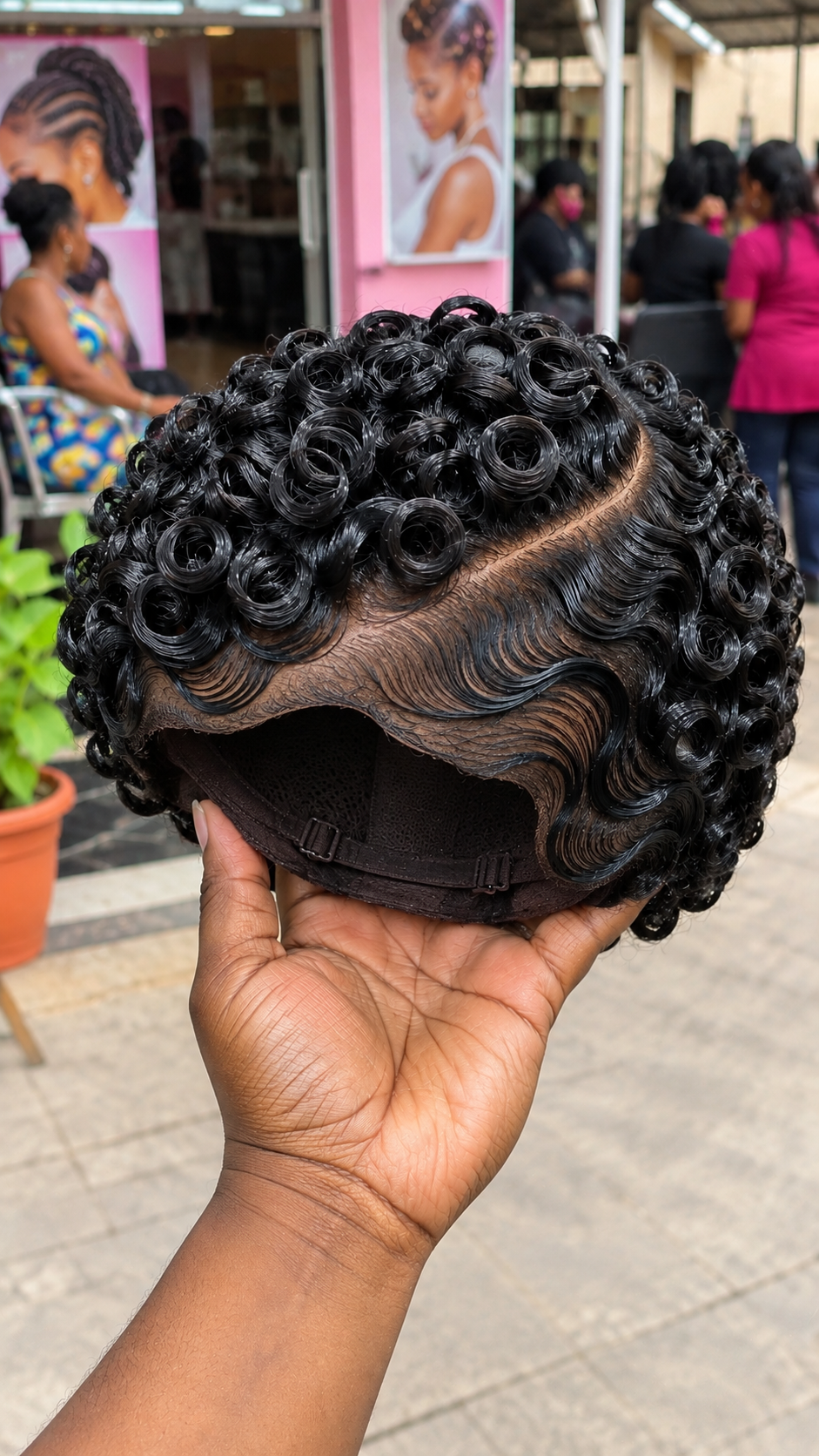
A long finger wave sweeps across the front of this black pixie, dipping toward the temple before curling back into the side. Above it, open ringlets sit in a rounded crown, their glossy rims catching daylight in fine streaks. Between the two areas, a narrow side part curves toward the back of the visible top. The part gives the fuller curls room to rise while the hair below it follows a flatter, more deliberate path.
The wave gets wider as it approaches the front. Several smaller bends sit close to the part, then open into a broad S shape with thinner strands tracing its edge. At the far side of the photograph, smaller ringlets continue down toward the perimeter. The contrast is easy to see. The crown has body and rounded openings, and the front has room for the eye to follow one long movement across the hairline.
The black ringlet pixie wig is held open from below, so you can see brown lace, a dark mesh interior and adjustment hardware along the inner band. Those details are useful when comparing similar units. The cut has a distinctly styled shape before it goes on, but the position of the side sweep depends on how the cap sits on the wearer. If this is your reference for a purchase or a salon appointment, use the broad wave to decide where you want the hairline to sit.


Follow the Longest Wave From the Part to the Temple
The wave begins beside the angled part, where the hair lies close and the bends are compact. Farther down, the strands spread into longer arcs. One ridge travels across the front and turns sharply near the outer edge, where another small curve follows it toward the side. Fine hairs fill parts of the space between the larger ridges. This is why the hairline reads as a broad, layered sweep even though the cut itself is short.
When you show the photo to a stylist, trace the longest wave with your finger and say where you want its low point. You may like the idea of a curve that comes toward one brow, or you may prefer the same shape higher up so the forehead stays more open. The stylist can mark the intended placement while you look straight ahead. A slight adjustment toward the center of your face will affect how dramatic the sweep looks from the front, while an adjustment toward the ear will make more of the change visible in profile.
Give the finer edge hairs their own consideration. They add detail by tracing the large curves and softening the outer edge, especially in the area where you can see the lace in the photograph. If you prefer a lighter hairline, ask the stylist to retain the main ridge and use fewer fine hairs around it. If you love the layered effect, show exactly which strands you want to remain visible between the bends. Either choice can preserve the overall flow of the style.
The Crown Has a Rhythm of Its Own
The ringlets up top are more open than the waves beneath them. Several show a complete circle, while others tilt enough for their centers to look oval. A few of the largest curls sit close to the upper end of the part, where their openings are easy to see. Smaller circles fill out the visible sides and help the shape curve inward. That mix of orientations is part of the design. A wig with evenly spaced upright curls would have a more uniform surface and a different profile.
Pay attention to the space where the top curls meet the broad front wave. The curls can sit close to that boundary, but they need enough separation for the wave to stay visible below. If you are requesting more volume, ask the maker where they will place it. A little additional lift toward the upper crown can give the pixie more height. Extra fullness directly above the brow may cover part of the sweep you chose the style for.
The dark hair makes the curl pattern look different under different light. In daylight, small reflections trace the outer turns and help separate one curl from the next. In softer light, the silhouette and the larger wave may register first. When assessing a unit remotely, ask for a slow video turn in indirect daylight and another ordinary indoor view if possible. The way the rings look once they move out of the brightest reflection is a good indication of how clearly the pattern will show in the places you usually wear your hair.
Show Your Stylist the View You Care About Most
A straight-on view tells you how the broad wave sits above the brows. A profile shows the depth of the curl set and how the small circles approach the ear. A view from slightly above makes the part and the openings in the ringlets easy to judge. If one of these angles matters more to you, say so at the consultation. For example, if you chose the pixie for the way the wave frames your face, ask the stylist to preserve that placement before making changes to the height of the crown.
Bring any glasses you wear often and put them on while the wig is fitted. The arm of a frame can cross the lower bend, especially when that bend extends toward the temple. If the arm presses on the hair, check whether the cap is positioned correctly before asking for changes to the wave. Once the fit is settled, the stylist can decide whether to shorten the tail of a bend or leave a little more room above the ear.
The lower back of the wig also deserves a look before you commit. This photo gives a good view of the front, much of the crown and one side. Ask for a rear photograph of the unit you are considering, and decide whether you want small curls carried down toward the nape or a closer finish there. Try the proposed length with the neckline you wear most often, especially if you want clearance for a high collar.
Get The Details On This Wig
Look for specialist wig boutiques, beauty supply stores with sculpted short styles and custom makers whose portfolios show both finger waves and structured ringlets. When enquiring, use the phrase deep side sweep pixie with open ringlets and send the reference. Ask to see the front and the fuller side of any wig they suggest. A listing labelled finger wave pixie might feature waves across the whole top, while a listing for a ringlet wig may show very little styling around the forehead. A profile and a front view help you find the combination you want.
For a custom order, send your preferred part direction from your own perspective, your head measurements, the amount of forehead you like showing and a note about the finished crown height. Mark the longest wave on the reference. This is particularly useful when ordering by message, as the maker can point to the corresponding area in an approval photo. Describe the finish as well. You can request a glossy black set like the one pictured or ask to see how the loops look with a softer sheen before deciding.
Before paying, request a clear image of the complete interior, including the band, adjustment points and area of usable lace. Confirm the fiber, cap size and whether the lace will arrive trimmed. For a finished unit, ask for a video of the actual piece. For custom work, agree on the production time, delivery charges, alteration terms and when you will see the approval photographs. If the wig is for an event, allow time for a fitting after delivery so the wave can be placed around your face before the date.
To have a similar style made or fitted locally, contact a short-hair salon or a wig stylist with close views of their hairline work. Show the reference before booking and explain whether the unit already has a set. A fitting for a finished wig calls for different preparation from a full cut and curl appointment. If you want a version on your own hair, ask the stylist to assess the length above the part and the amount of hair available for the front wave. Those are the areas that determine whether the look will translate to your existing haircut.
Cap and Installation Choices Around the Broad Front
The image gives you a partial look at the cap, including dark mesh and small adjusters along a band. For a similar wig, ask the maker where the front lace ends and how far it extends along the side part. A lace-front unit can suit the style when the usable area accommodates the full sweep and the part. A frontal may give the stylist more working room near the temple, depending on its width and depth. A useful fitting question is whether the lowest bend can be placed where you want it while the cap still sits comfortably around both ears.
A closure may suit a fixed interpretation when there is enough room within its usable area for the angled part. If your favorite detail is the low wave across the side of the forehead, ask the maker to show how that area would be finished with the chosen closure. A full-lace cap can give you more freedom if you want to change the part or move the set later. That flexibility is worth weighing against how often you expect to wear the hairstyle in this exact arrangement.
For a glueless fitting, check what keeps the front edge in place when you turn your head or look down. An adjustable band can help with fit, and the size and shape of the cap still determine how the edge sits. Follow the maker’s measuring instructions, including ear-to-ear and front-to-nape measurements if requested. During a trial, remove the wig and put it back on yourself. See whether the deep bend returns to the same place above the brow without having to tighten the band again.
An adhesive installation is an option for a compatible lace unit when you prefer additional hold at the front. Ask the stylist to show you the final position before securing or trimming the lace. Discuss which remover goes with the product and how to release the edge without pulling on the fine hairs. Your wear schedule is relevant here. A wig you plan to remove every evening will receive frequent handling around that broad front wave, so make sure the installation and removal routine is manageable for you.
When More Length or Density Helps
The crown needs enough strand length for each ringlet to make its turn. The front needs a different distribution of length, with enough hair to make a wide S shape and finer strands available along the perimeter. If a listing gives only one length, ask for a photo of the finished wig from the side and a close view of the hairline. Those views will help you understand how much of the listed length goes into the curls and how much remains available for the broad sweep.
Density also has a different purpose in each area. At the crown, enough hair is needed to form a visible ring around each opening. Along the front, a lighter arrangement lets the separate wave ridges remain distinct. Too much hair directly beside the part can close the exposed line, and excessive density at the edge can make the low wave difficult to position. If you want a fuller pixie, ask the maker to put most of the additional volume where the crown rounds upward and leave room for the longest front bend below it.
Budgeting for the Set and the Fit
The USD ranges below are illustrative planning figures. A quote for a similar style will depend on the fiber, cap, location and amount of hand styling. Confirm which services the seller includes. A pre-styled pixie may already have the right ringlets and still need separate front work, while a custom quote may include the broad wave and the first fitting. Ask for delivery and any later salon services to be itemized when you compare offers.
| Tier | Illustrative Price Range | Potential Scope |
|---|---|---|
| Budget | USD 20–45 | Ready-made synthetic pixie with a fixed curl arrangement and a simpler front. |
| Value | USD 45–115 | Styled synthetic unit with open ringlets, a visible part or a more pronounced wave. |
| Mid | USD 95–190 | Short human-hair unit with a cut, curl set or lace finishing potentially billed separately. |
| Premium | USD 175–325 | Custom finish on a standard cap with agreed part placement and a shaped front sweep. |
| Salon-Grade | USD 325–650+ | Made-to-measure fit with individual ringlet placement, detailed wave work and hairline adjustments at fitting. |
Use the front wave as your point of comparison when reviewing quotes. If the seller can reproduce the crown but the lace stops before the intended bend, the proposed unit may require a simpler front. A stylist who works with short wigs can review the cap photographs before you buy. On a custom order, have the agreed wave depth and part direction recorded alongside the size and fiber so you can assess the finish before the wig is delivered.
A Care Routine for the Wave and the Rings
After each wear, check the deepest bend in the front before you put the wig away. The ridge may shift where a frame, scarf or hand touched it. Hold the unit by a sturdy part of the cap while inspecting the edge. If a single curl has moved, use your fingertips to follow the direction of the existing set and adjust that section gently. Drawing a brush through the front can pull the fine strands across neighboring bends, making it harder to see where one wave ends.
For frequent wear, inspect the cap and lace weekly for perspiration and product buildup. Set your washing interval according to actual wear and the instructions for the fiber. When washing is due, support the lace, handle the front gently and blot excess moisture before letting the wig dry on a suitable stand. Leave room around the lowest wave so it can dry without pressure. If you use adhesive, follow the relevant removal instructions before cleaning the lace.
A human-hair unit may be suitable for a wet reset or another method chosen by your stylist. For a synthetic piece, follow the manufacturer’s instructions on heat, steam and washing. Ask the salon which product was used for the flatter front section. Repeated coats of a finishing product can obscure the fine waves, particularly against black hair. If the long ridge separates or several ringlets begin to open, a professional reset can restore their spacing without adding more product over the existing set.
Store the wig on a stand that supports the cap and leaves the edges free. Choose a firm case with room above the ringlets if you are taking it to an appointment or away for a weekend. Keep the lace edge unfolded, and support the inside of the cap lightly so the shape holds during transport. Save a front photo and an eye-level profile taken just after fitting. Those images show the stylist where the fullest rings and lowest bend sat when you were happy with the style.
What the Pixie Asks of You on an Ordinary Day
The pixie gives you a short neckline, a rounded top and a distinctive frame around the face. The black shade works across different outfits, while the sweep offers enough interest for a formal occasion. Once the cap is adjusted, the part provides a clear reference for setting the wig into position. For daily wear, test whether you can put the unit on in a mirror and get the low bend to land where you like it without spending time rearranging the crown.
The upkeep comes from preserving two shapes. Pressure across the top can flatten the ringlets, while contact around the temple can disturb the front without changing the crown. A fixed side part also keeps the sweep moving in one direction, which may suit a signature look better than a routine built around frequent changes. At a fitting, wear your usual glasses and try the wig with a favorite neckline. If the low wave clears the frames and the short sides sit comfortably, you can judge how well the style fits into the rest of your routine.
Search Terms
black pixie with deep side sweep · open ringlet crown wig · short black pixie with broad finger waves · glossy circular curls with curved side part · lace front pixie with layered hairline waves · black sculpted S wave wig · short ringlet wig with temple swoop · black curled pixie with fine wave edges