
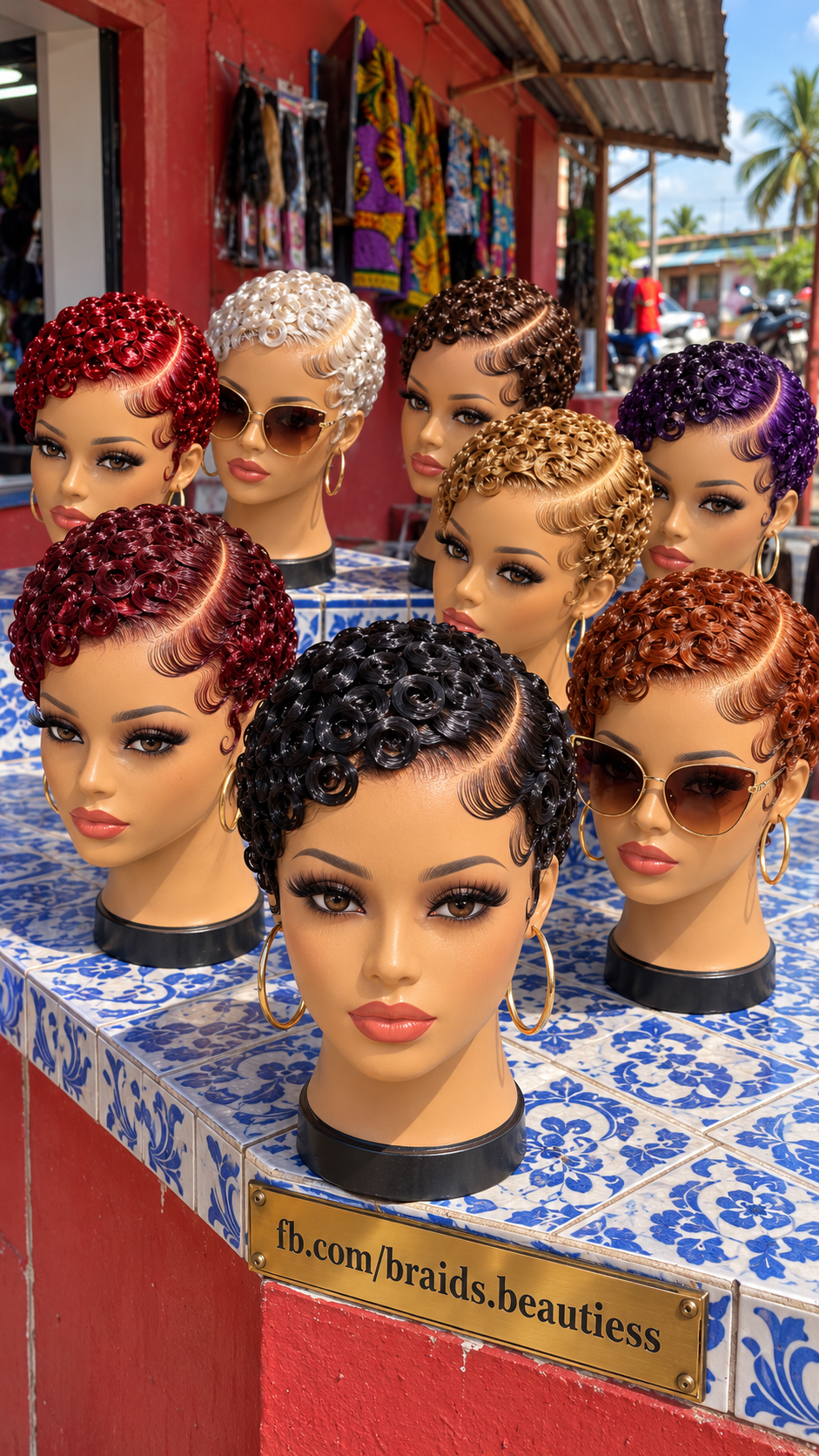
The selection includes black, burgundy, bright red, pale platinum, deep brown, honey blonde, copper, and purple. Arranged on mannequin heads outside a shop, the wigs offer a useful comparison of how one short silhouette can support several different looks. The black version at the front emphasizes the contrast between the part and the surrounding curls. The lighter versions reveal more of the strand arrangement within each wave. Together, they provide a strong reference for anyone considering a side-parted pixie wig with sculpted curls, whether for everyday wear or a deliberate color change.
The Sweeping Line That Holds the Look Together
Rather than sitting as a straight central division, the visible part curves across the upper side of each wig. That curve directs the eye toward the crown curls before leading down into the flatter side section. The effect is especially noticeable on the front black wig, where the lighter-looking part contrasts with the surrounding hair. Its placement gives the cut a clear direction and keeps the circular curls from appearing like an evenly distributed cap of identical loops.


The side waves follow that direction closely. They sit lower than the crown curls and travel toward the temples in controlled curves. This difference in height is important to the overall balance. If the side section were as raised as the crown, the wig would have a wider outline. If the crown were flattened completely, the hairstyle would lose much of its circular detail. A successful recreation should preserve the relationship between these areas rather than copying only the most obvious curls.
The image shows the wigs on display heads, so their exact position on an individual wearer remains a fitting question. The same part may appear slightly higher, lower, or more diagonal once the unit is worn. Before ordering, ask for the wig to be shown from the front and above on a correctly sized stand. If you are purchasing in person, check the part while the cap is sitting comfortably in its intended position. Styling and fit need to work together.
Black and Brown for a Darker Overall Finish
The black wig at the front offers the clearest view of the main design. Its circular curls cover the upper surface, while the pronounced part separates them from a flatter side sweep. Bright reflections trace the strands without changing the overall black appearance. This is a useful choice to discuss if your priority is the cut itself. A single dark shade allows the shape, curl size, and part placement to remain the strongest elements, especially when paired with simple clothing or understated accessories.
The deep brown wig near the back gives a warmer interpretation of the same arrangement. Its highlights appear brown rather than black, particularly across the crown and around the part. When shopping for a similar shade, request daylight photographs because descriptions such as chocolate, espresso, and dark brown can cover a broad range. Ask whether the color is uniform or includes lighter strands. A photograph taken under warm shop lighting may make a very dark brown look different from the unit you receive.
For either shade, assess coverage and curl placement before focusing on shine. Strong reflections can make a display photograph appealing, but they do not establish fiber quality or durability. Ask to see the wig moving slowly in ordinary light and inspect the areas between the curls. You want enough coverage to support the intended appearance without unnecessary bulk. A darker color should still allow the individual loops and side waves to remain readable rather than merging into an indistinct mass.
Burgundy, Red, and Copper Offer Different Kinds of Warmth
The burgundy wig at the lower left has a deep wine-colored appearance, with red reflections becoming more noticeable across the raised curls. It offers a dark overall impression while introducing a visible color change. The bright red wig at the upper left is more saturated and immediately draws attention. Although these shades belong to a related color family, they are not interchangeable. Specify whether you want a deep burgundy result or a brighter red, and request an example of the exact color being offered.
Copper, shown at the lower right, brings orange-brown warmth to the circular pattern. The shade makes the strand direction particularly noticeable around the side wave. If you are considering this version, ask whether the supplier’s copper leans more red, orange, or brown. Those differences can be substantial even when sellers use the same general color name. A clear daylight video can help you compare the proposed shade with your reference before committing to a custom order.
Choosing among these three colors is partly a question of how much contrast you want in your usual wardrobe. Burgundy can sit comfortably within a darker color palette, while bright red becomes a stronger focal point. Copper offers a warmer alternative that can be styled with neutral clothing or richer colors. You do not need to match every accessory to the wig. Instead, imagine wearing the unit on an ordinary day and decide which shade feels appealing outside the context of the complete display.
Platinum, Honey Blonde, and Purple Change the Emphasis
The pale platinum wig at the back has an ivory appearance in this lighting. Its light color makes the small curls easy to distinguish from one another, while the curved front section remains visible against the mannequin. Before ordering, clarify whether you want pale platinum, pearl white, or a warmer light blonde. Those descriptions are often used loosely. Ask for the supplier’s color reference and confirm whether the roots will be the same shade, darker, or blended into the lighter lengths.
Honey blonde, positioned near the center, creates a golden version of the cut. It brings attention to the raised loops and the broad side sweep without the pale contrast of the platinum unit. For a close match, ask about the balance between gold and brown in the proposed color. Some honey shades appear quite yellow, while others look more caramel. The most useful comparison is an actual sample or an unfiltered photograph, especially if you plan to coordinate the wig with another hairpiece.
Purple gives the shared silhouette its most unconventional interpretation. The shade appears deep across the flatter areas, with brighter violet reflections on the curls. If that is the version you prefer, confirm whether the supplier can reproduce the depth shown rather than providing a much brighter alternative. Also ask whether the unit is supplied in that color or requires additional coloring work. The image establishes a visible styling reference, but it does not verify the materials or process used to create any of the shades.
Find Out Where To Buy This
Search for wig boutiques, independent wig makers, and salons that regularly show short pin curl wigs or molded pixie styles. Their portfolios should demonstrate more than one attractive front photograph. Look for consistent work around the crown, temples, and nape, with examples photographed from several angles. A maker who already produces circular curls and close side waves is better placed to discuss this reference in detail. Ask how they approach the curved part and whether they can maintain the compact outline.
Useful search phrases include “side wave pixie wig,” “short sculpted curl wig,” and “pin curl wig with side part.” Product names vary, so inspect the photographs rather than assuming a familiar title guarantees a match. Some listings show loose ringlets, while others show flatter pin curls or larger barrel-shaped rolls. The reference here combines small open loops with a lower side section. Include the image in your inquiry and describe that contrast so the seller understands what you want reproduced.
The page address visible on the display identifies text within the photograph, but it does not independently verify stock, business ownership, or purchasing terms. If you contact a business associated with a display image, ask for current photographs of the actual unit and a written description of what is included. Confirm the ordering process directly. For any supplier, the important evidence is the product they can show you now, its documented specifications, and the terms attached to the transaction.
Before paying, establish whether you are buying a finished wig, an unstyled base, or a styling service. Request the fiber description, cap size, color, parting construction, and total cost. For a custom order, discuss completion time, review photographs, and alteration terms. For a stock unit, ask whether the item in the video is the one that will be sent. These details help turn an appealing reference into a clear order and make it easier to compare offers fairly.
What the Display Cannot Tell You About Construction
The image shows the outside of the wigs, so it cannot confirm lace grade, fiber type, or the interior cap system. A visible part does not establish unlimited parting space, and a close front does not prove that a unit is glueless. Ask the seller for an inside-cap photograph and an explanation of the construction. Depending on the product, the base may include wefted sections, a lace front, a limited lace part, or another arrangement. Choose according to the styling and fit you need.
If you want to keep the pictured part, a fixed placement may suit your routine. If you want to move it later, ask how much adjustment the construction permits. The surrounding curls may also need resetting when the part changes. Do not assume that a new part can be created simply by pushing the finished hair in another direction. A maker should explain both the available parting area and the styling work required to use it differently.
Fiber selection should be connected to your care expectations. Ask whether the circular curls are part of the underlying fiber pattern or a temporary set created by the stylist. For synthetic hair, request the specific care and heat instructions. For human hair, ask how the finished arrangement is renewed after cleaning. Neither material guarantees that the wig will return to this exact shape after washing. You need guidance for the completed hairstyle as well as information about the base.
Arrange a Fitting Before Final Customization
A cropped wig has little length to conceal poor placement around the ears and temples. Measure according to the supplier’s directions and compare your measurements with the available sizes. If the maker requests circumference, front-to-nape, and ear-to-ear measurements, provide all of them. Size labels alone are not enough to establish a match. A cap should sit comfortably while allowing the part, front wave, and lower edges to fall where they are intended.
During a fitting, check the wig over the hair preparation you actually plan to use. An uneven base can change the crown height or push one side outward. Ask your stylist how to prepare for the appointment and avoid judging the final outline over a temporary arrangement that you will not repeat. Move your head normally and inspect both sides in a mirror. The unit should remain stable without needing an adjustment so tight that comfort becomes a problem.
If the chosen wig has excess lace, settle its placement before trimming. A stylist can assess the front edge while preserving the waves you want to keep. Also discuss whether you prefer the pronounced temple curves shown in the display or a more restrained front. That choice affects the finished appearance and maintenance routine. It is easier to incorporate your preference during customization than to undo a completed set after the lace and front sections have already been altered.
A Five-Tier Price Framework
The table below offers illustrative budget bands in US dollars. These are planning examples, not verified prices for the displayed wigs or a current market price list. Actual quotations depend on the documented materials, cap, color work, styling, fitting, and other included services. Use the bands to organize your questions rather than treating them as proof of quality. A higher quote should come with a clear explanation of what additional work or materials it covers.
| Purchase Tier | Illustrative Budget | Option to Explore | Key Question |
|---|---|---|---|
| Entry Option | Under $75 | A stock short wig or basic base for occasional wear | Does the price include the circular curls and side-wave setting? |
| Ready-Styled Option | $75–$150 | A completed stock unit in a standard color and cap size | Can the seller show the exact finished wig and its interior? |
| Customized Finish | $150–$300 | A suitable base with cutting, shaping, and a dedicated curl set | Which styling and fitting services are included in the total? |
| Individual Order | $300–$500 | A project with agreed color, measurements, part, and front details | What review and alteration process applies before delivery? |
| Extended Custom Package | Above $500 | A bespoke unit or a package including additional salon services | What specific construction, workmanship, and appointments justify the cost? |
Compare the complete cost of reaching a wearable result. One offer may include the cut and set while another covers only the base wig. Delivery, taxes, lace preparation, installation, and color adjustments may be separate. Ask for a written breakdown when several services are involved. If you need to simplify the order, prioritize a suitable fit and accurate styling. Optional accessories will not compensate for an uncomfortable cap or a side wave placed differently from your agreed reference.
Consider later maintenance as part of the purchase. If you cannot recreate the curls yourself, identify a local stylist who can reset the unit and ask what that service involves. You do not need to commit to a fixed schedule before wearing it, but you should understand the care process. A wig is more practical when its upkeep fits your time and budget, particularly when its appeal depends on a precise arrangement rather than a loose texture you can easily refresh.
Book the Service That Matches the Styling
For salon work, look for a wig stylist who can show molded waves, short curl setting, or pin curl arrangements. Send the reference before booking and specify whether you need a new wig, a fitting, or a restyle of an existing unit. If you already own the base, provide its fiber details and current photographs. This allows the stylist to assess whether the requested finish is feasible and reserve enough time for the work.
Discuss the silhouette before the smaller decorative details. Establish the crown height, the closeness of the sides, and the nape shape, then review the part and front wave. Ask whether the fit can be checked before the final setting. Bring glasses if you wear them regularly so their arms can be considered around the temples. The sunglasses on the display heads are styling accessories; an individual fitting is what establishes how your own frames and wig will sit together comfortably.
If regular removal matters to you, ask whether a suitable glueless version is available and how it stays secure. The seller should explain the relevant cap components. If you prefer an installed finish, discuss that service with the stylist and follow the directions for the products used. In either case, request removal and handling instructions that protect the front waves. A short style can still require careful handling when its defining details have been deliberately sculpted.
Preserve the Circular Curls Between Wears
Support the wig by its cap when lifting or positioning it. Avoid pulling at the open centers of the curls or brushing through the finished arrangement. Those loops are part of a set, so separating them repeatedly can change the appearance. Ask the stylist to demonstrate a minor correction for a displaced curl. A targeted touch-up may be enough when most of the hairstyle remains intact, while extensive combing can create more work than the original problem required.
Before washing, find out what the wig is expected to look like afterward. Follow the instructions for its verified fiber, including products, water temperature, and drying method. A salon-created set may need renewal even when the underlying hair remains in good condition. Plan cleaning around that possibility, especially before an event. Knowing whether you need a professional reset is more useful than assuming the photographed arrangement will automatically return as the wig dries.
Use finishing products only as directed for the unit. The strong reflections in the display do not mean that extra oil or shine spray is needed before every wear. Repeated layering can leave residue and affect how the strands sit together. Store the wig on a suitable support with space around the curls, and protect it from compression during travel. A container that presses against the crown can disturb the loops even if it keeps the hair from tangling.
Choose the Version You Will Reach For
The range of colors is appealing as a collection, but your purchase needs to work as an individual wig. Picture the chosen shade with your usual clothes, accessories, and daily plans. Then check that the cut still appeals to you without the surrounding display. You may decide on black for frequent wear, burgundy for a darker color change, or a lighter shade that brings more attention to the curl pattern. The right choice is connected to how you intend to use it.
Before accepting the finished unit, inspect the crown, both sides, and back in ordinary light. Check that the color, part, front waves, and cap match the agreed description. For a delivered order, do this before alterations that may affect the seller’s return terms. With a clear specification and appropriate fitting, the strongest details can remain intact: small circular curls, a sweeping part, and close side waves that give this short hairstyle its distinctive direction.
Search Terms
side wave pixie wigs · short pin curl wigs · curved side part wig · black sculpted curl wig · burgundy pixie wig · platinum pin curl wig · copper short curl wig · honey blonde finger waves